

By Mario Peshev, DevriX
When a deal partner asks me what an open source audit for M&A is supposed to produce, the honest answer is short: a list of every third-party component the target ships, its license terms, and an estimate of what each one costs to keep, replace, or defend. That list is what you underwrite against. If the diligence report you get back reads like a compliance checklist with no dollars attached, you paid for reassurance, not evidence.
This matters at a specific moment. You are past LOI, inside confirmatory diligence, and you need to sign off on a technology risk register before close. Somewhere in that target’s stack are open source packages under licenses that could force disclosure of proprietary code, dependencies no longer maintained, and a few components that carry known vulnerabilities the CTO has never mentioned. None of that shows up in a QoE. It shows up here, or it shows up in year two when a customer’s security team runs their own scan and walks.
What the audit is actually deciding
The decision is not “is the code clean.” No codebase is clean. The decision is whether the open source exposure changes your price, your close conditions, or your first-year budget, and by how much.
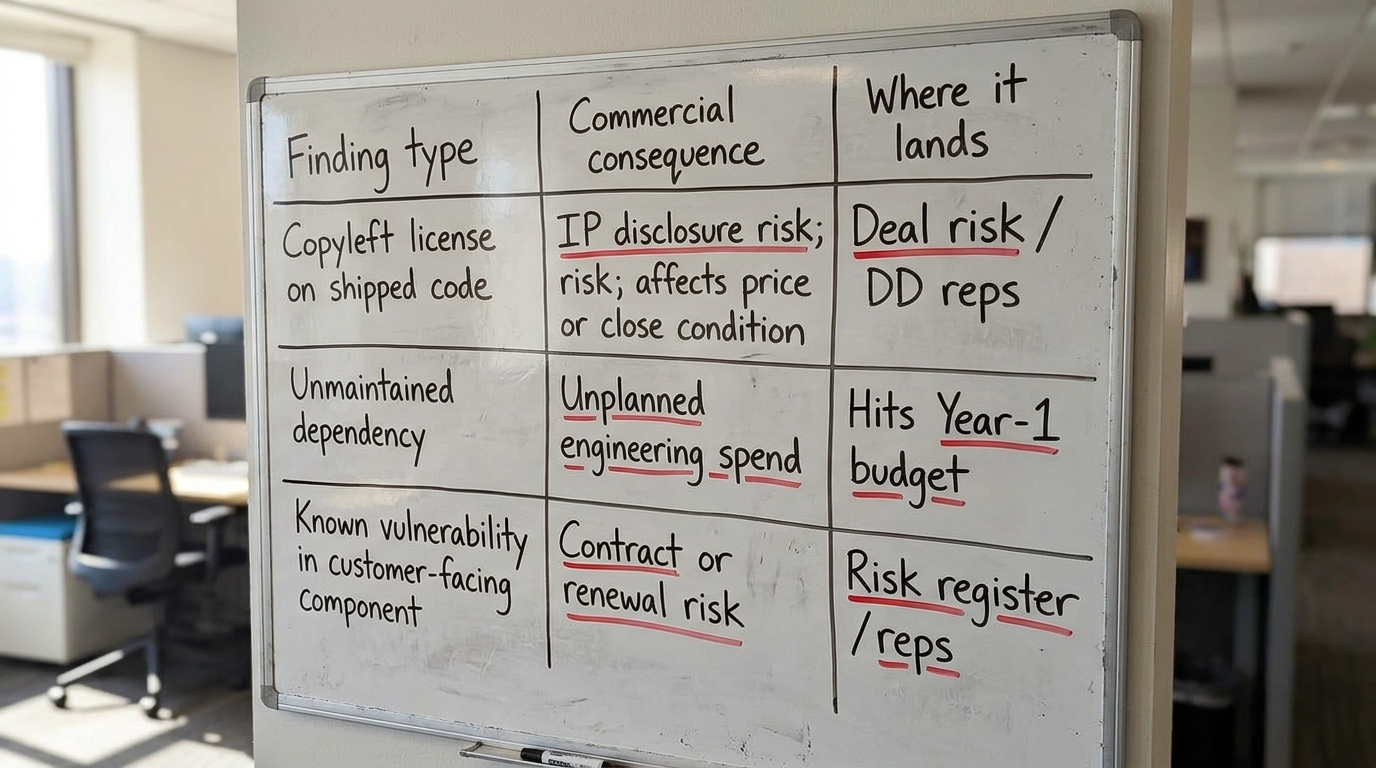
Three commercial outcomes hang on it. First, whether a license obligation could compromise the value of the target’s proprietary IP, which is often the thing you are paying a premium for. Second, whether a dependency is a maintenance liability that shows up as unplanned engineering spend after Day 1. Third, whether a known vulnerability is a deal-blocker with a named enterprise customer whose contract renews inside your hold.
Each of those is a number, not a color-coded risk tile. A serious open source audit for M&A converts findings into estimated remediation cost and ties that cost to the value creation plan. That is the same discipline I argue for in pricing deal risk in EBITDA rather than in adjectives.
This sits inside the broader technology due diligence workstream, and it should not be run as a separate procurement exercise. The findings only mean something when they are read against the growth thesis and the integration plan.
Start from a real bill of materials, not a self-report
The first failure mode is trusting what the target tells you. Founders and CTOs frequently do not know every component in their own build, because modern dependency trees pull in hundreds of transitive packages nobody chose deliberately. A questionnaire answered by management is a starting inventory, not evidence.
A software bill of materials should be produced by scanning the actual codebase and build artifacts, including the full dependency tree and third-party components as they exist in production. Composition analysis tools generate this output, but the scan result is raw data. Someone with technical and commercial judgment has to review it, prioritize findings by materiality, and connect them to the transaction risks the investment committee is asking about.
The three columns that carry the weight
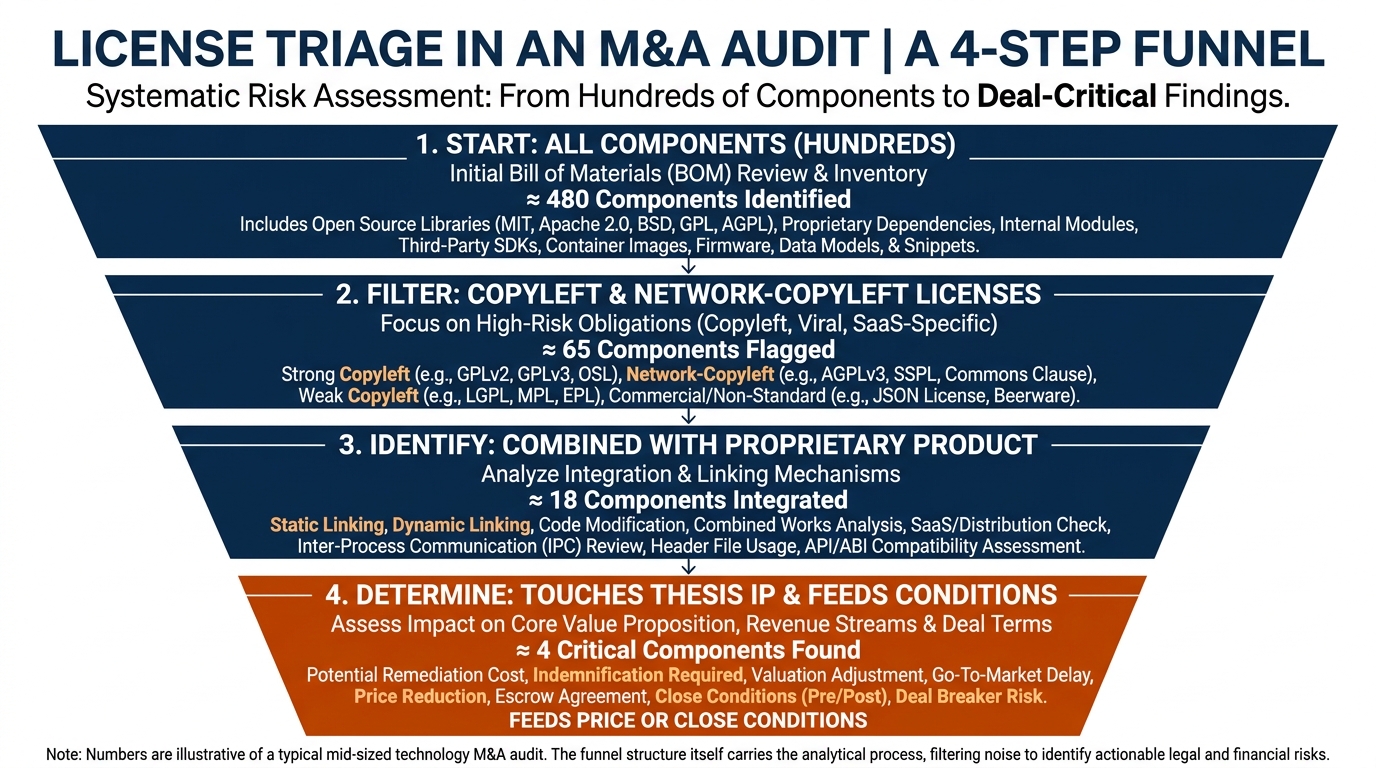
For every component that matters, the audit needs the package and version, the license and its obligations, and the maintenance signal (last release, contributor count, whether a maintained fork exists). Version matters more than people expect, because a license or a vulnerability profile can change between minor releases of the same package.
If the report gives you a component list without versions, or licenses without the actual obligation spelled out in plain commercial terms, send it back. “MIT, permissive” is fine. “GPL, copyleft” with no assessment of whether that code is statically linked into the proprietary product is an unfinished sentence.
License exposure is the part that can move the price
Most open source licenses are permissive and create no constraint on a private buyer. The licenses that require attention are copyleft and network-copyleft licenses (GPL, AGPL, and their variants), because they can attach disclosure or distribution obligations to code the target combines with them. The question is whether the target combines GPL-licensed code with its proprietary product in a way that triggers an obligation, and whether that obligation reaches the IP the investment thesis depends on. Most companies use some GPL-licensed components, so presence alone means nothing without the combination analysis.
I have seen this scoped badly in both directions. A flagged license that turns out to be an isolated build tool inflates the risk register without adding information. A permissive-looking dependency that was modified and redistributed under terms the target never honored is a real exposure that a shallow scan misses entirely.
The reason this belongs in front of a deal partner and not buried in an appendix is that IP integrity is often the core of the valuation. The Harvard Law School Forum on Corporate Governance has published extensively on how representations, warranties, and diligence findings interact in an acquisition, and open source obligations are exactly the kind of thing that ends up in a specific indemnity or a price adjustment when it surfaces late.
Maintenance risk is a Year-1 budget line, not a footnote
The second thing the audit surfaces is dependency health. A component with no release in three years, a single maintainer, and no active fork is a future engineering cost whether or not it has a vulnerability today. When it eventually breaks or needs a security patch, the portfolio company has to fund the fix, migrate off it, or absorb the risk.
This is where the audit connects directly to the operating plan. If your value creation thesis assumes the engineering team spends the next 18 months shipping new revenue features, and the audit shows a dozen abandoned dependencies that will demand attention, those two facts are in conflict, and you want to know before you set the budget. The remediation choices here are the ones I break down in the remediation decision a deal partner actually owns: fix now, defer with a reserve, or accept and monitor.
Classify each item so the number does not read as more certain than it is. A known remediation with a scoped estimate is a forecast cost you can budget. A dependency that might need work someday is a risk you reserve against, not a line you spend against on Day 1.
Security findings that a customer will find first
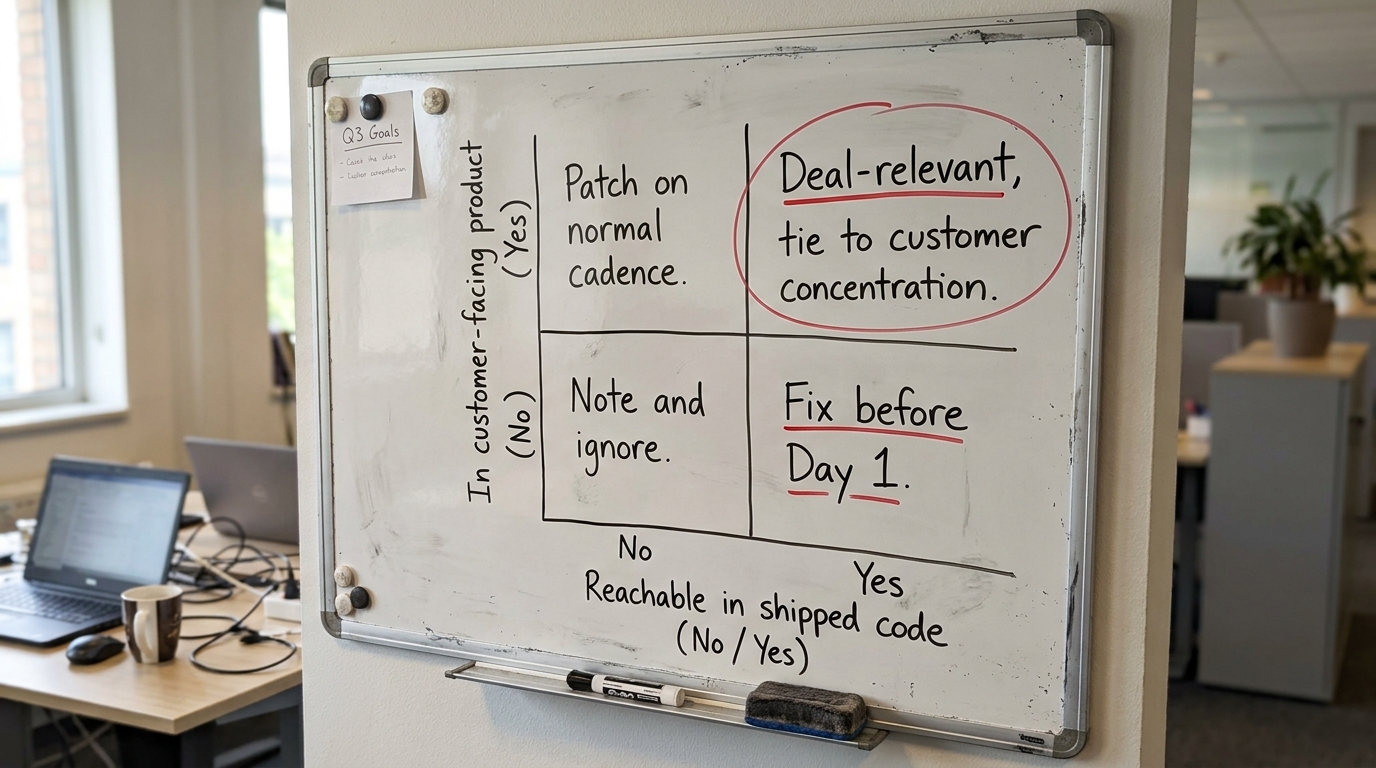
Known vulnerabilities in open source components are usually the easiest thing to scan for and the easiest thing to overweight. A long list of CVEs looks alarming and mostly is not, because many affect code paths the target never executes. The audit’s job is to separate the vulnerabilities that are reachable and shipped in a customer-facing product from the ones that sit in a dev dependency nobody deploys.
The finding that matters commercially is a reachable vulnerability in a component that a named enterprise customer’s security review will catch. If that customer represents revenue concentration and their contract renews during the hold period, a single unpatched component can block renewal. That is the direct line between a technical scan output and a revenue forecast miss, and it is the reason security findings belong in the diligence workstream that models churn and customer concentration rather than in a separate technical annex.
Bain’s annual Global Private Equity Report has tracked for years how much of the return now depends on operating improvement rather than multiple expansion, which means the reliability of the asset you buy carries more weight than it used to. A stack that generates its own outages and its own customer-security friction is a drag on exactly the operating margin the thesis needs.
How to judge the firm doing the audit
The market is full of open source scanning that stops at the tool output. You can buy a composition report cheaply, and it will tell you almost nothing you can price. What you are actually hiring is the judgment layer on top, and here is how I separate the two.
Ask what they price, not what they scan
A credible provider will tell you which findings changed a recommended price, close condition, or budget in past deals, in the abstract if they cannot name the client. A weak one describes their tooling and their coverage. Coverage is table stakes. The translation into commercial consequence is the product. This is the same test I apply across every technical vendor in what a deal partner actually needs from a consultant.
Check that they read the report against your thesis
An audit run in isolation flags everything at equal weight. An audit run by someone who understands your growth plan flags the three things that threaten it and tells you the rest is manageable. The difference is whether they asked about your thesis before they started. If they did not, they cannot tell you which findings matter to you specifically, and you are back to reading a checklist. The broader version of this judgment is in how to judge M&A consulting firms when you are the one underwriting the deal.
Confirm the output feeds the risk register
The deliverable should map cleanly onto the risk register you carry into the investment committee and onto the integration plan. If the format is a standalone PDF that nobody can act on, the work stops at the report. A good audit hands you owners, decision rights, and estimated costs by workstream, which is what makes it usable in the first 100 days rather than filed and forgotten.
Where this fits in the diligence budget
The scope depends on how much technology risk sits in the thesis. For a light-touch pre-LOI read, where you mainly want to know whether there is a license landmine that should change your bid or your walk decision, a focused review is proportionate. For confirmatory diligence on an asset where the software is the product, a full five-day technical read that includes the open source audit alongside architecture, security, and team assessment is the right level of spend.
McKinsey’s private capital research and PitchBook’s deal data both point to longer hold periods and tighter underwriting than the last cycle, which raises the cost of a technology surprise that surfaces after close. A few thousand dollars of diligence against a seven or eight figure remediation is not a close call. The point is to scope the audit to the risk, not to buy the biggest report available.
The open source findings also do not stand alone. They interact with how the systems will be combined after close, which is why I treat them alongside what IT integration actually decides and, for a platform doing add-ons, how to judge a post-merger integration consultant. A license obligation that was harmless standalone can become a problem the moment two codebases merge.
What a deal partner should walk away with
The test of an open source audit for M&A is whether it changed a decision you were about to make. If the report confirms the stack is clean enough to proceed at your bid, that is a real outcome and worth the fee, because you can sign the technology reps with evidence behind you. If it surfaces a copyleft exposure on the core product, an abandoned dependency stack that reprices your Year-1 engineering budget, or a reachable vulnerability sitting in your largest customer’s deployment, that is worth many multiples of the fee, because each one is a number you can act on before the wire clears.
What you should not accept is a report that lists findings without pricing them, or grades risk in colors without connecting any of it to your thesis. That version tells you the target uses open source, which you already knew. It does not tell you what to do at the investment committee, which is the only reason to commission it. The same standard applies to how those findings show up later in board reporting that drives decisions, where a resolved-or-open remediation line is worth more than any dashboard of scan counts.
Run the audit as part of the underwriting, tie every finding to price, budget, or a close condition, and make sure whoever runs it read your growth plan first. That is the difference between a document you file and a number you can defend in front of your partners.
Where to take this next
If you have an asset under LOI and the software is central to the thesis, DevriX runs the open source audit inside a broader technical read scoped for private equity deal teams: a focused pre-LOI review to catch a license or dependency landmine before you commit, or a five-day confirmatory read that prices the full technology risk register in terms your investment committee can act on. Scope the diligence to your deal here.
