

By Mario Peshev, DevriX
The wrong M&A consulting firm does not just waste a fee. It anchors your investment committee to a diligence read that the business cannot support, and you find out eighteen months later when the growth line in the model never materializes. I have sat on both sides of that table: as a founder whose company was diligenced, and as an operator brought in after close to fix what the deal team either missed or accepted on faith. The pattern repeats. A firm produces a polished deck, the deal closes, and the value creation plan turns out to be a slide with no owner.
If you are a deal partner, an operating partner, or a CFO evaluating who to bring into a transaction, you are not buying analysis. You are buying a better decision and a shorter, less risky path to a return. This piece is a checklist for judging mergers and acquisitions consulting firms against that standard, not against how impressive their credentials look on a website.
I write for a reader with budget and a live mandate. So I will skip the definitions and go straight to what separates a firm that improves your enterprise-value math from one that bills hours against a template.
1. Start with what you actually need decided
Before you shortlist anyone, name the decision. A firm that is excellent at one job is often useless at another, and the biggest waste I see is a deal partner hiring a strategy-house brand for a job that needed an operator, or hiring a boutique operator for a job that needed a full quality-of-earnings team.
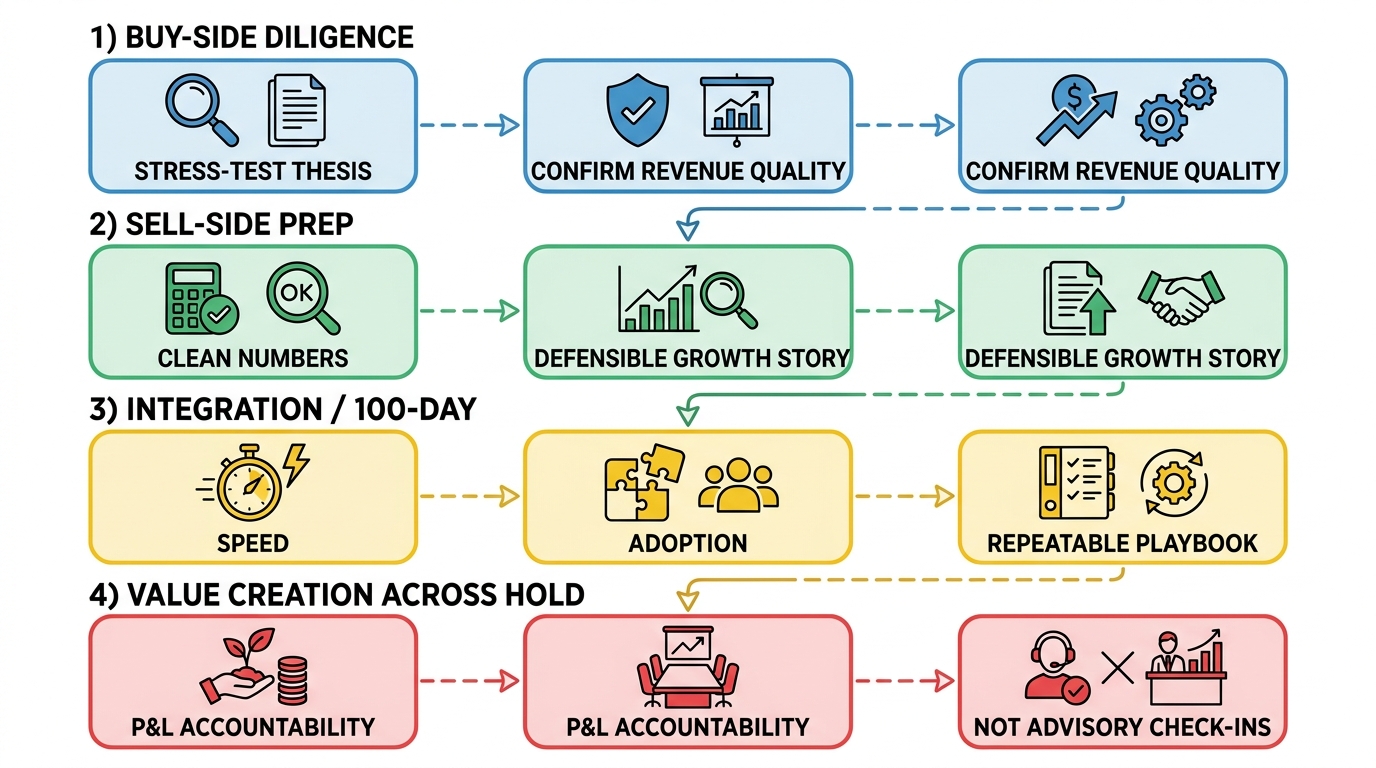
Sort the mandate into one of four buckets:
- Buy-side diligence. You need the thesis stress-tested, the revenue quality confirmed, and the risks priced before you sign.
- Sell-side preparation. You need the business dressed for exit, with a defensible growth story and clean numbers.
- Integration and 100-day execution. You have closed and now need speed, adoption, and a repeatable playbook.
- Value creation across the hold. You need someone accountable to the P&L, not a quarterly advisory check-in.
These are different skills and, frankly, different firms. You write to the stakeholder, not to “PE.” A deal partner asking about integration speed and an operating partner asking about diligence risk are asking two different questions, and a firm that answers both with the same deck is telling you it does neither well.
I have written before about why value creation consultants and operators are not interchangeable. That distinction is the first filter. Advice you can accept or ignore. P&L accountability you cannot.
2. Can they connect their work to enterprise value, or only to activity?
The clearest tell in a first meeting is what a firm leads with. Weak firms lead with activity: the number of interviews they will run, the frameworks they will apply, the data rooms they have processed. Strong firms lead with the financial consequence: what the finding does to the entry multiple, to the run-rate EBITDA, to the covenant headroom, to the exit timeline.
This is not a stylistic preference. Hours, tickets, workstreams, and slide counts are the vendor register, and they are a failure mode, not a value proposition. A PE-backed buyer is purchasing measurable enterprise-value improvement, which resolves to one of a short list: revenue growth, EBITDA expansion, cash-flow improvement, faster integration, reduced operating risk, better management visibility, a higher multiple, or a shorter path to exit. If a firm cannot map its scope to at least one of those, you are buying a report, not a result.
Ask a firm to classify the value it claims to create. Is a given impact realized, run-rate, forecast, enabled, or risk avoided? A firm that lets forecast value read as realized value is either careless or selling. I have watched a “growth uplift” that was pure forecast get baked into a base case as if it were already in the bank. It was not, and the operating partner spent a year explaining the gap.
3. Look at the diligence they run, not the diligence they describe
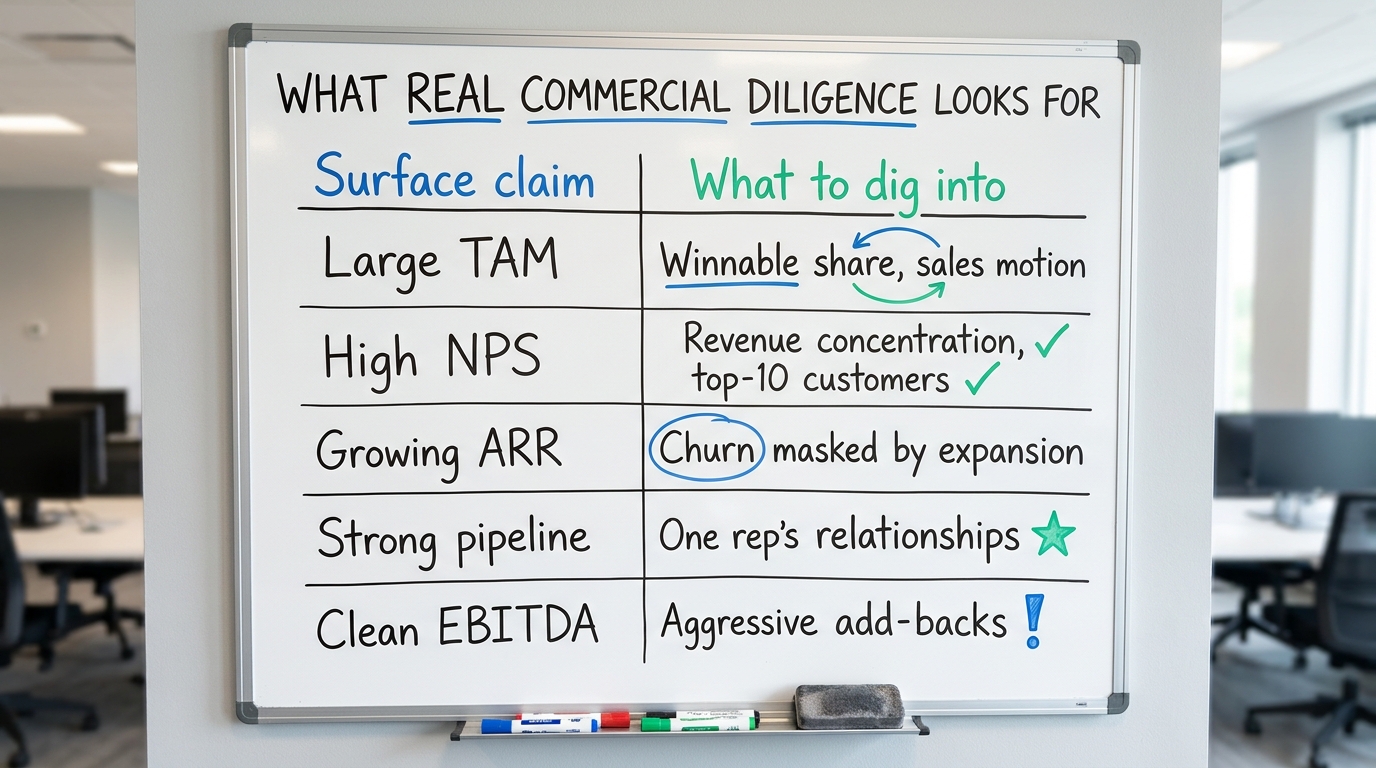
Any competent firm will tell you it does commercial due diligence. The question is what it actually looks for and whether it knows a red flag when it sees one. Commercial due diligence that stops at TAM slides and customer NPS is decoration. The version that protects your capital digs into revenue concentration, churn masked by expansion, pricing that will not survive an owner change, and pipeline that is really one rep’s relationships.
I keep a running list of commercial due diligence red flags in B2B businesses for exactly this reason. If a firm cannot name half a dozen of these unprompted, they are running a checklist, not an investigation.
Press on the earnings quality
The same discipline applies to the numbers. A firm that treats every add-back as legitimate is helping the seller, not you. Adjusted EBITDA is where deals are won and lost, and I have written on the art of add-backs because the difference between a defensible adjustment and an aggressive one is often the difference between a fair price and an overpay. Standards bodies like the AICPA and CIMA maintain the accounting guidance that a serious quality-of-earnings process leans on. Ask your firm which standards frame their QoE work. Silence is an answer.
4. Do they have a point of view on where value leaks in this kind of business?
Generic firms diligence any business the same way. Firms worth their fee have a sharpened view of where value tends to hide or bleed in your target’s specific model. In B2B, that is almost always in the commercial engine: leaky funnels, mispriced renewals, undermanaged customer bases, and go-to-market that never scaled past the founder.
I built the B2B portfolio revenue leakage diagnostic around this, because the same three or four leaks show up across most acquisitions and most diligence decks miss them entirely. A firm that walks in with a hypothesis about where the value is leaking, before it has seen your data room, is worth more than one that promises to “assess” and get back to you.
The macro backdrop makes this sharper. Bain’s annual Global Private Equity Report has tracked how much harder multiple expansion has become as a return driver, which pushes operational improvement to the center of the thesis. McKinsey’s private capital research makes the same point from a different angle: the returns are increasingly earned inside the business, not at entry and exit. A firm that still sells you a financial-engineering story in this environment has not updated its model.
5. Is the firm accountable to the outcome, or just the recommendation?
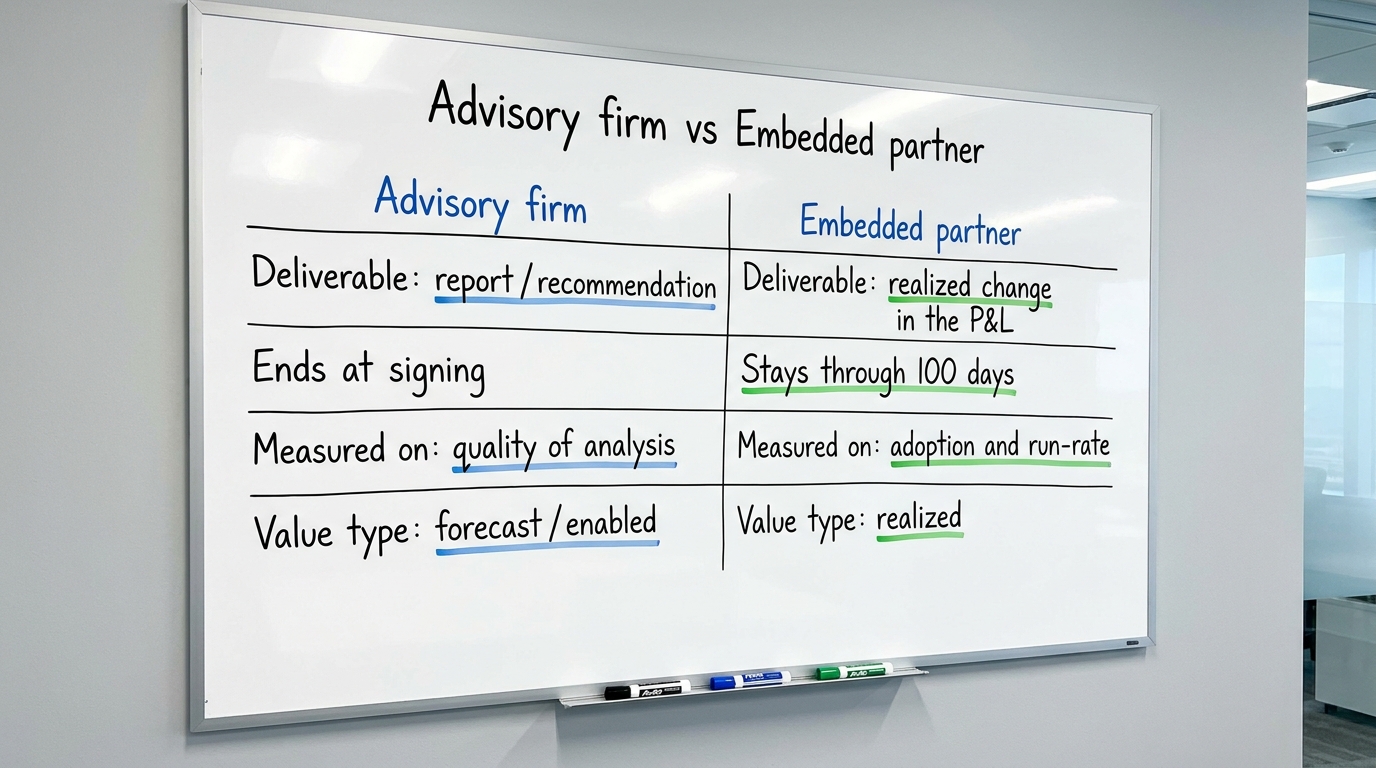
This is the line I care about most. Most M&A consulting firms deliver a recommendation and leave. Whether it works is your problem. That model made sense when the return came from leverage and multiple arbitrage. It makes far less sense when the return has to be manufactured operationally.
I have argued that PE value creation requires embedded partners, not advisory firms, and I stand behind that in a diligence context too. The firm that helped you underwrite the growth thesis should be willing to stay and own part of delivering it. When a firm refuses that, treat it as information. Either they do not believe their own numbers, or they only know how to produce decks.
Ask the accountability question directly
Put it to them plainly: “If your value creation plan is right, will you stay through the first hundred days and be measured on adoption?” The answer sorts the field fast. A firm that says yes and proposes shared metrics is one kind of partner. A firm that explains why that is outside their engagement model is another.
6. Can they move at deal speed without breaking the diligence?
Deals run on a clock. Exclusivity windows are short, and a firm that needs twelve weeks for a read you need in four is not going to work no matter how good the read is. But speed cannot come from skipping the parts that de-risk the price. The best firms have a triage discipline: they know which questions actually move the valuation and go deep there, and they know which questions are hygiene and handle them fast.
Ask a firm how it sequences a compressed timeline. If the answer is “we do the same process faster,” be skeptical. If the answer names the two or three findings that would kill or reprice the deal and shows how it front-loads those, you are dealing with people who have done this under pressure.
The transactional context matters here as well. Data providers like PitchBook and Preqin track deal pace and holding periods across the market, and the trade press at Buyouts and PE Hub is a reasonable pulse on how sponsors are compressing timelines. A firm that operates in your world reads this the way you do.
7. Do they understand the exit before they touch the entry?
Every diligence read should be written toward an exit. What will the next buyer test? What story will need to be true, and provable, in three to five years? A firm that only underwrites the entry is doing half the job. The findings that matter most are the ones that shape how you build the business toward the eventual sale.
This is where sell-side thinking has to inform buy-side work. When I advise on the 100-day go-to-market plan for a newly acquired business, the plan is reverse-engineered from what a future buyer will pay a premium for: predictable revenue, a repeatable sales motion, and management the business does not depend on. Governance and disclosure discipline matter to that future buyer too, which is why the Harvard Law School Forum on Corporate Governance and, for anything approaching public-market scrutiny, the SEC‘s frameworks belong in a serious firm’s field of view.
8. How do they translate commercial findings into the CFO’s language?
A finding that cannot be expressed as a forecast the CFO can defend is not finished. The CFO wants quality of earnings, cash, covenants, and forecast reliability. The CTO wants engineering and product risk expressed as diligence exposure and EBITDA impact, not as a list of technical debt. A good M&A consulting firm does that translation as a matter of course.
Watch how a firm hands off. Does the growth thesis arrive as a slide, or as a set of assumptions the CFO can stress-test line by line? Does the commercial risk arrive as a color-coded heat map, or as a repricing recommendation with a number attached? When I run portfolio company operating reviews, the whole point is to hold commercial KPIs to the standard the finance function actually uses. A firm that cannot meet that standard produces work the deal team quietly sets aside.
9. Do they know the go-to-market pitfalls that kill value creation plans?
Most value creation plans fail in execution, not on paper. The plan assumes a sales team that can absorb new targets, a marketing function that can generate demand, and a pricing model the market will tolerate. Those assumptions are usually wrong, and a firm that has actually operated knows where they break.
I have catalogued the private equity go-to-market value creation pitfalls that recur across portfolios, and the same failures show up whether the sponsor is large or small. The most common is confusing revenue theory with revenue mechanics. A plan that says “grow enterprise segment 40 percent” without fixing the win rate and CAC underneath it is a wish. That is why the fractional CRO’s job in PE is to fix win rate and CAC, not to sell revenue theory. Judge whether your consulting firm can tell the difference. Many cannot.
10. Are they building you a capability, or a dependency?
The last test is about what remains after the firm leaves. A good engagement leaves the portfolio company stronger and more self-sufficient: a repeatable playbook, a management team that has absorbed the discipline, reporting that keeps running. A weak engagement leaves a dependency, so the next time you need the same answer you write the same check.
This connects to a broader theme I keep returning to about how organizations stay resilient over time. Capability compounds. Dependency does not. When you evaluate a firm, ask what the portfolio company will own at the end that it did not own at the start. If the honest answer is “a relationship with us,” that is a cost, not an asset.
The takeaways I would keep on one page
- Name the decision first. Buy-side, sell-side, integration, or hold. Match the firm to the job, not to the brand.
- Watch what they lead with. Activity is a warning sign. The financial consequence is the point.
- Make them classify the value. Realized, run-rate, forecast, enabled, or risk avoided. Do not let forecast masquerade as realized.
- Test the diligence, not the description. Real red flags, real earnings scrutiny, a point of view on where B2B value leaks.
- Insist on accountability. A firm that will not stay through the first hundred days may not believe its own numbers.
- Underwrite toward the exit. Every finding should shape what the next buyer will pay for.
- Demand translation. Commercial findings have to arrive in the CFO’s language, with numbers attached.
- Build capability, not dependency. Judge what the company owns after the firm walks out the door.
None of this requires you to become an operator yourself. It requires you to ask questions that reveal whether the firm across the table has ever carried a P&L or only ever described one. The financial press, from Private Equity International to the M&A coverage at Harvard Business Review, keeps documenting the same lesson: returns now come from operational improvement, and the firms that help you earn them look and behave differently from the firms that helped you buy well in an easier era. Research desks at BCG and market-intelligence groups like S&P Global Market Intelligence tell the same story in the data.
Where to take this next
If you have a live mandate and you are weighing which M&A consulting firm to bring in, the fastest way to sharpen your evaluation is to talk it through with someone who has been diligenced and who has fixed the aftermath. That is the vantage point I bring. If you want a second read on a firm’s scope, or on whether a value creation thesis will survive contact with the sales team, start with a value creation advisory conversation. When the work moves from evaluation to execution, DevriX runs the embedded, P&L-accountable delivery side, and you can see the scope of that at the DevriX private equity practice.
The best time to be rigorous about who you hire is before the deal closes, not eighteen months after, when the growth line has flatlined and everyone is looking for the slide that promised otherwise.
