

I’ll add the external source links. The article already references Bain, McKinsey, BCG, PitchBook, and S&P Global by name, I just need to link them in the sentences where they’re attributed.
By Mario Peshev, DevriX
Most integration plans I see fail before day one. Not because the operating teams are weak, but because the plan answers the wrong questions. It documents workstreams, org charts, and system migrations in exhaustive detail while leaving the two decisions that actually move enterprise value unspoken: what are we integrating for, and how will we know it worked in cash terms.
A deal partner does not need a Gantt chart with 400 dependencies. A deal partner needs to decide where value gets created, what gets left alone, and which risks could break the thesis. An operating partner needs the same decisions translated into speed and adoption. When integration planning stays in the language of activity, hours logged, tickets closed, systems consolidated, it quietly disconnects from the return the fund underwrote. That gap is where most of the value leaks out.
This piece lays out the framework I use to judge an integration plan the way a partner should: as a value-creation instrument, not a project schedule. The logic here is straightforward: activity is not outcome, and every claim should connect to revenue growth, EBITDA expansion, faster integration, or reduced operating risk.
The problem is that integration planning defaults to activity
Bain & Company’s annual Global Private Equity Report has tracked, across cycles, how much of expected deal value depends on post-close execution rather than entry price. Yet the typical integration plan reads like an IT migration document. It is dense with workstream leads, cutover dates, and dependency maps, and thin on the number that matters, which is the incremental EBITDA the thesis promised the investment committee.
I have sat in enough integration steering committees to recognize the pattern. Everyone is busy, the tracker is green, systems are consolidating on schedule, and eighteen months later the synergy case has not landed. The plan optimized for completion, not for value. It measured the vendor register that sinks these efforts, tickets and features and hours, and mistook motion for progress.
The fix is not a better tracker. It is a different question at the front of the plan. Before anyone maps a workstream, the plan has to state which mechanism of value it is chasing and how that mechanism converts into cash. Everything downstream is either serving that mechanism or it is overhead dressed as diligence.
I have written before about why PE value creation requires embedded partners, not advisory firms, and integration is where that distinction becomes expensive. An advisory deck describes what should happen. An operator owns whether it did.
The framework: decide across four value lenses before you plan anything
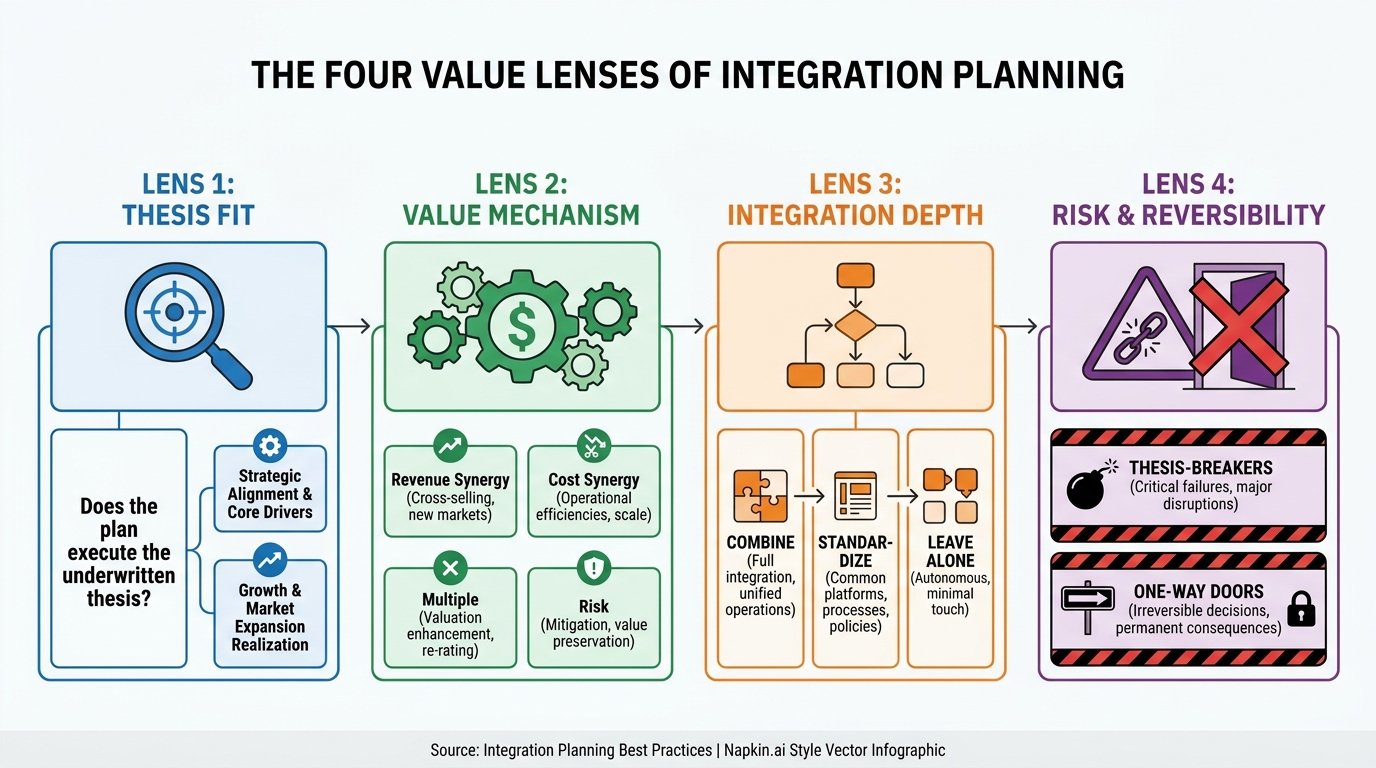
I judge integration plans through four lenses, in order. Each one forces a decision a partner has to own, and each one has a failure mode I have watched sink otherwise sound deals.
- Thesis fit. Does the plan execute the specific value-creation thesis the deal was underwritten on, or a generic best-practice checklist?
- Value mechanism. Which lever, revenue synergy, cost synergy, multiple expansion, or risk reduction, is this plan actually pulling, and is that lever credible?
- Integration depth. What do we combine, what do we standardize, and what do we deliberately leave alone?
- Risk and reversibility. What could break the thesis, and which decisions are one-way doors?
These are not sequential phases. They are the four questions I want answered on one page before I approve a budget. A plan that cannot answer them concisely is not ready, no matter how detailed the appendix is.
Does the plan execute the actual thesis
Every deal gets underwritten on a story. Buy-and-build platform. Margin repair through operational discipline. Cross-sell across a fragmented customer base. Geographic expansion off an acquired brand. That story is the thesis, and it should be visible in the first three pages of any integration plan.
What I see instead, more often than I would like, is a plan that could have been written for any acquisition in the portfolio. Consolidate ERP, harmonize HR policy, unify the brand, migrate to one CRM. All defensible activities. None of them tied to why the fund paid the multiple it paid.
The test I apply
I ask a single question: if I removed the target’s name from this plan, would it still read as this deal’s plan? If the answer is no, the plan is executing a template, not a thesis. A margin-repair thesis should have a plan dominated by cost structure and pricing. A cross-sell thesis should have a plan dominated by go-to-market integration, sales enablement, and account mapping. When the plan’s weight sits somewhere other than the thesis, the deal partner is about to fund the wrong work.
This is also where commercial diligence findings should carry forward. If diligence surfaced weak pipeline coverage or customer concentration, the integration plan should name those directly. I covered the warning signs in commercial due diligence red flags in B2B businesses, and the integration plan is where those flags either get addressed or get quietly dropped.
Name the value mechanism and pressure-test it
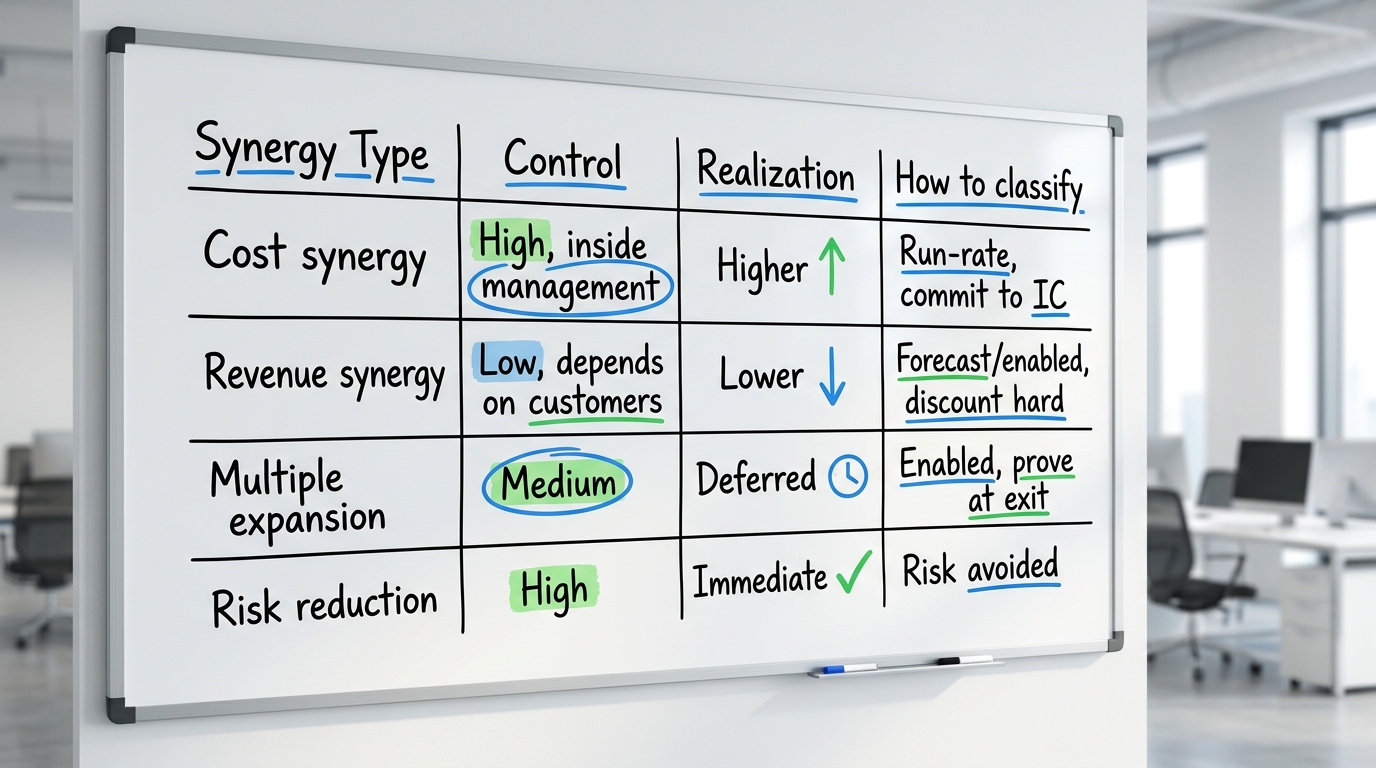
Synergy is not one thing. The distinction between revenue synergy and cost synergy matters enormously for how you plan, staff, and judge integration, because the two behave differently in time and in credibility.
Cost synergies are more credible and should land first
Cost synergies, procurement consolidation, overlapping headcount, redundant systems, duplicate facilities, are largely within management’s control. They are the ones you can commit to the lenders and the IC with confidence. McKinsey & Company research on value creation in private equity has repeatedly noted that cost synergies land at higher realization rates than revenue synergies, which is why a serious plan front-loads them and treats them as run-rate value, not forecast.
Revenue synergies are real but discount them hard
Cross-sell and new-market revenue depend on customer behavior, sales-team adoption, and channel dynamics that no integration lead controls. I treat revenue synergy in an integration plan as forecast or enabled value, never realized, until there is pipeline evidence. Classification discipline matters here: presenting a cross-sell target as though it were banked EBITDA is how integration plans overstate their own success and how deal partners get surprised at exit.
This is also why I push portfolios toward a fractional CRO who fixes win rate and CAC rather than revenue theory. Revenue synergy is where integration plans get most optimistic and least accountable, and it needs someone who owns the number, not someone who models it.
Decide what to combine and what to leave alone
The most costly integration mistake I see is over-integration. Teams treat full combination as the goal, as if a single instance of everything is inherently better. It is not. Integration depth should be a deliberate decision per function, tied to the thesis, not a default toward maximal consolidation.
I use three levels of depth, and I want the plan to assign every function to one of them explicitly.
- Combine. One team, one system, one process. Reserved for functions where scale genuinely reduces cost or risk: finance consolidation, treasury, shared back-office, procurement.
- Standardize. Keep separate operations but adopt common standards, reporting, and governance. Common for sales and delivery where local relationships and speed matter more than uniformity.
- Leave alone. Deliberately preserve. This is the level most plans skip, and it is often where the acquired value actually lives. A brand, a product team, a customer-intimate sales motion that outperforms yours.
The buy-and-build trap
In buy-and-build strategies, the pressure to combine everything is strongest and often most destructive. Boston Consulting Group research on programmatic M&A has noted that the platforms that compound value tend to standardize the back office aggressively while leaving customer-facing operations intact. If your integration plan combines the sales motion of a high-performing add-on into the platform’s slower engine, you can destroy the very margin that justified the acquisition. Combine what scales. Leave alone what performs.
Deciding this well requires visibility into where each business actually makes money, which is why I lean on a portfolio revenue leakage diagnostic before setting integration depth. You cannot decide what to leave alone until you know what is working.
Find the thesis-breakers and the one-way doors
Every integration carries risk. The job is not to eliminate it but to identify which risks could break the thesis and which decisions cannot be reversed cheaply.
Thesis-breakers
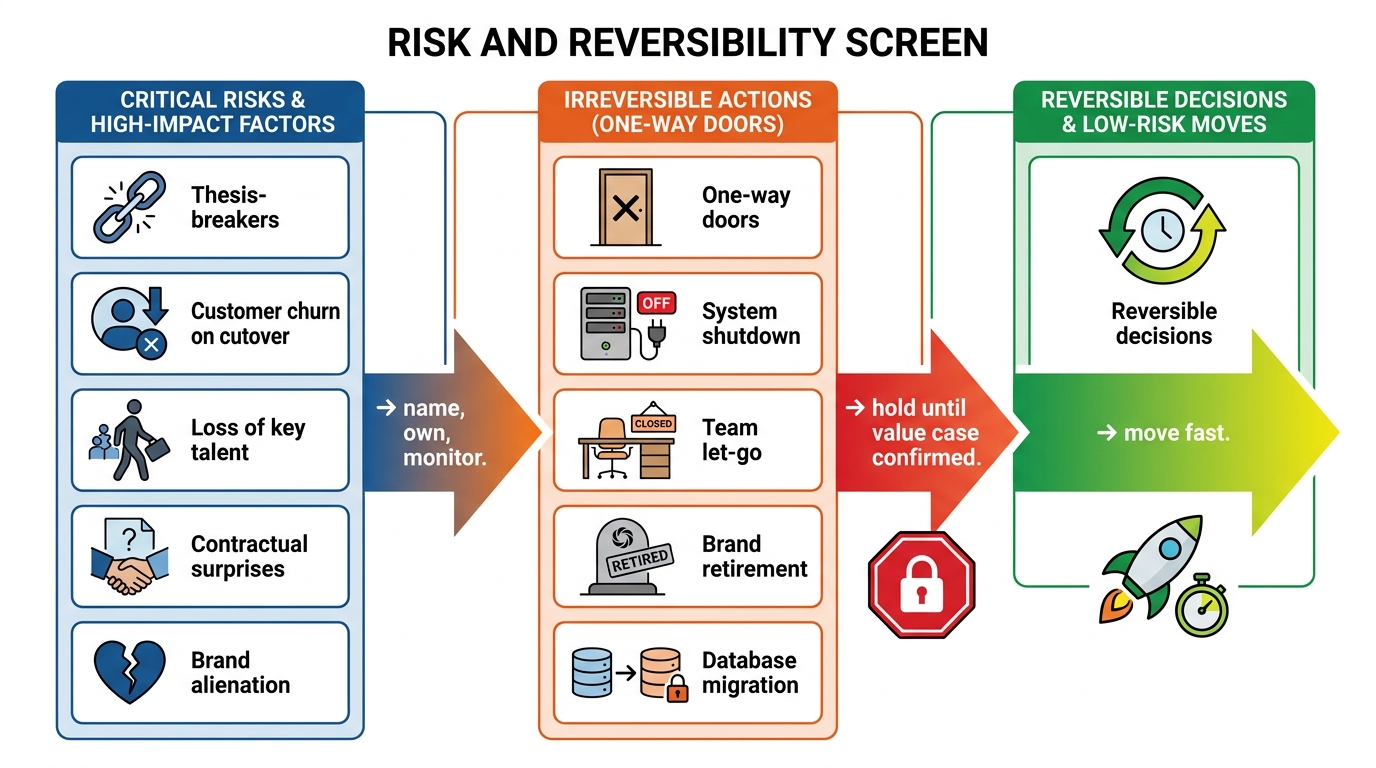
These are the failures that do not just delay value, they invalidate the underwriting. Customer churn triggered by a botched cutover. Loss of the founder or the key sales talent the deal depended on. Regulatory or contractual issues surfacing post-close. A brand migration that alienates the base. I want these named at the top of the plan with owners and monitoring, not buried in a risk register nobody reads.
One-way doors
Some integration decisions are cheap to reverse. Others are effectively permanent: shutting down a system, letting go a customer-facing team, retiring a brand, migrating a customer database. I want the plan to flag every one-way door and hold it until the value case is confirmed, not before. Reversible decisions can move fast. Irreversible ones earn extra scrutiny.
This risk lens is also where CFO priorities live. Forecast reliability, covenant headroom, and cash timing all depend on which risks the plan is actually managing. The connection between integration decisions and adjusted earnings runs directly through how add-backs get treated, because integration costs and one-time charges shape the EBITDA number lenders and buyers scrutinize.
How to sequence the plan once the four decisions are made
Only after the four lenses are answered does sequencing matter, and the sequence follows the value logic, not the org chart.
Days 0 to 100, protect the base and bank the certain
The first hundred days are about not breaking anything and capturing the cost synergies that are within control. Retain key people. Reassure key customers. Stand up reporting so you can see the business clearly. Execute the procurement and back-office consolidation that carries low risk. I have written a full breakdown in the 100-day go-to-market plan for a newly acquired B2B business, and the principle holds: the first quarter is about certainty, not ambition.
Months 4 to 12, build the revenue mechanism
Revenue synergy work belongs here, once the base is stable and reporting is trustworthy. Cross-sell motions, account mapping, sales enablement, and pricing all need a stable foundation to land against. Attempting them in the first quarter, while people are anxious and systems are moving, is how you convert forecast synergy into churn.
Beyond year one, prove the multiple case
Multiple expansion, the improved margin profile, the cleaner recurring revenue, the demonstrated buy-and-build engine, is enabled value that only becomes realized at exit. The integration plan should set up the evidence a future buyer will diligence, not assume the multiple has already moved.
How a partner should judge the plan in the room
When an integration plan lands on my desk, I am not reading for completeness. I am reading for whether the person who wrote it understands what the deal is for. A few questions separate the plans I trust from the ones I send back.
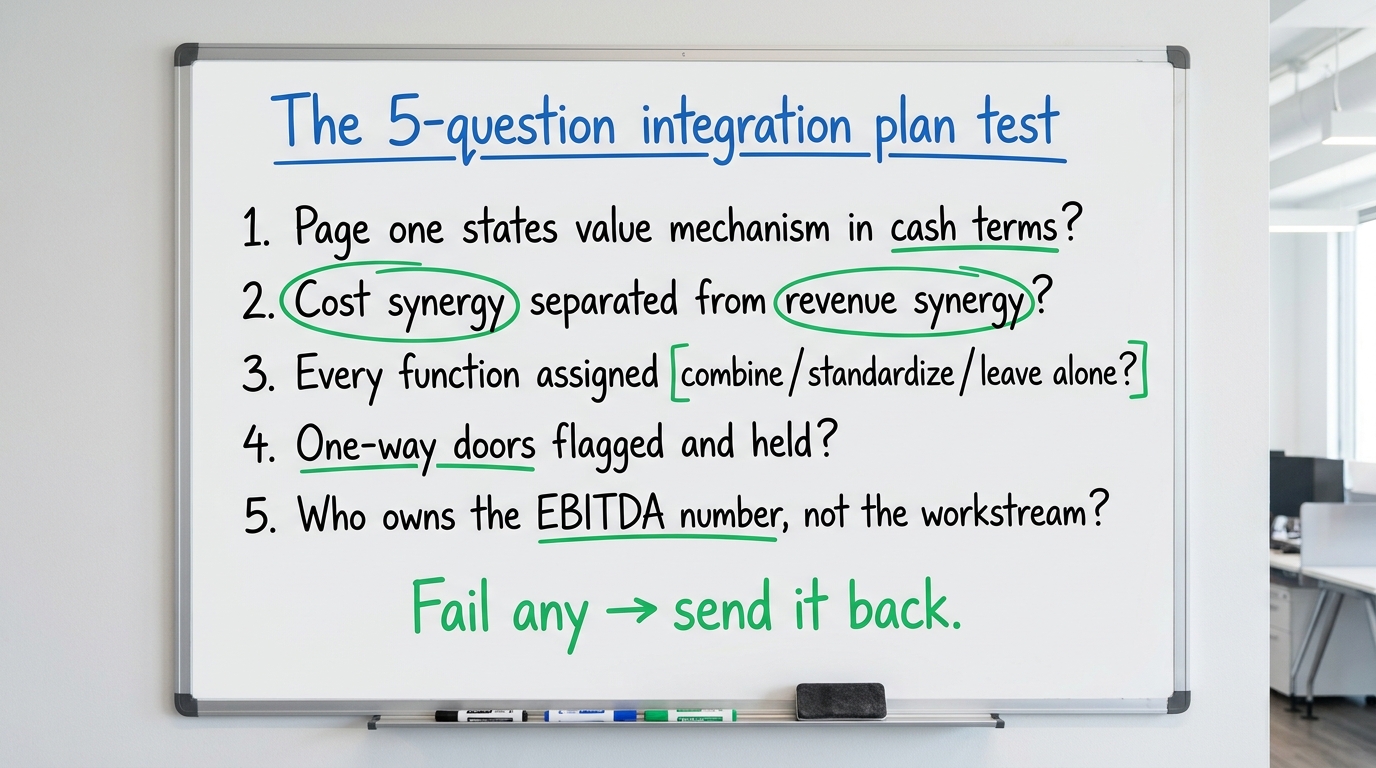
- Does page one state the value mechanism in cash terms? If the plan opens with a workstream list rather than the EBITDA it is chasing, it is an activity document.
- Is cost synergy classified separately from revenue synergy? If they are blended into one number, someone is hiding optimism inside certainty.
- Has every function been assigned a depth? Combine, standardize, or leave alone. If everything defaults to combine, over-integration risk is unmanaged.
- Are the one-way doors flagged? If irreversible decisions are scheduled alongside reversible ones with equal weight, the plan does not respect risk.
- Who owns the number, not the workstream? Activity has owners in every plan. Outcomes rarely do. I want a name against the EBITDA, not just against the migration.
This last point is the one I care about most. The difference between value creation consultants and operators comes down to P&L accountability. A plan full of advisors documenting activity is not the same as a plan with operators accountable for the result. The best integration plans I have judged read like operating commitments, not project schedules.
Tie integration back to the operating reviews that follow
An integration plan is a hypothesis. The operating reviews that follow are where it gets tested against reality. If the plan committed to cost synergies of a given size by a given quarter, the operating review should show whether they landed. If revenue synergy was forecast, the review should show pipeline evidence, not aspiration.
This continuity is where most portfolios lose the thread. The integration plan lives in one document, the operating cadence lives in another, and nobody reconciles them. I keep the same commercial KPIs live from close through the hold, which I detailed in portfolio company operating reviews and the KPIs that matter. The metrics that judged the integration plan should be the same ones that run the business afterward.
The wider point about avoiding value-creation pitfalls in private equity GTM applies here too: a plan disconnected from the operating cadence becomes a document people admired once and never revisited. And staying accountable through the hold is part of the broader discipline I cover in future-proofing organizations for 2026.
Judge the plan by the decision it forces, not the detail it contains
The detail in an integration plan is easy to admire and easy to fake. A thick document with hundreds of dependencies feels rigorous. But rigor lives in the four decisions, not the page count. Does the plan execute the actual thesis. Does it name and pressure-test the value mechanism. Does it decide what to combine and what to leave alone. Does it respect thesis-breakers and one-way doors. A plan that answers those four on one page, with a named owner against the EBITDA, is worth more than a hundred pages of workstream detail that never mentions the return.
PitchBook and S&P Global Market Intelligence both track how entry multiples and hold periods have shifted in recent cycles, and the pattern is consistent: with less room to rely on multiple expansion at exit, the value has to be built operationally during the hold. Integration is the first and largest lever in that build. Getting the plan right is not a project-management exercise. It is where the deal thesis either becomes a business or stays a spreadsheet.
If you are underwriting a deal or standing up an integration and want a plan judged the way a partner should judge it, against the value mechanism rather than the activity list, that is the work my team does. Start an advisory exploration with me here, and we will pressure-test the plan before the capital and the cutover dates lock it in.
