A PE deal partner needs a consultant to produce a better decision on the thesis, faster: is it real, what breaks it and what the exit looks like. Judge a private equity consultant on whether they translate every finding into your numbers and classify every claim, and ignore the size of the deck.
The fastest way to waste six figures of fund money is to hire a private equity consultant who answers a question nobody at the table asked. I have watched it happen from the inside: a deal partner wants a defensible view on whether the commercial thesis survives contact with reality, and instead receives a 90-slide deck full of market sizing, maturity curves and a color-coded capability heatmap. The work is competent. It is also useless, because it never touched the decision the partner had to make by Friday.
This is the core problem with the phrase “private equity consultant.” It describes an activity, not an outcome, and the buyers who get value from these engagements are the ones who refuse to let it stay that vague. If you sit on a deal team or an operating team, your job is not to buy consulting. It is to buy a better decision, or a faster path to one, at a cost that is small relative to the enterprise value it protects or creates.
Below is what each buyer inside a PE firm actually needs, how to judge whether the person across the table can deliver it, and the questions I hear most often from sponsors who are about to sign.
Three buyers with three different briefs
Most consultants sell a generic “PE advisory” offering and bend it toward whoever picks up the phone. That is backwards. Three people hold budget, and they have almost nothing in common in what they need on a given day.
The deal partner is making a go or no-go and a price. They want three things: is the thesis real, what breaks it, and what does the exit look like. A consultant who walks into a diligence conversation describing implementation activity, marketing channels or engineering staffing plans has lost the room. That is the wrong altitude.
The operating partner lives with the asset after close. They want speed, adoption and a playbook they can run across more than one portfolio company. They do not want a one-off insight. They want something that survives the departure of the consultant, the analyst and the champion who hired everyone.
The portfolio CFO cares about quality of earnings, cash conversion, covenant headroom and whether the forecast survives the next board meeting. A recommendation that cannot be translated into those terms will be ignored, however good it is.

When a consultant blurs these three, the deliverable satisfies none of them. I have written about why PE value creation requires embedded partners rather than advisory firms, and the same logic applies to scoping: name the buyer, name the decision, then buy against it.
The brief has also become harder. Bain’s annual Global Private Equity Report has tracked for years how much of the return story has moved from multiple expansion and debt toward operational improvement. When cheap debt is not doing the lifting, the consultant’s job stops being “confirm the story” and becomes “help build the value that has to come from operations,” and most advisory firms are not built for that.
What the deal partner has to decide
Strip away the vocabulary and the deal partner faces one question with three parts: should we do this deal, at what price, and what protection do we need in the structure. A consultant earns the fee by moving the confidence on those three, not by producing a document.
Is the thesis real
Commercial due diligence exists to test whether the revenue story survives outside the CIM. The seller’s narrative is always clean: durable customers, expanding wallet, defensible position, obvious cross-sell. The consultant’s job is to find where that narrative is quietly false. Concentration hiding inside a “diversified” logo count. Retention that looks strong only because churned accounts were re-signed at worse terms. A pipeline that is really one rep’s relationship book.
I have catalogued the specific tells in commercial due diligence red flags in B2B businesses, and the dangerous ones are rarely in the summary. A good consultant returns with a small number of findings that would change your price or your walk decision. A weak one returns with a market that is “attractive and growing,” which tells you nothing you can act on.
What breaks the thesis
Every thesis has a load-bearing assumption. Sometimes it is a single customer. Sometimes it is a founder-CEO who is the entire sales function. Sometimes it is a pricing model that has never met a competitor who decided to get serious. The deal partner needs that assumption named and stress-tested before the wire goes out, not discovered in year two.
Technology is the assumption mid-market deals check least. In Kroll’s February 2026 survey of 325 private equity portfolio leaders, 81% of firms above $25 billion in AUM made cybersecurity diligence a standard part of transaction diligence, against 29% of smaller firms, and the average cyber incident carried a $2.1 million financial impact. If your consultant’s scope stops at the commercial story, ask who is checking the platform the revenue runs on. I covered what that check should include in security due diligence for private equity.
What the exit looks like
A serious consultant reasons backward from the sale. Who buys this in four years, at what multiple, and what has to be true about the business for that buyer to pay it. If the answer requires the company to become something structurally different, that is not an insight to save for later. That is the whole investment.
What the operating partner has to decide
Once the deal closes, the question changes. Where is the value, how fast can we get it, and can we do this again next time. The operating partner is not evaluating a thesis. They are running a P&L against a hold-period plan, and they need a partner who thinks in the same terms.
This is where the distinction between advice and accountability becomes commercial rather than philosophical. I made the full case in value creation consultants versus operators. The short version: a consultant who hands you a recommendation and leaves has transferred no risk. A partner who signs up to a number and stays until it moves has a stake in your outcome.
Where the value actually sits
In most B2B assets I see, the value is not in a heroic new market. It is in the leaks the current owner learned to live with: renewals handed off badly, discounts nobody approves, a win rate on qualified deals that slipped while nobody was measuring it, a segment the company keeps serving at a loss, and acquisition cost that crept up because the funnel was never rebuilt.
Fixing the leak is usually cheaper, faster and lower risk than buying growth, and it shows up in the numbers sooner. That is why I built a portfolio revenue leakage diagnostic, and why a fractional CRO in a PE context fixes win rate and CAC, not revenue theory. When you are judging a consultant for an operating engagement, ask what they would measure first. If the answer is “market opportunity,” walk. If the answer is a short list of leaks with recovery values attached, keep talking.
Speed and the first 100 days
Time is the operating partner’s scarcest asset, because the return math compounds against a fixed hold period. Value created in the first year is worth far more than value promised in year four. That is why the 100-day go-to-market plan for a newly acquired B2B business is not a nicety, and why a 100-day value creation plan needs owners and dates rather than themes.
Diligence and post-close work are different jobs
Pre-close, the consultant answers “should we buy, and at what price.” The output is a decision and a price adjustment, not a plan. Post-close, the question becomes “now that we own it, what changes and when,” and the output is a sequenced plan with owners, dates and a baseline.
The skills overlap less than the marketing suggests. A strong diligence shop is not automatically a strong operating partner, and an operator who is excellent at execution may not be the right person to price a thesis in three weeks. When you hire, say which job you are buying. If you need both, decide who carries the findings from one into the other, because that handoff is where most of the diligence value is lost.
How to judge the consultant in the room
The market is full of confident people, and the deliverable often looks the same whether it is excellent or empty. These are the tests I use.
They translate everything into your numbers
Hours, tickets, features, campaigns and traffic are the vendor’s register. The buyer’s register is revenue, EBITDA, cash, integration speed, operating risk and the path to exit. A good consultant leads with the financial consequence and treats the activity as the mechanism. Cross out every sentence in a proposal that describes what the vendor will do and see whether a business case survives. If nothing is left, you are looking at a staffing arrangement.
The sharpest version of this test is the CFO’s. Ask the candidate to walk you from their proposed initiative to the line in the P&L it moves, and then to how a quality-of-earnings review would treat that movement. A durable operating change and a one-time adjustment the next buyer’s QoE team will strip out are very different things. I laid out where that line sits in adjusted EBITDA and the art of add-backs.
They classify every claim
The single most revealing question you can ask is: “Is that value realized, run-rate, forecast, enabled, or risk avoided?” Realized means it is in the accounts. Run-rate means it is annualizing from a real change. Forecast means it depends on execution that has not happened. Enabled means you have a capability whose value is still theoretical. Risk avoided means a loss was prevented before close. A serious operator draws those lines without flinching. A weak one collapses all five into one number and presents it as cash in the bank.

They fix the baseline before the work starts
The most expensive mistake in value creation consulting is starting work without agreeing on what “before” looked like. Without a baseline you cannot claim the improvement, and you certainly cannot defend it in a data room three years later. A credible partner fixes the baseline, the measurement method and the attribution logic on day one. Our own outcome claims carry an account, a period, a baseline and a method, or we do not make them.
Baselines also change the work itself. Before we price fixed scopes at DevriX, we look at where hours on similar work actually went. On one multi-site program, under half of 1,390 tracked hours went to planned build, while coordination took 16% and rework after client feedback took 14%. That single baseline changed how we write scopes: work starts at a complete intake, review rounds are counted, and changes arrive as written orders.
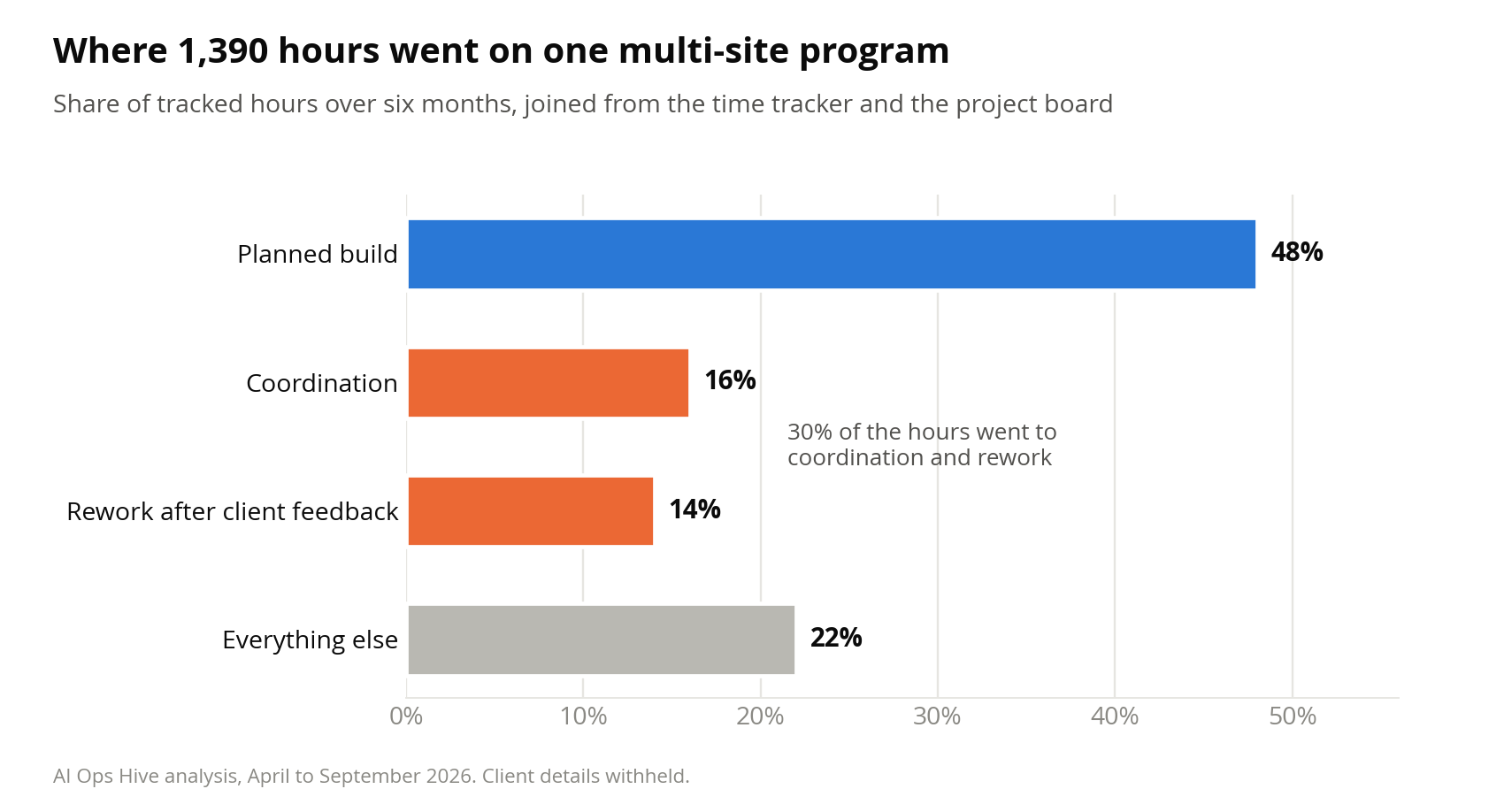
We keep baselines like that current with our AI Ops Hive, which reads tasks, hours, code and invoices every night, so the “before” picture is not reconstructed from memory when someone finally asks.
They know which KPIs predict the exit
Ask what they would put on the monthly operating review. If the list is 40 metrics long, they are hiding. The commercial KPIs a next buyer will underwrite are a short set: net revenue retention, gross margin by segment, sales efficiency, pipeline coverage and the durability of the top accounts. I explained the shortlist I hold portfolio companies to in portfolio company operating reviews. A consultant who reports impressions and MQLs while the retention curve bends the wrong way is creating the appearance of progress.
This matters more as holds lengthen. PitchBook’s research has tracked longer holding periods in recent years, and over a longer hold the metrics that last matter more than the ones that flatter a single quarter.
They accept accountability, not just advice
The final filter separates a value creation partner from a well-dressed advisor. Will they stand next to their recommendation while it is implemented, and will they carry some of the downside if it does not land? Advisory that ends with a deck hands the execution risk back to you at the exact moment execution risk is highest. In my experience, value in deals is lost in execution far more often than in the thesis, so a consultant who is accountable only for the thesis is accountable for the wrong half.
Ask the direct question: what part of your fee is at risk against the outcome, and what does it take for you to still be here in six months?

The failure modes that keep repeating
After enough engagements, the same three failures show up. All three are avoidable if you name them at scoping.
The deck with no decision in it
The most common failure is the beautiful deliverable that never touches a decision. It describes the market, benchmarks the company and stops exactly where the hard call begins. This happens when the engagement was scoped as “produce analysis” rather than “answer this question.” The fix is on the buyer’s side: commission a decision, not analysis.
The value that was always forecast
The second failure is the value creation plan that looked enormous on paper and delivered a fraction, usually because forecast and enabled value were counted as if they were realized and nobody made the difference visible. The team funds growth before fixing retention, the GTM plan assumes a sales motion the company has never run, or the consultant optimizes a channel that was never the constraint. I described these traps in private equity GTM value creation pitfalls. The plans that hold tag each line with its confidence level and an owner inside the company.
The insight that leaves with the consultant
The third failure is the most expensive because it looks like success at first. The engagement delivers, the metric moves, and then the consultant leaves and the gains erode because nothing was built into the organization. Value that lives only in an external head is a liability disguised as an asset, which is the thread running through my lessons on future-proofing organizations. A good engagement leaves the company stronger without the consultant in it.
Before you sign
What I would run through before committing fund money to any private equity consultant, for diligence or for post-close work:
- Name the buyer and the decision. Deal partner (thesis, risk, exit), operating partner (speed, adoption, playbook) or CFO (cash, covenants, forecast). One engagement rarely serves all three well.
- Demand a decision, not a document. Ask what call this work will let you make, and by when. If they cannot answer, the scope is wrong.
- Say which job you are buying. Diligence and post-close operating work have different burdens of proof.
- Fix the baseline and classify the value. Every promised number gets a baseline, a method and a tag: realized, run-rate, forecast, enabled or risk avoided.
- Test the numbers. Ask for the five KPIs that predict enterprise value in this business, and for the P&L line each initiative moves.
- Check who owns it after they leave. The value has to live inside the company, held by named management.
- Price against the value at stake. The fee should be small relative to what it protects or creates, with part of it tied to the outcome.
Common questions
What do private equity firms look for in a consulting partner?
They look for someone who can name the decision in front of them and move it, in their language. In practice that means findings that change a price or a plan rather than a market overview, claims classified honestly from realized to forecast, fluency in the numbers a CFO and a QoE team will check, and a willingness to stay accountable through execution rather than handing over a deck.
What should an operating partner look for in a RevOps consulting firm?
Look for a firm that starts by measuring the existing revenue engine before proposing new spend: win rate on qualified deals, sales cycle, discount discipline, renewal handoffs and pipeline coverage. It should be able to fix the systems underneath, such as the CRM, the integrations and the reporting, not only the process on paper, and it should agree a baseline before the work starts. A firm that leads with tools or a new methodology before it has looked at your data is selling activity. That is the bar we hold our own revenue operations work to.
When should a PMI expert come in: before, during, or after the deal closes?
Before. The integration questions that decide the first 100 days, such as which systems survive, which customers are at risk in the transition and who owns the revenue data, are cheapest to answer before signing, when they can still shape the price and the structure. An integration lead brought in after close inherits decisions that were made by default. I covered what a deal partner actually decides in integration in this piece on PMI.
The point of hiring one at all
A private equity consultant is worth hiring when they shorten the distance to a better decision or build value that stays after they go. That is the entire test. The frameworks, benchmarks and maturity curves are instruments in service of one of those two outcomes, or they are overhead dressed as insight.
The buyers who get this right refuse to commission analysis in the abstract. They make the consultant name the decision, classify the value, fix the baseline and hand the capability to the company. The result is a cleaner go or no-go, a price you can defend, and an operating plan that survives the exit of the person who wrote it.
If you are weighing an acquisition or a value creation plan and want a second read on the decision in front of you, that is the value creation advisory work I do. When the plan needs execution inside the portfolio company, across its platforms, integrations and data, DevriX runs it as one accountable team, against a baseline agreed before the work starts.