

By Mario Peshev, DevriX
A red flag in a technology diligence report is not a decision. It is an invoice waiting for someone to sign it. And the person who signs it, more often than not, is a deal partner or an operating partner who has read a forty-page assessment full of severity ratings and now has to answer three questions the report never asked: how much of this must we fix, when, and what does it cost us if we do not.
I have sat on both sides of this. I have written the technical findings that landed on a partner’s desk, and I have been the operator asked to price and sequence the remediation after the deal closed. The gap between those two documents is where value gets created or quietly destroyed. Most technology diligence tells you the state of the asset. Almost none of it tells you what to do about it in terms a P&L owner can act on. That translation is the job. This piece is about how to do it.
Why the diligence report stops exactly where the decision starts
The standard technology due diligence deliverable is built to protect the assessor, not to arm the buyer. It catalogs. It rates. It flags. Then it ends. You are left holding a list of concerns sorted by a severity scale that the vendor invented, with no linkage to the thesis you underwrote or the hold period you committed to.
That is the structural failure. A CTO reading the report sees engineering problems. A deal partner needs those problems translated into EBITDA risk, integration friction, and exit narrative. This is a translation problem: activity and findings get mistaken for outcomes. A list of forty vulnerabilities is a vendor register. The decision the partner owns is a capital allocation question, and it deserves to be framed as one.
Consider what the buyer is actually purchasing. Not code quality. Not test coverage. A buyer is purchasing measurable enterprise-value improvement, and technology remediation only matters to the extent it moves one of a short list of levers: it protects revenue, it removes a drag on EBITDA, it shortens integration, it reduces the risk that surfaces at the next diligence, or it clears an obstacle to a cleaner exit. If a proposed remediation item does not map to one of those, it is a preference, not a requirement, and it can wait.
The four buckets every finding belongs in
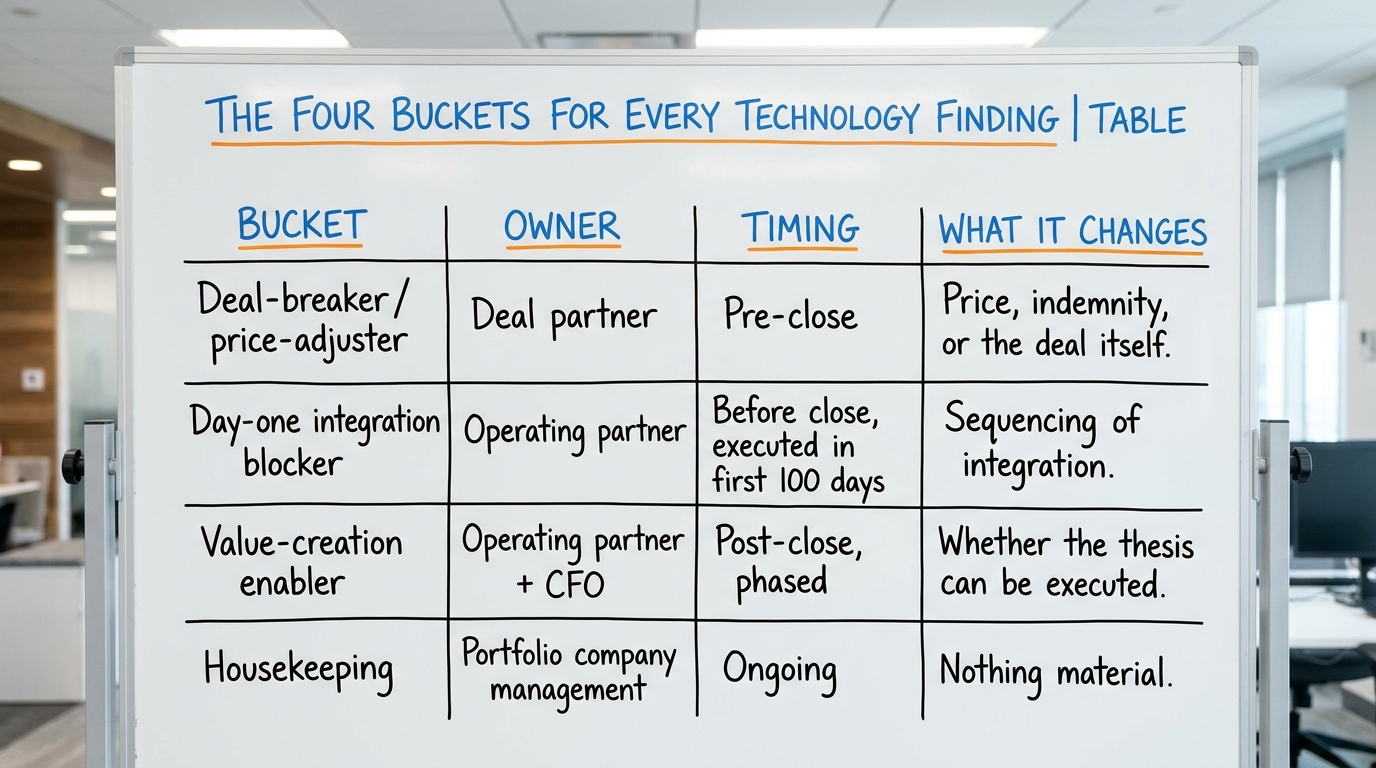
Before you price anything, sort it. I put every technology finding into one of four buckets, and the bucket determines who decides and how fast.
Deal-breakers and price-adjusters
These are findings that change the thesis or the price. A core system that cannot scale to the growth case you underwrote. A licensing exposure that becomes a liability at your ownership. A single engineer who holds the only working knowledge of the billing engine. These belong in the deal partner’s hands before signing, not in a 100-day plan. They either adjust the purchase price, become an indemnity, or kill the deal. The commercial due diligence side has its own version of this, and I have written about the red flags that surface in B2B commercial diligence; the technical ones deserve the same pre-close treatment.
Day-one integration blockers
These do not change the price but they gate the first hundred days. You cannot consolidate two ERPs, you cannot cut over the acquired company’s identity system, you cannot pull financials into a single reporting stack until these are handled. They are sequencing constraints. They belong to the operating partner and they should be costed and scheduled before close, not discovered in week three.
Value-creation enablers
These are the items that, once fixed, let the thesis work. The pricing system that cannot support a move upmarket. The data model that blocks the cross-sell you underwrote. These are investments, not repairs, and they should be judged against the return they enable rather than the risk they remove.
Housekeeping
Everything else. Documentation debt, minor version upgrades, cosmetic cleanup. Real, but not urgent, and never worth pulling forward at the expense of the first three buckets. Most technology reports over-weight this category because it is the easiest to find and the safest to flag.
Turning severity ratings into money and time
A severity rating is an opinion. A dollar figure and a date are a decision input. The single most useful thing you can do with a technology diligence report is force every material finding through three columns: cost to remediate, time to remediate, and cost of not remediating within the hold period.
That third column is the one everyone skips, and it is the one that matters most. A finding rated “high severity” that costs nothing if left alone until exit is not a high-priority item, it is a footnote. A finding rated “medium” that quietly caps revenue growth at fifteen percent when your thesis needs twenty-five is the most expensive line in the report. Severity without a financial consequence is noise.
When I price remediation, I classify the impact carefully. Is this a realized cost we already carry, a run-rate improvement once fixed, a forecast benefit that depends on execution, an enabler that makes something else possible, or purely a risk avoided? A partner who confuses “enabled” value with “realized” value will over-invest in remediation that does not pay until three other things also go right. I have watched more than one operating team spend eighteen months rebuilding a platform for a cross-sell that the commercial team never had the capacity to run.
The cost of not remediating is a real number
Write it down as one. If the aging infrastructure means a two-week outage risk with a quantifiable revenue exposure, put the revenue exposure in the cell. If the technical debt means every new feature takes forty percent longer to ship, translate that into delayed revenue or higher engineering cost per release. If the security gap means the next buyer’s diligence will discount the asset, estimate the discount. This is the same discipline the CFO applies to adjusted EBITDA and add-backs: an adjustment you cannot defend with a method and a baseline is not an adjustment, it is a hope.
How to read a remediation estimate without a technical background
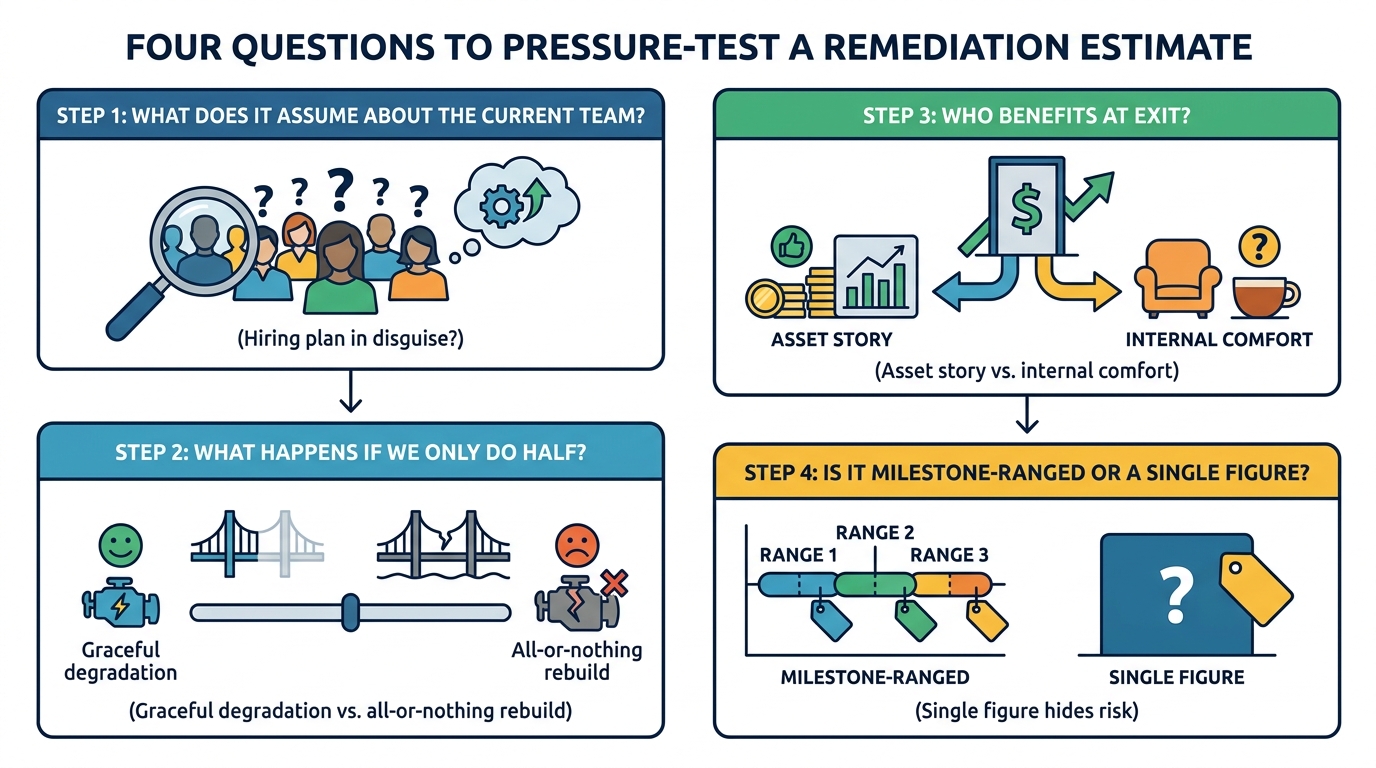
Deal partners tell me they feel disarmed by technology estimates because the vendor speaks a language they do not audit for a living. You do not need to. You need to interrogate the estimate the way you would interrogate any capital request.
- Ask what the estimate assumes about the current team. A remediation plan that quietly assumes you will double the engineering headcount is a hiring plan disguised as a fix, and it carries integration and retention risk the number does not show.
- Ask what happens if you do half of it. A credible plan degrades gracefully. If the answer is “it only works if we do all of it,” you are being sold a rebuild, not a remediation.
- Ask who benefits at exit. Some remediation improves the asset’s story to the next buyer. Some only serves internal comfort. The first is investment, the second is preference.
- Ask for the estimate in ranges tied to milestones, not a single figure. A single figure means the vendor either does not understand the risk or is hiding it.
The pattern I trust least is the estimate that leads with hours, tickets, and headcount. That is a description of activity, and activity is not outcome. The estimate I trust leads with the financial consequence and works backward to the work. If the vendor cannot connect their plan to your revenue, EBITDA, or exit multiple, they are billing you for effort and letting you carry the risk of whether it mattered.
The remediation trap that eats hold-period value
The most expensive mistake I see is not underspending on remediation. It is a full technical rebuild launched in year one under the banner of “fixing the debt,” funded before anyone connected it to the value-creation plan. Two years later the platform is cleaner, the team is proud, and the enterprise value has not moved because the rebuild displaced the commercial work that the thesis actually depended on.
Bain’s annual Global Private Equity Report has tracked for years how much of the industry’s return now has to come from operational improvement rather than multiple expansion and leverage. That shift raises the cost of misallocated remediation. Every quarter and every dollar spent rebuilding something the market does not reward is a quarter and a dollar not spent on the growth lever that does. McKinsey’s private capital research makes the same point from the value-creation angle: the funds that outperform are disciplined about where operating effort lands, not merely energetic about applying it. BCG’s work on principal investors and private equity echoes the same discipline, that operating value comes from choosing the few interventions that move the thesis rather than exhausting the list.
Remediation has to be sequenced against the commercial plan, not run in parallel by a technology team optimizing for their own definition of quality. This is exactly why I argue that value creation needs embedded partners rather than advisory firms. An advisor hands you a remediation roadmap and leaves. An embedded operator has to live with the tradeoff between fixing the platform and shipping the revenue feature, and that tension produces better decisions than any standalone report ever will. The difference between advice and P&L accountability shows up most sharply here.
Who owns which decision, and when
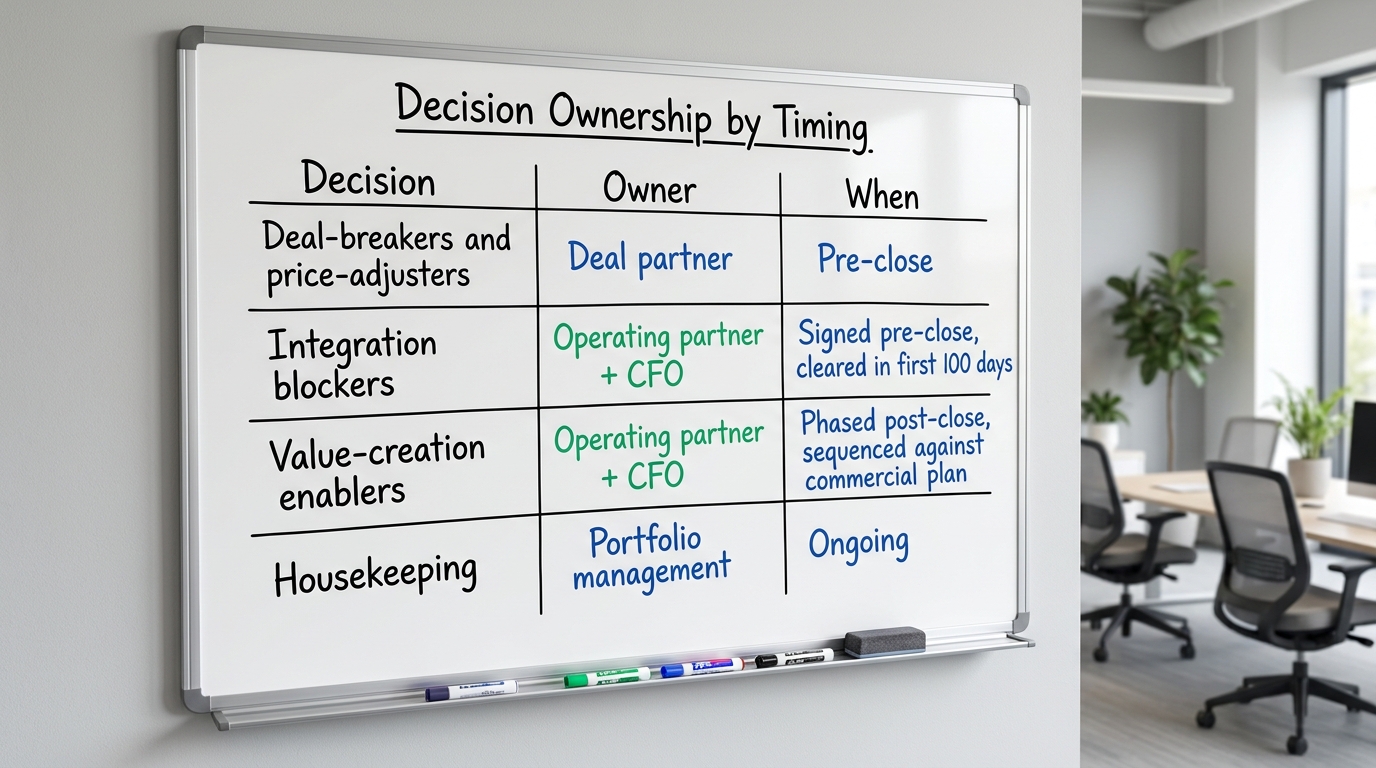
Remediation goes wrong when the wrong person owns the call. The deal partner should own the deal-breakers and price-adjusters, because those move the thesis and the price, and they are pre-close by definition. Waiting until after close to discover a licensing liability or a scaling ceiling is how a good deal becomes a mediocre one.
The operating partner owns the integration blockers and the sequencing of the value-creation enablers, working with the CFO on what gets funded and when. This is where the 100-day plan earns its keep, because the first hundred days are when integration blockers either get cleared or calcify. The CFO owns the forecast reliability, which means the CFO needs to know which remediation items, if they slip, put the covenant or the forecast at risk.
The portfolio company’s own management owns housekeeping and the ongoing quality bar. Handing them the deal-breakers is how those items get quietly deprioritized in favor of whatever the team was already doing.
What good remediation reporting looks like after close
Once the plan is running, the reporting has to change too. If your monthly technology update is a burndown of tickets closed, you have recreated the vendor register inside your own portfolio. I want remediation progress reported the way I want any operating metric reported, which is against the enterprise-value lever it was supposed to move.
The integration blocker report should show which financial or operational consolidation each fix unlocks, and whether that consolidation is on schedule. The value-creation enabler report should show whether the commercial capability it was meant to unlock is actually being used, because an enabler that ships into an empty room created no value. This is the same discipline I apply across portfolio operating reviews: the KPIs that matter are the commercial ones, and technology progress earns its place in the review only when it connects to them.
There is a leakage angle here that most technology tracking misses entirely. A remediation item can technically close and still leave value on the table if the process around it was never fixed. I built the B2B portfolio revenue leakage diagnostic precisely because a system can pass a technical audit while the business it runs quietly loses margin through it. Clean code around a broken pricing process is a solved problem next to an unsolved one.
How this reads to the next buyer
Every remediation decision you make is also a diligence artifact your eventual buyer will read. A hold period of clean, documented, thesis-linked remediation shows up at exit as a lower-risk asset and a defensible growth story. A hold period of ad hoc firefighting and undocumented rebuilds shows up as a discount.
The Harvard Law School Forum on Corporate Governance has published extensively on how diligence and governance quality shape deal outcomes, and the through-line is consistent: buyers pay for assets whose risks are known, quantified, and managed, and they discount assets whose risks are vague. The remediation record you keep is part of the risk profile the next buyer prices. Treat it as an asset you are building, not a chore you are clearing.
This is also why I keep steering technology teams away from perfectionism during the hold. The goal is not the cleanest possible platform. The goal is an asset that supports the growth case, carries no unmanaged surprise, and tells a coherent story at exit. Over-remediation is as much a value leak as under-remediation, and it is harder to spot because it wears the costume of diligence. The broader principle sits inside how I think about building organizations that stay durable: resilience is about the right investments, not the maximum ones.
The operator’s checklist
If you take one thing from this, take the sequence. When a technology diligence report lands, before you approve a single line of remediation spend:
- Sort every finding into deal-breaker, integration blocker, value-creation enabler, or housekeeping.
- Force each material finding through three columns: cost to fix, time to fix, and cost of not fixing within the hold.
- Classify each impact as realized, run-rate, forecast, enabled, or risk avoided, and do not fund forecast or enabled value as if it were already in hand.
- Assign each decision to the right owner at the right time: deal-breakers to the deal partner pre-close, everything else sequenced against the commercial plan.
- Report progress against the enterprise-value lever, not against the ticket count.
None of this requires you to read code. It requires you to refuse the report on its own terms and insist it answer the questions a capital allocator actually owns. The value-creation pitfalls I see most often in portfolios start right here, with a technology decision made in engineering language instead of P&L language. And the commercial-side fix, the work of translating capability into win rate and CAC, only pays off if the platform underneath it was remediated for the right reasons.
Where this leaves you
Technology remediation is not a technical problem you delegate. It is a capital allocation problem you own, dressed in technical language that makes it easy to hand off and easy to overspend on. The partner who translates every finding into money, time, and exit consequence, and who sequences the fixes against the thesis instead of against an engineer’s sense of tidiness, protects the return. The partner who signs the invoice the report implies does not.
Get the translation right at the deal moment, before the report calcifies into a roadmap nobody stress-tested. If you are staring at a technology diligence report and cannot yet see the four buckets, the three columns, or the owner for each decision, that is the conversation worth having before capital moves.
At DevriX I work with deal teams and operating partners to translate technology diligence into remediation decisions a P&L owner can defend. If you want a second read on a live report, or a framework applied to your next deal, start an advisory exploration with me here. The best time to price remediation correctly is before you have committed to fixing the wrong things.
