

By Mario Peshev, DevriX
Most board reporting inside private equity portfolio companies is built to survive the meeting, not to change a decision. That is the problem. A CFO assembles forty slides, the operating partner scans for the one number that moved, the deal partner is half-listening for anything that threatens the exit timeline, and everyone leaves with the same open questions they walked in with. The pack was activity. The board needed a decision.
I have sat on both sides of that table. I have built reporting layers for portfolio companies where the sponsor could not tell whether the commercial engine was working, and I have watched deal partners quietly stop reading a pack because it never told them anything they could act on. The difference between a report that earns budget and a report that gets skimmed is not design polish. It is whether the document answers the specific questions the people in the room are paid to answer.
This is a piece about that gap, and how to close it.
What a deal partner and an operating partner actually decide
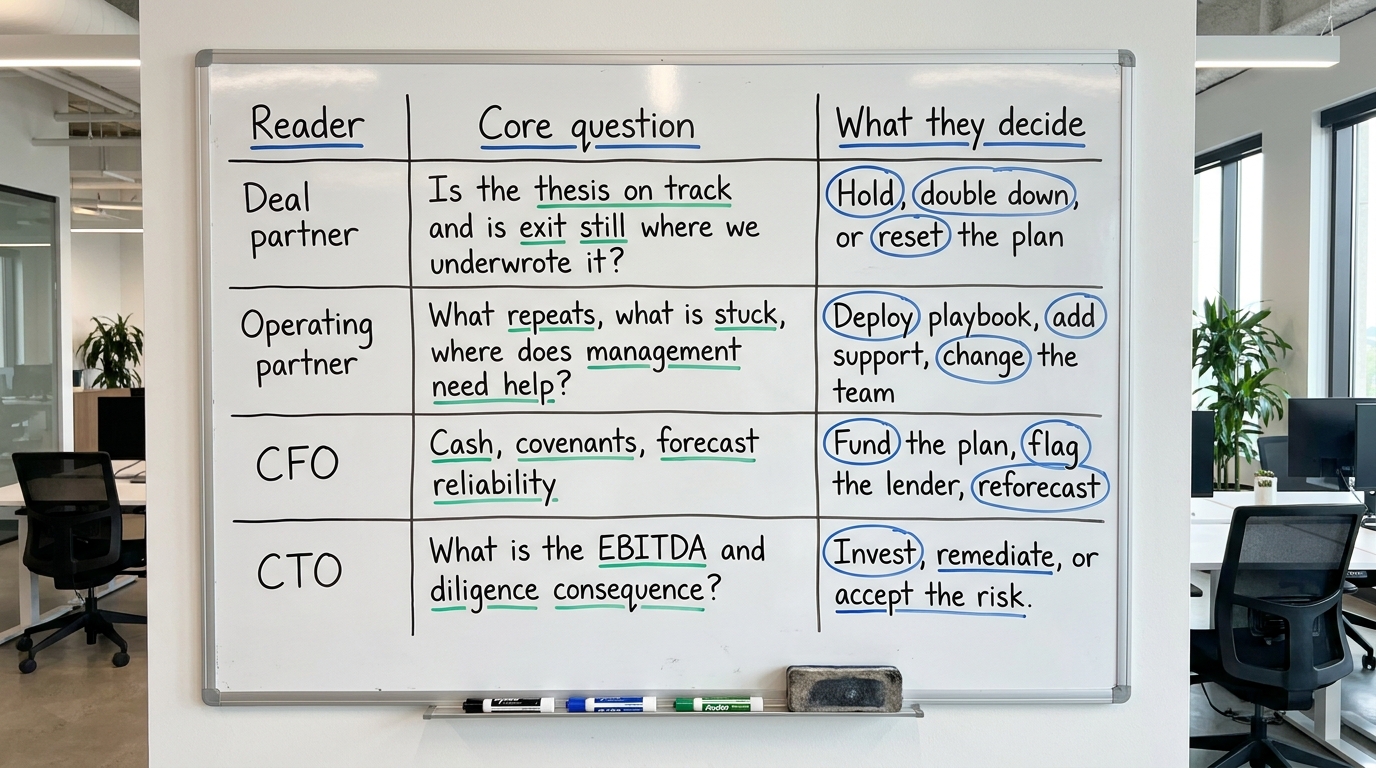
Start with the reader, not the template. The house error in portfolio reporting is writing to “the board” as a single audience. There is no such audience. There are two or three people with sharply different mandates, and a pack that serves all of them equally usually serves none of them well.
A deal partner is holding the thesis. Their questions are narrow and unforgiving: is the value-creation plan on track, has the risk profile changed, and is the exit window still where we underwrote it. They do not want a marketing funnel walkthrough. They want to know whether the number that justified the entry multiple is still true.
An operating partner lives closer to the P&L. They want to know what is working well enough to repeat across the portfolio, what is stuck, and where management needs help versus where management needs replacing. Their questions are about adoption, velocity, and repeatable playbooks. I wrote about why that role only works when it is embedded rather than advisory, and the same logic applies to what they read. An operating partner cannot act on a report they receive once a quarter in polished retrospect.
The CFO, if they attend as a principal reader rather than the author, cares about cash, covenants, and forecast reliability. A CTO who reports to this board needs their world translated into EBITDA and diligence risk, not described as engineering activity.
Write to those mandates separately. A single pack can hold all of them, but each section has to know who it is for.
Reporting activity instead of consequence is the failure mode
The most common defect I see is a pack full of activity that never resolves into consequence. Pages of tickets closed, campaigns launched, features shipped, pipeline generated, headcount added. All of it real work. None of it a decision.
Activity is the vendor register. It is what a supplier reports to justify an invoice. A board pack that leads with activity is quietly asking the sponsor to do the translation themselves, to figure out whether all that motion produced revenue growth, EBITDA expansion, cash improvement, or reduced risk. Most sponsors will not do that translation. They will assume the answer is no.
The fix is to lead with the financial consequence and put the activity underneath as evidence. Not “we ran twelve campaigns and generated 400 MQLs” but “new-business revenue is running 9 percent ahead of plan, driven by two channels we can now fund harder, and here is what we spent to get there.” The activity still appears. It just stops being the headline.
This discipline matters most where the numbers are soft. When a report classifies every improvement as if it were already banked, it loses credibility the first time a forecast misses. Separate what is realized from what is run-rate, forecast, or merely enabled. A sponsor who has seen forecast dressed up as realized once will discount everything you show them afterward.
The five categories every claim should fall into
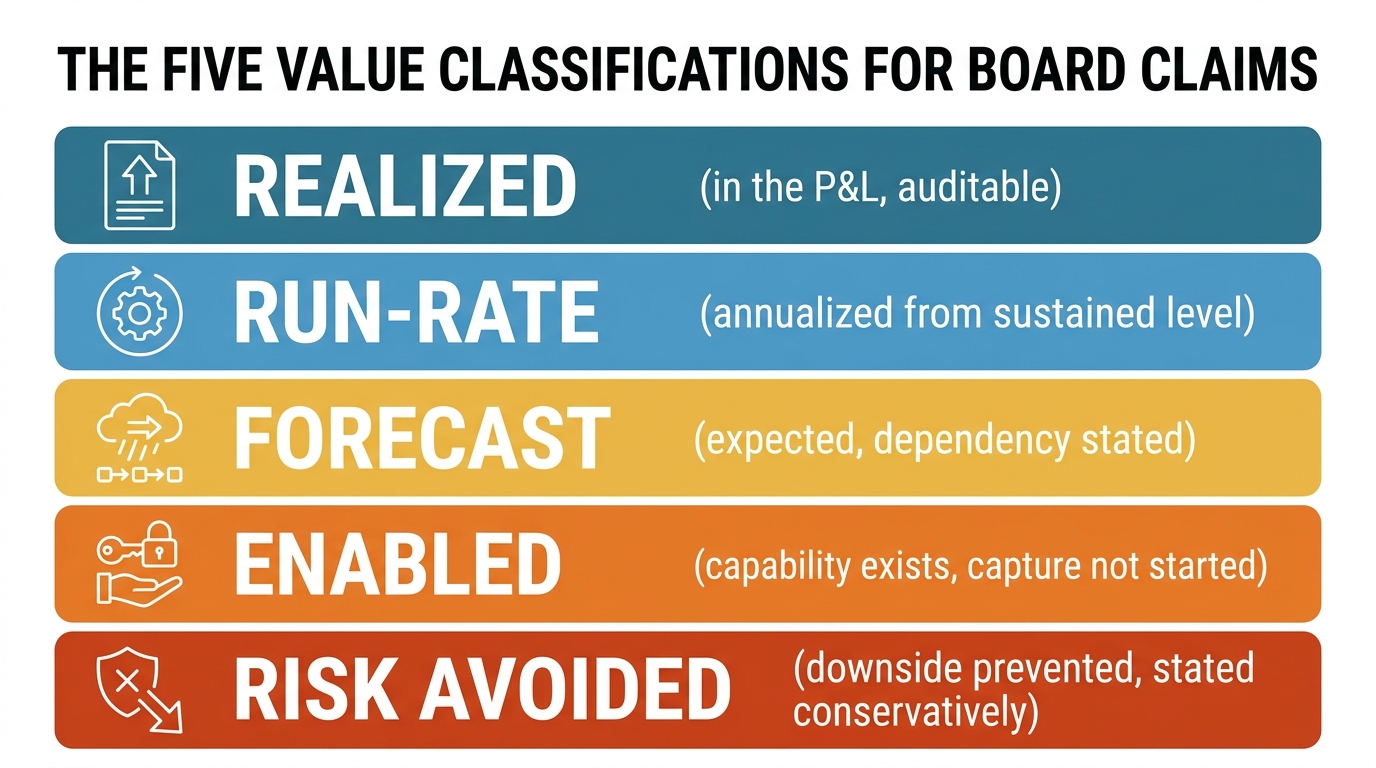
Before a number goes into a board pack, I make the team classify what kind of value it represents. This single habit removes more argument than any dashboard tool.
- Realized. Already in the P&L or the bank. Auditable. This is the only category that supports “we did it.”
- Run-rate. Annualized from a current, sustained level. Credible, but state the run-rate window and the assumption.
- Forecast. Expected but not yet earned. Attach the confidence and the dependency.
- Enabled. Capability now exists to capture value, but capture has not started. Useful, and dangerous when it masquerades as realized.
- Risk avoided. A downside that did not materialize because of an action taken. Real value, hardest to prove, worth stating conservatively.
When a board pack tags each material claim this way, the conversation changes. The deal partner stops interrogating whether the number is true and starts deciding what to do about it. That is the entire point of reporting.
The weekly brief our AI Ops Hive sends me follows the same rule: at most three points, each with a number, an owner and a date.
The metrics that survive a real operating review
Boards drown in KPIs because nobody culled the list at the start. The discipline is to report the handful of metrics that connect directly to the thesis and cut the rest to an appendix. I have laid out the specific commercial numbers that matter in portfolio company operating reviews, and the board version is a tighter subset of that.
Commercial health, not vanity traffic
Net revenue retention, gross margin trend, new logo velocity, and win rate against a named competitor set tell a deal partner whether the commercial thesis holds. Website sessions and social reach do not. If you are reporting traffic to a PE board, you are reporting activity again.
Win rate and customer acquisition cost deserve special attention because they are where most B2B commercial problems actually live. A fractional commercial leader earns their keep by fixing exactly these, which I covered in the piece on fractional CROs fixing win rate and CAC rather than selling revenue theory. A board pack that surfaces a deteriorating CAC payback before it shows up in cash has done its job.
Cash and covenant reality
The CFO section is where forecast reliability gets tested. Track forecast-to-actual accuracy over the trailing quarters, not just the current period variance. A management team that beats and misses randomly is telling the board something worse than a team that misses consistently in a knowable direction. Bain’s global private equity work has repeatedly flagged how sensitive returns have become to margin and cash discipline as multiple expansion stops doing the heavy lifting; you can follow that thread in the Bain Global Private Equity Report. When leverage does the underwriting, covenant headroom is a board-level number, not a finance footnote.
EBITDA quality, not just the total
The board should see EBITDA the way a future buyer’s diligence team will see it. That means being honest about add-backs and one-time adjustments now, so the number does not get repriced at exit. I went deep on this in adjusted EBITDA and the art of add-backs. A board pack that quietly inflates adjusted EBITDA with add-backs that will not survive a quality-of-earnings review is setting up an unpleasant conversation eighteen months out. The professional standards bodies that define how earnings quality gets tested, including the AICPA & CIMA, are worth knowing before a buyer’s team applies them to you.
The reporting cadence a thesis actually needs
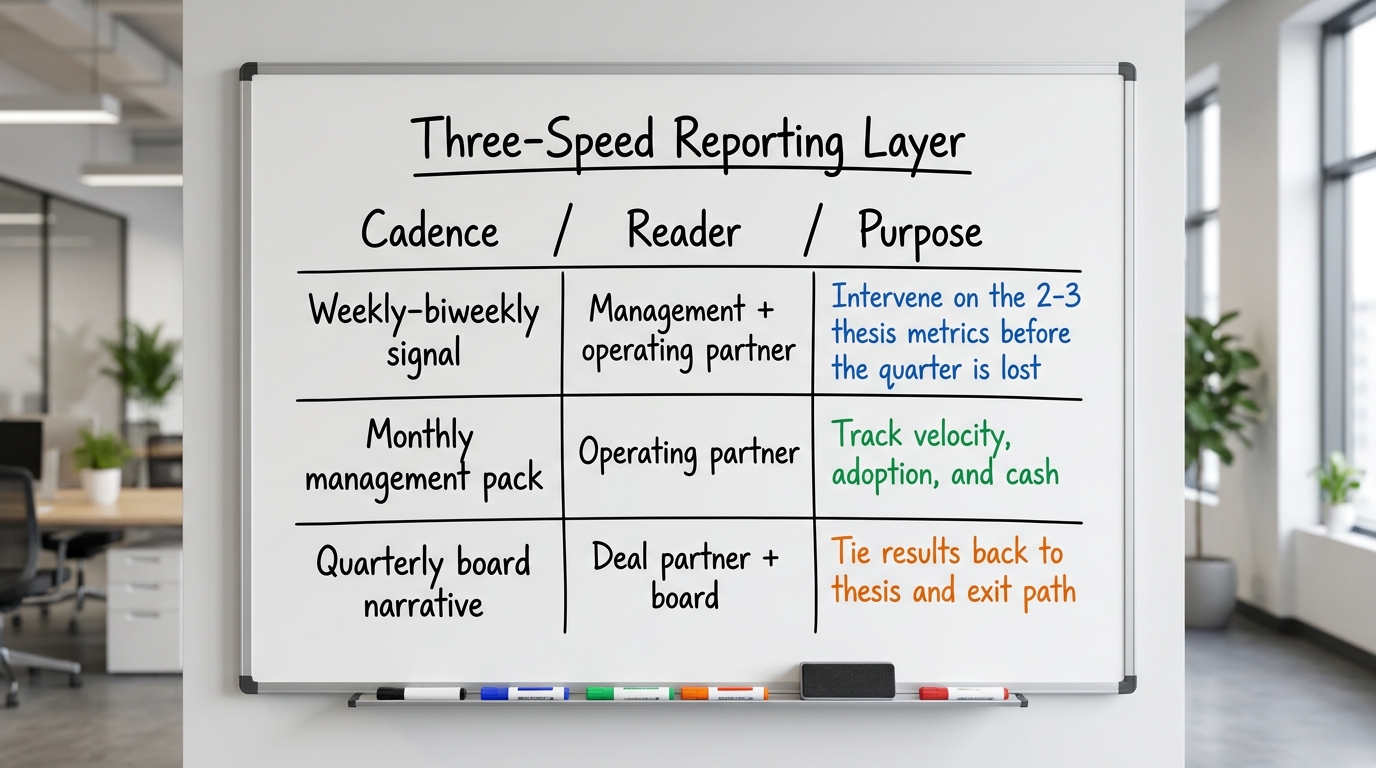
Quarterly board packs are table stakes and mostly useless for driving action, because a quarter is long enough for a fixable problem to become a structural one. The reporting layer that works has three speeds.
A monthly management pack keeps the operating partner close to velocity and adoption. A weekly or biweekly signal on the two or three metrics tied directly to the value-creation plan lets the team intervene before the quarter is lost. And a quarterly board narrative ties it all back to the thesis and the exit path. Each speed has a different reader and a different purpose. Collapsing them into one quarterly document is why so many boards learn about problems a quarter too late.
The first hundred days set this rhythm. If a newly acquired business does not have a working reporting cadence within that window, the sponsor is flying blind through the period when intervention is cheapest. I laid out that early sequence in the 100-day go-to-market plan, and reporting infrastructure is not a nice-to-have inside it. It is how you know whether the rest of the plan is working.
How to judge whether a board pack is any good
Here is the test I apply, and I recommend sponsors apply it too. Read the pack and ask three questions.
Can I make a decision from this without a follow-up call?
If the honest answer is no, the pack has failed at its primary job. A good board pack anticipates the decision the reader has to make and gives them what they need to make it. It does not require a separate call to explain what the numbers mean. When a management team routinely needs the follow-up call, they are using the pack to look busy rather than to inform.
Does it tell me what is going wrong, plainly?
The single strongest signal of a trustworthy reporting culture is bad news arriving early and clearly. A pack that only ever surfaces good news is not a report, it is marketing. The Harvard Law School Forum on Corporate Governance has published extensively on why board information quality, and specifically the flow of bad news to the board, correlates with governance outcomes. Inside a portfolio company the stakes are sharper, because the board can actually act, and quickly. A CFO who buries the covenant risk on slide 34 is not protecting the company. They are delaying the intervention that would protect it.
Does every number connect to enterprise value?
If a metric cannot be traced to revenue growth, EBITDA, cash, integration speed, operating risk, management visibility, or the exit multiple, question why it is in the board pack at all. This is the same lens I apply to commercial spend generally, and it is why the distinction between consultants who advise and operators who own the P&L matters so much. Reporting that is accountable to enterprise value looks different from reporting that is accountable to looking productive.
Where reporting exposes revenue leakage the sponsor cannot see
Good board reporting is not just a mirror of what happened. It is a diagnostic tool. Some of the most valuable things a reporting layer does is surface the money the business is already losing but cannot see, expiring contracts nobody renewed, discounting that crept past policy, a cohort of customers quietly churning below the aggregate line.
Aggregate metrics hide this. Net revenue retention can look healthy while a specific segment bleeds, masked by growth elsewhere. A reporting layer built for a PE board segments deliberately to expose exactly these problems. I built a full method for this in the B2B portfolio revenue leakage diagnostic, and the same instinct belongs in every board pack. The pack should not just report the number. It should show the sponsor where the number is quietly wrong.
This is also where diligence and reporting connect. The red flags a good commercial due diligence process looks for, which I covered in commercial due diligence red flags in B2B businesses, do not disappear at close. They become the things the board pack should keep monitoring. A reporting layer that tracks the specific risks diligence flagged is worth more than one that starts from a generic template.
What good reporting is worth at exit
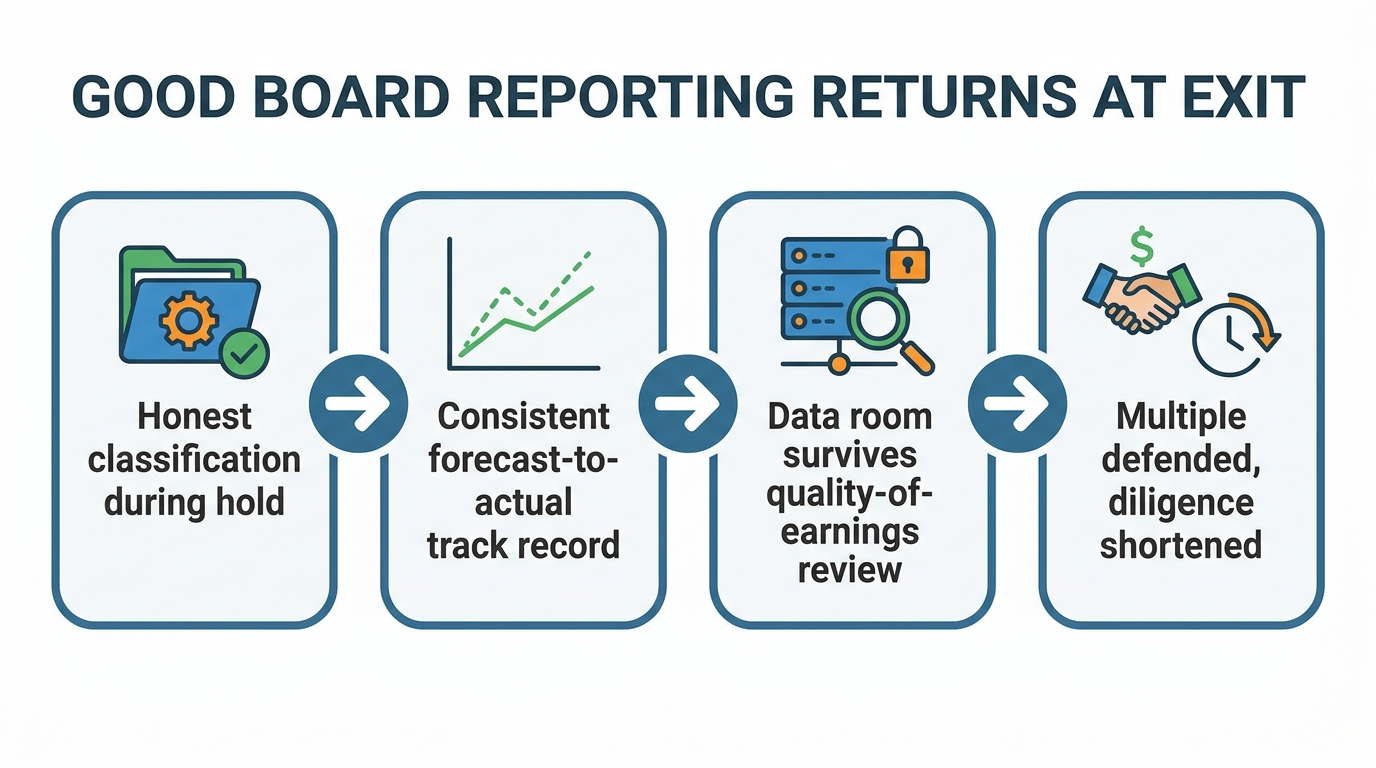
The final argument for taking board reporting seriously is the exit. A business that has reported cleanly, classified its value claims honestly, and tracked forecast-to-actual reliability for years walks into a sale process with something scarce: a data room that survives scrutiny. A management team that can show a buyer a consistent, honest reporting history is telling that buyer the numbers can be trusted, which shortens diligence and defends the multiple.
The reverse is expensive. When a target’s internal reporting was optimistic and inconsistent, a buyer’s quality-of-earnings work finds it, and the price adjusts down. Research houses that track exit dynamics, including PitchBook and the private capital work published by McKinsey, have documented how much longer holding periods and tougher exit conditions have raised the premium on clean, defensible numbers. Reporting quality is not overhead. It is a component of enterprise value, realized at the moment of sale.
The GTM discipline that produces this over a hold matters too. Sponsors who skip it hit predictable value-creation pitfalls, which I catalogued in the piece on PE GTM pitfalls. And for management teams thinking beyond a single hold, the reporting habits that make one exit clean are the same ones that keep an organization durable across cycles.
The judgment that separates a report from a pack
Every element above comes down to one operator instinct: the board pack exists to change a decision, not to document effort. When I audit a portfolio company’s reporting, I am not counting slides. I am asking whether a deal partner could hold, double down, or reset the plan from this document alone, and whether an operating partner could tell what to repeat across the rest of the portfolio.
Most packs fail that test because they were built by people optimizing to look thorough. The ones that pass were built by people who understood the reader’s mandate and wrote to it. That is a skill, and it is trainable, but it starts with abandoning the idea that more reporting is better reporting. It is almost always the opposite.
Build a reporting layer your sponsor can decide from
If your board pack is generating follow-up calls instead of decisions, or if your sponsor cannot tell from the reporting whether the value-creation plan is on track, the reporting layer is the problem, not the business underneath it. We build sponsor reporting layers for portfolio companies that connect every number to enterprise value and give each reader, deal partner, operating partner, CFO, exactly what they need to act.
If you want a direct read on where your current reporting is failing the people who read it, bring the last board pack and start an advisory conversation here. We will find the decisions it should have driven and did not.
