

By Mario Peshev, DevriX
Most tech due diligence reports get read once, get filed, and never influence the price you pay or the plan you run. That is the real failure mode. You spend six figures on a diligence provider, you receive a hundred slides on architecture, tech debt, security posture and team velocity, and none of it tells the deal partner whether the thesis survives contact with the codebase. The scoping was technical. The decision it needed to support was financial.
I have sat on both sides of this. As the founder of DevriX, I have run the engineering diligence that a sponsor commissioned before an add-on, and I have inherited portfolio companies where the pre-close tech review missed the exact liability that later ate two turns of multiple. The pattern is consistent: the best tech due diligence firm for private equity is not the one with the deepest engineering bench. It is the one that translates what it finds into enterprise-value language a deal partner, an operating partner and a CFO can each act on.
This piece is a buyer’s rubric. Ten things I would judge a firm on if I were writing the check, with what good looks like and what to walk away from.
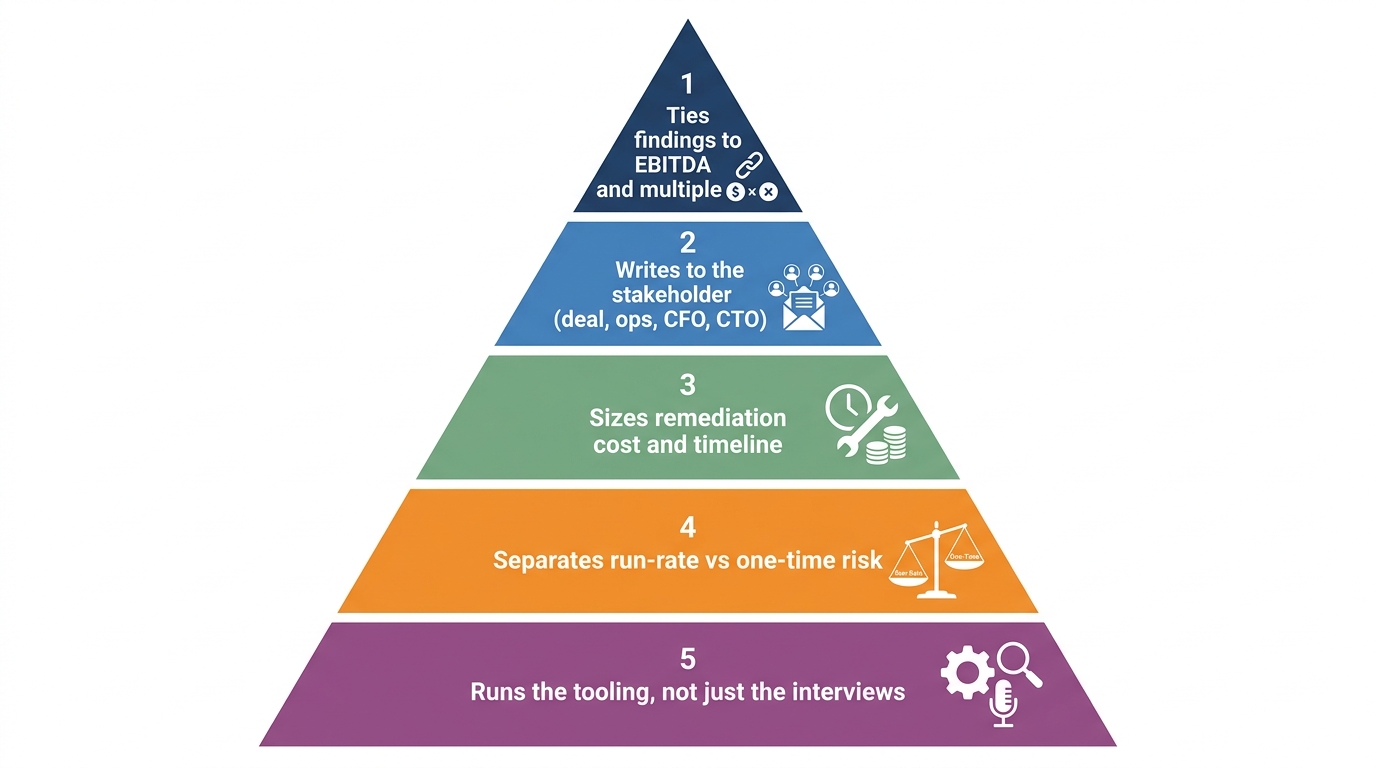
1. It prices the risk in EBITDA, not in severity labels
A weak report classifies findings as high, medium and low. A strong report tells you what each finding costs and when. A “critical” scalability limitation means nothing to a deal partner until someone says: this platform cannot support the volume in your growth case without roughly eighteen months of re-platforming, call it a defined capital cost, and until it lands the company cannot take on the enterprise logos the thesis depends on.
That is the difference between activity and outcome. A vendor register of hours, tickets, features and findings counts is a failure mode precisely because it substitutes volume for consequence. When you evaluate a firm, ask to see a redacted prior report and check whether the executive summary leads with financial consequence or with a heat map. If it leads with the heat map, the analyst never learned to think like an owner.
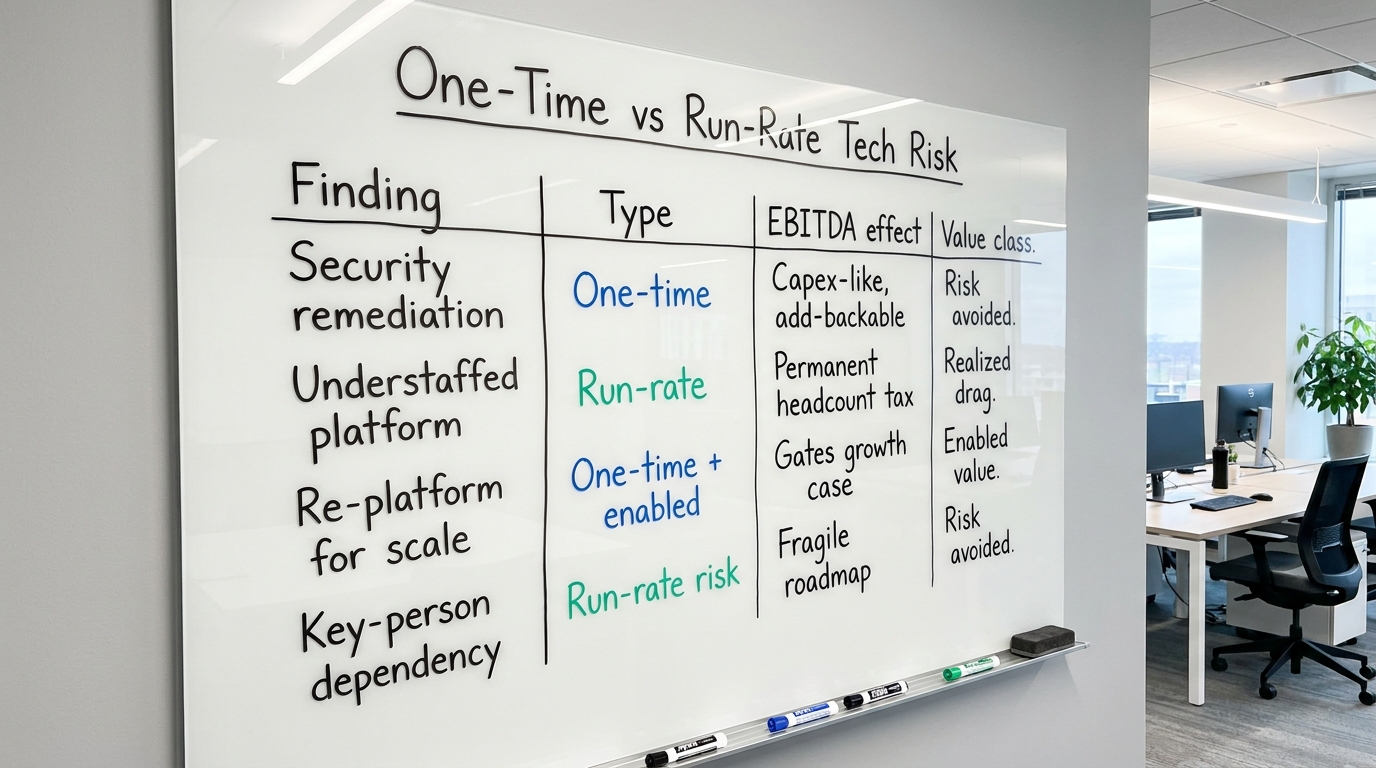
The best providers also classify the type of value at stake. Is this a risk you can price into the offer, a cost you will carry post-close as run-rate drag, or a one-time remediation you can add back? That framing mirrors how a CFO already reasons about the P&L, and it connects directly to the work of adjusted EBITDA and the art of add-backs. A diligence finding that cannot be located on the P&L is a finding you cannot negotiate with.
2. It writes to the actual reader, not to a generic “PE” audience
Every deal has at least four readers, and they want different things. A deal partner wants the thesis stress-tested, the downside sized, and the exit story intact. An operating partner wants to know whether the team can execute the 100-day plan and where adoption will stall. A CFO wants the numbers, the forecast reliability, and anything that touches covenants. A CTO or technical operating partner wants the engineering reality translated into diligence risk and post-close cost.
I have seen firms send a deal partner forty pages describing microservice boundaries and CI pipelines. That partner does not care about pipelines. He cares whether the pipeline problem delays the integration that his return math assumes. The best tech due diligence firm segments its output by reader. There is a two-page memo the deal team acts on, and there is a technical appendix the operating partner and CTO work from. If a firm hands you one undifferentiated document, it has not decided who its client is.
This is the same reason I argue that value creation requires embedded partners, not advisory firms. A firm that only produces a report is one step removed from the P&L. A firm that thinks about who reads it and what they will do next is already reasoning like an operator.
2. It sizes remediation with a cost and a calendar
Finding a problem is table stakes. Any competent engineer can walk a codebase and list what is wrong. The value is in the remediation estimate: what it costs to fix, how long it takes, whether it needs specialist hires you cannot easily source, and what breaks if you defer it.
Ask a candidate firm to walk you through how they estimated remediation on a past deal. If the answer is qualitative, “significant effort,” “meaningful investment,” you have a firm that does not want to be held to a number. The good ones give you a range tied to team size and duration, and they tell you which items are optional, which are gating for the growth case, and which are landmines you inherit regardless.
Bain’s annual Global Private Equity Report has tracked for years how much of a fund’s return now depends on operational improvement rather than multiple expansion or leverage. If value creation is where returns come from, then the diligence that scopes value-creation cost is not a formality. It is the input to the model.
4. It separates one-time cost from run-rate drag
This is subtle and it matters enormously. A platform that needs a one-time security remediation is a different asset than a platform that structurally requires 40% more engineering headcount to ship the same roadmap. The first is a check you write once. The second is a permanent tax on EBITDA that follows you to exit and shows up in the next buyer’s own diligence.
A firm that conflates the two will overstate or understate the impact on your model. The best tech due diligence firm for private equity flags run-rate drag explicitly, because run-rate drag is what compresses your multiple at exit, and it is the exact category a sophisticated secondary buyer will hunt for. If the firm does not think three years ahead to your exit diligence, it is only doing half the job.
5. It knows commercial and technical diligence are joined at the hip
Tech due diligence run in isolation misses the point. The question is never “is this good engineering.” The question is “does this technology support the revenue story the deal is priced on.” A beautifully architected platform serving a shrinking market is worth less than a messy platform inside a business with expanding net revenue retention.
The best firms coordinate with the commercial diligence stream or run it themselves. They know the churn number, the concentration risk, the sales motion. They can tell you whether a technical limitation is actually constraining revenue or whether it is a cosmetic concern the founders obsess over. If you are evaluating firms, I would push hard on this, because I have written before about the commercial due diligence red flags in B2B businesses that a purely technical review sails straight past.
Revenue leakage is often a joint failure of go-to-market and platform, not one or the other. The B2B portfolio revenue leakage diagnostic I use assumes both streams talk to each other. A tech firm that cannot connect its findings to the revenue model is delivering an academic exercise.
6. It stays available after close, or tells you honestly that it will not
Here is the gap that kills value. A firm produces a sharp diagnostic, hands it over, and disappears. Then the operating partner is left to translate the report into a remediation plan, hire against it, and sequence it into the 100-day plan, with no institutional memory of why the findings were prioritized the way they were.
I strongly favor firms with continuity into execution, and I say that as someone whose firm does exactly this work. That is not a universal rule. Some funds deliberately separate the diligence provider from the remediation vendor to avoid the conflict of interest where the assessor inflates problems it then bills to fix. That is a legitimate governance concern and you should weigh it. But the separation only works if the diligence output is detailed enough that a second team can execute against it without re-diagnosing everything.
The distinction I keep returning to is between advice and accountability. I have laid out the full argument in value creation consultants versus operators, advice or P&L accountability. In diligence specifically, the practical test is simple: can this firm’s report be handed to the team that will own the P&L, and will that team be able to act on it in week one? If yes, the firm understood its job.
7. It runs the tooling, not just the interviews
A surprising number of “tech due diligence” engagements are structured interviews with the target’s engineering leadership and a review of documents the target chose to share. That is management’s version of reality. It is useful and it is also self-serving.
The firms worth paying instrument the actual system. They run static analysis on the codebase, examine deployment and incident history, look at the real ticket backlog rather than the curated roadmap, and check whether the security and compliance posture matches what the data room claims. They read the commit history, not the org chart. The delta between what management describes and what the tooling shows is frequently the most valuable finding in the entire engagement.
When you scope a firm, ask what access they require and what they will run against it. If the plan is entirely interviews and document review, you are buying a summary of the seller’s narrative. That is worth something, but do not confuse it with independent verification. McKinsey and BCG both publish extensively on private-capital value creation through their private capital research and principal investors practice, and the through-line is that operational upside is only capturable if you have measured the real starting point, not the represented one.
8. It has seen your deal shape before
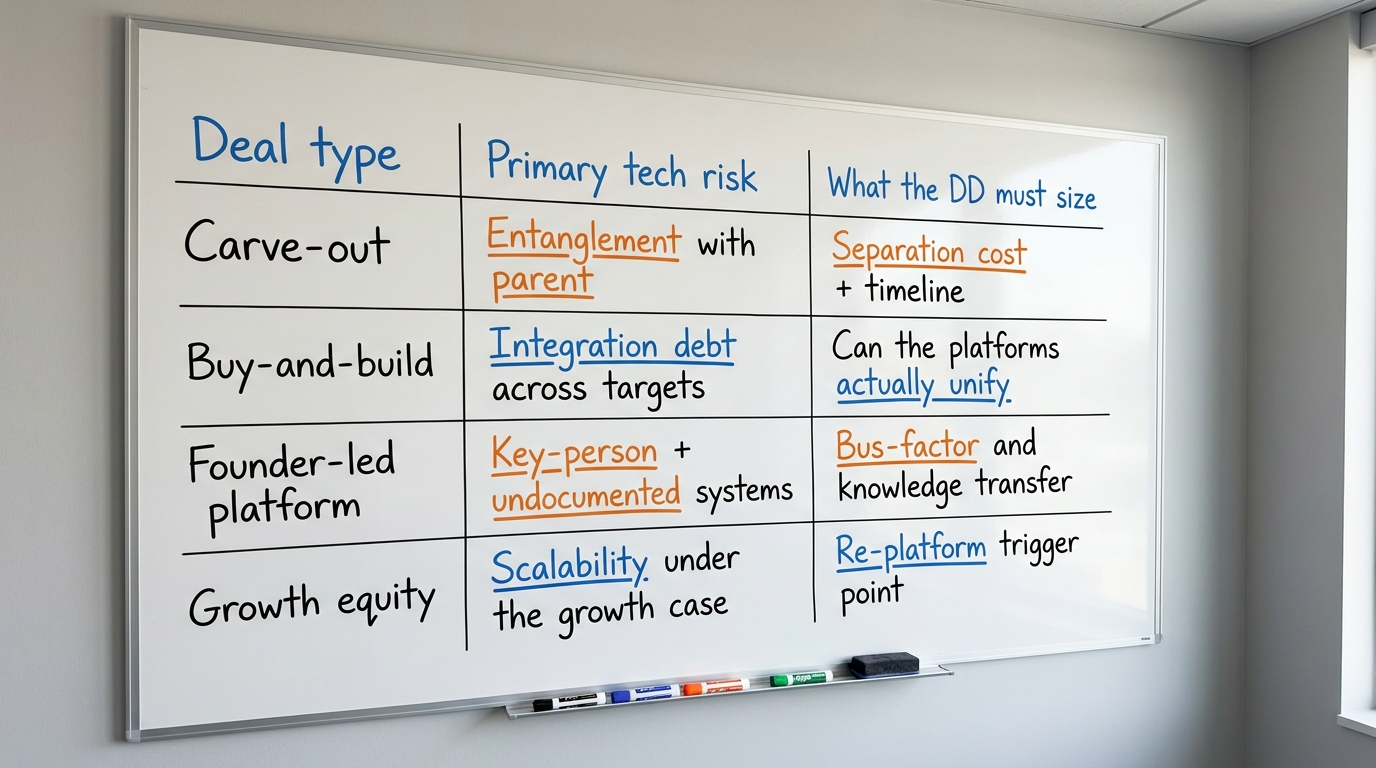
Generalist diligence firms exist, and they can be fine on a straightforward asset. But deal shape matters. A vertical SaaS carve-out from a corporate parent has entirely different technical risk than a bootstrapped founder-led platform, which is different again from a roll-up where you are stitching four codebases and four data models into one.
Carve-outs
The dominant risk is entanglement. Shared infrastructure, shared identity systems, shared data, licenses that do not transfer. A firm that has done carve-outs will map the separation cost and timeline on day one, because that cost is often larger than the whole rest of the tech budget combined.
Buy-and-build
Here the risk is integration debt across the platform. If your thesis depends on cross-selling and shared operations across acquisitions, the diligence has to assess whether these systems can actually be unified or whether you are buying four permanent silos. This is where the 100-day go-to-market plan for a newly acquired B2B business either becomes executable or falls apart, because a GTM plan that assumes integrated data on a platform that cannot integrate is fiction.
PitchBook and S&P Global both track deal volume by strategy and sector through their research and data and market intelligence platforms. The point of citing that is not the number, it is the reality that add-on activity now dominates deal count in many markets, which means integration diligence is no longer a specialty. It is the base case.
9. It flags the governance and compliance exposure that survives to exit
Technical debt is negotiable. Regulatory and data exposure is often not. Undisclosed use of copyleft open-source in a commercial product, personal data handled in ways that violate the terms it was collected under, security gaps that would fail a customer’s own vendor audit, these are liabilities that transfer to you and that your exit buyer will find.
AI has raised the stakes here sharply. A target that trained models on data it did not have rights to, or that has embedded a third-party model with licensing terms nobody read, has planted a liability that may not surface for two years. The SEC and governance commentators at the Harvard Law School Forum on Corporate Governance have both been increasingly active on disclosure and data governance, and a diligence firm that treats these as an afterthought is exposing you to a risk that gets more expensive the longer you hold. I have made the broader case for building this kind of resilience into the operating model in my notes on future-proofing organizations.
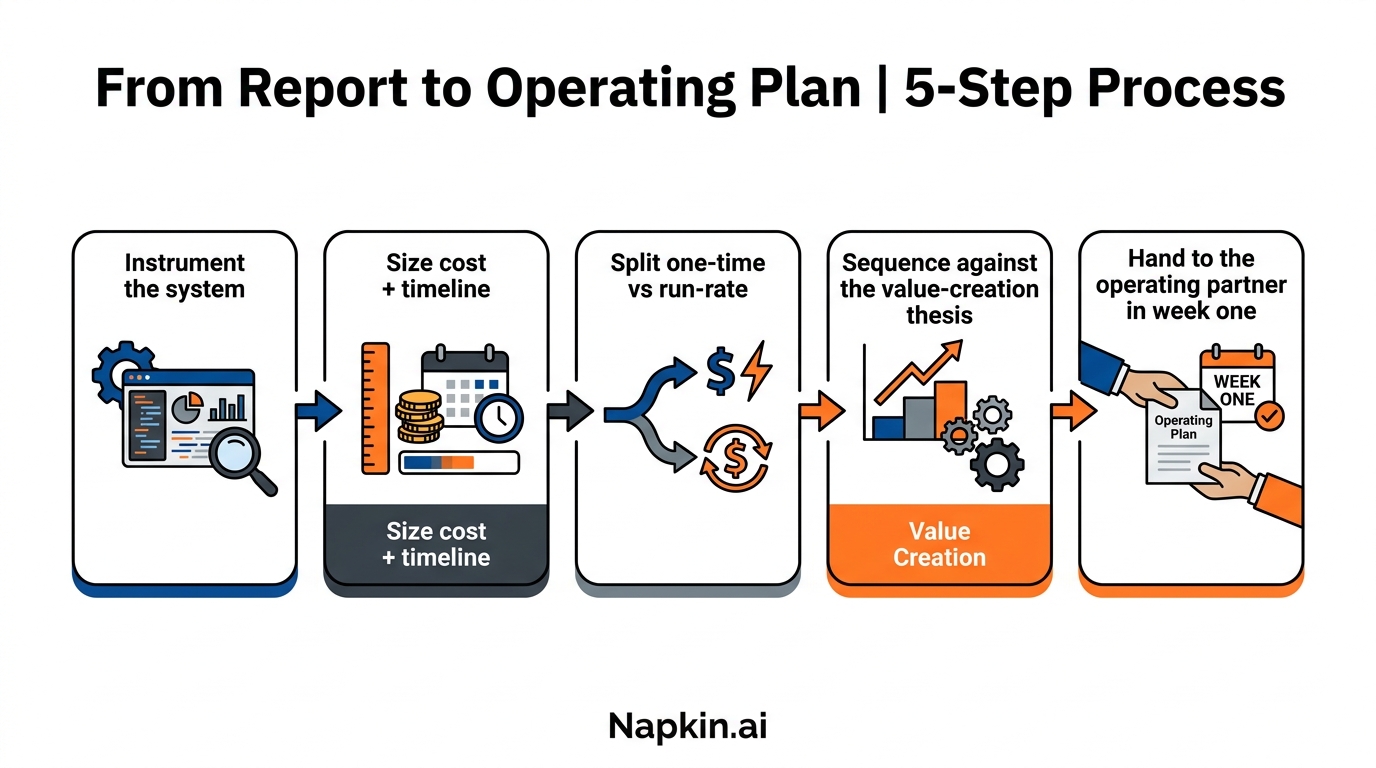
10. It hands the operating partner something to run, not just something to read
The last test is the one that separates a report from a plan. After the deal closes, the operating partner has to sequence the technical remediation against everything else in the value-creation plan, competing for the same capital and the same management attention as the commercial workstreams.
The best tech due diligence firm delivers findings already prioritized against the value-creation thesis, sequenced, and costed, so they slot directly into the operating plan. That means the output should map cleanly onto the portfolio company operating reviews and the commercial KPIs that matter, because a technical fix that does not move a commercial KPI is a technical fix you can probably defer.
This is also where the go-to-market realities show up. A platform limitation that blocks the sales motion is a revenue problem, and it belongs in the same conversation as the work I describe in avoiding private equity GTM value-creation pitfalls and in the role a fractional CRO plays in fixing win rate and CAC. Tech diligence that stops at the codebase leaves the operating partner to draw those lines alone.
What this adds up to for a buyer
If I compress the whole rubric, the best tech due diligence firm for private equity is not the most technically impressive one. It is the one that behaves as if it will personally own the consequences of what it finds. Concretely:
- It leads with financial consequence, not a severity heat map, and locates every material finding on the P&L.
- It writes distinct output for the deal partner, the operating partner and the CFO, because they act on different things.
- It sizes remediation with a real cost and a real calendar, and separates one-time cost from permanent run-rate drag.
- It coordinates with the commercial story rather than assessing engineering in a vacuum.
- It instruments the actual system rather than summarizing management’s narrative.
- It hands you a plan the operating partner can execute in week one, sequenced against the value-creation thesis.
A firm that does all six is rare, and it will not be the cheapest line item in the deal. But the cost of the wrong diligence is not the fee. It is the turn of multiple you did not see coming, the re-platform you priced at zero, and the exit buyer who finds what your provider missed.
Where to take this next
If you are evaluating firms for an active deal or building a repeatable diligence standard across a portfolio, the work is worth doing with someone who has sat in the operating seat after close, not only in the diligence seat before it. That is the perspective I bring, and it is the standard my team holds itself to.
You can start a conversation through my value creation advisory intake, or review how we structure post-close technical and go-to-market execution through the DevriX private equity practice practice. The report you commission before close should be the plan you run after it. Judge every firm by whether it can deliver both.
