

Software engineers often think about starting a web development business of their own.
We may be talking about a traditional senior software developer working on a product after hours. No exposure to marketing, sales, and business development tasks at work. Traditional Computer Science degree. Complete focus on software engineering.
Products Don’t Sell Themselves
They launch a product and probably sell through their own network or social media accounts. A couple of developers join the team, assisting with additional features, maintenance, and deployments.
Have you started your own business as an engineer (or considered founding one)?
The beginning is always tough – you need to find your place in the industry, generate some income, and plan for recurring revenue. When you can plan a few months ahead, you can start growing your team as well, with other experts helping you build more products, double the amount of work you do, or anything that you offer to your customers.
This is why Sales is among the 7 pillar categories of the biggest business problems in the world.
After getting a few people on board, you usually have to start looking for other areas for business development that are not directly related to your work.
Two of the key areas that I will be talking about in this article are the management and sales areas of a web development business, focusing more on how the latter can be explored by a technical head with no sales and business development background.
Starting And Managing A Web Development Company
I gave a relevant talk at WordCamp Europe in 2016 discussing our internal process for managing a remote web team at DevriX:
The video primarily talks about our processes as a web team combined with some strategies on hiring a workforce and handling specific types of activities.
While my presentation is stressing on recruitment and management advice, there are numerous key pieces determining the business development aspect of growing a leading international tech company.
The 11-Step Sales Checklist For Business Development
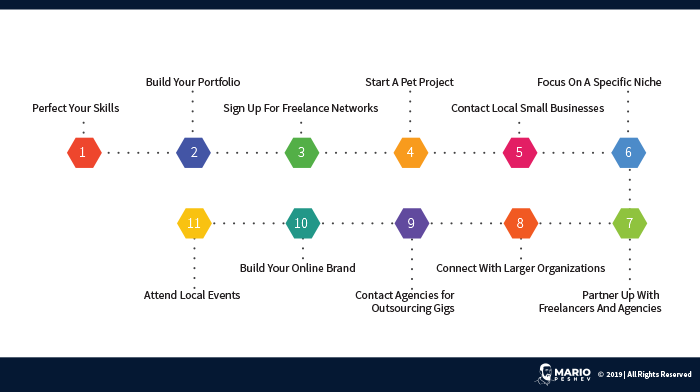
Outside of growing a team, the remaining aspect is building a customer base. When starting (often as a freelancer), you may rely on my 11-step checklist described below, namely:
- Perfect Your Skills
- Build Your Portfolio
- Sign Up for Freelance Networks
- Start a Pet Project
- Contact Local Small Businesses
- Focus on a Specific Niche
- Attend Local Events
- Build Your Online Brand
- Contact Agencies for Outsourcing Gigs
- Connect With Larger Organizations
- Partner Up With Freelancers and Agencies
This is the main workflow I’ve followed as a freelance developer before I founded my business and grew it to a team of 40+. It’s still applicable in terms of scaling a business.
Still, this is primarily a kickstart approach over the first months (up to a couple of years). In terms of scaling a web development business, you have to engage in different activities that overlap with the initial plan and build upon it. I’ve covered the next step in the growth journey in The Definitive Sales Process For a WordPress Development Company:
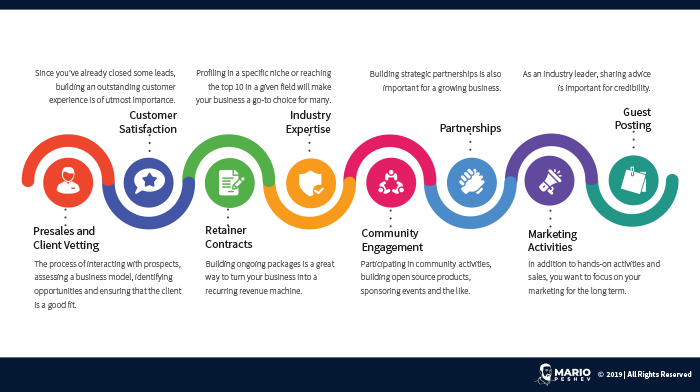
Presales and Client Vetting
The process of interacting with prospects, assessing a business model, identifying opportunities, and ensuring that the client is a good fit. Once you get some traction, working with the right clients is extremely important. One problematic client can easily sink your entire business.
Customer Satisfaction
Since you’ve already closed some leads, building an outstanding customer experience is of utmost importance. Happy clients can convert to a recurring business opportunity, sending testimonials or even referrals to your business.
Retainer Contracts
Building ongoing packages is a great way to turn your business into a recurring revenue machine. Instead of bidding on fixed-fee projects alone, discuss ongoing opportunities, maintenance work, regularly scheduled redesigns, or new integrations with products that stand out. Some of our “one-off” clients have been working with us for 3 years and going thanks to our retainer agreements.
Industry Expertise
Profiling in a specific niche or reaching the top 10 in a given field will make your business a go-to choice for many. Instead of building solutions for a wide range of platforms, pick one or two and become extremely proficient. Understand the underlying layers, take certifications, build some high-scale projects and showcase them as proof of your quality work.
Community Engagement
Participating in community activities, building open source products, sponsoring events, and the like. If you’re doing web development for a living, it’s only natural that you would be naturally inclined to engage with other industry peers.
Connecting with hosting companies, product developers, and core contributors in your field is an important channel for upping your skills and increasing your value as a vendor. Plus, it reveals additional opportunities for large businesses looking for reputable service providers.
Partnerships
Building strategic partnerships is also important for a growing business. If you offer back-end development services, partner up with front-end developers or design companies. Are you a full-stack team? Talk to SEO agencies, creative studios, and advertising companies that often get pitched for web development.
Now, if your portfolio is solid, you have a chance for building new recurring sales funnels and cross-promote your services out there.
Marketing Activities
In addition to hands-on activities and sales, you want to focus on your marketing for the long term. Start a newsletter, build ebooks and whitepapers, build your social media accounts, craft some designated landing pages, and create a freemium software – plenty of opportunities to increase your traffic and convert some of your readers into prospects.
Guest Posting
As an industry leader, sharing advice is important for credibility. Talk to industry blogs and magazines and suggest topics that would be of use to their audience. Not only can you reach a wider audience, but backlinks to your site will increase your visibility in SERP.
The further you specialize and build your professional brand, the more your business will shift to inbound leads instead of cold calls and emails.
This will let you discuss ongoing retainer opportunities which will grow your monthly recurring revenue, letting you hire additional resources, invest in complementary tools for your business, and spend money on ads and partnerships.
Not A Sales Person?
How can you build a successful business as a software developer if you are not a salesperson?
Of course, the tricky question is – how to land repetitive customers?
I have discussed in the video below the different techniques for introducing salesforce to your business, as a technical expert.
Sales and Marketing For Technical Founders
Their lack of marketing and sales experience will definitely be a blocker. Digital marketing covers a wide range of skills – content production, email marketing, affiliate and partnerships, social media, analytics, setting KPIs, tracking, and launching new campaigns – you name it.
Sales work in a similar manner, too. An inbound salesperson should handle the incoming leads via email capture or contact form submissions through landing pages, freebie offers, webinars, and partnership campaigns. An outbound salesman will engage in cold calls and emails, attend industry events, and explore prospects on LinkedIn.
That’s why plenty of startups are formed by multiple co-founders responsible for different portions of the business. A trustworthy expert in business development techniques may be instrumental in a similar role.
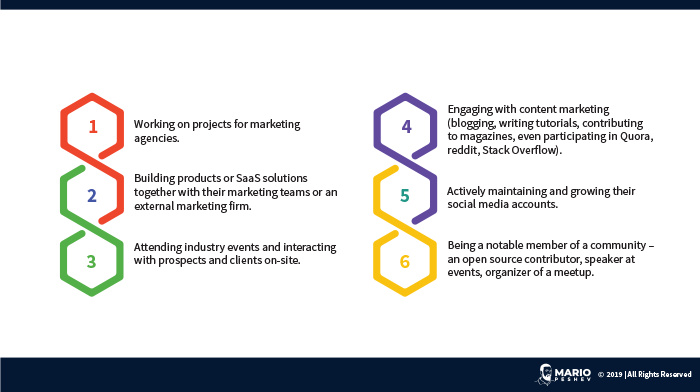
However, technical CEOs may have some exposure to marketing and growth.
- Working on projects for marketing agencies.
- Building products or SaaS solutions together with their marketing teams or an external marketing firm.
- Attending industry events and interacting with prospects and clients on-site.
- Engaging with content marketing (blogging, writing tutorials, contributing to magazines, and even participating in Quora, Reddit, and Stack Overflow).
- Actively maintaining and growing their social media accounts.
- Being a notable member of a community – an open-source contributor, speaker at events, and organizer of a meetup.
Those bits may determine the business plan of the startup and uncover successful strategies that could be explored at the very beginning.
How I Learned Sales And Marketing
I’ve hired marketers and salespeople who didn’t live up to the expectations. They promised a lot but couldn’t deliver. We spent tons of capital with no ROI whatsoever.
Over the past 5–6 years, I had to delve deeper and deeper into sales and marketing. I went through rough times while we were generating a loss. I was already into blogging and social media but didn’t really understand what converted and what didn’t.
We took on a couple of marketing platforms and I had to study marketing extensively. I hired a couple of writers for our blog after writing 40 posts myself (after thorough keyword research, browsing BuzzSumo for successful titles that convert, and looking up our competitors via Moz and SEMrush).
I spoke to marketing consultants on Clarity and business developers in my network. The same goes for successful businesses and agency owners willing to share some tips.
We finally had the data we needed in order to understand what’s worth investing in further. I worked on a detailed document explaining our marketing initiatives and ideas for expansion.
The list goes on, but our “trial-and-error” led to a better-structured model.
The Guide to Scaling a Sales Team
Close.io also suggest a similar model when hiring a salesperson.

The CEO should be the best salesperson. There’s hardly any way around it.
Once you have the background in place, you can hire someone who can follow the successful steps and expand further. It’s an easy way to evaluate the process and see if they add any value.
Otherwise, partnering up with a consultant, hiring a co-founder, or blindly relying on someone who is trustworthy seems to be the only option.
Are you ready to work with a business advisor?