

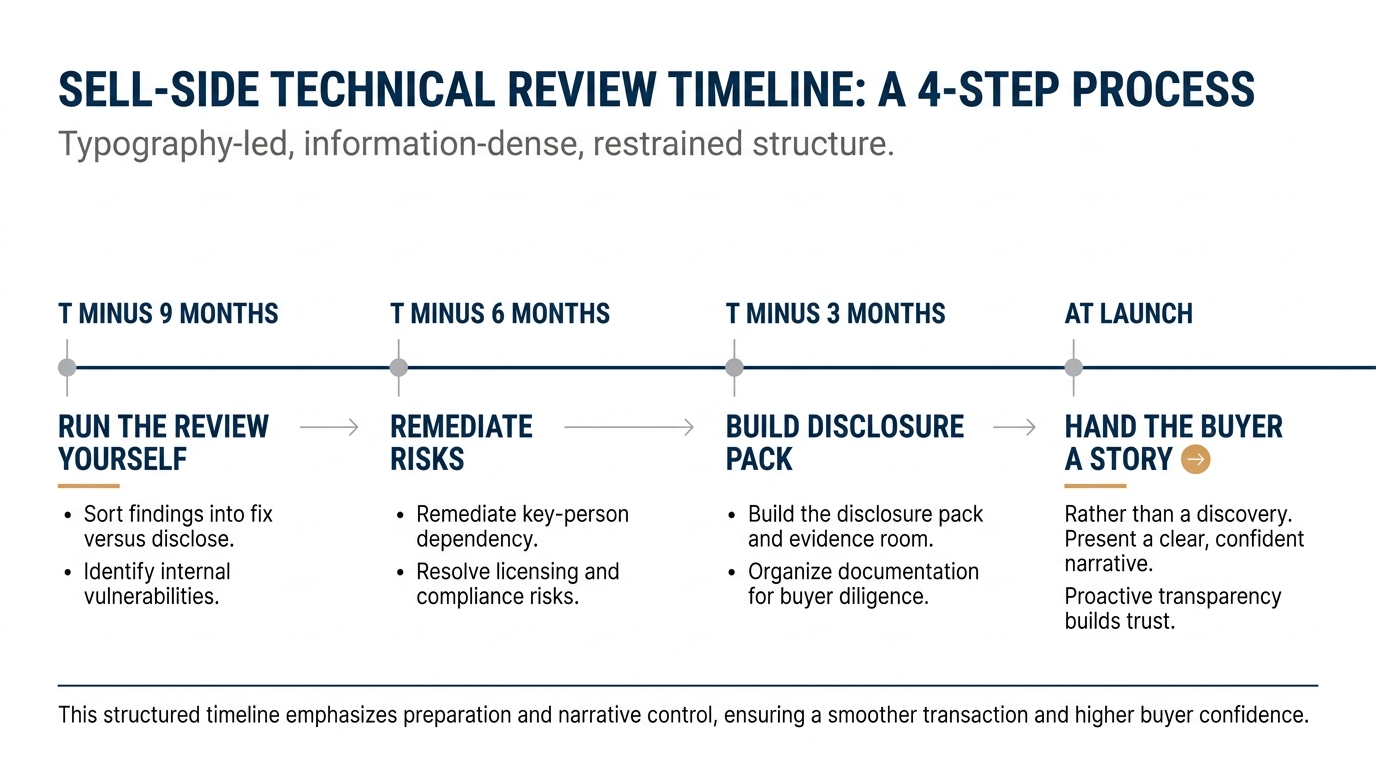
By the time a buyer’s diligence team opens your codebase, the price range is mostly set. If you are the deal partner or operating partner running an exit, sell-side technical due diligence is the work that decides whether the buyer’s findings confirm your thesis or reset it downward. The reset is not theoretical. A finding that arrives during confirmatory diligence, a single-person dependency on the payments module, a licensing gap in a core library, an architecture that cannot absorb the next add-on, becomes a retrade lever, an escrow request, or a reason to walk. Doing that same work yourself, six to nine months before you launch the process, converts those findings into fixes and gives you the story instead of the buyer.
By Mario Peshev, DevriX
This is written for the person underwriting the exit. The piece assumes you already know what a technical review contains; what you need to decide from it and how you judge whether the work was any good are the questions that matter when you are the seller commissioning it.
Why the seller runs the review first
The buyer’s technical review exists to find reasons to pay less. Yours exists to remove those reasons before the buyer can use them. That asymmetry is the whole argument for running it early.
Bain’s annual private equity report has tracked how holding periods have stretched and how much of the return now has to come from operating improvement rather than multiple expansion. When a larger share of the return depends on what happened inside the company, the buyer’s diligence gets more forensic, not less. You can read Bain’s framing on the state of the asset class in its Global Private Equity Report, and McKinsey’s private capital research makes a similar point about value creation carrying more of the load.
The practical consequence is that a technology finding at the wrong moment moves the number. I have watched a clean-looking asset lose two turns of leverage in confirmatory diligence because the buyer’s engineers found that a founding contractor still held the keys to the deployment pipeline and no one else could ship. That was fixable in a quarter. It was not fixable in the two weeks between finding and signing.
What the review has to answer for you, the seller
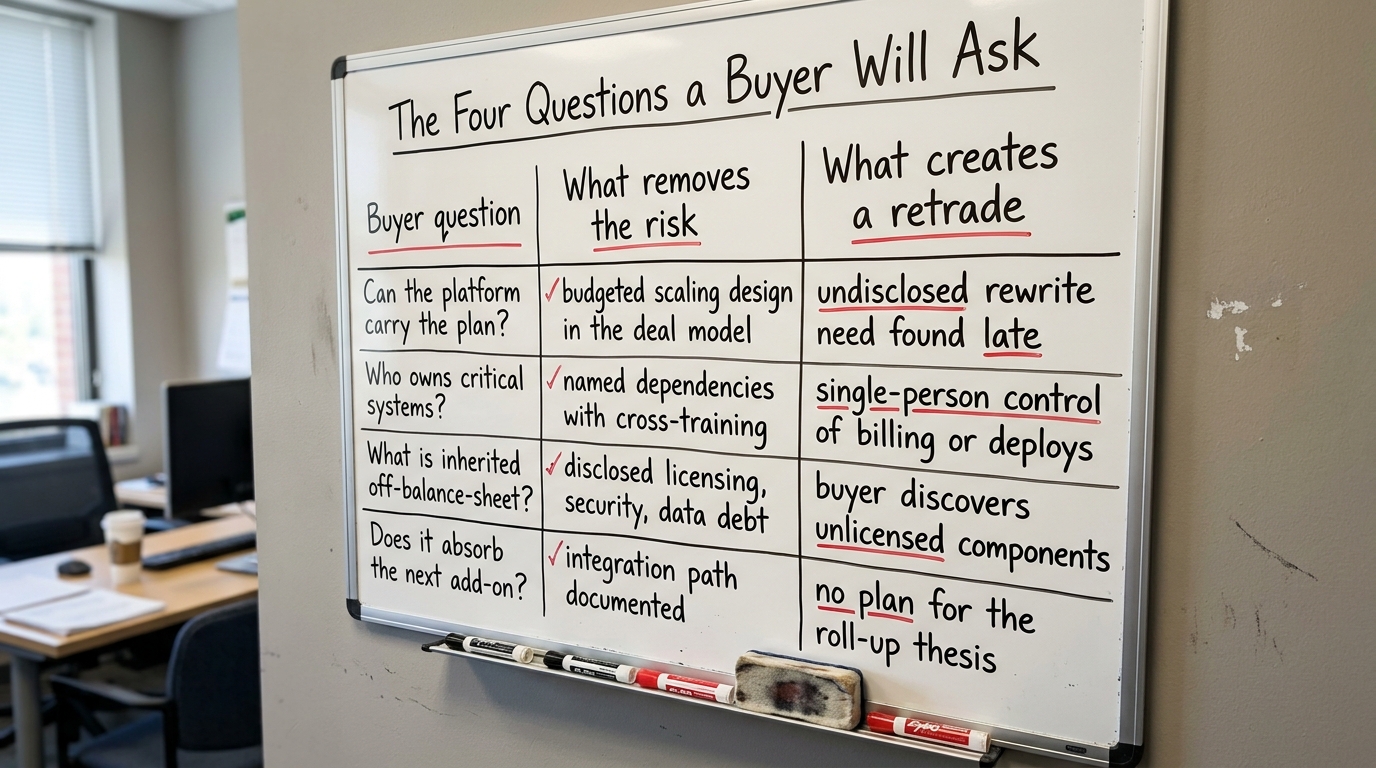
A sell-side technology due diligence exercise is not a list of tickets or a code-quality score. It has to answer the questions a sophisticated buyer will ask, in the order they will ask them, so you can either fix the answer or write the honest disclosure yourself.
Can the platform carry the growth in the model?
If your investment memo assumes revenue doubles over the hold, the buyer will ask whether the architecture supports that without a rewrite. You need a specific statement: at what point does the current design need real investment, how much, and does that spend already sit in the plan the buyer is underwriting. A seller who can say “we hit a scaling wall at roughly 3x current volume, the fix is budgeted at X, and here is the design” has removed a retrade lever. A seller who lets the buyer discover the wall has handed one over.
Who actually owns the critical systems?
Key-person risk is the finding I see most often and the one sellers most often miss about themselves. If one engineer holds the only working knowledge of billing, or a single offshore contractor controls the release process, that is a concentration the buyer will price. Name every such dependency before the buyer does, and show what you have done to spread the knowledge.
What does the buyer inherit that is not on the balance sheet?
Unlicensed components, expired certificates, security debt, data handling that would not survive a customer audit, none of these appear in the QoE, and all of them show up in the buyer’s technical review. This is exactly the ground covered in my earlier piece on what tech due diligence actually has to answer before you sign, written from the buy side. Run that same lens on yourself first.
Judging the work, when you are the one paying for it
Most sell-side technical reviews are graded on the wrong axis. A thick report full of code-smell findings and severity heat maps looks rigorous and tells you almost nothing about the deal. The test is whether every material finding is expressed as money and time: what it would cost the buyer, when it would bite, and what it would take to fix.
I have argued elsewhere that the best technical diligence firm is the one that prices deal risk in EBITDA, and the same standard applies when you are the seller commissioning the review. If a finding cannot be tied to a revenue risk, a margin risk, or a capital requirement, it is engineering trivia and it does not belong in the report you hand a buyer.
The three tests I apply
- Quantified, not qualitative. “Technical debt is high” is useless. “Roughly 40 engineer-days to remove the deployment single point of failure” is a decision input.
- Tied to the thesis. If the deal is a buy-and-build, the review must speak directly to whether the platform can absorb acquisitions. A generic assessment that ignores the roll-up strategy has missed the point of the transaction.
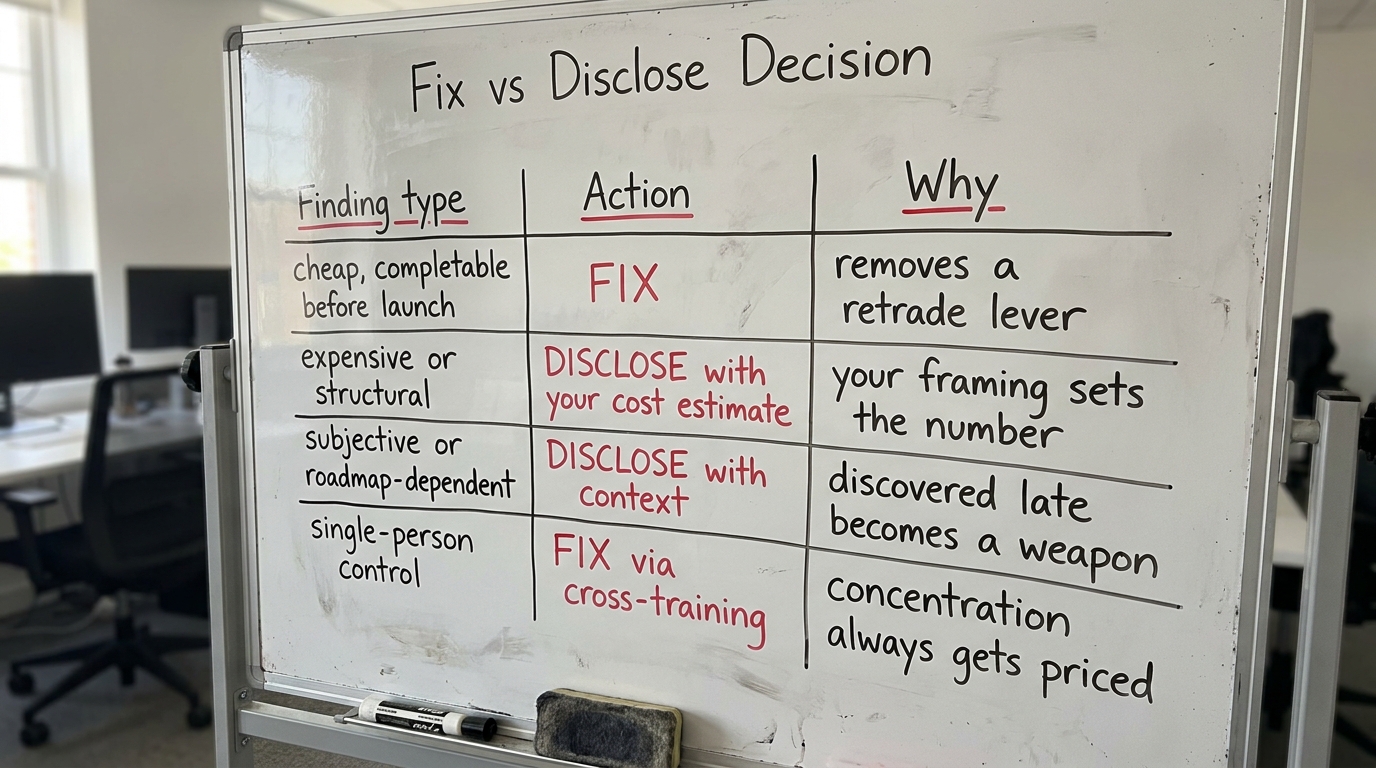
- Fixable versus disclosable. Every finding falls into one of two buckets: things you can fix before launch, and things you disclose and price. A good provider sorts them for you. A weak one just lists them.
The discipline here mirrors what I laid out on how to judge a value creation partner before you sign. You are hiring judgment about materiality, not a scanner.
The findings that actually move the price
Not every issue matters equally. In my experience the ones that reliably reset a number cluster in a few areas, and the seller who addresses these ahead of time protects the most value.
Concentration you cannot see from the org chart
Revenue concentration shows up in the financials. Technical concentration does not. A single vendor hosting your entire stack with no exit path, a database only one person understands, a customer integration that would take a year to rebuild, these are the ones buyers find and sellers rationalize. Preqin and PitchBook both track how diligence scrutiny has intensified as capital has gotten more selective; you can see the deal-environment data at Preqin and PitchBook. Selective capital means fewer benefit-of-the-doubt calls.
The gap between what sales sells and what engineering built
When the product roadmap the sales team is selling against does not match what the platform can actually deliver, the buyer’s model inherits the gap. This is why sell-side technical review and revenue diligence cannot run in separate rooms. I covered the adjacent problem in what a deal partner actually buys when they buy revenue operations consulting, and the same seam matters here.
Data you cannot stand behind
If the buyer asks for cohort retention or usage-based metrics and your systems cannot produce them cleanly, that alone can cost you credibility on every other claim. A seller who cannot substantiate the metrics in the CIM invites discount on the whole story. My note on what a deal partner actually needs from portfolio analytics applies directly: if you cannot report it, the buyer will not underwrite it.
How this connects to the integration the buyer is already planning
A sophisticated buyer is not evaluating your platform in isolation. They are evaluating it against the integration or roll-up they intend to run after close. That means your sell-side review should anticipate the buyer’s integration questions, because those questions are where the price gets made.
If the buyer plans to fold your company into a platform asset, they will ask what it costs to migrate your customers, consolidate systems, and retire duplicate tooling. I have written about this from the buyer’s chair in what a deal partner actually buys when they buy post-merger integration and in what a deal partner actually decides in M&A integration planning. A seller who can answer the integration cost question credibly narrows the buyer’s uncertainty, and uncertainty is what buyers discount.
This is especially true where the buyer’s thesis rests on consolidating overlapping systems. The CRM consolidation problem after an add-on is a common one, and a seller who has already documented their data model and integration surface removes a large unknown from the buyer’s post-close plan.
Where AI readiness fits, and where it is noise
AI has become a diligence line item, and most of what gets said about it is noise. What a buyer actually wants to know is narrow: does the company have data assets that create defensible advantage, and is the platform in a state where AI features could be built without a rebuild. I scored this in detail in what AI readiness actually tells you in a deal, and the sell-side version is the same test run early.
Do not oversell AI capability you do not have, because a buyer’s technical team will find the gap in an afternoon and it will cost you trust on every other claim. Document what is real, name the data you own, and leave the roadmap language out of the technical pack.
The disclosure decision is the whole game
Once you have the findings, the real work is deciding what to fix and what to disclose. This is the seller’s central call, and it is a commercial call, not a technical one.
Fix the things that are cheap relative to the value they protect and that you can complete before launch: the deployment single point of failure, the expired certificates, the unlicensed library with a licensed alternative. Disclose the things that are expensive, structural, or genuinely subjective, and disclose them with your own framing and your own cost estimate attached. A finding you disclose with context is a fact. The same finding surfaced by the buyer’s team is a weapon.
The Harvard Law School Forum on Corporate Governance has published extensively on how disclosure quality shapes deal outcomes and reps-and-warranties exposure; the forum’s archive is a useful reference for how the legal side thinks about this. The operating point is simpler. Controlled disclosure keeps the price you set. Discovered problems reset it.
What good looks like when you commission it
When you hire a provider to run sell-side technical due diligence, judge the proposal by whether it commits to three things: findings quantified in money and time, findings sorted into fixable versus disclosable, and a remediation plan you can execute before launch. A provider that promises a report and a severity matrix is selling you the buy-side deliverable, which is the wrong document for a seller.
I have set out the broader version of this test in how to judge M&A consulting firms when you are underwriting the deal. The short version for the sell side: you are paying for a provider who thinks like the buyer’s diligence team and works for you. That combination is what converts a technical review into a valuation defense.
The same discipline carries into the first 100 days after a buyer closes, which is worth remembering, because the buyer who trusts your disclosure pack is the buyer who moves faster after signing and pays for the confidence.
The operator takeaway
Sell-side technical due diligence is a valuation exercise wearing an engineering costume. Run it early enough that findings become fixes, judge it by whether every finding carries a number and a timeline, and treat the disclosure decision as the commercial call it actually is. The seller who hands a buyer a documented, quantified, honestly framed technical picture is negotiating from evidence. The seller who lets the buyer’s team assemble that picture is negotiating from whatever the buyer chooses to find.
S&P Global Market Intelligence and the broader deal-data providers all point the same way: as diligence gets deeper, the value goes to sellers who did the work first. You can see S&P’s deal coverage at S&P Global Market Intelligence. The advantage is not in having a clean asset. It is in knowing exactly where the asset is not clean and controlling how that gets told.
Where to take this next
If you are six to nine months from launching an exit and want the technical picture assembled before a buyer assembles it for you, DevriX runs sell-side technical review and exit readiness work built to price findings in EBITDA and sort them into fix-before-launch versus disclose-with-context. See how we structure that work within our private equity practice and start the exit readiness conversation there.
