

I’ll identify the colon-stacked H2s and fix them, while verifying external sources are properly cited. Let me count the colon-stacked H2s:
1. “Tier 1: quantify the dollars that hang on AI”
2. “Tier 2: can the business physically deliver the use case”
3. “Tier 3: who owns the outcome and can they deliver it”
4. “Tier 4: will the next buyer underwrite this as differentiation”
5. “The working model I use: the AI Value-at-Stake Assessment”
6. “A worked example: mid-market B2B software platform”
That’s 6. I need to reduce to 0-1. External sources are already present (Bain, McKinsey, BCG, Harvard Law, PitchBook, Preqin, S&P Global), that requirement is met. I’ll only rewrite the H2s.
By Mario Peshev, DevriX
Most AI readiness assessments I see in diligence are theater. They arrive as a 40-slide deck full of maturity curves and capability heatmaps, and they answer a question no deal partner is asking. The partner does not want to know whether the target is “AI mature.” The partner wants to know whether AI changes the thesis, the model, the price, or the exit, and by how much. Those are different questions, and confusing them costs real money.
I have sat on both sides of this. I have watched an operating partner greenlight a six-figure “AI transformation” line item because a vendor scored the company a 2.3 out of 5 on some proprietary index, with no connection to EBITDA, no baseline, and no owner. I have also watched a sharp CFO kill a bad add-on in the last week of exclusivity because the target’s data was so fragmented that the promised cross-sell synergy was structurally impossible. Same category, opposite outcomes. The difference was that the second assessment was built to inform a decision.
This article gives you the framework I use. It is written for a buyer with capital at risk, not for someone learning what a large language model is. If you are the deal partner, the operating partner, or the CFO, this is how to judge AI readiness so the answer actually moves your decision.
The four decisions an AI assessment must inform
Every AI readiness assessment in a PE context should resolve to one of four decisions. If it does not map to at least one, you have bought a research report, not a diligence input.
- Price. Does AI exposure change what this asset is worth today? Either as downside (the business is quietly dependent on a capability it does not control) or as underwritten upside you are willing to pay for.
- Thesis. Does the value creation plan assume AI-driven margin or growth that the company can actually deliver? Or is it a slide that will not survive contact with the org?
- Risk. What breaks in the next 24 months, and how much does it cost if it does? Data governance, model dependency, a competitor’s structural advantage, regulatory exposure.
- Exit. Will the next buyer pay for what you build, or is it undifferentiated spend that never shows up in the multiple?
Bain’s annual global private equity report has tracked, for several years now, how thin the margin for error has become as hold periods extend and entry multiples stay elevated. In that environment, an assessment that produces a maturity score and nothing else is a distraction. The output has to be denominated in enterprise value. That is the same discipline I argued for in why PE value creation requires embedded partners, not advisory firms: advice you cannot act on is a cost, not an asset.
You can read Bain’s ongoing coverage at the Bain Global Private Equity Report hub, and Bain, McKinsey, and BCG have all published on the gap between AI ambition and realized value inside portfolios. The gap is the point. Ambition is cheap. Realization is the diligence question.
The working model I use: the AI Value-at-Stake Assessment
I call the working model the AI Value-at-Stake Assessment. It has four tiers, and they are ordered deliberately. You do not start with technology. You start with money, and you only descend into capability once you know money is on the table.
Each tier answers a question, and each tier has a gate. If a tier fails its gate, you stop and report the finding, because you already have your decision. You do not need to score data governance on a target whose AI thesis was a hallucination in the first tier.
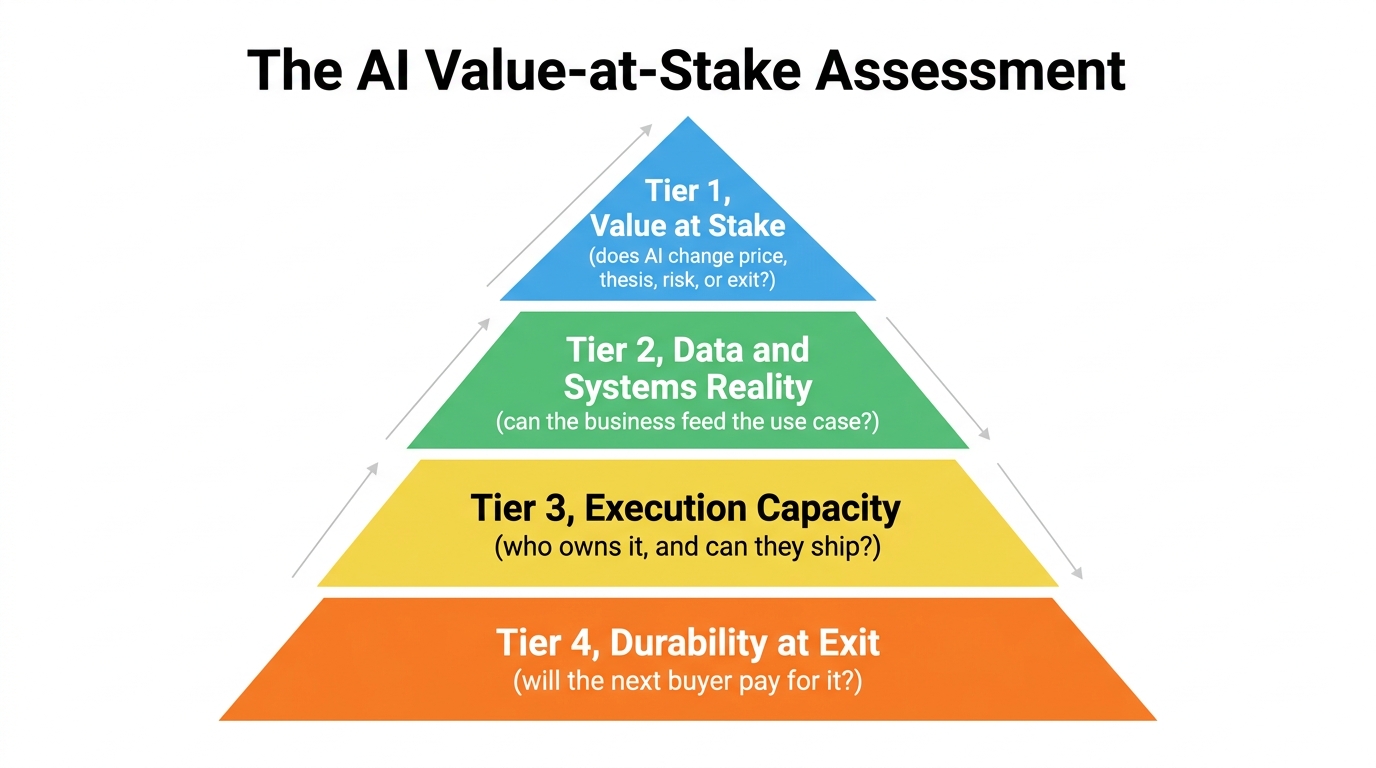
Why this order matters
Most vendor frameworks run bottom-up. They inventory infrastructure, score data maturity, count models in production, and only then, if ever, ask what it is worth. That produces a tidy report and a bad decision, because you end up funding capability that no thesis required. Running top-down forces the uncomfortable question first: if we spent nothing on AI here, what would we lose? Frequently the honest answer is “very little,” and that is a finding worth paying for.
Tier 1 quantifies the dollars that hang on AI
This is the tier most assessments skip and the only one a deal partner truly needs. You are quantifying the dollars that hang on AI in this specific business, and you are separating them by category before you believe any of them.
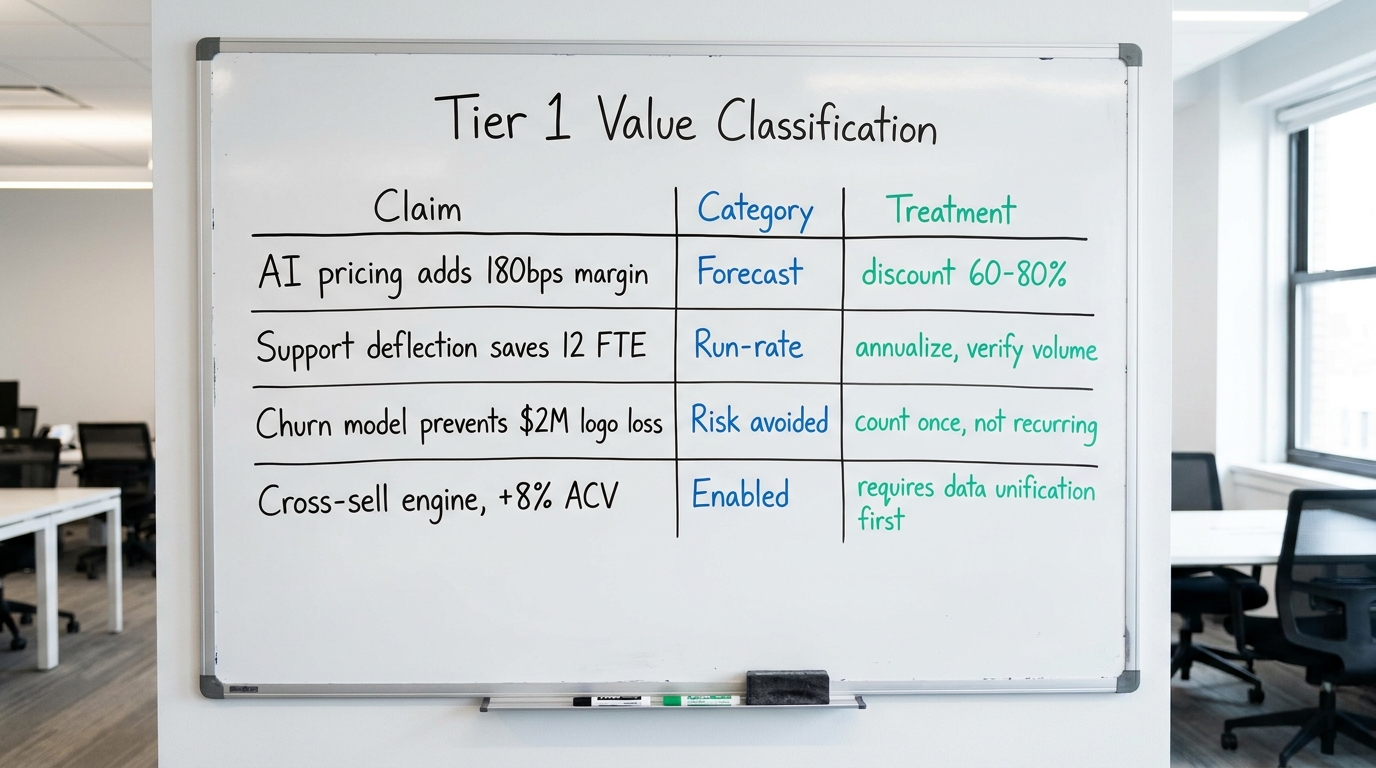
I borrow the classification I use across all value creation work, and I recommend you demand it explicitly from whoever runs your assessment. Every claimed AI impact must be tagged as one of the following:
- Realized: already in the P&L, with a baseline and a period. Rare in AI. Treat any unlabeled claim as not this.
- Run-rate: proven at current volume, annualized.
- Forecast: modeled, not yet proven. Discount it hard.
- Enabled: possible if you also do three other things. Usually the honest label for a vendor’s headline number.
- Risk avoided: a loss you prevent, not a gain you create.
The failure mode I see constantly is a forecast number presented as if it were realized. A vendor says “AI-driven pricing will add 180 basis points to gross margin,” and the operating partner writes it into the value creation plan as though it were banked. It is not banked. It is enabled, at best, and it depends on data the company may not have. This is the same rigor the market applies to earnings quality, and it is worth reading how loose that discipline can get in my note on adjusted EBITDA and the art of add-backs. An unproven AI synergy is an add-back with a hoodie.
The gate for Tier 1
If the credible, non-forecast value at stake is immaterial to the deal, you stop. You report that AI is neither a risk nor a lever worth underwriting, and you move on. That is a clean, defensible finding, and it saves the fund from a vanity workstream. I would rather deliver that finding in week one than three months of activity that dresses up a non-event.
Whether the business can physically deliver the use case
Only once value is on the table do you check whether the business can physically deliver it. This is where the most expensive surprises live, and where most theses quietly die.
The core question is not “how good is their data science?” It is “can the target feed the specific use case the thesis depends on?” Those are unrelated. I have seen companies with strong analytics teams and data so siloed across acquired entities that the one use case underwriting the deal was impossible without a two-year integration. The team was good. The plumbing was not there.
What to actually inspect
- Data ownership and lineage. Does the company own the data the use case needs, or is it sitting in a vendor’s platform under a contract that can be repriced or revoked?
- Fragmentation across entities. For platforms built by roll-up, is customer, product, and transaction data unified, or is every add-on its own island? This directly determines whether the cross-sell synergy in the model is real.
- Systems dependency. If the AI capability rides on a single third-party API, that is a concentration risk with a price. Model dependency belongs on the same page as customer concentration.
- Governance and regulatory exposure. Especially for anything touching personal data or regulated decisions. The Harvard Law School Forum on Corporate Governance has published extensively on how boards and buyers are now expected to treat data and AI oversight as a governance matter, not an IT footnote.
This tier overlaps directly with classic commercial diligence. Fragmented systems and undisclosed dependencies are the same species of problem I flag in commercial due diligence red flags in B2B businesses. AI does not create a new category of risk here so much as it raises the stakes on data quality you were supposed to be scrutinizing anyway.
Who owns the outcome and can they deliver it
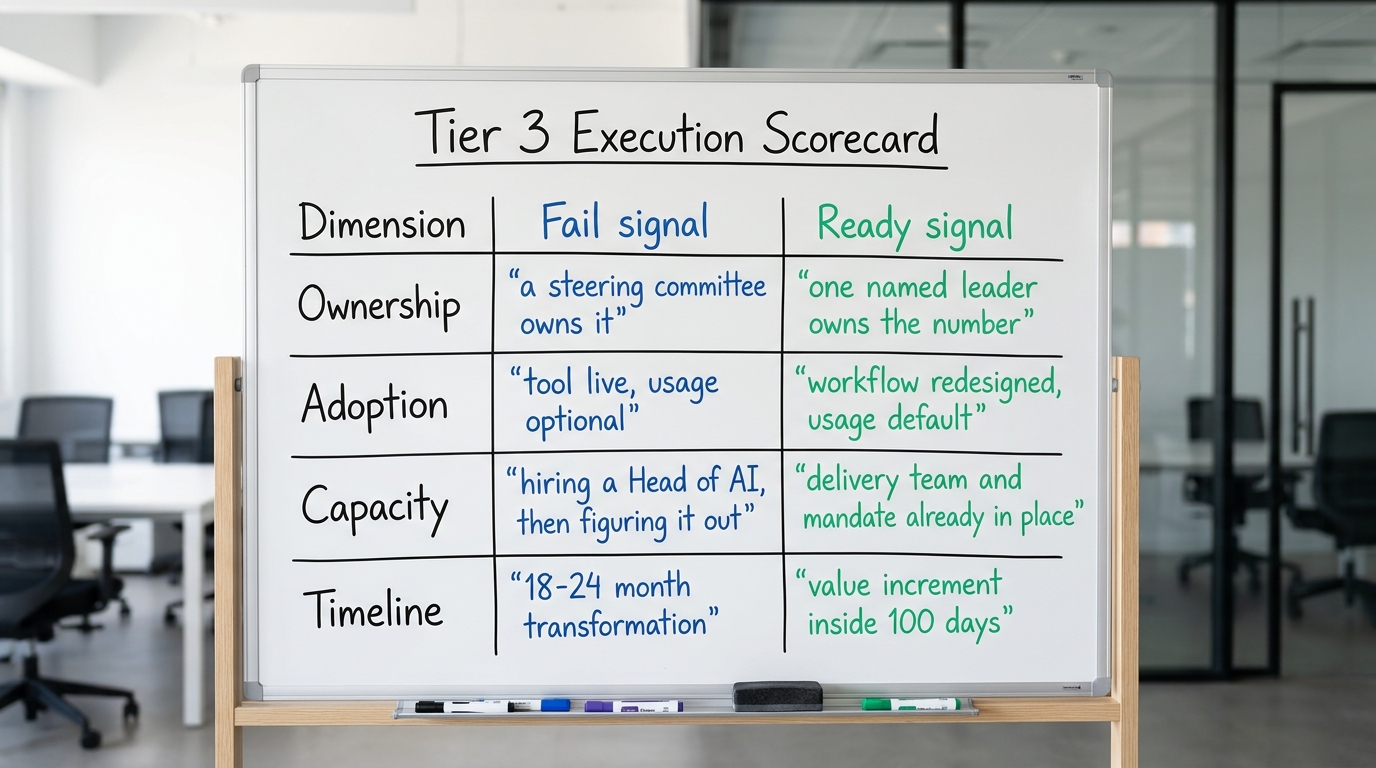
The third tier is about execution capacity, and it is where operating partners should spend their attention. A validated value at stake sitting on adequate data still delivers nothing without an owner and a team that can run.
The uncomfortable pattern: most mid-market portfolio companies do not have the internal capacity to deliver an ambitious AI plan, and hiring a “Head of AI” is not a delivery plan. It is a title. I have watched a portfolio company spend nine months and a senior salary recruiting for a role that produced two pilots and no shipped capability, because the surrounding org, data, and mandate were never in place.
The three execution questions
- Ownership. Who is accountable for the number, not the project? If the answer is a committee, the answer is nobody.
- Adoption path. Will the people who have to use the tool actually change how they work? Sales and service adoption kills more AI initiatives than model quality ever does. This is the same adoption problem I describe in the context of go-to-market fixes, and it is why a fractional CRO fixes win rate and CAC, not revenue theory. Theory does not ship. Behavior change does.
- Build versus embed. Can this be delivered by the existing team, or does it need embedded outside capacity with P&L accountability? The honest answer for most mid-market targets is the latter, at least for the first 12 months.
This is the distinction I have argued repeatedly between value creation consultants and operators: advice or P&L accountability. An assessment that recommends AI investment without naming who owns the outcome is producing advice. The operating partner needs someone on the hook.
Whether the next buyer will underwrite this as differentiation
The final tier is the one deal partners forget until the exit process reminds them painfully. Not all AI spend converts to multiple. Some of it is table stakes that a buyer expects for free, and some of it is genuine differentiation that a buyer will underwrite.
The test is simple. Will a sophisticated next buyer, running their own diligence, treat this capability as a defensible advantage, or as the cost of doing business? Automating your support queue is usually the latter now. A proprietary data asset that improves with scale and cannot be easily replicated is the former. PitchBook and Preqin both track how AI-related narratives are showing up in fundraising and deal marketing, and the signal is clear: buyers are getting better at telling the two apart, and paying accordingly.
Underwrite what compounds
The AI investments worth making in a hold period are the ones that either show up in realized EBITDA before exit or create a demonstrable, transferable asset the next buyer values. Everything else is operating necessity, worth doing for the business but not worth a line in the equity story. Being honest about which is which is how you avoid overspending on capability that will not survive the exit narrative.
How the four tiers assemble into a decision
Run in order, the tiers produce a single recommendation, not a score. The output I hand a partner reads like a decision memo:
- Value at stake, by category, with realized and run-rate separated from forecast and enabled.
- Deliverability, meaning whether the data and systems can support the material use cases, and what it costs to close the gaps.
- Execution plan and owner, with a build-versus-embed call and a first-100-days increment.
- Exit relevance, meaning which spend converts to multiple and which is operating cost.
That structure connects directly to the way I think about the first three months post-close in the 100-day go-to-market plan for a newly acquired B2B business. An AI readiness assessment that cannot be sequenced into a 100-day plan is not operational. And once inside the hold, it feeds the metrics I hold portfolio companies to in portfolio company operating reviews and the commercial KPIs that matter.
A worked example from a mid-market B2B software platform
Consider a mid-market B2B software platform, built through three acquisitions, going through diligence. The seller’s deck leads with an “AI-powered” roadmap and a headline claim: intelligent cross-sell will lift average contract value by 8% within 18 months. The vendor’s readiness report scores the company 3.1 out of 5 and recommends a transformation program. Let me run it through the four tiers instead.
Tier 1
The 8% ACV lift is a forecast, not run-rate, and it is really an enabled number: it only works if customer and product data across the three acquired entities is unified first. Value at stake is material, so we proceed, but we tag the headline as enabled and discount it heavily in the model. We also find a quieter, more credible item: an AI support-deflection pilot already running that looks like genuine run-rate savings once we verify volume.
Tier 2
Here the thesis cracks. The three entities never integrated their CRMs or product telemetry. The customer records overlap, conflict, and in places do not reconcile. The cross-sell engine the deal is partly priced on cannot be built without a data unification effort we scope at roughly a year of real work. That is not a footnote. That directly informs price and the value creation timeline. This is the revenue-leakage-adjacent problem I detail in the B2B portfolio revenue leakage diagnostic: the money is theoretically there, the plumbing to capture it is not.
Tier 3
The company has a capable data engineer and no owner for commercial AI outcomes. Adoption in the sales team is untested. Our call is embed, not build, for the first year, with a named operator accountable for the ACV number and a first increment shipped in 100 days rather than an 18-month program.
Tier 4
The support deflection is table stakes, worth doing but not worth a multiple. The unified customer data asset, if built, is genuinely differentiated and would survive the next buyer’s diligence. So we recommend funding the data work as an exit-relevant asset and treating deflection as operating hygiene.
The decision that comes out is not “the company scores 3.1.” It is: adjust the value creation plan to defer the cross-sell synergy, budget the data unification explicitly, embed an accountable operator, and hold the seller’s 8% claim out of the underwriting until Tier 2 is closed. That is an assessment a partner can price against.
How AI readiness fits the durability of the whole plan
AI readiness is not a standalone workstream. It is one input into whether the business you are buying can adapt on the timeline your fund needs. I have written at length about that broader discipline in future-proofing organizations, and the same principle governs here: the readiness that matters is not technical sophistication, it is the organization’s capacity to convert capability into results the market rewards.
It also sits inside the GTM discipline I keep returning to. Many AI theses are really go-to-market theses wearing new clothes, and they fail for go-to-market reasons, not model reasons. The pitfalls I catalog in private equity GTM value creation pitfalls apply almost one for one to AI initiatives that overpromise and underadopt. External research from firms tracked at S&P Global Market Intelligence and BCG consistently shows the gap between reported AI investment and reported AI value, and that gap is an execution and adoption gap far more than a technology one.
What a good assessment leaves you holding
When it is done right, you should be able to state, in a sentence each, four things: how much enterprise value hinges on AI in this asset, whether the business can physically deliver it, who owns the outcome and how fast they can ship, and whether the next buyer will pay for what you build. If your current assessment cannot answer those four, it is scoring maturity for its own sake, and you should not fund from it.
The reason I run it top-down is that it fails fast and cheap on the deals where AI does not matter, and it goes deep only where the money justifies it. That is the same embedded, accountable posture I bring to every value creation engagement, and it is the opposite of a deck that scores a company and disappears.
When the questions are answered from live systems instead of interviews, the assessment stays current through the hold. That is how our agentic operating system runs on our own company.
Conclusion and next step
An AI readiness assessment in private equity earns its place only when it changes a decision, on price, on thesis, on risk, or on exit. The AI Value-at-Stake framework gets you there by starting with the money at stake, testing whether the business can deliver it, naming who owns the outcome, and asking whether the next buyer will pay for it. Skip the maturity score. Demand the four answers.
If you are underwriting a deal with an AI-flavored thesis, or you hold a portfolio company where the AI plan has become activity without an owner, that is exactly the work my team does. We run the value-at-stake diagnostic and, where it makes sense, embed to deliver the increment with P&L accountability rather than hand you a report. Start with a short advisory exploration to pressure-test the thesis, and see the broader engagement model at the DevriX private equity practice.
