

By Mario Peshev, DevriX
The first casualty of a botched CRM consolidation is not the software. It is the forecast. When you fold an add-on’s revenue system into the platform’s, you are not merging databases. You are merging two versions of what a qualified pipeline looks like, two definitions of a closed deal, and two sets of sales reps who each believe their process is the one worth keeping. Get it wrong and you spend the first two quarters of the hold period unable to answer the one question your investment committee will ask on every call: is the combined book actually growing, or does it just look bigger because you stapled two systems together?
I have watched this play out inside portfolio companies more than once. The technical migration finishes on schedule, the dashboards go green, and then someone notices that combined bookings for the quarter cannot be reconciled against either legacy system. The number is not wrong. Nobody can prove it is right either. That is the failure mode that matters to a deal partner, and it has almost nothing to do with the tooling.
What you are actually deciding, and who owns the decision
Let me be precise about the reader here. This is not a piece about which CRM to buy. It is about a decision that lands on a deal partner and an operating partner in the weeks after an add-on closes, and the two of them usually want different things from it.
The deal partner cares about the thesis. If the add-on was bought for cross-sell into the platform’s base, or for a product line the platform lacked, then the CRM consolidation is the mechanism that proves the synergy is real. It is the instrument panel for the one line in the model that justified the multiple you paid. The operating partner cares about speed and adoption: can the combined sales team run one motion, on one system, without a revenue air pocket while the change happens.
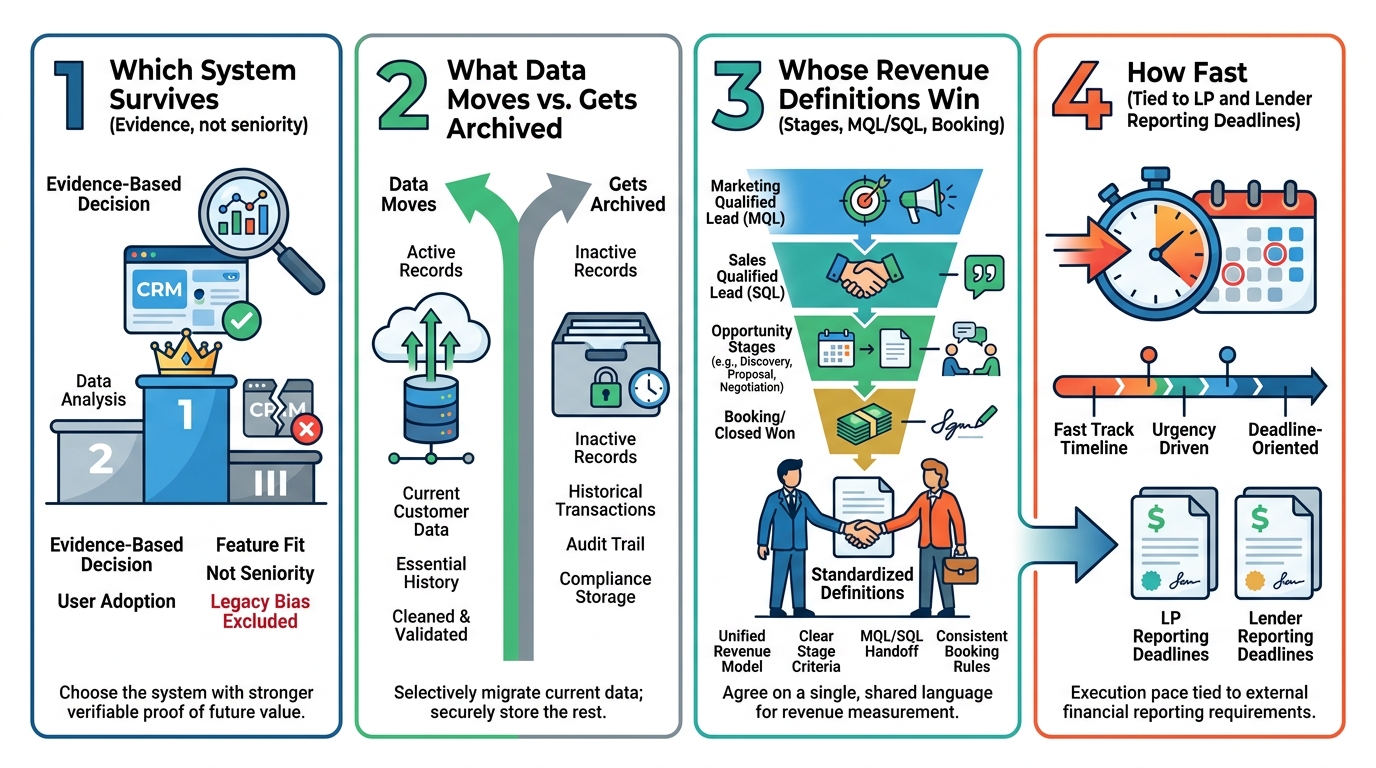
Both are right. But the decision they own is not “consolidate the CRM.” It is a sequence of four narrower calls, and confusing them is where most integrations lose the plot:
- Which system survives, and on what evidence, not on which team shouts louder.
- What data actually moves, versus what gets archived because it was never trustworthy.
- Whose revenue definitions win, stage names, qualification criteria, what counts as a booking.
- How fast, measured against the reporting deadlines your LPs and lenders already expect.
Only the fourth is a project-management question. The other three are commercial governance, and they should never be delegated to whoever installed the last integration. This is the same pattern I described in why PE value creation requires embedded partners, not advisory firms: the work that moves enterprise value sits at the intersection of finance and operations, not inside an IT ticket queue.
Why this is a value-creation problem, not an IT problem
The reason CRM consolidation earns airtime in an operating review is that it sits directly on top of forecast reliability, and forecast reliability is what a CFO defends in front of a lender every quarter. Bain’s annual Global Private Equity Report has documented for years that buy-and-build has become a dominant value-creation lever, with a large share of deals structured as platform-plus-add-on. The math of that strategy assumes the add-ons integrate. When the revenue systems do not, the “combined” company on the model is a fiction you cannot report against.
Here is the connection a deal partner should hold onto. A clean, consolidated CRM produces three things that show up in enterprise value:
Management visibility that survives diligence
At exit, a buyer’s commercial due diligence team will ask for a clean pipeline history across the whole combined entity. If your history is spliced together from two systems with different stage logic, you will spend the sale process explaining discontinuities instead of telling a growth story. I covered the buy side of this in commercial due diligence red flags in B2B businesses, and a fractured CRM lineage is exactly the kind of thing that makes a diligence analyst discount your numbers.
Cross-sell that is measurable, not asserted
The synergy case usually rests on selling the add-on’s product into the platform’s accounts. You cannot measure that lift unless both customer bases live in one system with one account hierarchy. Until then, “cross-sell is going well” is a claim, not a number. That is an enabled value at best, in the classification I keep coming back to, not a realized one.
A shorter path to a repeatable revenue motion
Two sales teams running two processes on two systems will not scale. Consolidation forces the decision about which motion the combined company runs. That decision, made deliberately, is worth far more than the software savings, which is where most integration business cases wrongly put their emphasis.
McKinsey’s private capital research has consistently pointed to operational improvement, rather than financial engineering, as the durable source of returns in the current environment. CRM consolidation is squarely operational. Treat it as a value driver, staffed and governed accordingly, and it behaves like one. Treat it as a migration, and it behaves like a cost with a long tail of confusion.
The pre-work most teams skip, and always regret
Before you decide which system survives, you need a clear read on what each system is actually worth as an asset. Not the license cost. The data quality, the process discipline, and the adoption.
I ask three questions of each CRM before anyone touches a migration plan.
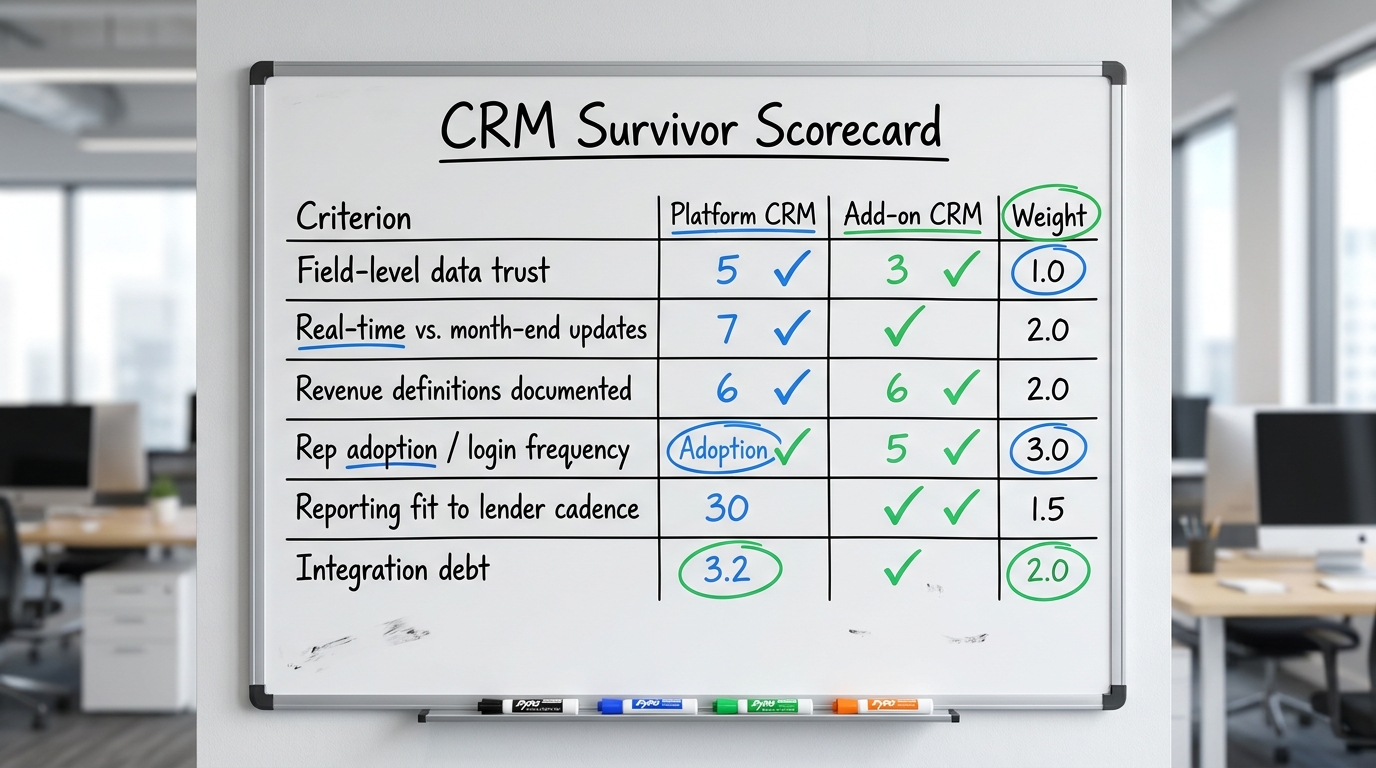
Is the pipeline data trustworthy at the field level?
Pull the last four quarters of closed-won deals and check whether close dates, amounts, and stage transitions were actually maintained or backfilled at month-end. A CRM that reps update honestly in real time is a far better survivor than a bigger one that gets stuffed with data the night before the board meeting. This diagnostic overlaps heavily with the work in the B2B portfolio revenue leakage diagnostic, because dead pipeline and phantom stages are exactly where reported revenue and real revenue diverge.
Do the revenue definitions even match?
One company’s “qualified” is another company’s “we spoke to them once.” If the two systems define an MQL, an SQL, and a booking differently, you cannot merge the pipelines without first agreeing on a single revenue taxonomy. This is the single most under-budgeted piece of the entire exercise, and it is not a technical task. It is a commercial one, and it is best owned by whoever carries the revenue number.
Who actually uses it, and how would you know?
Adoption is the quiet killer. A technically superior CRM that the add-on’s reps refuse to use will produce a cleaner-looking system and worse data than the messy one they trusted. Check login frequency and record-update recency before you assume the “better” platform wins.
How to choose the surviving system without a turf war
The default assumption, that the larger platform’s CRM automatically absorbs the add-on, is right often enough that people stop checking. Check anyway. I have seen a $40M platform run on a neglected instance while a sharp $12M add-on ran a disciplined process on a cleaner one. Size of company is not the same as quality of system.
The decision should rest on evidence, weighted roughly in this order: data integrity first, adoption second, reporting fit to your lender and LP cadence third, and feature depth a distant fourth. Feature depth is where vendors and internal champions want to fight, and it is the least important variable for a hold-period integration. You are not building the perfect revenue stack. You are producing a system that gives you a defensible number by the next board meeting and a repeatable motion by the end of the year.
One caution on speed, and here I will depart slightly from the “move fast” instinct that dominates the first hundred days. The 100-day plan is real and it matters, and I laid out the broader version in the 100-day go-to-market plan for a newly acquired B2B business. But a CRM cutover forced to hit an arbitrary day-90 flag, before the revenue definitions are agreed, produces a fast migration of bad data. Fast is a virtue only after the definitions are settled. Sequence beats speed here.
Protecting the number while you cut over
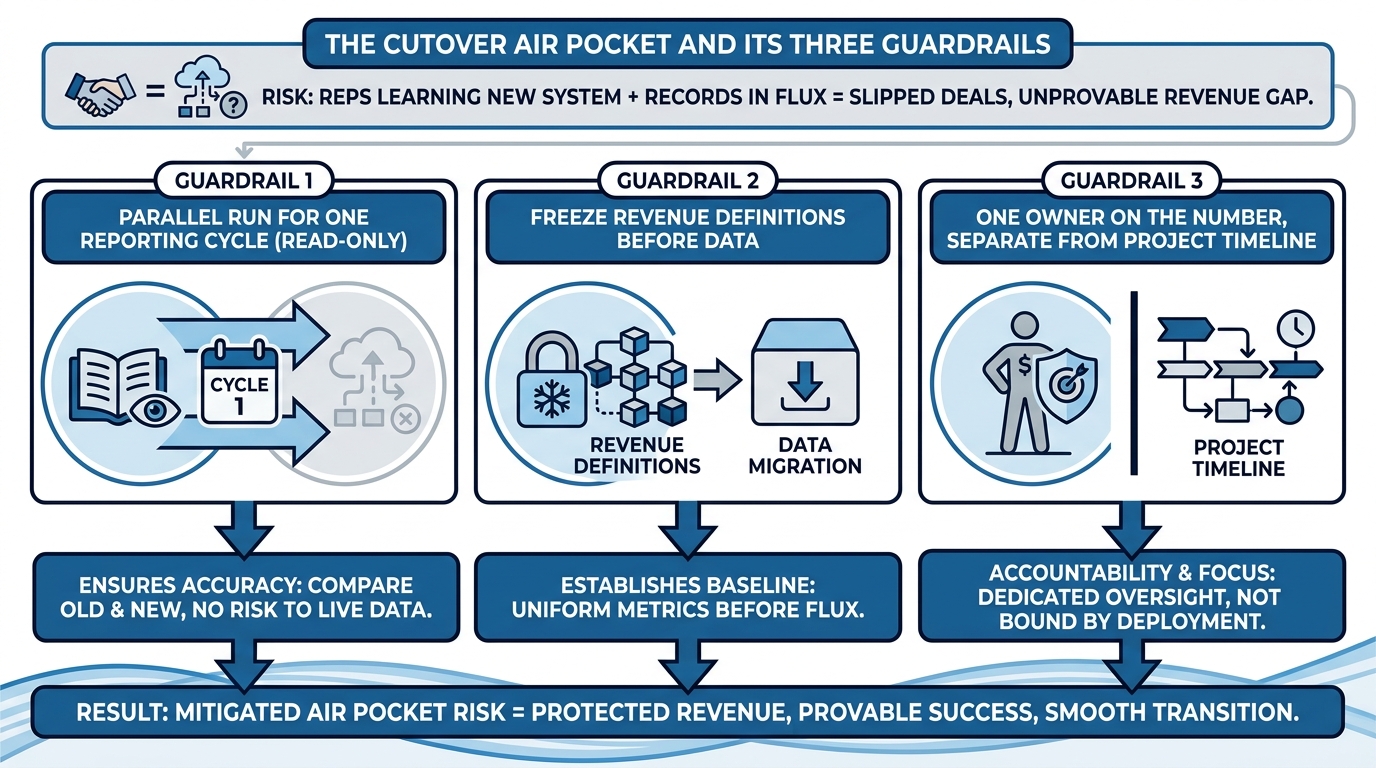
The risk a deal partner should lose sleep over is the revenue air pocket: the period during a cutover when reps are learning a new system, records are in flux, and deals slip through the seams. This is where a consolidation quietly costs you a quarter of bookings and nobody can prove why.
Three guardrails contain it.
Run parallel long enough to reconcile, not a day longer
Keep the legacy system readable, not writable, for one full reporting cycle after cutover so finance can reconcile the first consolidated quarter against a known baseline. Extending parallel operation indefinitely, though, is how you end up with two live systems forever, which is worse than either alone.
Freeze the pipeline definitions before you freeze the data
Agree the combined stage model and booking definition in writing, signed off by the person who owns the revenue forecast, before any records move. If you migrate first and define later, you will re-map historical deals under pressure and lose the audit trail. That audit trail is what protects your adjusted EBITDA story, and as I noted in adjusted EBITDA and the art of add-backs, anything you cannot cleanly evidence is something a buyer’s advisors will strip out.
Put one person on the number, not on the project
Someone senior should own the combined revenue number through the transition, distinct from whoever owns the migration timeline. Their job is to raise a hand the moment reported pipeline stops reconciling. This is exactly the accountability gap that separates operators from advisors, a distinction I drew out in value creation consultants versus operators. A consultant hands you a migration plan. An operator carries the P&L consequence if the number breaks.
How a deal partner should judge whether it worked
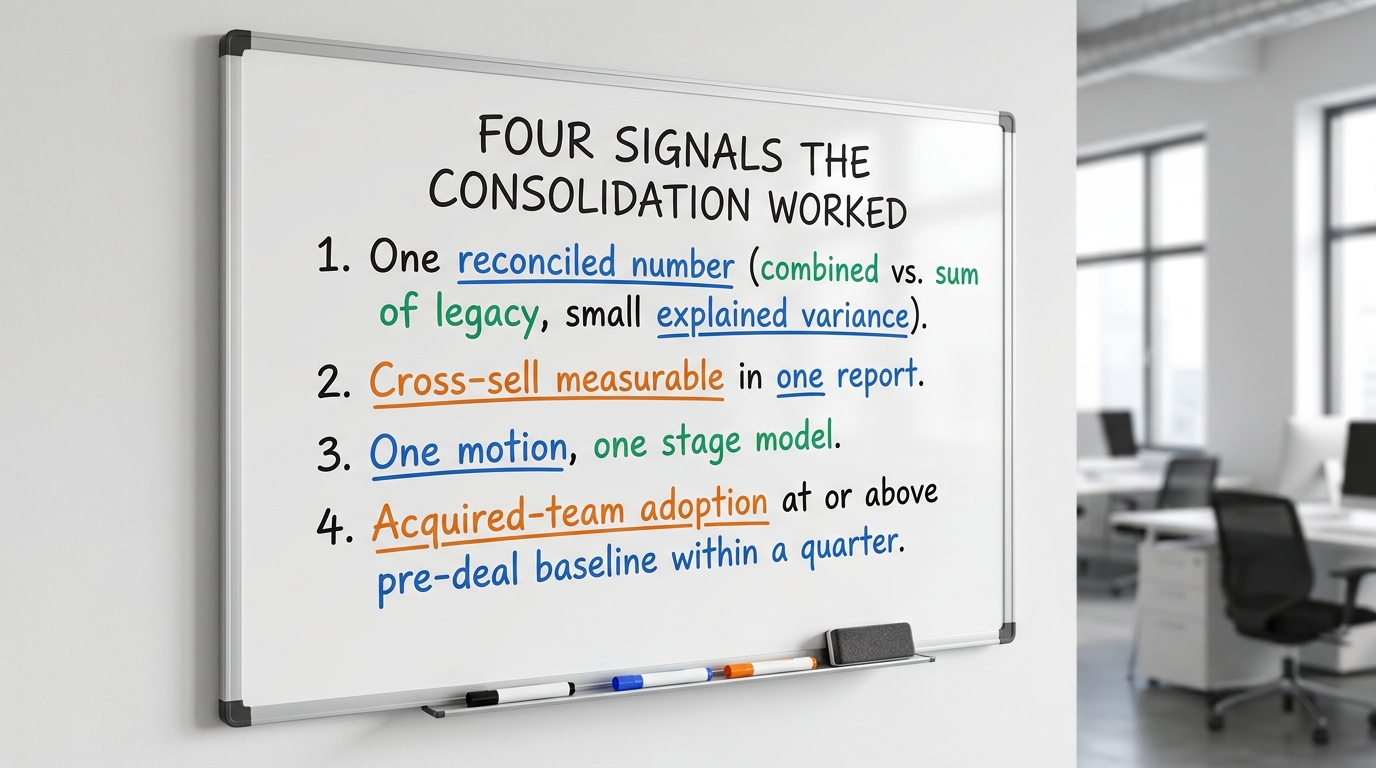
You do not need to inspect the migration. You need four signals that the consolidation delivered the value it was supposed to, and you should be able to get them in a single operating review.
One reconciled number
Combined bookings and pipeline for the most recent quarter reconcile against the sum of the two legacy systems for the prior period, within a small, explained variance. If finance cannot produce that reconciliation, the consolidation is not done, whatever the project status says.
Cross-sell you can actually measure
You can pull, in one report, how many platform accounts have bought the add-on’s product since close, and vice versa. If the answer is “we’re working on that report,” the synergy in your thesis is still unproven. That is the difference between a forecast and a result.
One motion, one set of definitions
The combined team runs one qualification process with one stage model. Two motions surviving under one logo means the consolidation was cosmetic.
Adoption holding
Login and update frequency among the acquired team should be at or above their pre-deal baseline within a quarter. A drop signals reps are working around the system, which means your data is decaying and your next forecast is already soft.
These map cleanly onto the broader dashboard I use in portfolio company operating reviews and the commercial KPIs that matter. CRM consolidation is not a separate discipline. It is one input into whether your commercial KPIs are trustworthy at all.
Where this fits in the wider revenue-systems picture
A CRM consolidation done well is the foundation for the rest of the revenue engine, not the whole of it. Once you have one system, one taxonomy, and one reconciled number, you can actually diagnose win rate, CAC, and sales-cycle length across the combined business, which is the work I described in how fractional CROs in PE fix win rate and CAC. Trying to fix those metrics before the systems are consolidated is fixing symptoms measured in two incompatible units.
It also connects to the failure modes I flagged in private equity GTM and the value-creation pitfalls to avoid. The most common pitfall is treating the go-to-market plan as a set of initiatives to launch, when the prerequisite is a revenue system you can trust to tell you whether the initiatives worked. And it is a durability question too: the organizations that hold up over a full hold period are the ones that build clean operating foundations early, a theme I returned to in future-proofing organizations for 2026.
External data backs the stakes. PitchBook’s research and data and BCG’s work on principal investors and private equity both point to a market where returns increasingly depend on operational integration rather than multiple expansion. In that market, the boring discipline of one clean revenue system is not overhead. It is the thing that lets you prove the story you underwrote.
The takeaway for the people who own the number
CRM consolidation after an add-on is not a technology decision that finance inherits. It is a commercial governance decision that determines whether your synergy case is provable, whether your forecast is defensible to lenders, and whether your exit story survives a buyer’s diligence. Own the sequence: settle the revenue definitions, choose the surviving system on evidence, protect the number through the cutover, and judge the result on reconciliation and cross-sell, not on project status.
The operating partners who treat this as a value driver get a combined company they can steer. The ones who treat it as a migration get a cleaner-looking system and a forecast they quietly stop trusting. The difference costs a hold period.
Where to take this next
If you are integrating an add-on and the combined revenue picture is not yet reconciling, that is a solvable problem, and it is worth solving before your next board cycle rather than after. At DevriX we work inside portfolio companies on exactly this kind of revenue-systems consolidation, from the CRM survivor decision through the reconciled reporting your CFO can defend. You can see how we approach the operational build on the DevriX private equity practice, or if you would rather start with the commercial and governance decisions above the tooling, book time through my advisory session and bring the two systems you are trying to merge. Come with the question your investment committee keeps asking, and we will work backward from the number you need to defend.
