

By Mario Peshev, DevriX
When a technical diligence report tells you the codebase is “modern” and the team is “strong,” you still do not know what the investment committee is paying for: will this engineering organization deliver the roadmap in the value creation plan on the timeline the model assumes. Engineering team assessment due diligence exists to answer that question, and most reports fail to do so because the person who wrote them graded code quality and headcount instead of grading delivery capacity against the specific bets in the thesis.
If you are inside confirmatory diligence on a software or software-enabled target, or you are staring at a first 100-day plan that assumes three new modules ship by month nine, the team is the variable that decides whether the plan is real. I have run this assessment on both sides of the table, and the gap between a team that looks good and a team that ships is the single most expensive thing a deal partner underwrites without measuring.
1. The decision the team assessment actually informs
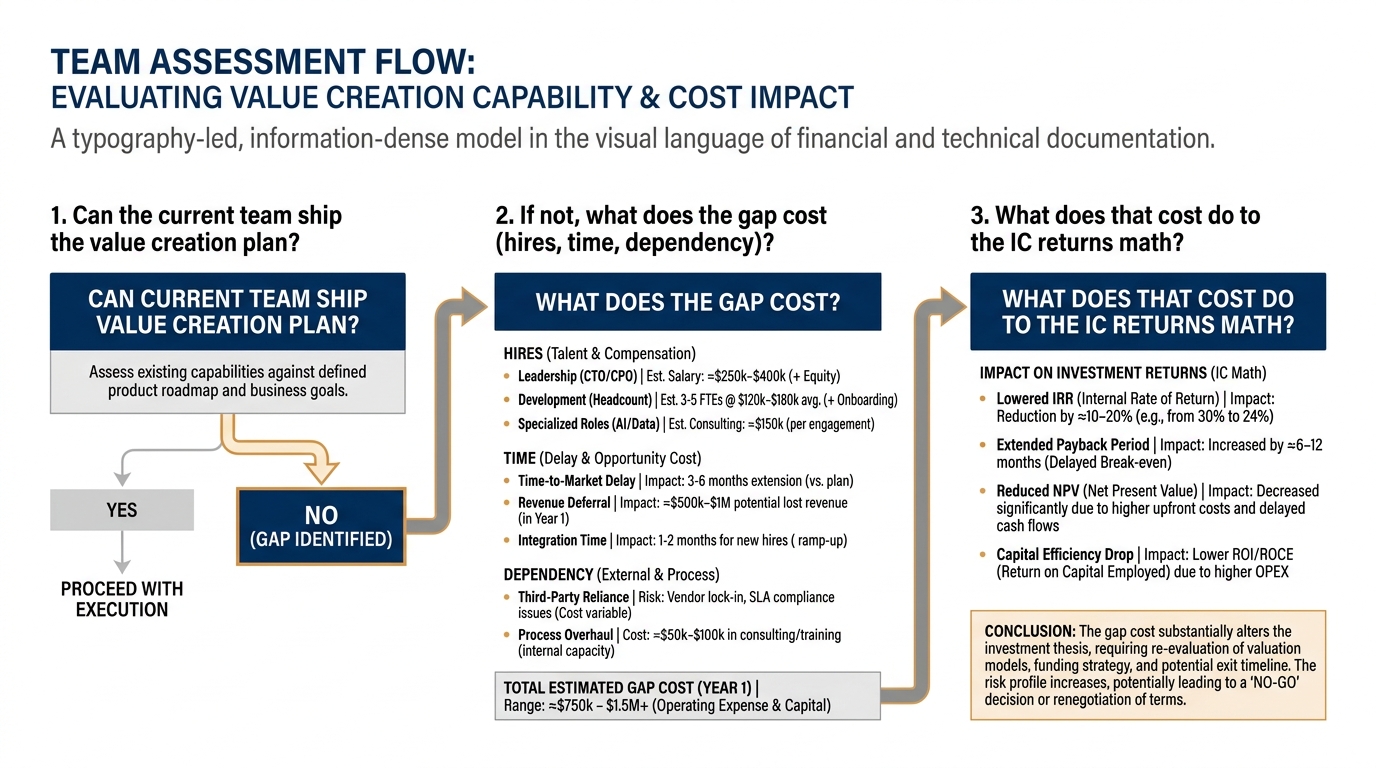
The output of an engineering team assessment feeds three decisions you own: whether the growth plan is achievable with the current team, what it costs to close the gap if it is not, and what that cost does to the returns math you presented at IC.
A software-enabled thesis usually rests on shipping something the target has not shipped yet: a new product line, a platform re-architecture, an integration after an add-on, a move upmarket that requires enterprise features. Every one of those is a promise about engineering throughput. The team either has the capacity, the skills, and the leadership to keep that promise, or you are funding a hiring plan you did not price.
Bain’s annual private equity report has documented for years how much of the return in the current environment has to come from operational improvement rather than multiple expansion. When the plan leans on product and engineering to drive that improvement, the team is the mechanism that determines whether that improvement happens. You can read the broader pattern in Bain’s Global Private Equity Report.
This is the same underwriting posture I described in the technology remediation decision a deal partner actually owns: you are not buying a diagnosis, you are buying a priced decision about what to do next.
2. Why headcount and pedigree tell you almost nothing
The two metrics that dominate weak assessments are the ones that predict delivery worst: how many engineers there are, and where they went to school or worked before. A team of forty can ship less than a team of twelve if the forty are trapped in a codebase that punishes every change, and a staff engineer from a famous employer can be an individual contributor who has never carried a delivery commitment.
What predicts delivery is the relationship between the team and its own system: how long a change takes to reach production, how often changes break things, how much of the week is spent on unplanned work versus roadmap work, and whether the people who understand the critical parts of the system can be replaced without stalling.
Those are measurable, and they are the ones vendors skip because they require reading the actual delivery record rather than the org chart. This is the difference between activity and outcome that separates real technology due diligence from a summary of what the team says it does.
3. The four tiers of an engineering team assessment
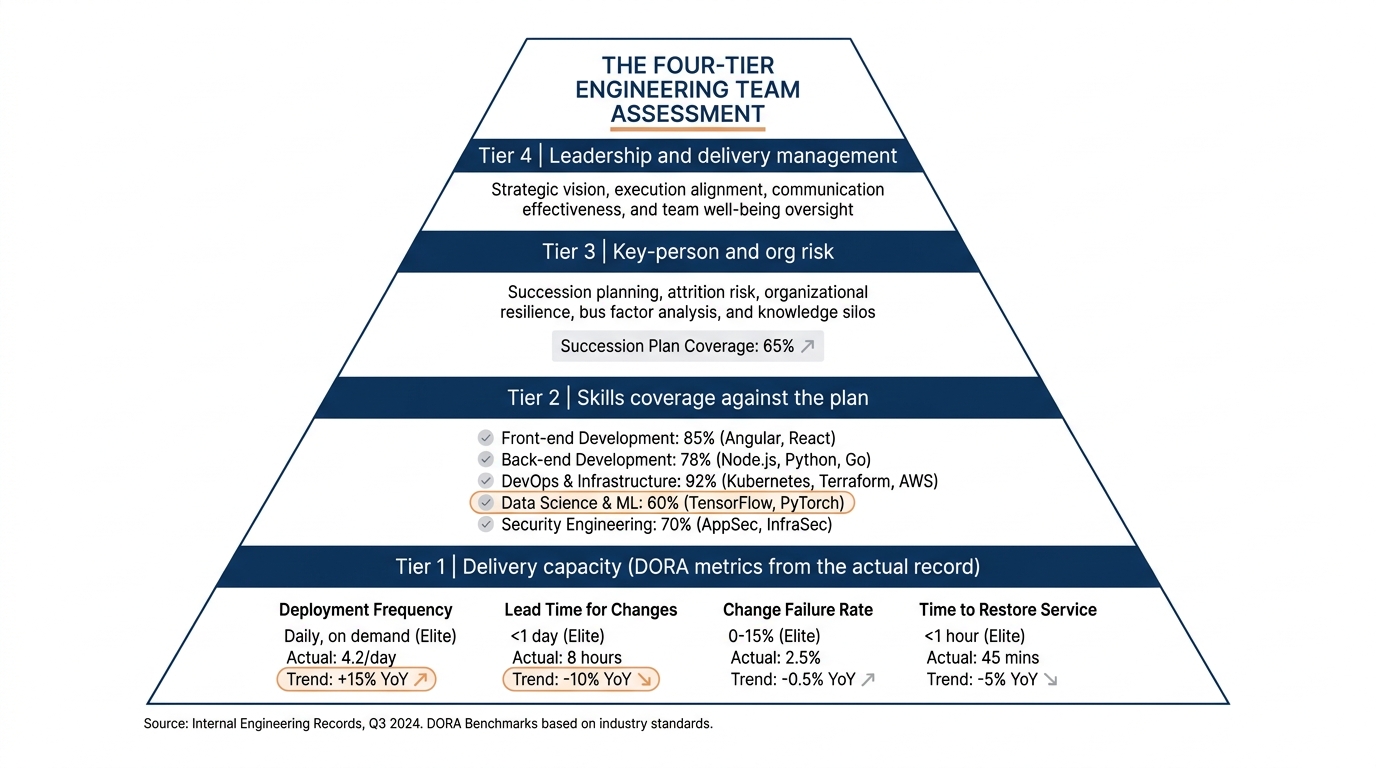
I structure the assessment in four tiers, from the most concrete to the most judgment-heavy. Each tier answers a different question the deal team has, and each one can independently kill the assumption in the model.
Tier 1, Delivery capacity
This is the record of what the team has actually shipped over the last twelve to eighteen months, measured against what it committed to. The evidence is in version control, the ticketing system, and release history, not in interviews. Deployment frequency, lead time for changes, change failure rate, and time to restore are the four measures the DORA research at Google has connected to delivery performance, and they are the ones I baseline first because they are hard to fake and easy to compare.
Tier 2, Skills and coverage against the plan
Here you map the specific skills the value creation plan requires onto the people who currently hold them. If the plan needs a data platform and no one on the team has built one, you have a hiring line with a lead time and a salary attached, not a training note. The same discipline I apply to scoring what AI readiness actually tells you in a deal applies here: capability is only real when a named person holds it.
Tier 3, Key-person and organizational risk
Every engineering organization has a small number of people who hold critical knowledge, and the assessment has to find them and price their departure. Concentration risk is common in founder-built companies where two or three people carry the system in their heads. If one of them leaves during the hold, the roadmap slips, and you want that risk on the register before Day 1, not discovered at the first board meeting.
Tier 4, Leadership and delivery management
The top tier is whether the engineering leadership can run a predictable delivery process, make trade-off decisions, and grow the team without the founder in the loop. This is the hardest to measure and the most decisive, because a strong leader can rebuild the other three tiers over a hold period and a weak one will erode them.
4. What evidence each tier requires
An assessment is only as good as the evidence behind it, and the difference between a defensible score and an opinion is whether you looked at the system of record or took the management team’s word. For each tier there is a primary source that management cannot easily dress up.
- Delivery capacity: commit history, pull request cycle times, deployment logs, incident history, and sprint or roadmap tracking over 12 to 18 months.
- Skills coverage: a skills matrix built from code ownership data and technical interviews, cross-checked against the roadmap the value creation plan requires.
- Key-person risk: code ownership concentration, documentation coverage of critical systems, and honest conversations about who could not be lost.
- Leadership: how the team plans, how it handles missed commitments, how it makes architecture decisions, and whether estimates have tracked actuals.
When a target cannot produce this evidence, that is itself a finding. A team that does not measure its own delivery is a team you cannot forecast, and an unforecastable team is a risk you carry into the hold whether or not you named it.
5. Turning tiers into a decision, not a score
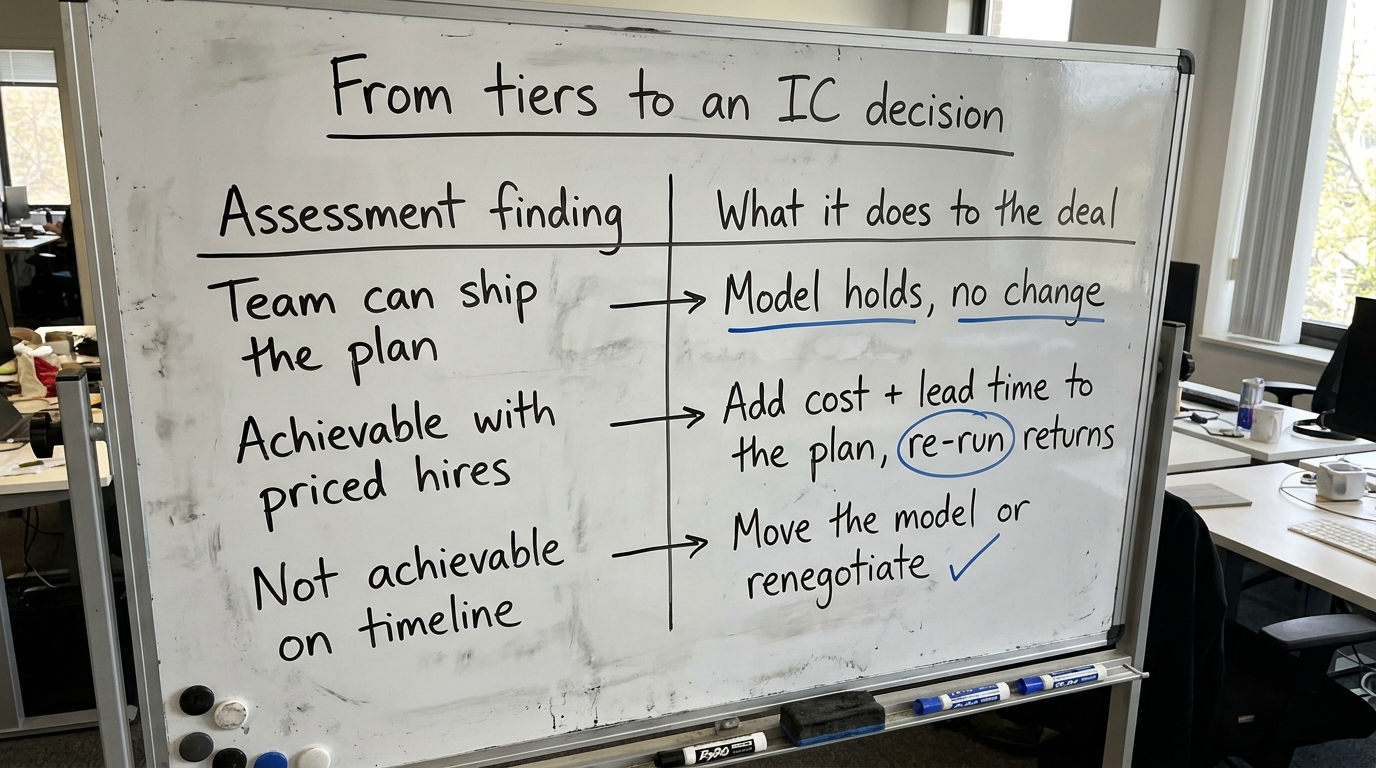
A number out of a hundred is comforting and nearly useless to an investment committee. What the IC needs is the assessment translated into the language of the deal: is the plan achievable as written, what changes if it is not, and what the fix costs in money and time.
I resolve each tier into one of three positions. The plan is achievable with the current team. The plan is achievable with a defined, priced set of hires and changes. Or the plan is not achievable on the assumed timeline and the model needs to move. That third outcome is rare, but it is the one that saves a deal from a value creation plan built on capacity that does not exist.
The priced middle case is where most real deals land, and it connects directly to how you should judge remediation work and integration spend once you own the asset. I laid out that judgment in how to judge M&A consulting firms when you are the one underwriting the deal.
6. An illustrative scenario
The following is an illustrative scenario, not a client outcome, to show how the tiers change a decision rather than just describe a team.
A sponsor is in confirmatory diligence on a vertical SaaS business. The thesis assumes two new product modules ship in the first eighteen months, which underwrites roughly a third of the projected revenue growth. The team is twenty-two engineers, the code is reasonably modern, and the founder who runs engineering is confident the plan is achievable.
The first tier of assessment shows lead time for a change running around three weeks and a change failure rate high enough that most sprints lose time to rework. The second tier shows that the two modules require integration and data skills the team has never built and no one currently holds. The third tier finds that one engineer owns eighty percent of the billing system that both new modules depend on, which means delivery risk is now concentrated in a single retention event.
None of that kills the deal. It reprices it. The plan now needs four hires with a six-month ramp, a stabilization effort before new features can move fast, and a retention arrangement for the billing owner. That is a real number the IC can weigh against the growth it underwrites, which is the entire point of running the assessment before you commit rather than discovering it in the first 100 days.
7. Where the team assessment connects to the rest of diligence
The team assessment does not stand alone, and reading it in isolation is how deal teams double-count risk or miss it entirely. It has to reconcile with the codebase assessment, because a fragile system explains a slow team, and with the integration plan, because an add-on strategy multiplies the demands on the same engineers.
If the thesis involves buying and integrating other companies, the same team that ships the roadmap also carries the integration work, and both compete for the same weeks. That interaction is exactly what I covered in what IT integration actually decides in an M&A deal and in how to hire and judge a post-merger integration consultant. The revenue side has a parallel dependency, which is why the team assessment should also inform RevOps decisions in the deal.
McKinsey’s private capital research and BCG’s work on principal investors both point to operational execution as the dominant driver of value in the current market, which is another way of saying the team either delivers the plan or the plan does not happen. You can review the underlying research at McKinsey and BCG, and PitchBook’s data on hold periods and returns at PitchBook gives you the context for how long the team has to sustain that delivery.
8. How to judge the firm running the assessment
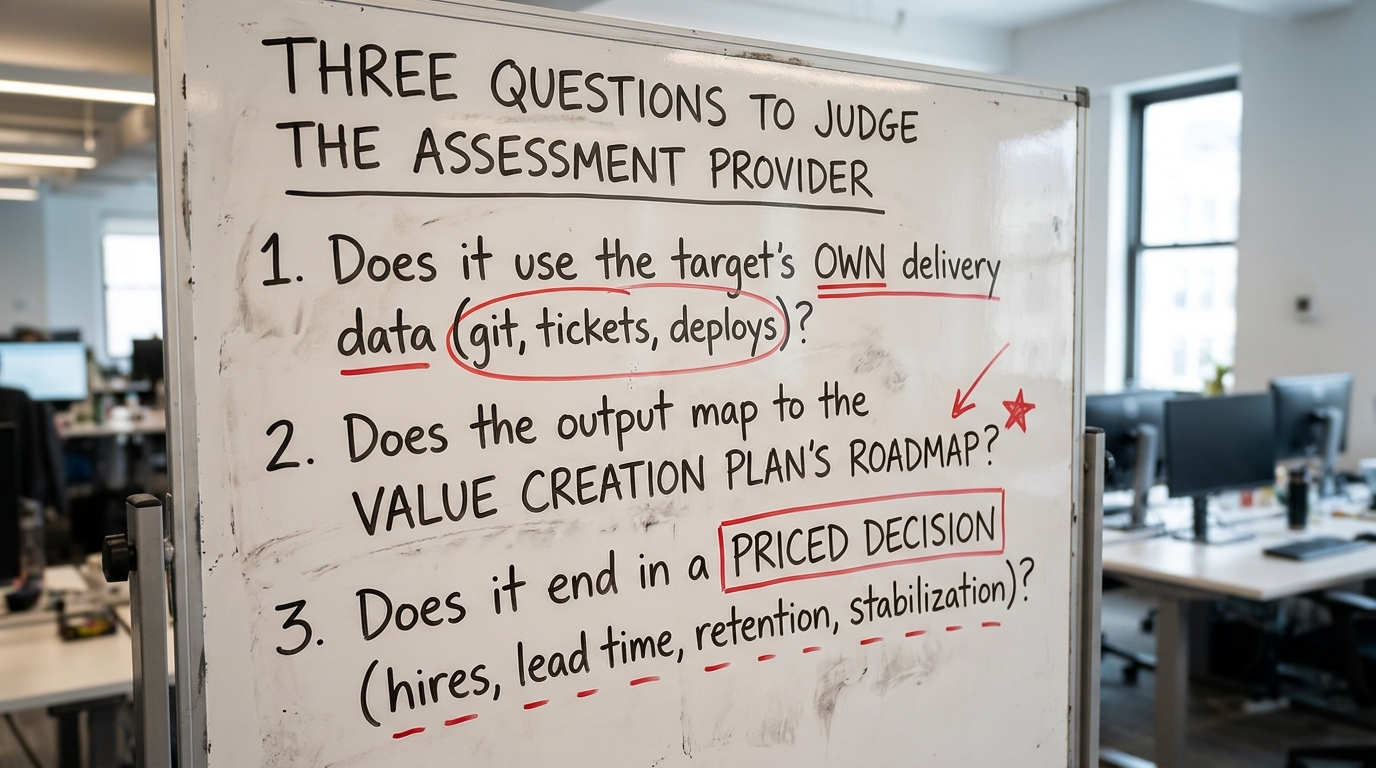
Since this is a commercial decision, judge the assessment provider the way you judge any diligence vendor: on whether the output changes what you do, not on the length of the report. Ask three questions before you engage one.
Does the method use the target’s own delivery record?
If the assessment is built on interviews and a management questionnaire alone, it will tell you what the team believes about itself. The defensible version reads version control, ticketing, and deployment history, because those are the sources that survive being wrong.
Does the output tie to the value creation plan?
A team assessment that grades the team in the abstract is worth little. The one you want maps the team against the specific roadmap in the thesis and tells you whether that roadmap ships. Everything I have written about what a deal partner actually needs from a consultant comes back to this test.
Does it produce a priced decision?
The report has to end in numbers a deal partner can put in the model: hires, lead times, retention costs, and a stabilization estimate. A finding without a price is an observation, and observations do not move an IC. That same standard is why board reporting has to drive decisions rather than describe activity, which I covered in board reporting for PE portfolio companies.
9. Timing this against the deal clock
The team assessment is most useful at two moments. A light version before LOI tells you whether the technical assumptions in the thesis are plausible enough to keep spending on the deal. The full version during confirmatory diligence gives you the priced decision the IC needs and the risk register the operating team inherits at close.
Running it late, after price is set, means any finding either erodes your returns or forces an awkward renegotiation. Running it early means the findings shape the price and the plan while you still have leverage. Harvard Business Review’s collection on M&A is worth reading on how often deals underperform because integration and delivery risk were priced after the fact rather than before, available at HBR’s M&A topic hub.
10. What good looks like in the final read
A finished engineering team assessment should let a deal partner say one sentence to the investment committee with evidence behind it: the current team can deliver the plan, or it can deliver the plan with this priced set of changes, or the plan needs to move. If the report cannot support one of those three sentences, it did not do the job, no matter how thorough it looks.
Everything else in the report exists to support that sentence. The metrics, the skills matrix, the key-person map, and the leadership read are the evidence, and the evidence only matters because it turns a comfortable assumption about the team into a number you can underwrite.
Conclusion
The team is the part of a software thesis that either ships the plan or does not, and it is the part most diligence measures worst. An assessment that reads the target’s own delivery record, maps the team against the specific roadmap, prices the key-person and skills gaps, and ends in a decision the IC can act on is the difference between funding a plan and funding a hope. Judge the work by whether it changes what you do, and time it while you still have leverage over price.
If you are approaching LOI or confirmatory diligence on a software or software-enabled target, DevriX runs engineering team and technology assessments built for the deal clock, from a pre-LOI read to a full five-day technical diligence that ends in a priced decision. See how we support private equity deal and operating teams and start the conversation on scope and timing.
