You already know the engineering stack will not be perfect. Every asset you look at has technical debt, an over-tenured lead who owns too much undocumented knowledge, and a roadmap that is 40 percent aspiration. The question that decides whether you sign, and at what price, is not “is the technology good.” It is “will the technology hold the value-creation thesis, and where will it break the plan.” A one-shot diligence report answers the first question at a single point in time. A continuous technology due diligence posture answers the second across the hold.
We run the same posture on our own company through the AI Ops Hive: a bank of 291 diligence and operating questions, answered from live systems and graded every night.
If you are approaching confirmatory diligence, structuring an add-on program, or staring at a portfolio company whose forecast just slipped for the second quarter, the difference is not academic. It is the difference between a risk you priced and a risk that surfaces in month nine, after the operating partner has already committed the integration budget. This piece is about what continuous technology due diligence actually decides for a deal partner or operating partner, and how to judge whether the work you are paying for is producing decisions or producing paper.
Why a single diligence snapshot ages badly
Classic technology due diligence produces a report keyed to the day the data room closed. That is useful and necessary. It is also perishable. The codebase you assessed ships new commits the week after you sign. The key engineer you flagged as a single point of failure may resign during the transition. The cloud bill you modeled at $38K a month drifts as the product scales into the growth case you underwrote.
Bain’s annual private equity report has tracked how long holds have gotten and how much of the return now depends on operational improvement rather than multiple expansion. You can review the pattern in Bain’s Global Private Equity Report. The practical consequence for the technology function is simple: if more of your return is earned inside the hold through operating changes, then the technology risks you underwrote at entry are exactly the risks that determine whether those operating changes are deliverable. A snapshot tells you the starting position. It does not tell you whether the position is degrading or improving while your money is at work.
Continuous technology due diligence is not a longer report. It is a live view of a small number of things that actually move enterprise value, refreshed on a cadence that matches your decision points rather than the transaction calendar.
What continuous technology due diligence actually decides
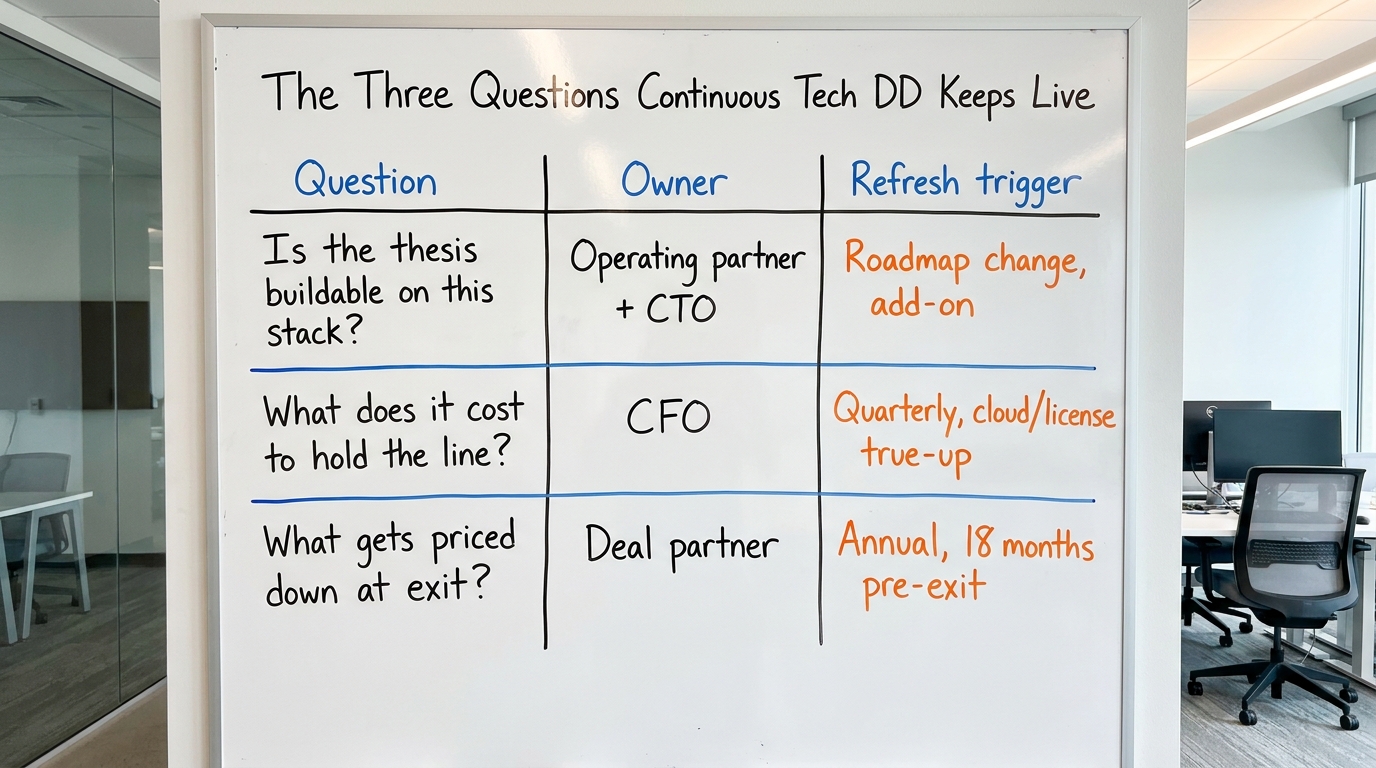
The mistake I see most often is treating technology diligence as a gate you clear once, then forget until exit. The deal partner wants three answers, and wants them to stay current:
- Is the thesis buildable on this stack? If the plan requires a new pricing engine, multi-tenant architecture, or a data layer that supports cross-sell, the diligence has to say whether that is a six-month build or a rewrite, and whether the current team can execute it.
- What will it cost to hold the line? Security remediation, license true-ups, cloud cost, and the hiring needed to remove key-person risk are real cash items. They belong in the model, not in a footnote.
- What gets priced down at exit if we do nothing? The buyer three or five years out will run the same diligence you are running now. Every gap you leave becomes their discount.
Those three answers are not stable over a four or five year hold. That is why the continuous framing matters. The point is not to re-audit constantly. It is to keep a short risk register live and re-priced against actual versus plan.
The difference between a report and a decision
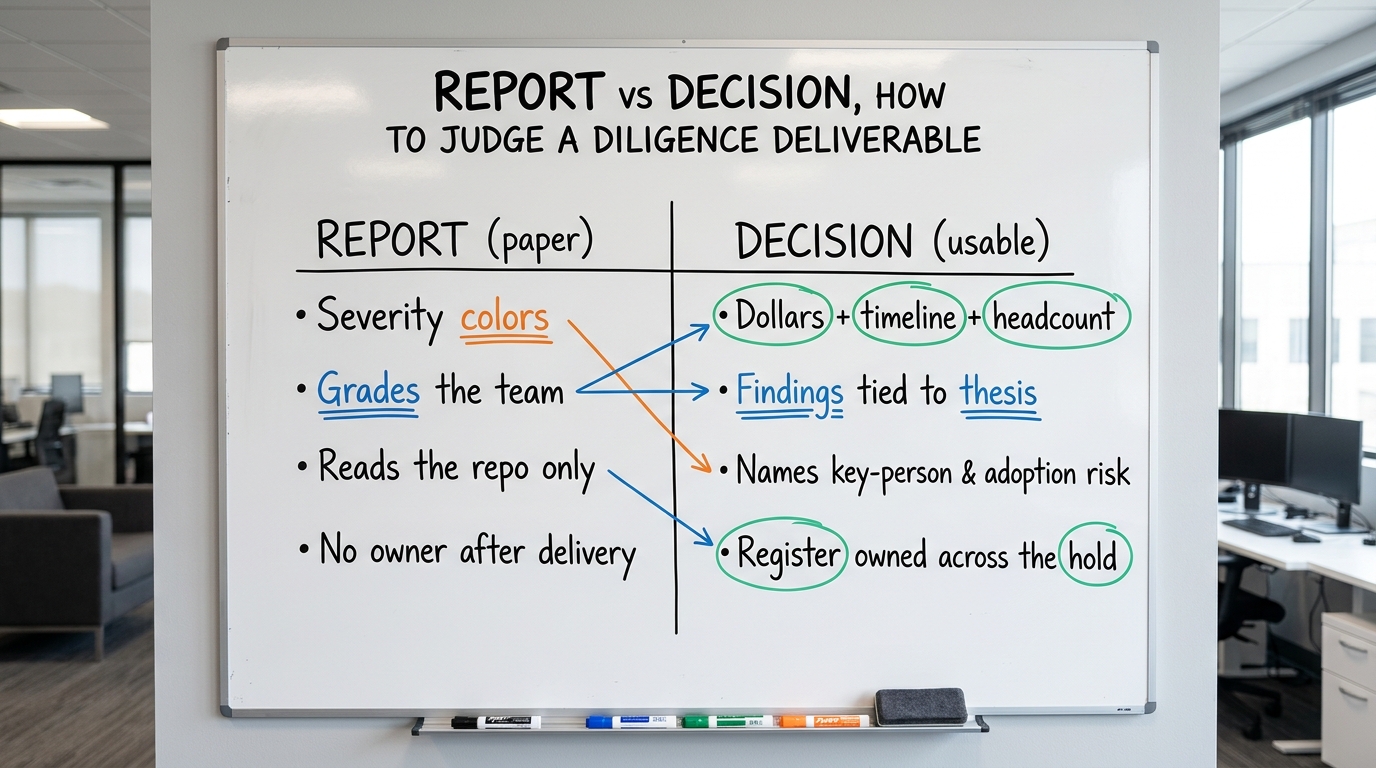
A report tells you the database is Postgres, the test coverage is 46 percent, and there are two critical CVEs open. A decision tells you that the 46 percent coverage means the pricing change in your thesis carries a regression risk you should fund a QA hire against before Day 1, and that the two CVEs are cheap to close but signal a patching discipline problem that will cost you at exit.
I have written before about the practical mechanics of the buy-side view in buy-side technology due diligence, and about how a code quality assessment for acquisition should translate directly into cost and risk rather than into a grade. The test for any diligence deliverable is this: can the deal team make a pricing, structuring, or 100-day decision from it without a second meeting to interpret it? If not, you bought a document, not diligence.
What a good deliverable puts on the table
- A ranked risk register, each item tagged as realized cost, run-rate exposure, or exit-price risk.
- A remediation cost and timeline for each item, expressed in dollars and headcount, not severity colors.
- An explicit call on whether the value-creation thesis is technically deliverable by the current team, or whether it needs a change in leadership, budget, or timeline.
- A short list of things to monitor across the hold, with the trigger that should make you re-open them.
When the cadence actually matters
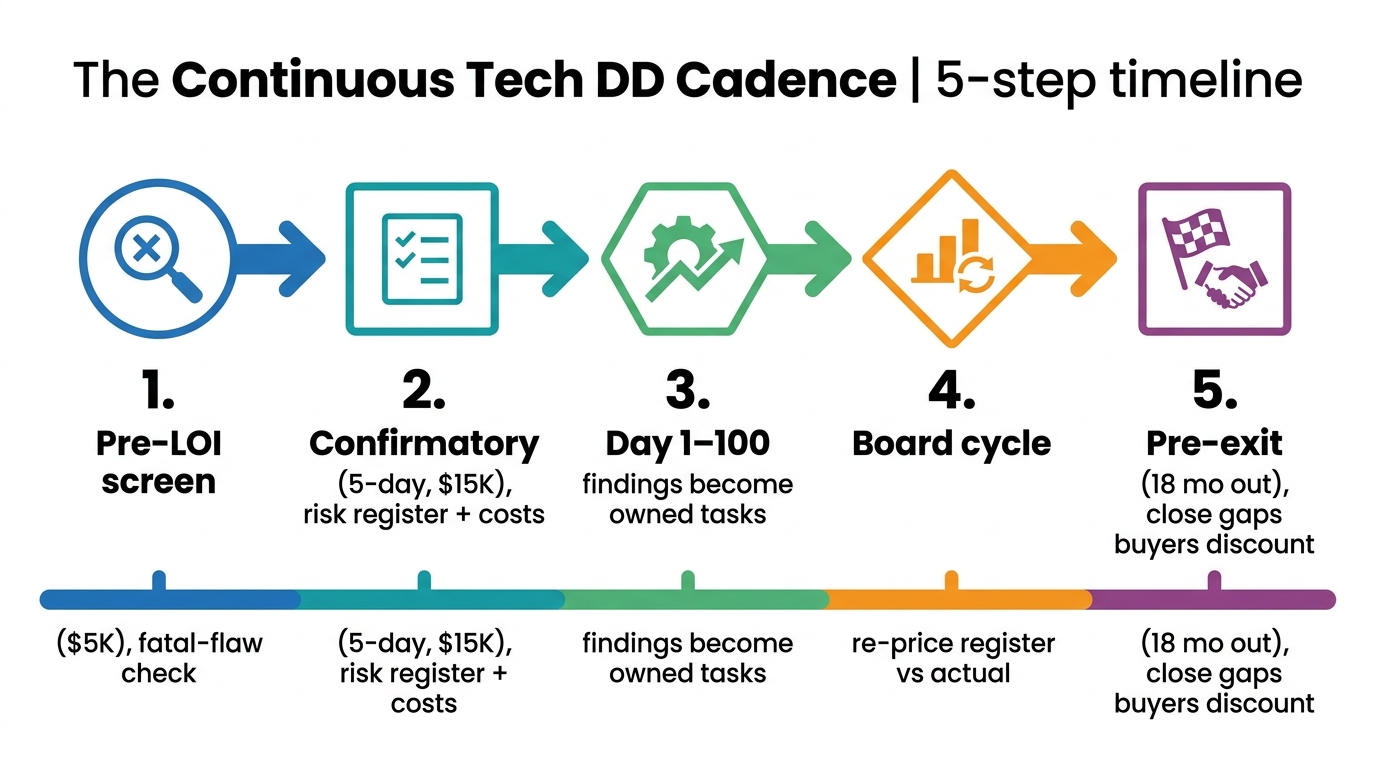
Continuous does not mean constant. It means tied to the moments where a technology fact changes a commercial decision. Those triggers are predictable:
Pre-LOI
Here the job is cheap and fast: is there a fatal flaw that should change the price or kill the deal before you spend real diligence money. This is not a full audit. It is a screen. A focused pre-LOI look, priced in the low five figures, exists to stop you from spending $200K of confirmatory diligence on an asset with an architecture that cannot support the thesis or a licensing exposure that changes the model.
Confirmatory diligence
This is the five-day deep pass that produces the risk register, the remediation costs, and the thesis-deliverability call. It feeds the model and the 100-day plan directly. If it does not, the timing was wasted.
Day 1 through the first 100 days
The diligence findings become an execution list. The gaps you priced now need owners and dates. I have laid out how this transition should run in the first 100 days work, and the pattern that separates a plan from a wish list in the difference between advice you can ignore and a plan someone is on the hook to deliver. A finding without an owner and a date is not part of a value-creation plan. It is a note.
Every board cycle after that
The risk register gets re-priced against actual performance. Did the cloud cost track the model? Did the key-person risk get resolved or worsen? Did the roadmap slip in a way that pushes the exit thesis out a year? This is where a technology and revenue audit in the first two weeks pays off later, because you have a baseline to measure drift against.
Who reads this, and what they need from it
The same set of technology facts means different things to different seats at the table. Diligence that ignores this produces a document nobody can act on.
The deal partner
Wants thesis, risk, and exit. Does the technology support the return math, what could break it, and what will the next buyer discount. The deal partner does not want a description of the CI pipeline. They want to know whether the CI state adds two months and a hire to every thesis milestone.
The operating partner
Wants speed and repeatability. Which findings become 100-day tasks, who owns them, and how fast can adoption happen. This is where aligning engineering, product, and RevOps matters, because most value-creation theses depend on those three functions moving together, and technology diligence usually only looks at one of them.
The CFO
Wants the cash items and the forecast reliability. Remediation cost, license true-ups, cloud spend trajectory, and whether the engineering budget in the model is real or optimistic. McKinsey’s private capital research, available through McKinsey’s insights, has repeatedly made the case that operational rigor, not financial engineering, drives current-vintage returns. For the CFO that means the technology line items are not overhead to minimize. They are part of the value bridge.
The portfolio company CTO or CEO
Needs the findings translated into decisions they can own, not a scorecard that reads as an indictment. The point of continuous diligence is to give the operating team a live instrument, not to grade them.
How to judge the work you are paying for
Since the search intent here is commercial, be direct about it. You are choosing a diligence provider. Here is how I would judge one, having sat on both sides of the transaction.
Does it price risk in dollars?
“High severity” is not a number. “Roughly $180K and two engineers over four months to make the platform multi-tenant, which the cross-sell thesis requires” is a number. If the deliverable does not convert findings into money and time, it cannot enter the model, and if it cannot enter the model, it did not do the job.
Does it name the key-person and adoption risks, not just the code risks?
The most common way a technology thesis fails is not bad code. It is that one person holds the system in their head and leaves, or that the team the plan depends on will not adopt the new way of working. Diligence that only reads the repository misses the risks that actually kill returns. This is part of why I argue that PE needs permanent digital capacity rather than advisory-only coverage: the person who assessed the risk should be close enough to see whether it is being resolved.
Does someone stay on the hook after the report?
A one-time report has no accountability for whether its recommendations get executed. Continuous diligence, by design, does. Whether through a virtual CIO arrangement for the portfolio or a part-time CTO seat that enforces decision rules, the value comes from someone owning the register over time, not from a PDF that ages in a shared drive.
The exit case for doing this early
The single strongest commercial argument for continuous technology due diligence is that the buyer at your exit will run diligence on you. Every gap you leave unaddressed becomes their negotiating leverage. I have detailed the specific technology and go-to-market gaps that get priced down in exit readiness for portfolio companies, and the pattern is consistent: the discounts are almost always for things that were visible at entry and never closed.
PitchBook and S&P Global Market Intelligence both track how exit conditions and holding periods have shifted, which you can follow through PitchBook’s research and S&P Global Market Intelligence. The takeaway for the operating team is that a longer hold gives you more time to close gaps, and also more time for undetected drift to compound. Continuous diligence is how you make sure the time works for you rather than against you.
There is also a positioning argument here. Framing this as a live discipline rather than a one-time event is part of how we think about the broader value creation plan as an owned category, and why private equity operating teams increasingly want a partner who stays engaged rather than a vendor who delivers and leaves.
An illustrative scenario
To make the mechanics concrete, and I want to be clear this is an illustrative scenario rather than a specific deal: imagine a mid-market SaaS asset entering confirmatory diligence. The thesis assumes a 30 percent price increase enabled by a new packaging tier, plus two bolt-on acquisitions integrated onto the core platform.
A snapshot diligence pass confirms the code is reasonable and the team is competent. It clears the gate. What it misses, because it only looks once, is that the billing system is hard-coded to the current pricing model and cannot support tiers without a rewrite, that the single engineer who understands the billing logic is planning to leave, and that the platform is single-tenant, which makes each bolt-on a bespoke integration rather than a repeatable one.
Continuous diligence surfaces all three as priced items at entry: roughly a two-quarter billing rebuild, a key-person mitigation plan with a hire and documentation timeline, and a multi-tenancy investment that turns the bolt-on strategy from custom work into a playbook. Same asset, same code, radically different plan and price. That is the entire commercial case in one example.
Conclusion
Continuous technology due diligence is not more diligence. It is diligence pointed at the decisions you actually make across a hold, kept current against the moments that matter: pre-LOI, confirmatory, Day 1, each board cycle, and the run-up to exit. The test is always the same. Does the work produce decisions a deal partner, operating partner, or CFO can act on without a translation layer, priced in dollars and time, with someone on the hook to see it through. Harvard Business Review’s coverage of mergers and acquisitions keeps returning to the same lesson, that value is made or lost in execution after the deal, not in the model before it. The technology function is where a surprising amount of that execution risk lives.
If you are approaching an LOI, sitting in confirmatory diligence, or holding an asset whose forecast has started to drift, and you want a diligence pass that produces priced decisions rather than a report that ages in a drive, bring the DevriX private equity team the specific asset and the thesis it has to hold, and we will scope the pre-LOI screen or the five-day pass against your decision points.