The wrong value creation partner does not just waste a fee. It burns two of the three years you have to move the number, and it does it quietly, behind a wall of dashboards and status decks that look like progress. By the time the operating partner realizes the plan produced activity instead of EBITDA, the hold is half over and the exit thesis is exposed.
I have sat on both sides of this. I run a firm that gets hired into portfolio companies to move commercial numbers, and I have watched deal partners and operating partners try to evaluate firms like mine using the wrong test. They ask about capabilities, headcount, tooling, and case studies with logos. Almost none of that predicts whether the partner will change the P&L.
This is a practical guide to the decision a PE deal partner or operating partner is actually making when they hire a value creation partner, and how to judge one before the engagement letter is signed. I am writing for someone with budget and a thesis to defend, not for someone learning what value creation means.
A PE-backed buyer is purchasing enterprise value improvement, not vendor services
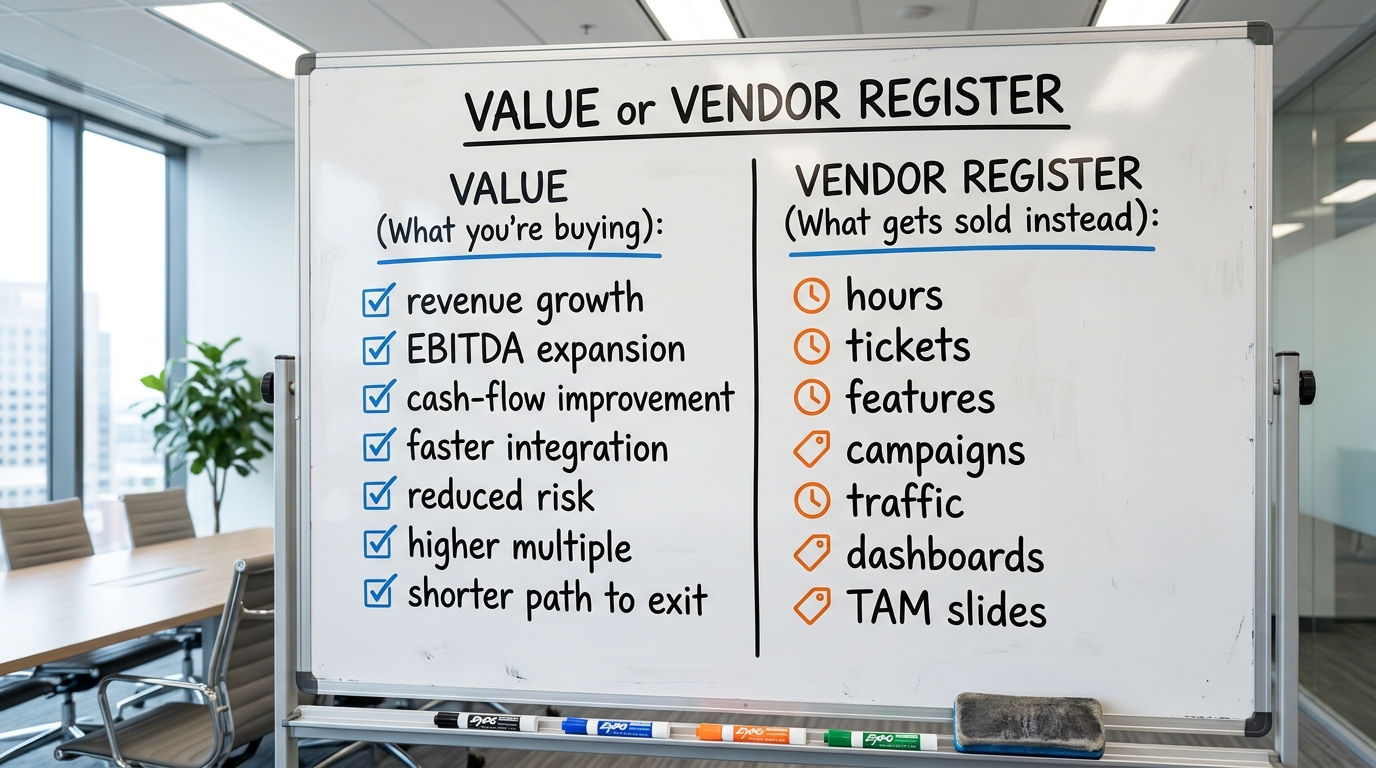
A PE-backed buyer is not purchasing websites, campaigns, engineering hours, analytics, or an AI initiative. It is purchasing a measurable improvement in enterprise value. That improvement shows up in a short list of places: revenue growth, EBITDA expansion, cash-flow improvement, faster integration, reduced operating risk, better management visibility, a higher exit multiple, or a shorter path to exit. If a value creation partner cannot tell you which of those it moves, and how you will see it in the model, you are being sold a vendor register, not a plan.
This is the reframe I push on every intro call. The question is not “what can you do?” It is “which line of the value creation plan do you own, and what does the number look like if you succeed?” Bain’s annual Global Private Equity Report has documented for years that returns increasingly come from operational improvement rather than multiple expansion or leverage. That shift is the whole reason the value creation partner category exists, and it is also why the evaluation has to be run against outcomes, not effort. You can read Bain’s ongoing work on this in their Global Private Equity Report.
So the first test is simple and most firms fail it: can they connect their offer to a specific value-creation lever, and can they classify the impact honestly? Realized, run-rate, forecast, enabled, or risk avoided are not the same thing, and a partner who lets forecast value read like realized value is either careless or selling you.
Each stakeholder needs something different, and a good partner knows which one they are addressing
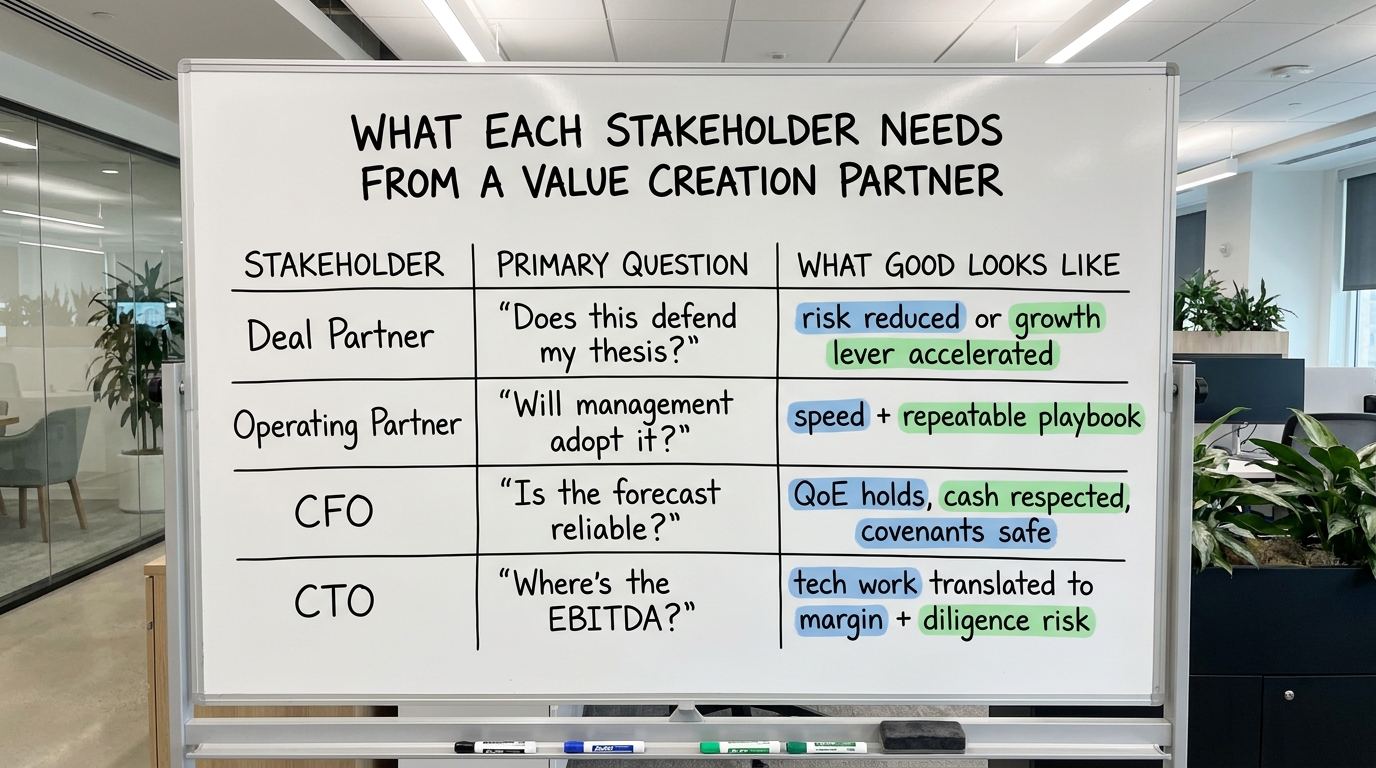
The most common evaluation mistake I see is a deal partner reading a value creation proposal as if they were the operating partner, or an operating partner reading it as if they were the CFO. Each of you needs something different, and a good partner will speak to the right one.
What each stakeholder actually needs
- The deal partner needs the thesis defended. Does this partner reduce a risk you underwrote, or accelerate a growth lever you paid a multiple for? They should be able to tie their work back to the investment committee memo, not to a marketing funnel.
- The operating partner needs speed, adoption inside the management team, and a repeatable playbook. A brilliant plan that the portfolio company CEO ignores is worth nothing. Adoption is the deliverable.
- The CFO needs quality of earnings to hold, cash to be respected, covenants to be safe, and the forecast to be reliable. A partner who proposes a spend that dents cash without a defensible payback window is a problem, not a solution.
- The CTO or technical operating partner needs engineering and product work translated into EBITDA and diligence risk, not described as a backlog of tickets.
When you judge a partner, watch who they instinctively write to. If a firm answers a deal partner’s thesis question with a description of engineering activity, that is a tell. I have written before about why value creation consultants and operators split on exactly this point: advice versus P&L accountability. The stakeholder you are speaking as determines which one you should hire.
Advisory produces recommendations, accountability carries the number, and they are not interchangeable
There is a category confusion at the center of most bad hires. Some firms sell advice. They produce a diagnostic, a set of recommendations, a slide deck, and a handoff. Others embed and carry the number. Both have a place, but they are not interchangeable, and the price you pay should reflect which one you are buying.
Advisory is appropriate when you need a point of view for the investment committee, a second read on a management team’s plan, or a diagnostic before you commit capital. It is inappropriate as a substitute for execution during a 100-day plan. I have argued that PE value creation requires embedded partners, not advisory firms, and the reason is mechanical: the value in a hold is created by things happening inside the operating company, not by things being recommended to it.
How to tell which one you are being sold
Ask who owns the result. If the answer is “we advise and management executes,” you have bought advice and you still need an execution owner. If the answer is “we own the win-rate target and we sit in the pipeline reviews,” you have bought accountability. A fractional commercial leader operating inside the business is a different instrument than a consultant. I have written specifically about how fractional CROs in PE fix win rate and CAC rather than revenue theory, and the distinction matters because theory does not close a covenant gap.
Five questions that predict whether the number moves
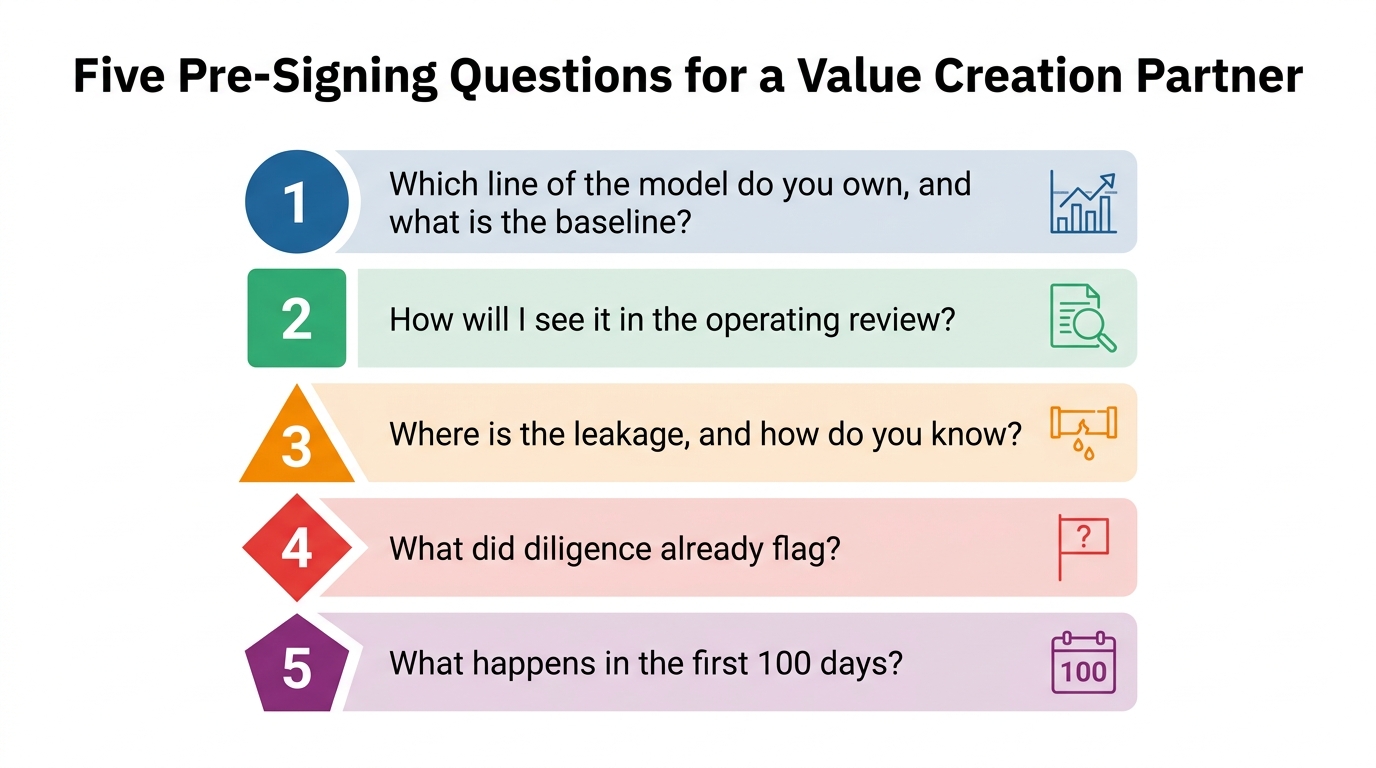
Over dozens of these engagements I have narrowed the pre-signing evaluation to five questions. None of them are about capabilities. All of them are about outcomes and accountability.
1. Which line of the model do you own, and what is the baseline?
A partner who cannot state a baseline cannot prove improvement later. Any credible outcome claim needs an account, a period, a baseline, and a method. If a firm shows you a case study that says “grew pipeline 40 percent” with none of those four, treat it as marketing, not evidence. This is not pedantry. It is the same discipline your CFO applies when a management team presents adjusted EBITDA and the art of add-backs. Numbers without method are decoration. The auditing and finance profession treats method with exactly this seriousness, as AICPA & CIMA’s standards work reflects at AICPA & CIMA.
2. How will I see it in the operating review?
The improvement has to surface in the monthly and quarterly cadence you already run. If a partner cannot map their work to the commercial KPIs you review, they are working outside your visibility, which is a governance risk. The metrics that matter in a portfolio company operating review are the ones a good partner instruments from day one, not the ones they discover in month four.
3. Where is the leakage, and how do you know?
Most mid-market B2B companies do not have a growth problem first. They have a leakage problem: deals lost in the funnel, churn nobody instruments, pricing left on the table, renewals that quietly slip. A partner who leads with a demand-generation spend before diagnosing leakage is selling the expensive fix before the cheap one. I built the B2B portfolio revenue leakage diagnostic for exactly this reason, and the good partners run something like it before proposing spend.
4. What did diligence already flag?
If commercial due diligence surfaced red flags, the value creation partner should be able to speak to them directly and say which ones they will close. A partner who has not read, or asks for, the commercial due diligence findings is going to rediscover known problems on your clock.
5. What happens in the first 100 days?
Vague answers here are disqualifying. A serious partner has a structured 100-day go-to-market plan for a newly acquired B2B business with sequenced, dated milestones and an explicit statement of what will be true by day 100 that is not true today. If the first 100 days are described as “discovery,” you are paying execution rates for a diagnostic.
Four failure modes that predict a wasted hold, and how to price them out before you sign
Knowing what good looks like is only half the job. The other half is recognizing the patterns that predict failure, because they are common and they are dressed up well.
The activity trap
Hours, tickets, features, campaigns, and traffic are the vendor register, not the outcome. A partner who reports activity as if it were value is the single most common failure mode in this category. When the monthly report leads with “we shipped 14 features and ran 6 campaigns,” and you have to hunt for what happened to revenue or margin, you have hired activity. The report should lead with the financial consequence and treat activity as the supporting detail.
The revenue-theory trap
Some firms sell a growth narrative that is analytically elegant and operationally hollow. A total-addressable-market slide is not a plan. I have written about the private equity GTM value creation pitfalls that recur here, and most of them share a root cause: a plan built on what the market could theoretically yield rather than on what the current sales motion is leaking today.
The cash-blind trap
A plan that grows revenue while quietly consuming cash can breach a covenant before it produces a return. The CFO has to be in the room, and the partner has to respect the cash and covenant constraints as hard boundaries. McKinsey’s private capital research has repeatedly emphasized that operational value creation in the current environment lives or dies on execution discipline inside these constraints, not on ambition. Their broader work is worth reading at McKinsey, and BCG’s principal investors and private equity practice makes a similar point about the widening gap between top-quartile and median operational outcomes.
The no-adoption trap
The best plan in the world dies if the portfolio company’s management team does not run it. A value creation partner who cannot get adoption is producing shelfware. Ask how they earn the CEO’s buy-in, because a partner imposed over management’s objection rarely survives contact with the operating reality.
Extended holds and uncertain exits put more weight on operational improvement you can bank during the hold
Hold periods have lengthened and exits have been harder to time, which puts more weight on operational improvement you can actually realize during the hold. PitchBook’s research and data have tracked the extended holds and the pressure on distributions across recent cycles, and you can follow their coverage at PitchBook. When the exit window is uncertain, the value you can bank through operations, run-rate improvement you can defend in a QoE, becomes the part of the return you actually control.
The Harvard Law School Forum on Corporate Governance publishes ongoing analysis of how sponsors and boards are governing portfolio-level value creation, worth reading for the governance framing at the Forum on Corporate Governance. And for the deal-level view of where operational improvement is expected to carry more of the return, Harvard Business Review’s coverage of mergers and acquisitions tracks the same shift from a strategy perspective.
The through line across all of this: the source of returns has moved toward operations, the hold is where that gets done, and the value creation partner is the instrument. That raises the stakes on choosing correctly and lowers your tolerance for a partner who sells activity.
Start with a paid diagnostic, small and time-boxed, to learn whether the partner thinks in outcomes
I would not start with a full engagement. I would start with a paid diagnostic, small and time-boxed, because a diagnostic is the cheapest way to learn whether a partner thinks in outcomes or in activity. The output of that diagnostic tells you almost everything: does it name the specific leakage, does it classify impact honestly, does it map to your operating review, and does it produce a sequenced plan with dated milestones?
That is exactly how we structure it at DevriX. A value creation diagnostic first, scoped tightly, then a 100-day value creation plan with owned outcomes if the diagnostic proves the thesis. The diagnostic is inexpensive by design. Its job is to de-risk the larger decision, which is the same logic you apply to a QoE before you commit deal capital. If a partner will not do a small, accountable first step, that itself is a signal.
The trust test underneath all of it
Underneath the five questions and the failure modes is one question of character: does this partner tell you the number is smaller when it is smaller? The ones who will pass forecast off as realized, or activity off as outcome, are the ones who will also tell you the plan is on track when it is not. I have watched a management team’s operational discipline become the difference between a defensible exit and a distressed one, which is one of the themes in my writing on future-proofing organizations. Honesty about the number is not a soft trait. It is the leading indicator of whether the plan will hold up in diligence at exit.
Judge a value creation partner the way you underwrite a deal, not the way you buy a service
Demand a named lever, a baseline, and a classification of the impact. Insist that it surface in the operating review you already run. Reject activity dressed as outcome, revenue theory dressed as a plan, and any growth story that ignores cash. Start with a small, paid, accountable diagnostic and let the output decide the rest.
The firms that pass this test are rare, and they tend to price themselves like operators rather than vendors, because they are carrying a number rather than logging hours. That is the trade you want. You are paying for enterprise value you can defend at exit, not for a partner who was busy.
Where to take this next
If you are holding a company where the commercial number needs to move and you are not sure whether you are buying advice or accountability, that is the exact decision a diagnostic resolves. We run a value creation diagnostic that maps the leakage, names the levers, and classifies the impact before anyone commits to a larger plan, then a 100-day value creation plan with owned outcomes if the thesis holds.
If you want to pressure-test your current partner or your own plan against the five questions above, start with a conversation. You can book an advisory exploration with me directly, and if the fit is right, we will scope the diagnostic from there. The goal is the same one you have: value you can prove, on a timeline you can bank.