You are three weeks from close on a software-enabled business, the LOI is signed, and the growth thesis rests on a product roadmap the target’s founder describes with total confidence. The problem is that nobody on your deal team can tell you whether the codebase underneath that roadmap can absorb the next 18 months of feature work, or whether it will consume your first two years of EBITDA in rewrites, security remediation, and key-person recovery. That gap is not academic. It is the difference between a value-creation plan you can underwrite and a forecast built on a system you have never actually inspected.
A code quality assessment for acquisition exists to close that gap, and it exists to inform exactly three decisions: what you pay, what you commit to in the first year, and what you flag on the risk register before you own the problem. This is not a code review for the sake of engineering hygiene. It is a commercial instrument. Below is the framework I use to run these assessments and, more importantly, how a deal partner or operating partner should read the output without needing to read a single line of code.
If you want the broader context this sits inside, our approach to technology due diligence treats code as one workstream among several, but it is the one that most often surprises buyers after close.
1. Why code quality is a pricing input, not a technical footnote
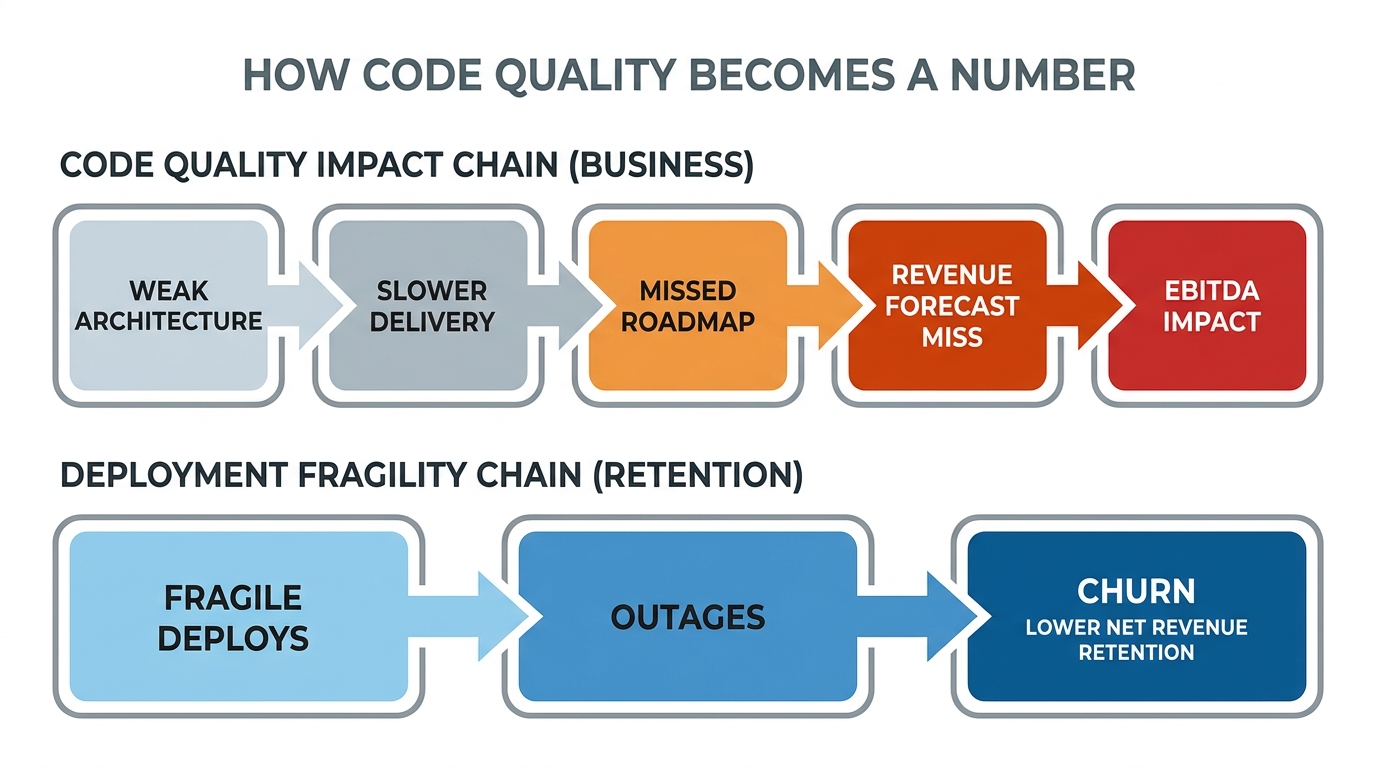
The reason this matters is that code quality does not stay a technical fact. It converts into money on a predictable schedule. Poor architecture shows up as slower feature delivery, which shows up as a missed roadmap, which shows up as a revenue forecast you do not hit. A brittle deployment process shows up as outages, which show up as churn. A single engineer who holds the entire domain model in his head shows up as an integration dependency the day he resigns.
Bain’s annual report on the private equity industry has tracked for years how value creation has shifted away from multiple expansion and financial engineering toward operational improvement, and software-enabled targets are where that operational lever is most concentrated. You can review Bain’s ongoing work on this in the Bain Global Private Equity Report. When the thesis depends on shipping more product to more customers, the engine that ships the product is not a footnote. It is the asset.
The practical consequence is that a code quality assessment for acquisition needs to produce numbers a deal partner can put next to the model, not adjectives an engineer would enjoy. “The code is messy” is useless. “Roughly 30 percent of engineering capacity is currently absorbed by rework and firefighting, which caps realistic feature throughput below the roadmap you underwrote” is a pricing input.
2. The four questions the assessment has to answer
Before any tooling runs, I anchor the engagement to four questions, each mapped to a decision the buyer owns. If the assessment cannot answer these, it has failed regardless of how thorough the technical appendix looks.
Can this codebase carry the growth thesis?
Not “is it good code” but “can it ship what the model assumes, at the pace the model assumes, with the team it currently has.” This informs the revenue build.
What will it cost to make it carry the thesis?
Remediation, refactoring, hiring, tooling. This informs your first-year budget and, if it is severe enough, the price.
What could break in the first 12 months?
Security exposure, single points of failure, unsupported dependencies, compliance gaps. This informs the risk register and the reps you will want.
How dependent is all of this on specific people?
This informs retention packages and Day 1 planning. Key-person risk in engineering is the most consistently underpriced item I see in software deals.
Everything the technical team produces should ladder up to one of these four. This discipline is also what separates a real assessment from a report you can safely ignore, a distinction I have written about in the context of an operational value creation plan someone is actually on the hook to deliver.
3. The four-tier grading framework
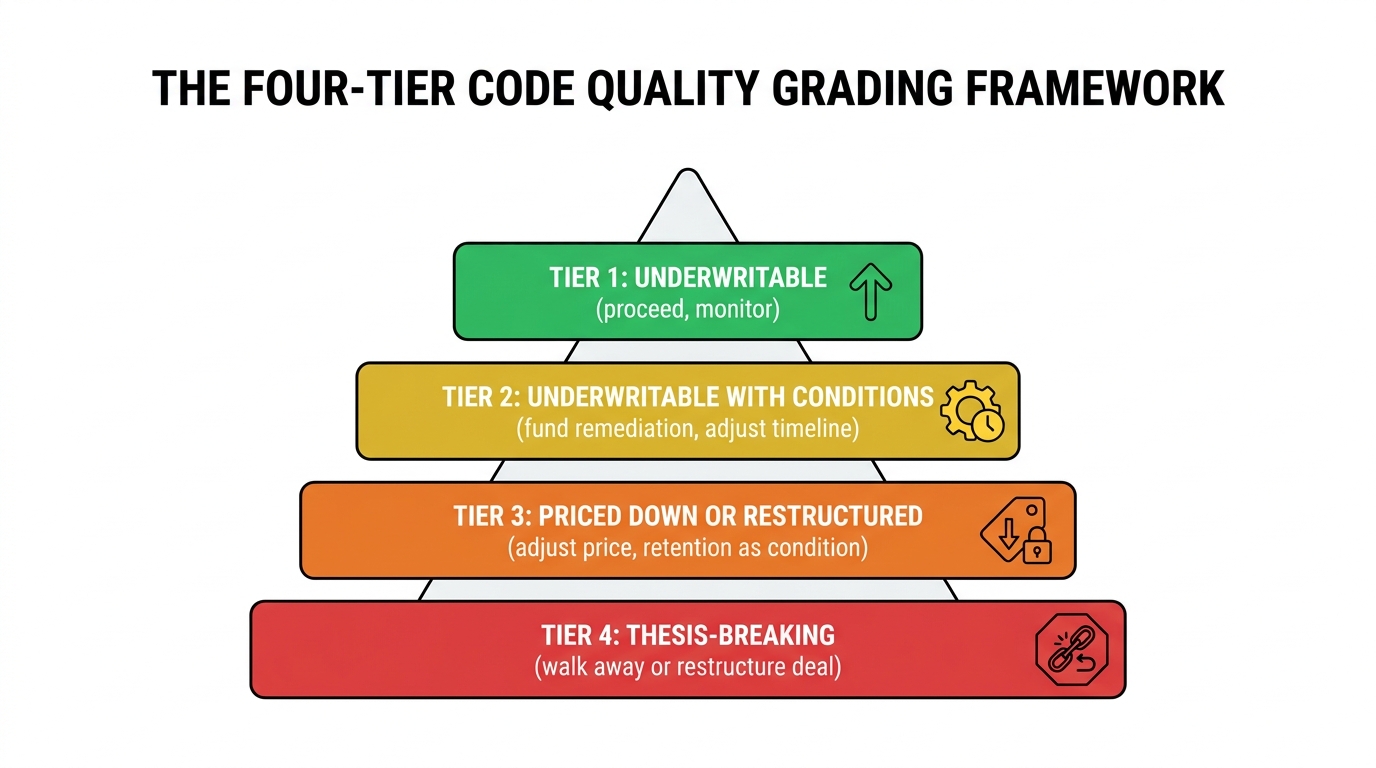
I grade codebases on four tiers, and I deliberately keep the labels blunt because the audience is not the engineering team, it is the investment committee. Each tier carries a default commercial posture.
Tier 1, Underwritable
The codebase supports the thesis as modeled. Architecture is coherent, tests exist and run, deployment is repeatable, dependencies are current, and the team could onboard a new engineer in weeks. Commercial posture: proceed, standard monitoring in the first 100 days.
Tier 2, Underwritable with conditions
The core is sound but specific areas need investment before the roadmap is credible. Maybe test coverage is thin in the payments module, maybe one service is a known bottleneck. Commercial posture: proceed, fund a named remediation workstream, adjust the roadmap timeline in the model.
Tier 3, Priced down or restructured
Material issues that will consume meaningful capacity and capital. Architecture fights the roadmap, deployment is manual and error-prone, key-person concentration is acute. Commercial posture: reflect remediation cost in price, restructure earnouts, or make retention a condition of close.
Tier 4, Thesis-breaking
The codebase cannot carry the growth story without a rebuild, or the security and compliance exposure is severe enough to be a standalone liability. Commercial posture: this is a walk-away or a fundamentally different deal.
The value of a tiered output is that it forces a decision. A 40-page report with no verdict lets everyone read their own preferred conclusion into it. A tier, with the evidence behind it and a named commercial posture, does not.
4. What we actually inspect, and what each signal tells you commercially
Deal partners do not need to know the tools. They need to know what each area of inspection reveals about their decision. Here is the mapping I use.
- Architecture and coupling. How tangled are the components? Tight coupling means every new feature risks breaking three others, which caps delivery speed. This is the single strongest predictor of whether the roadmap is realistic.
- Test coverage and quality gates. Not just the percentage, which is easy to game, but whether tests catch real regressions. Thin coverage means every release is a gamble, which means slower, more cautious shipping.
- Deployment and release process. Can the team ship safely and often, or is every deploy a manual, high-anxiety event? This directly limits how fast you can turn engineering spend into shipped revenue-generating features.
- Dependency health and technical currency. Outdated or unsupported libraries are latent liabilities, sometimes security ones, sometimes forced-migration ones. Either way, they are unplanned capacity draws.
- Security posture. Not a full penetration test, but obvious exposure: secrets in the codebase, missing access controls, known vulnerable dependencies. This feeds the risk register directly.
- Documentation and knowledge distribution. How much of the system lives only in someone’s head? This is your key-person risk made visible.
McKinsey’s research on private capital and technology-driven value creation, available through McKinsey’s insights hub, has consistently framed engineering capability as an operating lever rather than a cost center. The inspection areas above are how you find out whether that lever is available to you or already spent.
5. Reading the report without reading the code
The most common failure I see is not a bad assessment. It is a good assessment that the deal team cannot use because it was written for engineers. A code quality assessment for acquisition is only worth its fee if the investment committee can act on it in the room.
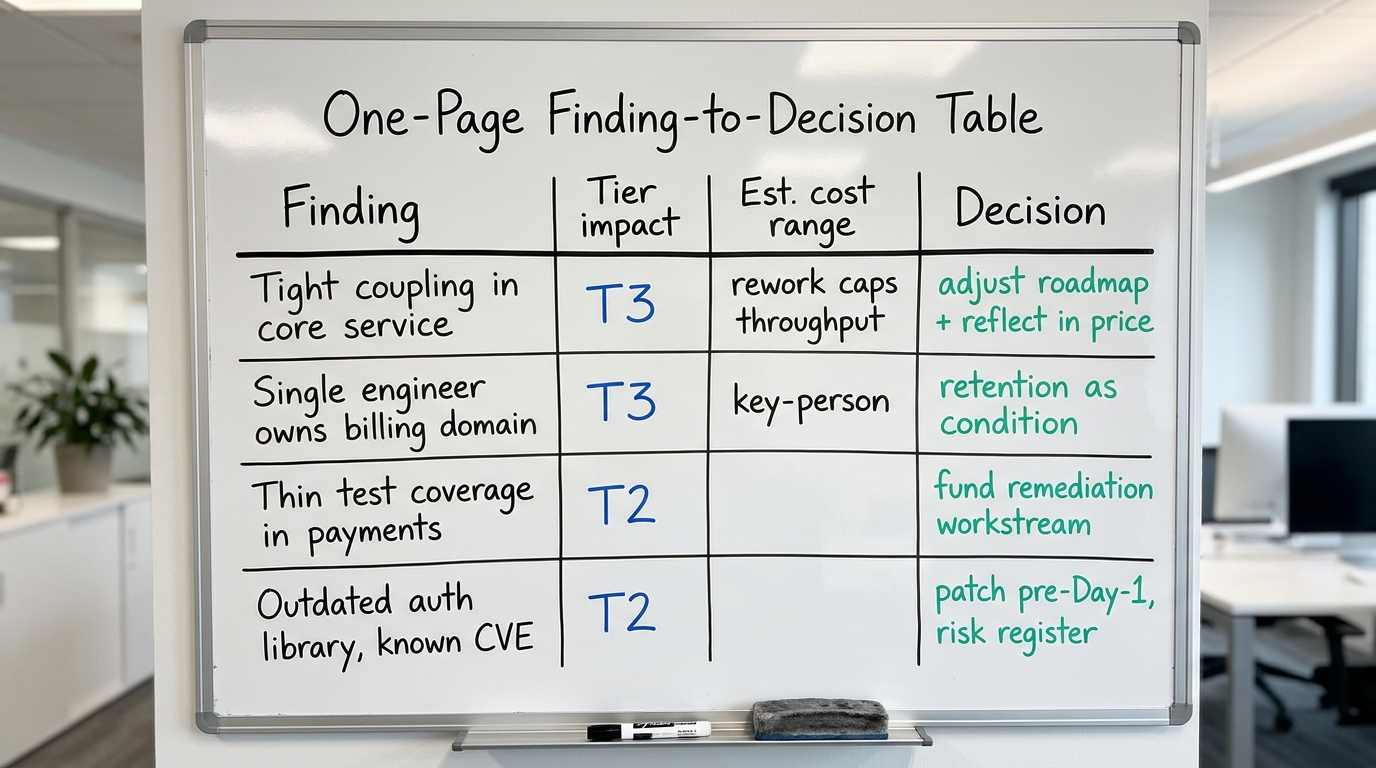
So the deliverable has to lead with the tier, the four answers from section two, and a single table that maps each material finding to a dollar range and a decision. The technical detail belongs in an appendix that the operating partner or an incoming part-time CTO can use to enforce decisions after close. The Harvard Law School Forum on Corporate Governance regularly publishes on how diligence findings should map to deal terms and post-close governance, and its archive on corporate governance is a useful reference for structuring that translation between finding and term.
If your technical advisor hands you a report and you cannot, within ten minutes, state the tier and the top three commercial actions, the report is not finished.
6. An applied example, labeled as illustrative
The following is an illustrative scenario, not a client outcome. It exists to show how the framework produces decisions.
A sponsor is acquiring a vertical SaaS business at a multiple that assumes the product ships two major modules in the first 18 months. The pre-LOI screen looked clean: revenue growing, gross margins healthy, a founder-CTO who demos well.
The code quality assessment finds the following. Architecture is a single large application where the billing logic, the reporting engine, and the customer-facing UI all share the same tightly coupled core. Test coverage is real for the reporting engine but nearly absent for billing. Deployment is a manual process the founder-CTO runs personally, on a fixed weekly schedule, from his own machine. The founder-CTO wrote roughly 70 percent of the current codebase and is the only person who understands the billing domain.
Here is the translation. The tight coupling means the two new modules cannot be built in parallel without constant regressions, so the 18-month roadmap is not credible with the current team and structure. That is a Tier 3 finding. The manual deployment tied to one person is both a delivery bottleneck and a key-person risk. The billing knowledge concentration is acute.
The commercial actions follow directly. First, the roadmap in the model is re-timed, which changes the revenue build and therefore the entry price conversation. Second, retention and knowledge transfer for the founder-CTO become a condition of close, not a nice-to-have. Third, the first-year budget now includes a decoupling workstream and a second senior hire, which the buyer funds deliberately rather than discovers in month seven. None of these are visible from a revenue chart. All of them are visible from the code.
This is exactly the class of gap that gets priced down at exit if it is left unaddressed, which I have covered in more detail in exit readiness and the tech gaps buyers price down.
7. Timing and when this assessment earns its fee
The assessment has two natural entry points, and they serve different decisions.
Pre-LOI screen
A lighter, faster read that answers one question: is there a code-based reason not to proceed to LOI, or a reason to adjust the range before you anchor. This is where you catch the Tier 4 problems before you have spent real diligence money.
Confirmatory diligence
The full assessment, run in the window between LOI and close, feeding the tier, the finding-to-decision table, and the first-year budget. This is where you generate the conditions of close and the risk register items you want reflected in terms.
Do not confuse the two. Running only the light screen and treating it as confirmatory is how buyers end up surprised. Running the full assessment on every early-stage target you look at is how deal teams burn budget. PitchBook’s data on deal timelines and diligence spend, available through PitchBook’s research, reflects how compressed these windows have become, which is the practical case for a fixed, fast assessment rather than an open-ended engagement.
8. What happens to the assessment after Day 1
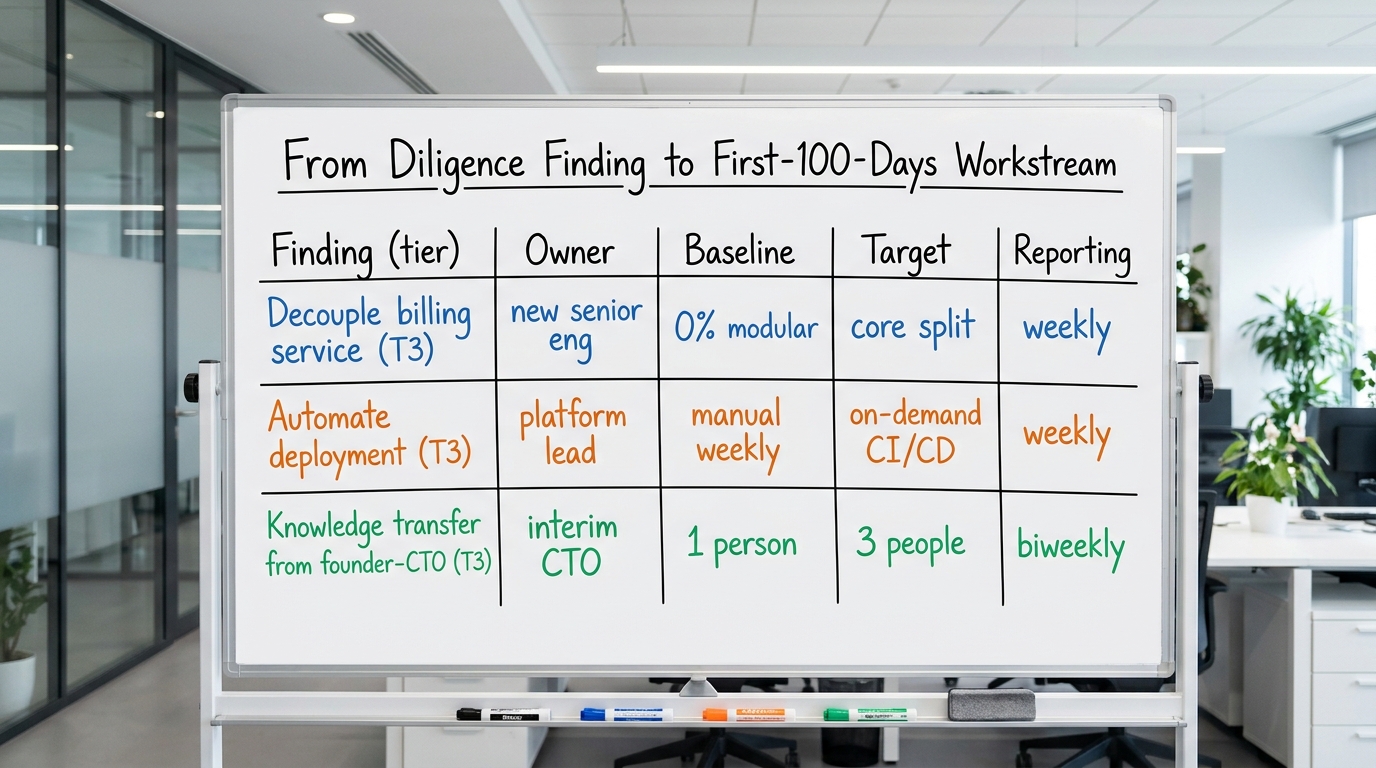
A code quality assessment for acquisition should not die at close. The findings are the first draft of your operating plan. Every Tier 2 and Tier 3 finding is a candidate workstream for the first 100 days, with an owner, a baseline, and a target.
This is where the assessment stops being a diligence artifact and becomes a value-creation instrument. The decoupling workstream, the second hire, the deployment automation, the knowledge transfer from the founder-CTO: these become tracked line items with actual-versus-plan reporting, not vague intentions. The distinction between an advisor who leaves you a document and a partner who operates inside the portfolio company is the difference I draw in how technical value creation partners actually operate inside portfolio companies.
For sponsors without a full-time technology leader across the portfolio, this is also where a virtual CIO arrangement provides coverage without a full-time hire, carrying the findings from diligence into execution so the tier you paid to establish actually improves. Getting engineering, product, and revenue operations pulling in the same direction after close is its own discipline, which I have covered in aligning engineering, product, and RevOps for value creation.
9. The mistakes that make an assessment worthless
A few patterns turn a code quality assessment for acquisition into wasted spend. I flag them because deal teams pay for them regularly.
- Grading against an abstract standard instead of the thesis. Code that is imperfect but sufficient for a business that ships twice a year does not need the same bar as one that ships daily. The question is always fitness for the thesis, not fitness for a textbook.
- Metrics without judgment. Coverage percentages, complexity scores, and line counts are inputs. A senior engineer’s read of whether the system can absorb the roadmap is the output. Tooling that runs without an experienced human interpreting it produces confident nonsense.
- No named cost or decision. A finding with no dollar range and no recommended action is a fact, not intelligence. Every material finding needs both.
- Ignoring the people. The org chart and the commit history together tell you where the risk really lives. An assessment that inspects code and not the people who wrote it misses the most expensive surprises.
The AICPA and CIMA have published extensively on diligence rigor and how evidence should support a conclusion, and their standards and guidance are a useful reminder that the discipline of tying a finding to evidence to a decision is not unique to financial diligence. It applies to code just as strictly.
10. Conclusion and next step
A code quality assessment for acquisition is not a technical courtesy you run to satisfy the engineering-minded partner. It is a pricing input, a risk register, and the first draft of your operating plan, all produced in the diligence window when you can still act on it. Judge it by whether it hands you a tier, four clear answers, and a table that maps findings to dollars and decisions. If it does not, it was activity, not evidence.
The buyers who get this right treat the codebase as the asset it is when the thesis depends on shipping software, and they carry the findings straight from diligence into the first 100 days. That is the whole point of the exercise: not to admire the code, but to underwrite it, price it, and improve it.
When you have a live target and need a fixed, fast read that a deal team can act on, our private equity practice at DevriX runs pre-LOI screens and 5-day technical due diligence built to produce a tier and a decision, not a report you file and forget. If you have a deal in the window, that is the place to start.