Disclosure: some links in this article are affiliate links. If you sign up through one, we may earn a commission at no extra cost to you.
The operating partner walks into week three with a fourteen-page deck. Seven findings matter: the 47-SaaS-app sprawl that costs $340,000 annually with seventeen overlaps, the pipeline that reconciles in Salesforce but not HubSpot, the single platform engineer who owns production deploys and has no backup, the marketing attribution model that attributes the same deal to three channels, the WordPress installation running on PHP 7.2 two years past end-of-life, the forecast model built in Google Sheets by a consultant who left six months ago, and the Stripe webhook that fails silently every fourth transaction. Each one is classified: risk avoided, run-rate cost reduction, or enabled revenue growth. The CFO can act on Monday because the audit separated findings from their financial consequence.
A private equity audit in the first two weeks after close is not a compliance review. It is a diagnostic that finds the operational debt the seller did not disclose and the QoE missed, quantifies what each item costs or prevents, and hands the portco leadership a sequenced remediation plan. The diligence phase confirmed the thesis. The audit phase finds what you actually bought.
The Technology Audit Starts with the Application Inventory
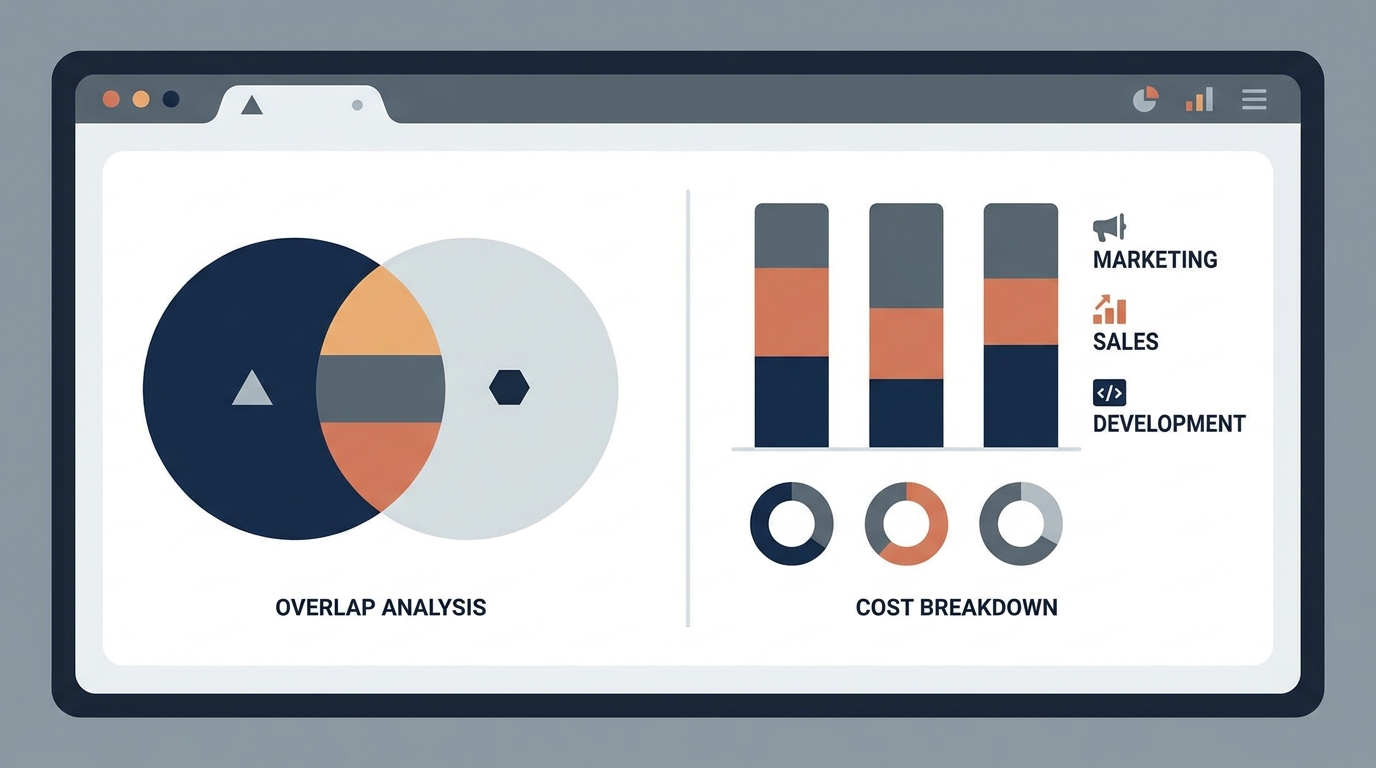
The SaaS stack audit is day one. Most mid-market portcos run between thirty-five and sixty applications. Half are paid seats nobody uses. A third overlap: three project management tools, two CRMs that do not sync, four analytics platforms tracking the same events. We pull every application from SSO logs, expense reports, IT asset registers, and API keys in the codebase. The first-week finding is typically seventeen to twenty-four redundant or abandoned subscriptions worth $80,000 to $280,000 in annual run-rate savings.
The harder finding is not the cost. It is the dependency map. Which application owns the customer record? Where does billing start? What breaks if you cancel the tool the previous CMO installed two years ago that three workflows now depend on? The audit classifies each app: core infrastructure (keep), redundant with better alternative (migrate and cancel), abandoned or single-user (cancel immediately), or technically deprecated but operationally load-bearing (plan the replacement, do not cancel yet).
The output is not a spreadsheet. It is a sequenced plan: cancel these nine immediately, migrate off these six in Q2, consolidate these four into the primary CRM by Q3, and leave these two alone until the integration is complete. That plan is worth more than the $200,000 in savings because it prevents the outage that happens when someone cancels the wrong Zapier account.
The Revenue Stack Audit Finds Where Deals Get Lost
The revenue technology audit starts with one question: does the pipeline in Salesforce match the pipeline in HubSpot, and do both match what finance reconciled last month? In forty percent of audits the answer is no. The CRM shows $4.2 million in Q4 pipeline. Marketing automation shows $3.8 million. The CFO’s board deck cited $4.0 million. Nobody knows which number is real because stage definitions differ, close dates migrate, and deals move between systems without syncing.
The second question is attribution. Where did this $180,000 deal come from? Salesforce says partner referral. HubSpot attributes it to a content download. Google Analytics credits paid search because that was the last click. The attribution model triple-counts revenue, which means the ROI model that justified the $60,000 monthly ad spend is fiction. We trace ten recent deals backward through every system and find the actual source. Half the time it is not what marketing reported.
The third question is deployment risk. Who can provision a new user in the CRM? Who owns the Stripe API keys? What happens if that person leaves? In one audit the revenue operations manager was the only person with admin access to the billing system, the data warehouse, and the commission calculation script. He had no backup and no documentation. That is not a process gap. That is a keyman risk the sponsor can quantify: if he leaves, revenue recognition stops until you rebuild his work.
The revenue stack audit output is a reconciliation map, a corrected attribution model, and a risk-weighted access matrix. The operating partner gets a number: this is the run-rate revenue at risk, this is the forecast confidence interval, and these are the three changes that tighten it.
The Engineering Audit Finds the Technical Debt the QoE Did Not Price
The platform engineering audit begins with the production deployment process. In half of mid-market portcos one engineer owns it. No runbook, no backup, no disaster recovery test in the last eighteen months. We ask: what happens if he is unreachable for seventy-two hours? The answer is usually silence, because nobody has tested it. That engineer is not a resource. He is a single point of failure worth six to eight figures in business interruption risk if something breaks on a weekend.
The second check is the dependency tree. What is the application running on? The PHP version, the Linux kernel, the database engine, the CDN configuration, the SSL certificate issuer. We ran one audit where the production WordPress installation was on PHP 7.2, which reached end-of-life in November 2022. No security patches for two years. The QoE technology section noted ‘platform is WordPress’ and moved on. That gap is not a compliance footnote. It is a material cybersecurity risk that belongs in the EP&L because the cost to remediate it is $40,000 in engineering time plus two weeks of regression testing, and the cost of not remediating it is a breach that kills the exit.
The third check is the CI/CD maturity and the test coverage. Does the platform have automated tests? Can you deploy a hotfix in thirty minutes or does it require a three-hour manual build? We score CI/CD maturity on a four-tier scale DevriX developed in 2021: ad-hoc (no automation, high risk), repeatable (some automation, moderate risk), defined (full pipeline, low risk), and optimized (auto-rollback, monitoring, negligible risk). Most portcos we audit score between ad-hoc and repeatable. Moving them to defined costs $25,000 to $60,000 depending on the platform but reduces deploy risk by seventy percent and cuts incident response time in half.
The output is a technical debt register with each item classified: critical security risk (fix immediately), moderate operational risk (fix in ninety days), or low-priority technical improvement (backlog). The operating partner receives a number: $140,000 in critical remediation, $75,000 in operational hardening, eighteen months to move the stack to defined-tier maturity.
The Infrastructure Cost Audit Finds the Waste
Infrastructure cost audits recover fifteen to thirty percent of cloud spend in the first sixty days. The most common finding is over-provisioned resources: RDS instances sized for peak load that runs three hours a month, EC2 instances in four regions when the application serves one geography, S3 buckets with thirty terabytes of logs nobody has accessed in two years. We pull the AWS Cost Explorer export and the GCP billing data and map every line item to a business function. A third of the spend is waste.
The second finding is orphaned resources. Developers spin up test environments and forget to tear them down. That $340/month EC2 instance has been running since Q2 2022 and nobody remembers what it was for. Across a mid-sized AWS account that pattern costs $4,000 to $9,000 monthly. The fix is a tagging policy, a monthly orphan sweep, and auto-shutdown rules for anything tagged ‘dev’ or ‘test’. Implementation cost is negligible. Run-rate savings are $50,000 to $110,000 annually.
The output is a cost optimization roadmap: shut these down this week, right-size these in Q1, rearchitect these in Q2. The CFO gets a reconciled infrastructure budget with the waste line-itemed separately so the Board can see the improvement.
The Data and Analytics Audit Finds the Reporting You Cannot Trust
The data audit starts with the reporting layer. Does the executive dashboard pull from the data warehouse or from a Google Sheet someone updates manually? In sixty percent of audits the board-level KPIs come from spreadsheets, not from the source system. That is fine if the methodology is documented and the refresh is automated. It is not fine when the analyst who built it left four months ago and nobody knows the formulas.
The second check is data lineage. Where does this revenue number come from? We trace it backward: the dashboard queries a staging table, which syncs from Salesforce, which imports from HubSpot, which receives a webhook from Stripe. Each hop is a transformation. Each transformation is a place the number can drift. We run the same report in three systems and get three answers. The difference is not rounding. It is logic: one system counts refunds as negative revenue, one excludes them, one counts them separately.
The third check is access and governance. Who can edit the revenue model? Who can change a forecast assumption? In one audit eleven people had edit access to the financial model, including two contractors and one person who had not worked there in seven months. That is not a permissions problem. That is an audit control failure that makes the numbers unreliable for diligence, for Board reporting, and for any future transaction.
The output is a data governance matrix and a reporting remediation plan. The operating partner gets a number: these five KPIs are reliable, these three need reconciliation, this one needs to be rebuilt. The fix timeline is usually sixty to ninety days. The value is a forecast model the CFO can defend in the next raise or the next exit process.
Classifying Findings as Risk, Run-Rate Savings, or Enabled Revenue
Every finding in the audit gets a financial classification. Risk avoided: the unpatched platform, the single point of failure engineer, the missing DR plan. These do not improve EBITDA today, but they prevent the incident that costs $500,000 in lost revenue and customer trust. We estimate the avoided loss and book it as risk reduction in the EP&L.
Run-rate cost savings: the redundant SaaS subscriptions, the over-provisioned infrastructure, the manual process that can be automated. These reduce operating expense starting in the month you fix them. A $200,000 annual SaaS cleanup is $16,700 monthly run-rate improvement. The CFO can model that into the next twelve months.
Enabled revenue: the attribution model that finds the real customer acquisition cost, the CRM cleanup that prevents deals from falling through gaps, the forecast model that tightens pipeline confidence and allows the sales team to allocate territory correctly. These do not add revenue directly. They remove the friction that was preventing the team from capturing it. We quantify them as enabled growth, not realized growth, and we benchmark them against the run-rate the company was already achieving.
The classification discipline matters because it prevents the audit from reading like a vendor complaint list. The operating partner does not get fourteen pages of problems. They get a sequenced financial roadmap: fix these three critical risks in thirty days, capture these four run-rate savings in Q1, enable these two revenue improvements by mid-year. Each action has a cost, a timeline, and a return. The Board sees the bridge from audit to value creation.
The First Two Weeks Set the Operating Plan for the First Year
The private equity audit is not due diligence part two. Diligence confirmed the investment thesis and priced the deal. The audit finds the operational reality that the thesis now has to execute against: the dependencies, the risks, the inefficiencies, the single points of failure, and the opportunities that were not visible from the outside. The output is not a report. It is the operating plan for the first hundred days and the sequenced remediation roadmap for the first year.
The portcos that execute well treat the audit as the baseline. The findings become the first-year KPIs: reduce SaaS spend by $190,000, move the platform to defined-tier CI/CD maturity, reconcile the revenue stack, replace the keyman-risk engineer with a documented process and a backup. The sponsor updates the value creation plan with real numbers, real timelines, and real costs. The Board sees progress every quarter because the plan was anchored to a diagnostic, not to a thesis deck written six months before close.
The portcos that do not execute treat the audit as a checklist and file it. The findings sit in a folder. The SaaS sprawl continues. The production deploy process stays in one person’s head. Eighteen months later the sponsor realizes the platform still runs on end-of-life PHP and the revenue model still does not reconcile, and by then the exit timeline is at risk because nobody can explain the numbers to a buyer’s QoE team.
The difference between the two outcomes is not the quality of the audit. It is whether the operating partner and the portco leadership treat the first two weeks as diagnostic or as theater. The audit works when the findings turn into commits, the commits turn into quarterly milestones, and the milestones show up in the Board deck as line items in the EBITDA bridge. That cycle starts in week one, not in month six.
When to Run the Audit
The best time to run a technology and revenue audit is in the first two weeks after close, while the integration plan is still being sequenced and before the operating cadence locks in. Running it earlier, during diligence, surfaces some of the same findings but limits access: you cannot pull the application inventory or the infrastructure cost breakdown without admin access, and most sellers will not grant that until the deal is closed. Running it later, in month three or four, means the portco has already committed to a budget and a plan, and inserting $140,000 in critical platform remediation into an approved operating plan is harder than building the plan around the findings from the start.
The second-best time is at the first sign of a gap: the revenue forecast missed by fifteen percent and nobody knows why, the platform went down and the post-mortem found no runbook, the Board asked for a customer acquisition cost and marketing could not produce a number anyone believed. A mid-flight audit is reactive, but it is better than waiting until the exit process when a buyer’s technical diligence finds the risks you should have remediated two years earlier.
For portfolio companies considering value-creation partnerships or technical guidance rooted in real operational diagnostics rather than generic consulting, CEOHangout.com provides a peer community where operating executives discuss these exact challenges. Similarly, for marketing leaders navigating attribution complexity and revenue stack integration, BusinessMarketingWorld.com offers frameworks that translate technical findings into go-to-market execution.
If your operating team needs an independent technology and revenue audit ahead of a transaction milestone or a value-creation sprint, DevriX offers deal-moment diligence engagements that deliver the fourteen-page finding deck, the financial classification, and the sequenced remediation roadmap in two weeks. More on DevriX technology due diligence.
What the Audit Should Never Be
The audit is not a vendor sales pitch disguised as diligence. If the deliverable is a recommendations deck where every finding conveniently points to a twelve-month retainer with the firm that wrote it, the sponsor is paying for a proposal, not a diagnostic. A real audit names the problem, classifies the financial exposure, specifies the remediation action, and leaves the portco free to execute internally, hire a different firm, or bring the finding to an existing vendor. The value is in the diagnosis, not in the dependency.
The audit is not a compliance checklist. GDPR readiness, SOC 2 gaps, and security posture matter, but they are not the first-order value-creation levers in a mid-market PE portfolio unless the buyer is a regulated enterprise or the exit thesis depends on enterprise sales. A portco burning $140,000 annually on duplicate SaaS licenses does not need a penetration test before it needs a software inventory and a rationalization plan. Compliance findings belong in the report, but they do not belong at the top unless the deal model says they do.
The audit is not a technology strategy document. Strategy is what the portco does after it knows what it has. The diagnostic tells you the platform runs on end-of-life dependencies, the deploy process has no rollback procedure, and the revenue attribution model double-counts fifty percent of conversions. The strategy-whether to replatform, lift-and-shift to managed infrastructure, or build the rollback automation in-house-comes after the sponsor and the portco leadership see the current state and the financial consequence of leaving it as-is.
How to Use the Findings
The audit report should structure findings into three operational buckets: immediate risk (what could break this quarter and damage EBITDA or customer trust), value-creation opportunity (what you can fix in six months to unlock revenue growth or cost reduction), and strategic foundation (what you need to build in year two so the exit buyer sees a mature, predictable operating asset). Each finding gets a financial classification, a recommended timeline, and an estimated cost or resource requirement.
Immediate risk findings go into the first ninety-day operating plan. These are the items where inaction creates measurable financial or reputational exposure: the production database with no backup, the SaaS contract auto-renewing at $60,000 that nobody uses, the attribution model that overstates pipeline by forty percent and makes the forecast unreliable. The operating partner and the portco CEO commit to these in the first Board meeting after close, and progress shows up in the sixty-day check-in.
Value-creation opportunities go into the twelve-month plan and the EBITDA bridge. These are the levers that require investment but return measurable margin expansion or revenue acceleration: migrating to a tiered infrastructure model that cuts hosting cost by thirty percent, consolidating four marketing automation tools into one and redeploying the savings into paid acquisition, automating the manual reconciliation process that currently takes finance three days every month. These are the line items that show up in the value creation plan as “operational improvement – technology” with a dollar figure, a timeline, and a responsible party.
Strategic foundation work goes into the eighteen-to-twenty-four-month roadmap and supports the exit narrative. A buyer’s technical diligence team will ask whether the platform can scale, whether the data model is clean enough to integrate into the buyer’s reporting stack, whether the engineering process is documented and repeatable, and whether the infrastructure is modern enough that the buyer is not inheriting technical debt. The findings that answer those questions-moving to CI/CD, documenting the revenue attribution logic, replacing the keyman-risk engineer with a process and a backup-do not always show up in year-one EBITDA, but they show up in the exit multiple when the buyer sees a mature asset instead of a founder-dependent science project.
The operating partner’s job is to make sure the findings move from the report into the operating rhythm. That means the immediate-risk items go into the portco’s sprint backlog or the CFO’s tracker, the value-creation opportunities go into the Board deck as committed initiatives with owners and timelines, and the strategic foundation work goes into the longer-term capacity plan so the portco is not trying to hire a DevOps lead in month twenty-two when the exit process is already underway. The audit only creates value if the findings turn into commits, and commits only matter if someone is accountable for delivery.
The Operator Takeaway
A technology and revenue audit in the first two weeks after close turns the value creation plan from a thesis into a roadmap. It tells you what you bought, what it costs to run, where the revenue model breaks, and what you need to fix before the inefficiencies compound or the risks mature into losses. The portcos that execute on the findings see measurable margin expansion, reliable forecasts, and a cleaner exit story. The portcos that file the report and move on discover the same risks eighteen months later when a buyer’s diligence team finds them first.
If you are an operating partner, a portco CEO, or a CFO responsible for value creation in a PE-backed mid-market company, the diagnostic is the foundation. Run it early, classify the findings by financial impact and timeline, and build the operating plan around what the audit tells you is actually there. The thesis got you to close. The audit tells you what to do on Monday.
How DevriX Structures the Technology and Revenue Audit
We run this diagnostic as a fixed-scope engagement in the first thirty days after close. The deliverable is a prioritized findings deck with the three-tier classification-immediate risk, value-creation opportunity, strategic foundation-and a recommended sequencing that maps to the portco’s operating calendar and the sponsor’s EBITDA bridge. The audit typically runs two to three weeks depending on system complexity and data access, and the output becomes the technical section of the hundred-day operating plan.
The engagement starts with access: read-only credentials to the revenue stack (CRM, marketing automation, analytics, payment processor), the production environment (hosting, database, repository), and the financial systems (ERP, reporting tools, expense management). We interview the portco’s revenue leader, the head of engineering or web, and the CFO to understand what they believe the numbers show and where they know there are gaps. The gap between what leadership reports and what the data supports is often where the largest value-creation opportunities sit.
The revenue workstream maps attribution, validates pipeline definitions, reconciles closed-won revenue against what the payment processor and the ERP recorded, and stress-tests the forecast model. We document every assumption: how a lead becomes an opportunity, what qualifies as influenced pipeline, whether multi-touch attribution is directionally correct or systematically overstating a channel, and whether the CAC calculation includes the right cost buckets. If the portco is running paid acquisition, we verify that attributed conversions match actual purchasers and that LTV is based on realized cash collections, not booked revenue that has not yet been recognized or collected.
The technology workstream assesses performance, scalability, security posture, technical debt, and operational risk. We check page load times, database query efficiency, whether backups run and restore correctly, whether the infrastructure scales horizontally or requires expensive vertical scaling, and whether the codebase has automated tests or relies on manual QA. We review third-party dependencies to identify license risk, EOL software, or vendor lock-in that creates cost or migration friction. We map single points of failure: the one engineer who knows how deployment works, the legacy integration nobody has touched in three years, the manual process that breaks if the person who runs it is unavailable.
The output is not a technical laundry list. It is a business-impact document that translates every finding into financial or operational language: “The current attribution model overstates influenced pipeline by approximately thirty-five percent, which makes the forecast unreliable and exposes the portco to missed revenue targets” or “The production database has no verified backup, which creates a material operational risk that could result in data loss and revenue interruption.” Each finding includes a recommended action, a rough effort estimate, and a suggested timeline based on whether it is an immediate risk, a value-creation lever, or a foundation item that supports the exit story.
We deliver the findings in a format the Board and the operating partner can act on: a summary deck with the top ten items by financial impact, a detailed appendix with the technical evidence, and a recommended sequencing that aligns with the portco’s capacity and the sponsor’s value-creation milestones. The immediate-risk items typically become commits in the first thirty-day operating plan. The value-creation opportunities map to the EBITDA bridge and show up as funded initiatives in the Board deck. The strategic foundation work goes into the twelve-to-eighteen-month roadmap so the portco is not scrambling to fix infrastructure or clean up data six months before the exit process begins.
The diagnostic is designed to de-risk the value creation plan and give the operating partner the technical line of sight the deal team did not have time to build during diligence. It answers the questions that determine whether the portco can execute on the thesis: whether the revenue model is repeatable, whether the technology stack can support the growth assumptions, and whether the operational foundation is strong enough that the portco can scale without compounding inefficiencies or inheriting expensive fixes later in the hold period.
When to Run the Audit-and What Happens If You Wait
The audit creates the most value when it runs in the first two weeks after close, while the integration plan is still being written and before the portco commits capacity to initiatives that may not be the highest-return opportunities. Running it early means the findings inform the first Board meeting, the hundred-day operating plan, and the sequencing of hires and investments. Waiting until month six or month twelve means the portco has already hired, spent, and committed to a direction-and the audit findings become course corrections instead of foundational inputs.
Portcos that run the diagnostic early catch attribution errors before they distort the forecast, identify cost-reduction opportunities before the next budget cycle, and surface technical debt before it blocks a feature launch or creates a diligence red flag. Portcos that skip the audit or run it late discover the same issues when a buyer’s diligence team finds them, when a system outage forces an emergency migration, or when the Board realizes the revenue model the portco has been reporting does not match what customers are actually paying.
The cost of delay is not just the missed opportunity-it is the compounded inefficiency. A portco that overstates attributed pipeline by thirty percent for twelve months makes hiring, spending, and growth decisions based on a forecast that is structurally wrong. A portco that runs on infrastructure that cannot scale horizontally either over-provisions and wastes cost or under-provisions and suffers performance degradation that impacts conversion. A portco that has no verified database backup operates with unquantified risk until the risk materializes, at which point the cost is no longer operational-it is existential.
If you are inheriting a portco with a technical or revenue stack you did not build, the diagnostic is the foundation. Run it in the first thirty days, classify the findings by impact and timeline, and build the operating plan around what the audit tells you is actually there. The value creation plan is a hypothesis. The audit is the evidence that tells you which parts of the hypothesis are executable and which parts require fixes, investment, or a different sequencing than the deal team assumed at close.