You are three weeks from signing, the LOI is out, and the technology section of your diligence report reads like a bug tracker. Forty pages of architecture diagrams, a stack inventory, a list of open tickets, and a paragraph of reassurance that “the platform is scalable.” None of it tells you the one thing you need before you commit capital: does the technology support the thesis you underwrote, and what will it cost you to hold that thesis together for the next four years.
That gap is the failure mode I see most often in technology due diligence commissioned by deal teams and operating partners. The work is thorough. It is also unusable, because it describes the asset instead of pricing the risk. This piece is about what buy-side technology due diligence should actually produce, who it is written for, and how to judge whether the report on your desk earned its fee.
What the report is for, and who reads it
A deal partner is not buying software. You are buying a return, and the technology is either an accelerant, a drag, or a landmine on the way to it. So the first test of any buy-side technology due diligence engagement is simple: does the output map to decisions a partner and an operating partner actually make?
Those decisions are few and specific:
- Do we proceed, and at what price?
- What do we insist on in the SPA, in reps, in escrow, in a price adjustment?
- What capital does the technology need in the first year, and is it already in the model?
- What breaks the thesis, and how would we see it coming?
Everything in the report should serve one of those four. A stack inventory that does not change your price or your plan is a cost center. As Bain has documented across its annual global private equity report, value creation has moved decisively from financial engineering toward operational improvement, which means the diligence that matters is the diligence that translates into an operating plan. Technology sits squarely inside that shift.
Write the report to the reader. A deal partner wants thesis, risk, and exit. An operating partner wants speed, adoption, and a plan someone will own on Day 1. A CFO wants the capex line, the covenant exposure, and forecast reliability. A technology assessment that ignores those readers and speaks only to engineers has failed the assignment, whatever its technical merit.
Activity is not risk, and a stack list is not an answer
The most common weak deliverable inventories what exists and calls it diligence. Languages, frameworks, cloud spend, headcount, ticket volume. All true, all beside the point. Knowing a platform runs on a particular framework tells you nothing about whether it will survive a 3x volume increase, whether one person holds the only working knowledge of the billing engine, or whether the roadmap the seller is selling you is real.
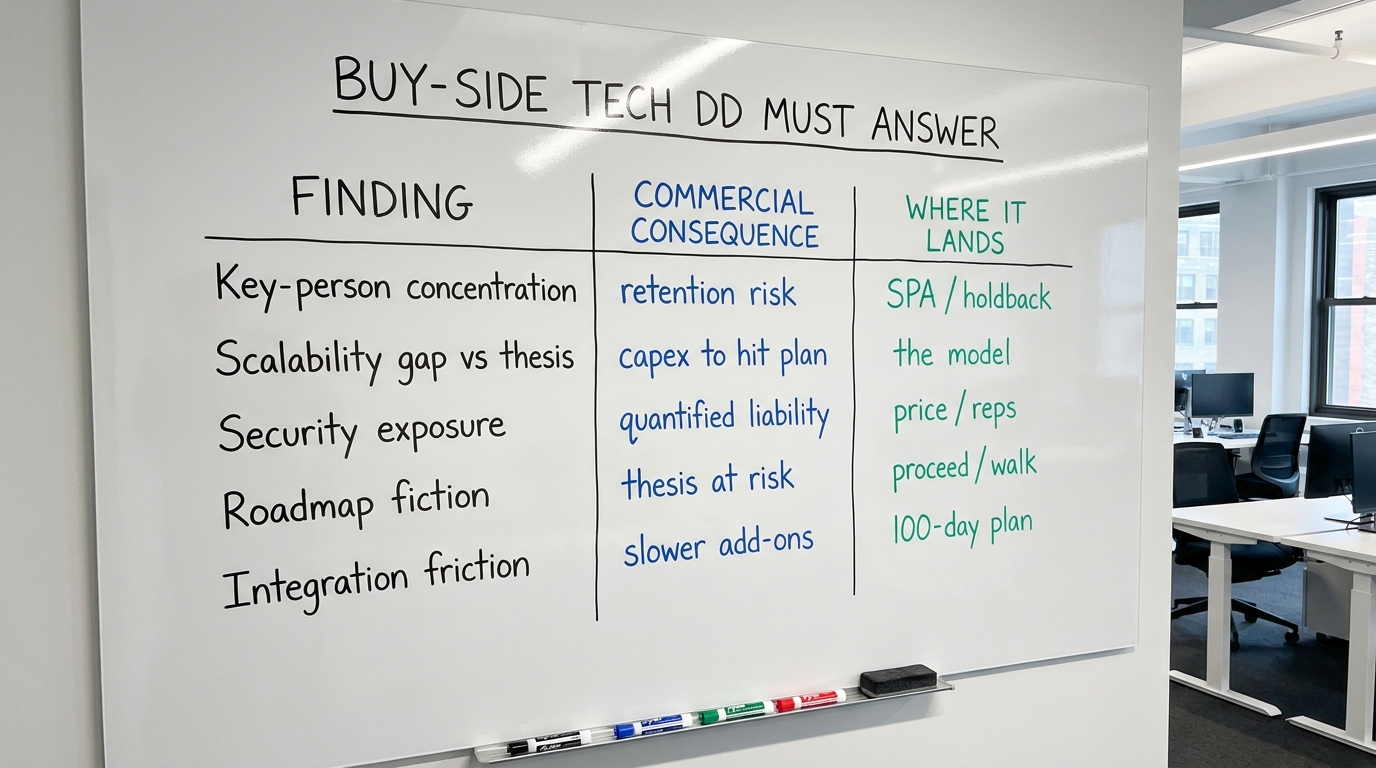
What you need instead is a small set of judgments, each tied to a commercial consequence.
Key-person and knowledge concentration
If a single engineer can halt the business by leaving, that is not a technical note. It is a diligence finding with a dollar sign and a retention clause attached. I have watched deals where the “CTO” was a founding contractor with no employment agreement and no documentation, and where that fact alone justified a holdback.
Scalability against the actual thesis
“Scalable” means nothing without a number. If your thesis assumes doubling transaction volume through an add-on program, the question is whether the architecture, the database, and the integration surface support that specific load, not whether the platform is generically modern.
Security and data posture as priced risk
A material breach exposure, unmanaged customer data, or missing controls is a liability you can quantify and negotiate. The SEC has continued to sharpen expectations around cybersecurity disclosure, and you can follow that trajectory through the U.S. Securities and Exchange Commission. In diligence, the point is not compliance theater. It is whether the exposure changes your price or your reps.
The five questions worth paying for
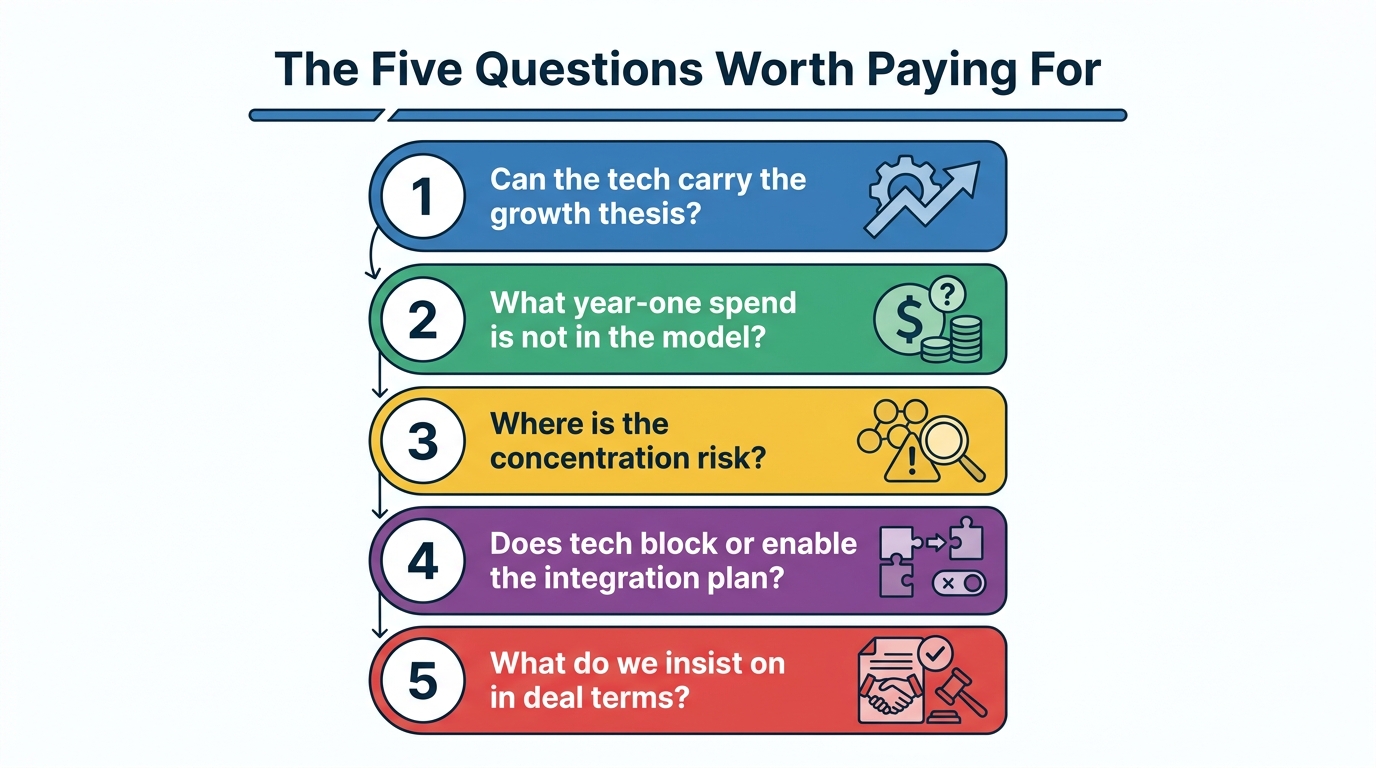
When I scope a buy-side technology due diligence engagement, I hold every workstream against five questions. If a section of the report does not move one of these, it does not belong in the report.
1. Can the technology carry the growth thesis?
Not “is it good software.” Can it hold the volume, the geographies, the product lines, and the customer count the model assumes? This is where you connect engineering to EBITDA. A platform that needs a rebuild before it can scale is a capex line and a delay to your value creation timeline, and both belong in the model before you sign.
2. What has to be spent in year one, and is it in the model?
Deferred maintenance, security remediation, a migration off an end-of-life dependency, a data platform the reporting thesis requires. These are real cash outflows. Surfacing them after close is how a clean-looking deal starts underperforming plan in month four. Bringing them forward is the entire point of paying for diligence.
3. Where is the concentration risk?
People, vendors, single points of failure, one customer running on a bespoke integration nobody else understands. Concentration is where forecasts break quietly.
4. Does the technology block or enable the integration plan?
If the thesis depends on add-ons, the question is whether this platform can absorb them. I have written more about how technology, product, and revenue operations have to line up for that to work in aligning engineering, product, and RevOps for PE value creation. Misalignment here does not show up in a stack inventory. It shows up in a stalled add-on program eighteen months later.
5. What would you insist on in the deal terms?
Good diligence hands the deal partner language: the rep to demand, the exposure to escrow, the price adjustment the findings justify. If the report ends at “here is what we found” and stops short of “here is what to do about it in the SPA,” it left value on the table.
How to scope diligence to the deal, not to a template
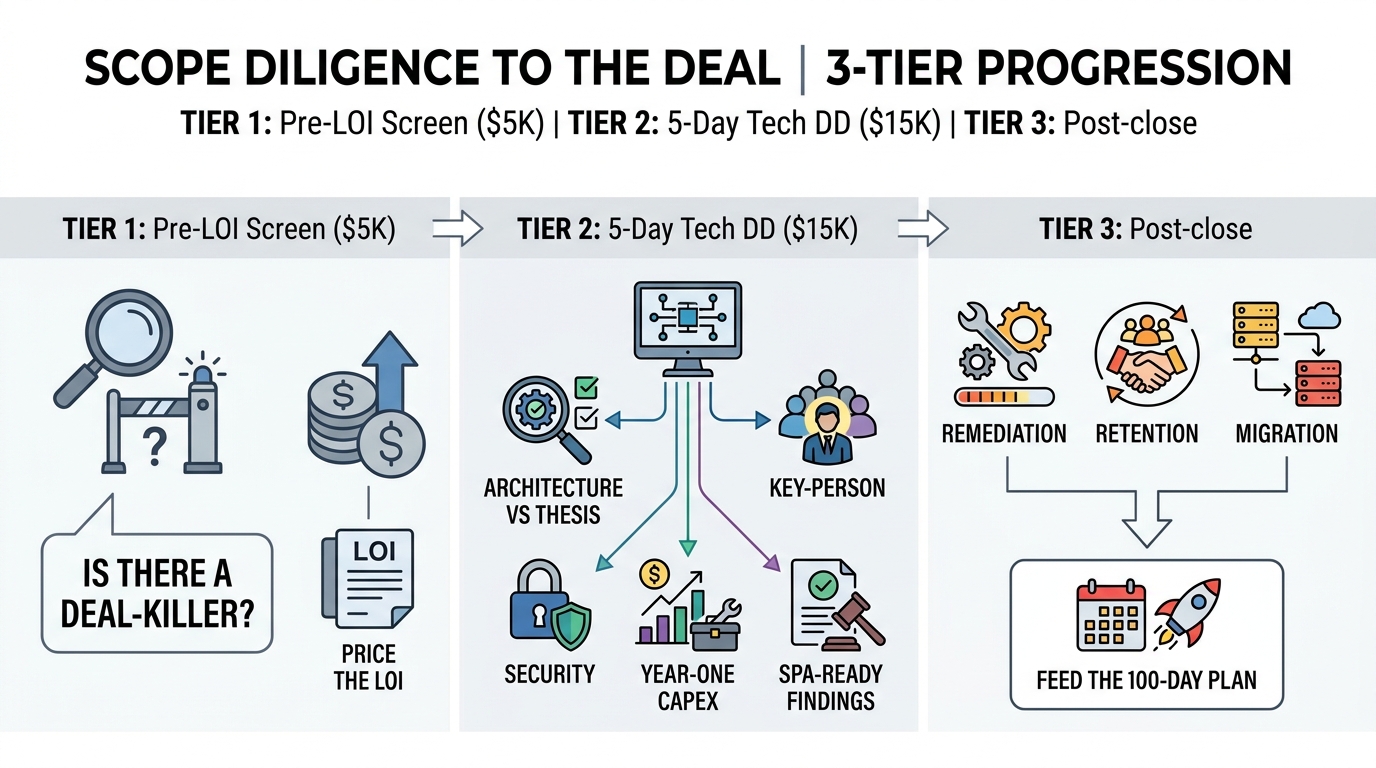
The single biggest waste in technology diligence is running a full engagement on a deal that does not warrant it, or running a light one where the thesis lives or dies on the platform. Scope should follow the thesis and the timeline.
Before the LOI
Pre-LOI, you do not need a forty-page report. You need a fast read on whether there is a deal-killer hiding in the technology, so you can price the LOI intelligently and avoid burning a confirmatory diligence budget on an asset that will not clear. A tight pre-LOI screen, the $5K tier of the work we do, exists precisely for this moment. It answers one question: is there anything here that should change your offer or stop the process before you commit real diligence spend.
Confirmatory diligence
Once you are under LOI and inside the confirmatory window, the depth changes. This is where a focused engagement, a 5-Day Tech DD at the $15K tier, does its work: architecture against thesis, key-person mapping, security posture, year-one capex, and a set of SPA-ready findings. The time box is deliberate. Deal timelines do not wait, and a diligence process that outruns the exclusivity period is worthless.
When the seller is running the process
Sellers increasingly bring their own vendor-side technology reports. Treat them as a starting hypothesis, not an answer. A seller-commissioned report is written to support the sale. Your job on the buy side is to test its claims against your specific thesis, which the seller could not have written to. McKinsey’s private capital research has repeatedly made the case that diligence rigor separates the deals that hit plan from the ones that drift, and rigor here means not accepting the counterparty’s framing.
Reading the report you paid for
Assume the diligence is done and the deliverable is on your desk. Here is how I judge whether it earned its fee.
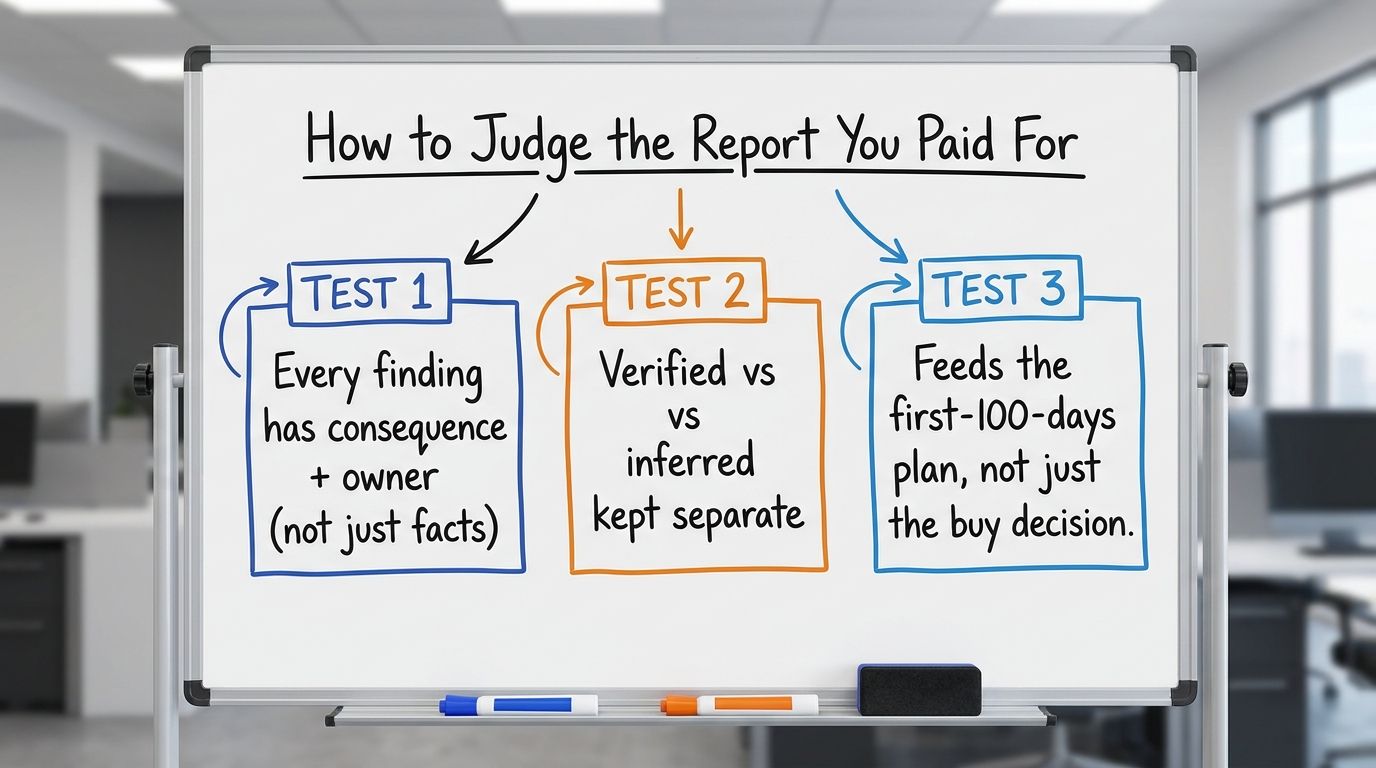
Every finding has a consequence and an owner
A finding without a “so what” is an observation. A good report says: here is the issue, here is what it costs, here is what to do about it, and here is who should own it after close. If the report reads like a list of facts with no price and no owner, it is a document, not a decision aid.
Findings are classified honestly
There is a real difference between a risk you have confirmed, a risk you suspect, and a cost you can already quantify. A report that presents a suspected problem with the same confidence as a measured one will lead you to over-negotiate or under-price. Insist on the distinction between what was verified and what was inferred.
It hands you a first-100-days spine
The best diligence does double duty. It supports the buy decision and it seeds the first 100 days. The remediation items, the retention priorities, the migration you now know is coming, all of it should flow straight into the post-close plan. If your diligence provider disappears at signing and hands you nothing the operating partner can execute, you paid for half the value. I have written before about the difference between advice you can ignore and a plan someone is on the hook to deliver, in this piece on the operational value creation consultant question.
The mistakes that cost the most
A few patterns show up repeatedly, and each one has a price.
Confusing a code review with diligence
A deep code audit is expensive, slow, and often the wrong tool. It tells you the code is messy. It rarely tells you whether the business can hit plan. Most deals need judgment on architecture, people, and risk against the thesis, not a line-by-line inspection. Spend the code-audit budget only when the platform itself is the asset and its internals are the value.
Diligence that ends at signing
Findings that never become a plan are findings that never get acted on. The value of knowing a migration is coming is realized only if someone runs the migration. This is why I keep returning to the theme that technical value creation partners operate inside portfolio companies rather than delivering a report and leaving.
Ignoring the revenue side of the stack
Technology diligence that stops at the product platform misses the systems that actually govern the growth thesis: the CRM, the billing, the data plumbing, the attribution. A two-week look at both technology and revenue operations tends to surface more thesis risk than a product-only review, which is the pattern I described in what a technology and revenue audit finds in the first two weeks.
Underpricing exit-side technology gaps
Every buyer of your platform, at exit, will run the same diligence you are running now. The gaps you tolerate at entry are the gaps a future buyer prices down. Underwriting with the exit buyer in mind is the discipline I laid out in exit readiness for portfolio companies. What you find in buy-side diligence today is a preview of what a buyer will find on the way out.
Who should actually run it
The person running your technology diligence needs to speak both languages: the technical one, so they can tell a real architecture problem from a cosmetic one, and the deal one, so they can translate it into price, terms, and plan. A pure engineer will hand you accurate findings you cannot act on. A pure generalist will miss the finding that matters.
This is the same capability set that makes a part-time CTO for private equity useful, and it is why diligence and post-close work belong on a continuum. The diligence provider who understands your thesis is the one best positioned to hold the technology accountable to it after close, whether through a virtual CIO arrangement or an embedded seat. On the governance-versus-execution split, I have argued for both roles in their place in this piece on board technology advisors, and for why a portfolio benefits from permanent capacity rather than intermittent advice in embedded versus advisory.
The bottom line for the deal team
Buy-side technology due diligence is not a technical exercise you outsource and file. It is an input to four decisions: proceed, price, terms, and plan. Judge every report by whether it moves those decisions. If it inventories the asset without pricing the risk, if it separates nothing verified from what was guessed, if it hands the operating partner nothing to execute on Day 1, it did not earn the fee, however impressive the diagrams.
The research consensus across Bain, McKinsey, and the broader coverage tracked by outlets like PitchBook points the same way: returns now come from operational improvement, and operational improvement starts with knowing, before you sign, exactly what the technology will and will not carry. Diligence done well is the first move of the value creation plan, not a box checked before it.
Where to take this next
If you have an asset under LOI or approaching one and you need a technology read that a deal partner can price and an operating partner can execute, that is exactly the work we scope at DevriX, from a pre-LOI screen to a five-day confirmatory engagement to the post-close plan it feeds. See how we run technology diligence and value creation for private equity and bring us the deal on your desk.