

By Mario Peshev, DevriX
By the time you are inside confirmatory diligence, the technology question is no longer whether the code is good. It is whether the platform can carry the growth your model assumes, whether the integration you have priced into the plan is achievable on the timeline you promised, and whether there is a liability sitting in the stack that will surface after close and eat into the return. A deal-ready technology review exists to answer those three questions with evidence, not adjectives, so your investment committee can price the risk instead of guessing at it.
I run these reviews for sponsors and operating partners, and the pattern is consistent. The technical report reads clean, the deal team feels reassured, and then eighteen months later the platform migration that nobody scoped is the reason the second add-on slips two quarters. The review that would have caught it was available for the price of a rounding error on the deal.
What the deal partner actually needs to decide
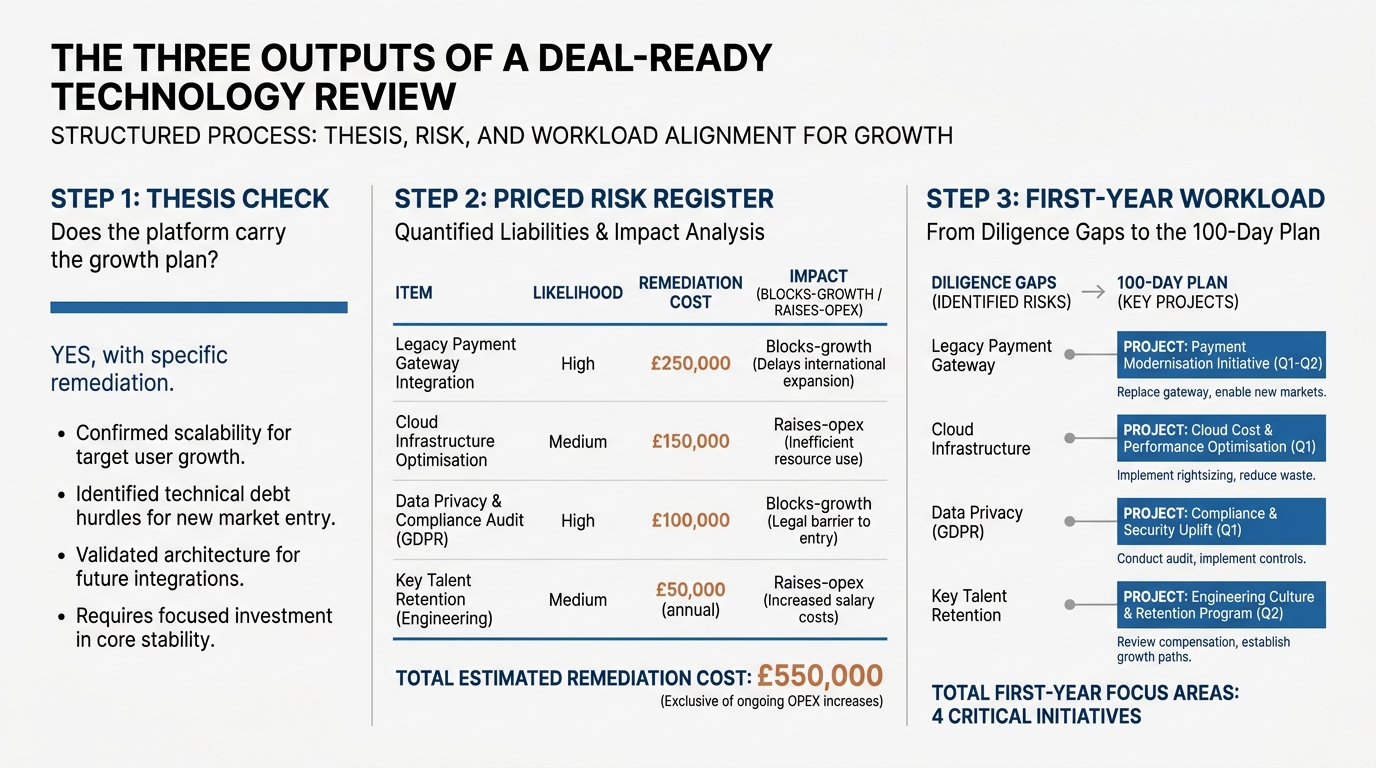
A deal partner is not buying an engineering audit. You are deciding whether to proceed, at what price, and with what conditions attached. That means the review has to translate technical facts into three commercial outputs.
The first is confirmation or challenge of the thesis. If your model assumes the platform can double transaction volume without a re-architecture, the review either confirms that headroom exists or tells you what the re-architecture costs and how long it takes. The second is a risk register you can price, with each item classified by likelihood, cost to remediate, and whether it blocks the growth plan or merely raises operating expense. The third is a view on the first year of post-close work, because the same weaknesses that create diligence risk become your first 100 days workload.
This is the same discipline I have written about in the broader question of what a PE deal partner actually needs from a consultant and how to judge it. The technology review is a specific instance of it: evidence tied to a decision, owner named, cost attached.
Why the standard technical report keeps missing the point
Most technical due diligence reports I inherit from prior processes are inventories. They list languages, frameworks, cloud spend, headcount, and a maturity score against some rubric. All of that is real, and almost none of it is a decision. A deal partner cannot do anything with “the codebase scores 3 out of 5 on maintainability.” You can do a great deal with “the payments module has a single engineer who understands it, he is not under a retention agreement, and rebuilding that knowledge costs roughly four months if he leaves the week after close.”
Engineers write for engineers, and that creates a framing problem rather than a competence problem. Bain’s Global Private Equity Report tracks value creation annually and shows that returns increasingly come from operational improvement rather than multiple expansion, which means the investment committee needs to know whether the operating plan is actually deliverable. A technical inventory does not answer that question, but a review built around deliverability does.
Activity is not the same as risk
A long list of open tickets is not a finding. The finding is which of those tickets, if left alone, breaks the growth plan. I have seen reports flag two thousand items of technical debt and miss the one architectural decision that caps the platform at its current customer size. Volume of observation is easy. Judgment about what matters to the thesis is the work you are paying for.
The commercial questions a deal-ready technology review has to close
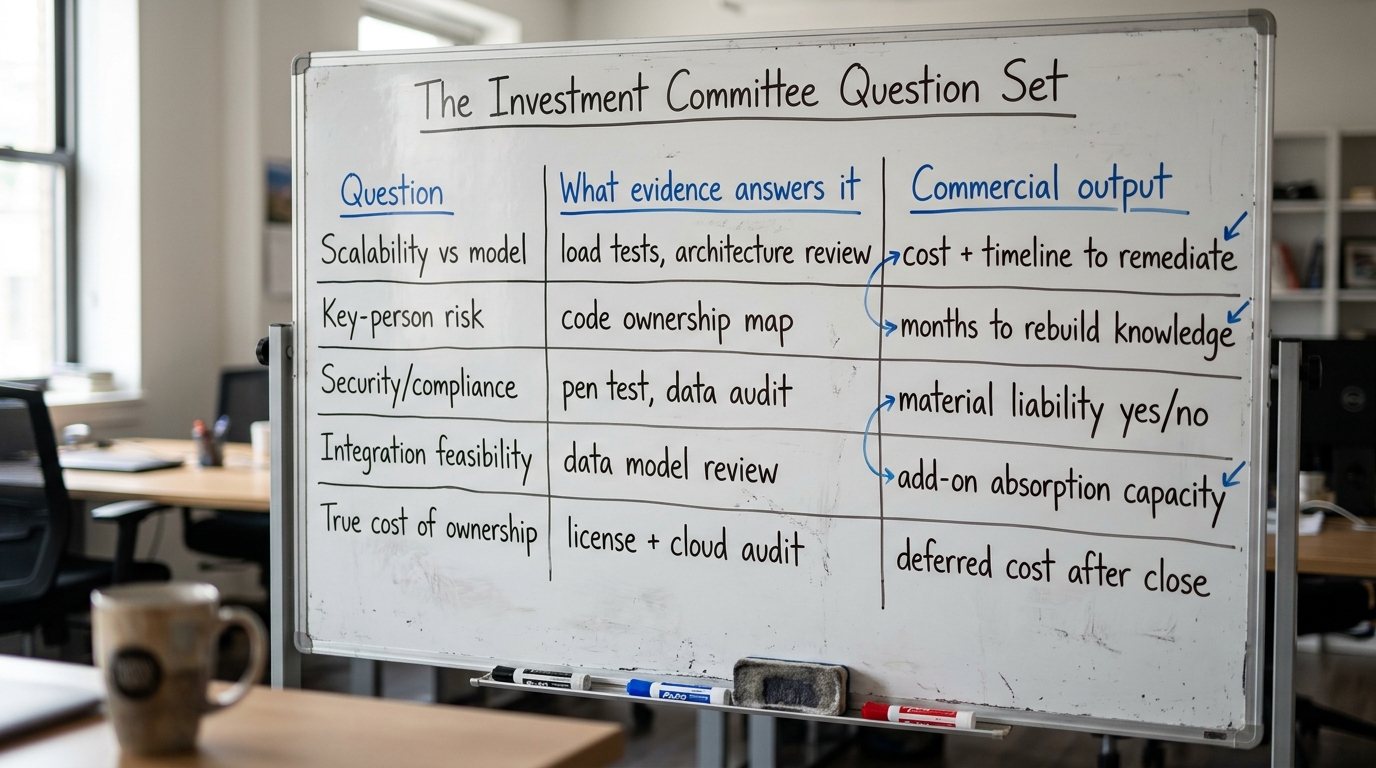
When I scope one of these, I anchor it to the questions the investment committee will raise, because those are the questions that determine whether the deal proceeds and on what terms. Here is the working set.
- Scalability against the model. Can the platform support the volume, geography, and product expansion in the plan, and if not, what is the cost and timeline to get it there?
- Key-person and knowledge risk. Which parts of the system depend on individuals who could leave, and what does that dependency cost to remove?
- Security and compliance exposure. Are there liabilities that a customer, a regulator, or an acquirer at exit would treat as material?
- Integration feasibility. If this is a platform for a roll-up, can the target actually absorb add-ons on the systems it runs today?
- True cost of ownership. Is the reported technology spend the real number, or are there deferred costs (license true-ups, cloud re-architecture, end-of-life systems) that land after close?
Each answer carries a number and a classification. A risk that is realized today is priced differently from one that is forecast under a growth scenario or merely enabled by a decision you have not yet made. Letting a forecast risk read as a realized one is how diligence reports lose credibility with a committee that has read a few hundred of them.
How to judge whether the review itself is any good
You are commissioning the review, so you also have to judge it. A few tests separate a report that informs a decision from one that fills a data room folder.
Every finding names an owner and a number
A finding without a remediation cost and a timeline is an observation, not a finding. When I hand a sponsor a risk register, each line says what it costs to fix, how long it takes, and who on the target’s team (or which hire) has to do it. If the report cannot attach those, it has not finished the work.
It ties to the plan, not to a generic rubric
Maturity scores against an abstract model tell you how the platform compares to an average that does not exist in your deal. What you need is how the platform performs against your plan. The same codebase can be entirely adequate for a hold-and-optimize thesis and completely inadequate for a five-acquisition roll-up on a two-year clock. The review has to know which one you are running.
It separates what blocks the deal from what you fix later
Not every weakness is a reason to renegotiate. Some are Day 1 problems, some are year-one operating expense, and some are genuinely fine to carry. A review that treats everything as urgent is as useless as one that treats nothing as urgent. The value is in the triage. I have written more about this triage discipline in the context of what IT integration actually decides in an M&A deal, because the sorting is the same skill applied at a different moment.
Where the review connects to the value-creation plan
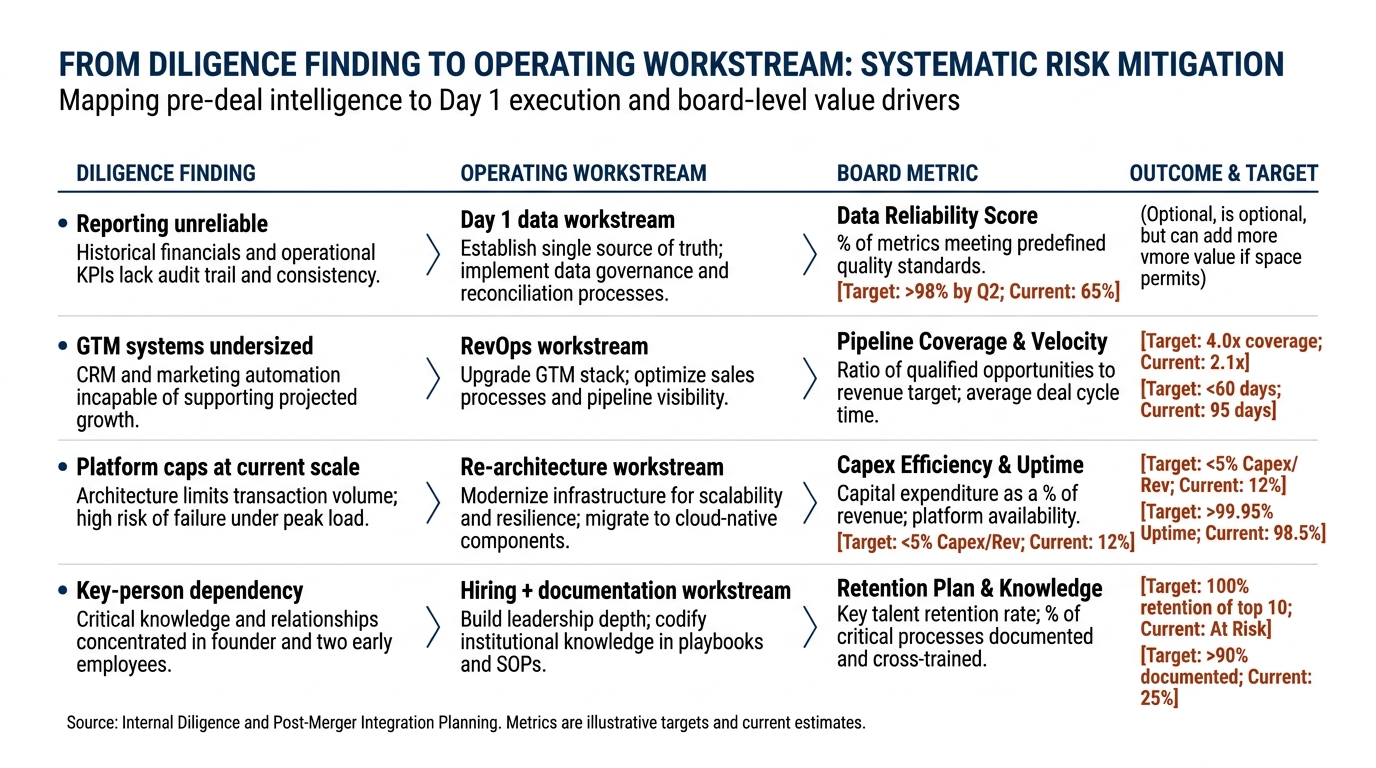
The review does not end at signing. The findings you priced in diligence become the workstreams your operating team executes after close. This is why I insist the review be written with the technology due diligence and the value-creation plan as one continuous document rather than two disconnected exercises.
If the review flags that reporting is unreliable, that becomes a data workstream in the first hundred days. I have watched this exact failure repeatedly, and it is the subject of why the sponsor never gets a number they trust. If the review flags that the go-to-market systems cannot support the pipeline your plan requires, that becomes a revenue-operations workstream, which I have covered in what actually needs deciding in RevOps. The technology review is the map of your first year of operating work, drawn before you own the asset.
The board will ask about the same things
The risks you surface in diligence are the metrics your first board meeting will interrogate. A review that produces a clean set of measurable items gives you the spine of your reporting, which matters more than most deal teams expect. I made the case for this connection in board reporting for PE portfolio companies that actually drives decisions, and it starts with the review naming things you can then measure.
The special case of a roll-up platform
If the target is the platform for a buy-and-build, the review has a heavier burden. You are not just judging the asset in front of you. You are judging whether it can absorb the acquisitions in your pipeline. That is a question about data models, integration architecture, and the operational discipline to onboard an acquired business without breaking the platform.
The most expensive surprise in a roll-up is discovering after the second add-on that the platform was never built to consolidate anything. Website and system consolidation, which sounds cosmetic, often exposes the underlying architectural constraint first, a point I made in what a roll-up’s website consolidation actually buys you. The review has to test the platform against the acquisition thesis, not against its current single-entity reality. Research from McKinsey on private capital and programmatic acquirers has long shown that repeatable integration capability, not deal volume alone, is what separates the roll-ups that compound value from the ones that stall.
When to run one, and which version
The timing question is straightforward. Before LOI, you want a light review that either kills the deal or confirms it is worth the full spend. That is a pre-LOI screen, a few days of focused work, priced around $5,000, whose job is to catch the deal-breaker early and cheaply. Inside confirmatory diligence, you want the full five-day review, priced around $15,000, that produces the priced risk register and the first-year plan.
Set against the size of the check you are writing, both numbers are immaterial. The Harvard Law School Forum on Corporate Governance has published extensively on diligence discipline in its coverage of governance and deal process, and the consistent theme is that the cost of good diligence is trivial relative to the cost of the risk it surfaces. The reviews that pay for themselves are the ones that change a price, add a condition, or occasionally stop a deal that would have destroyed value.
What the review is not
It is not a substitute for the operating team you will need after close. It is the instrument that lets you decide with priced risk instead of hope. The consulting relationship around it should be judged the way I described the broader engagement in what a PE deal partner actually needs from a consultant: clear scope, decisions served, no activity dressed up as outcome.
The operator takeaway
Commission the technology review with the investment committee’s questions written into the scope, insist that every finding carry a number and an owner, and require that the deliverable flow directly into the value-creation plan rather than closing out as a standalone report. The review should tell you what to change about the price, the terms, or the first hundred days, because otherwise you paid for an inventory.
The connection to private equity returns is direct. Bain, McKinsey and industry data providers like PitchBook have all documented the shift toward operational value creation as the dominant source of return in the current market. That shift raises the cost of getting the technology assessment wrong, because the operating plan you are betting on is the one the platform either supports or does not.
Bringing it together
A deal-ready technology review earns its place when it answers the questions your committee will ask, prices the risks it finds, names who owns each one, and hands your operating team a first-year plan on close. That is the standard I hold my own work to, and it is the standard worth demanding from anyone you commission.
If you have a live deal and want the technology assessment run to that standard, the DevriX private equity practice runs both the pre-LOI screen and the full five-day technology review, scoped to your thesis and delivered as evidence your investment committee can act on.
