Twelve to eighteen months before a planned exit is when most sponsors discover that the value creation story they want to tell a buyer is not yet supported by the operating data. The deck says the company has pricing power, a diversified customer base, and a scalable technology platform. The diligence room says the pricing changes were never tracked, the top three accounts carry most of the revenue, and the platform is a single engineer’s undocumented work. A pre-exit value creation sprint is the disciplined window where a deal partner or operating partner closes that gap on purpose, so the story and the evidence arrive at the buyer’s quality of earnings process at the same time.
This piece is for the partner who already owns the exit timeline and the board relationship. You are not learning what EBITDA bridges are. You are deciding where to spend a finite number of operating months, which workstreams actually survive a buyer’s confirmatory diligence, and how to judge whether the sprint is producing realized improvement or just a prettier narrative.
Why the last 18 months decide what a buyer will pay for
The exit multiple is set by what a buyer can verify and underwrite, not by what the selling sponsor believes. Bain’s annual private equity report has tracked for years how exit conditions tighten and holding periods extend when buyers discount thinly evidenced growth, and that discount shows up directly in the price. You can read the broader context in Bain’s Global Private Equity Report, which has documented the lengthening path to exit across recent cycles.
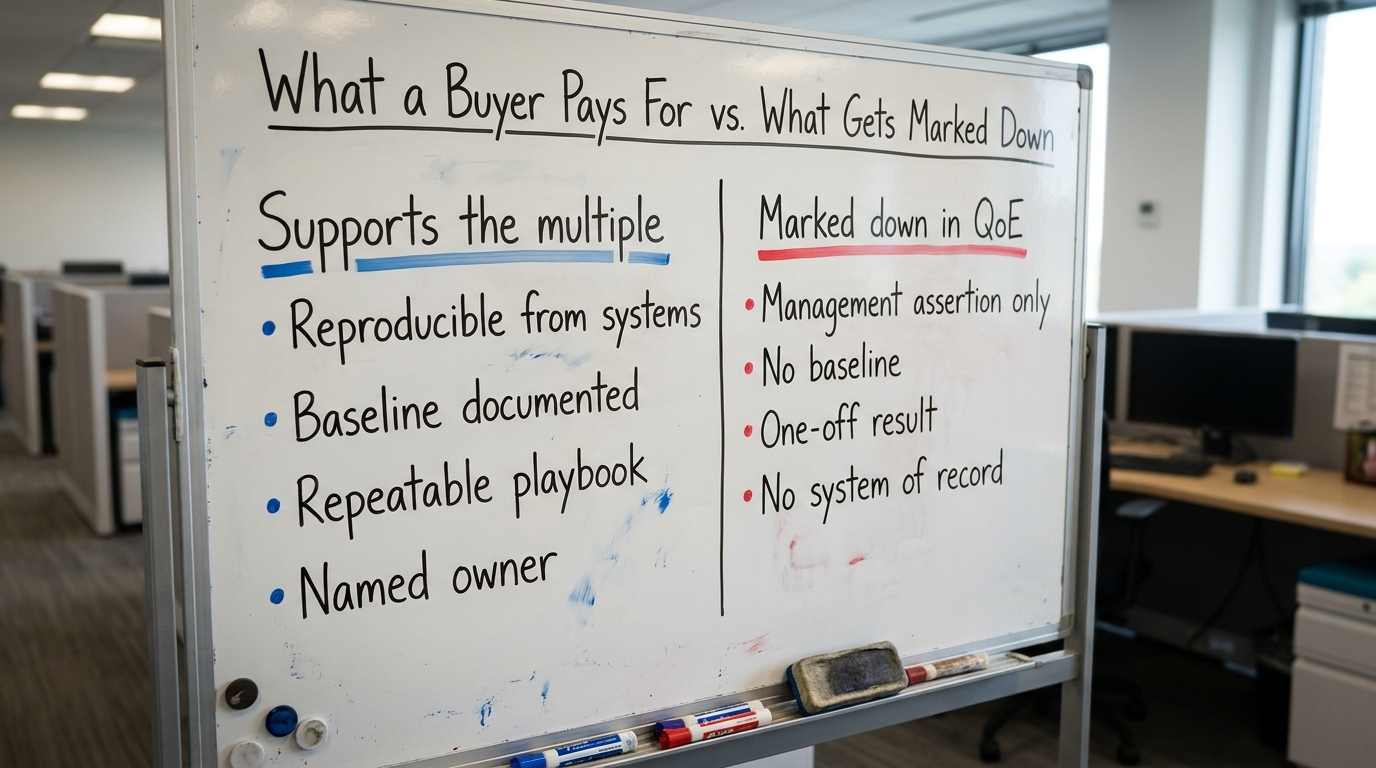
The commercial consequence is specific. A revenue growth claim that a buyer’s advisors can reconstruct from the CRM and the billing system supports the multiple. The same claim, asserted in a management presentation but not reproducible from the systems, gets treated as management optimism and marked down. The sprint exists to convert the second kind of claim into the first kind before anyone outside the firm is looking.
That is why the window matters. Starting the work at the LOI stage is too late, because a buyer’s confirmatory diligence runs in weeks and you cannot retroactively build eighteen months of clean pricing data in that time. The sprint has to be underway while you still control the calendar.
Decide the thesis the sprint is defending before you fund it
A sprint without a stated exit thesis spreads effort across every visible problem and improves none of them enough to matter. The first decision the deal partner owns is which two or three claims the next buyer will actually pay for, and therefore which claims the sprint must make defensible.
Those claims usually fall into a short set: durable organic growth, margin expansion that holds after the sprint ends, customer concentration that is improving rather than worsening, and a technology platform that a strategic or a larger sponsor could scale without a rebuild. Pick the ones your thesis rests on. Fund the evidence for those and accept that the rest stays as-is.
Write the thesis as a set of claims a buyer can test
Each claim needs a baseline, an owner, and a method a third party could repeat. “We expanded gross margin” is not a claim a buyer can test. “Gross margin moved from 41% to 47% over four quarters, driven by the pricing change rolled out in Q2, tracked monthly in the billing system, owned by the CFO” is. The difference between those two sentences is the entire point of the sprint.
The workstreams that survive confirmatory diligence
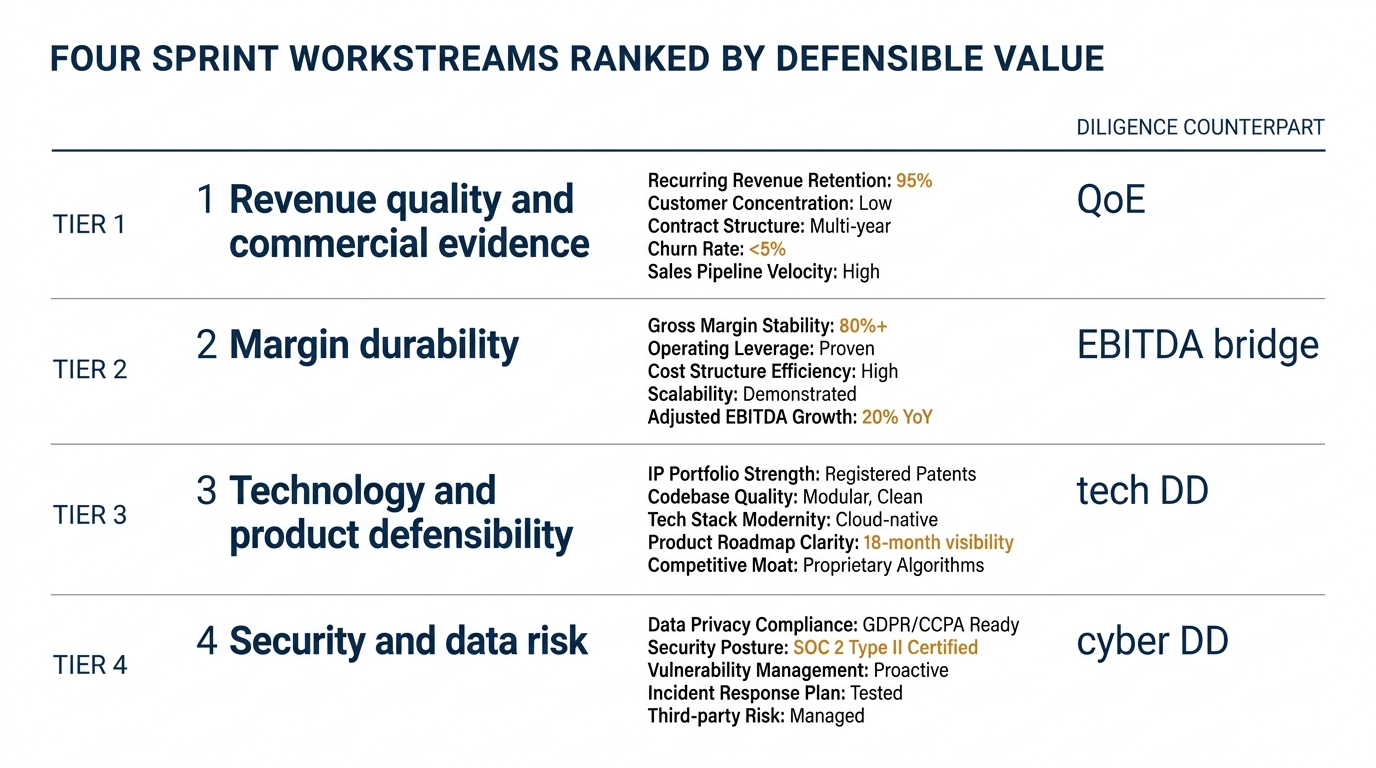
Not every operational improvement earns credit at exit. A buyer’s advisors look for improvements that are realized, repeatable, and documented in a system rather than in a spreadsheet one person maintains. In my experience across private equity engagements, four workstreams return the most defensible value per operating month.
Revenue quality and commercial evidence
This is where the largest markups and markdowns happen. A buyer wants to see net revenue retention, pipeline conversion, average contract value, and customer concentration tracked consistently over time, not reconstructed the week before the data room opens. If your revenue leadership cannot produce those monthly, that is the gap to close first. The discipline of a revenue operation that reports conversion and contract value every month is what I described in how fractional CROs measure pipeline conversion and average contract value monthly, and it is exactly the evidence a QoE team reconstructs.
Margin durability
Buyers discount margin gains that look like one-time cost cuts and credit margin gains that come from pricing, mix, or structural efficiency. The sprint’s job is to document which is which, with the baseline and the mechanism, so the improvement reads as run-rate rather than a last-minute trim.
Technology and product defensibility
A platform that only one or two people understand is a risk a buyer will price, not an asset a buyer will reward. The sprint should produce the documentation, the dependency map, and the resolved critical items that a technology due diligence process will ask for anyway. Doing that work before the buyer’s reviewer arrives means you set the narrative instead of defending against findings. The anatomy of what that review actually surfaces is covered in product and technology due diligence that actually informs the deal and, from the code side, in what software code review for M&A actually tells a deal partner.
Security and data risk
Unresolved security gaps are a reliable source of price retrades late in a deal, because they surface in confirmatory diligence when the buyer has leverage and you have a signed LOI. Running a portfolio cyber assessment during the sprint, and closing the material items, removes a category of surprise that otherwise erodes the price at the worst possible moment. The sell-side framing of this is laid out in security due diligence for private equity.
How to judge the sprint while it runs, not after
The failure mode is a sprint measured in activity: tickets closed, workshops held, dashboards built. The deal partner needs a small set of outcome measures reviewed at the board or operating-partner level, and a classification of every claimed improvement.
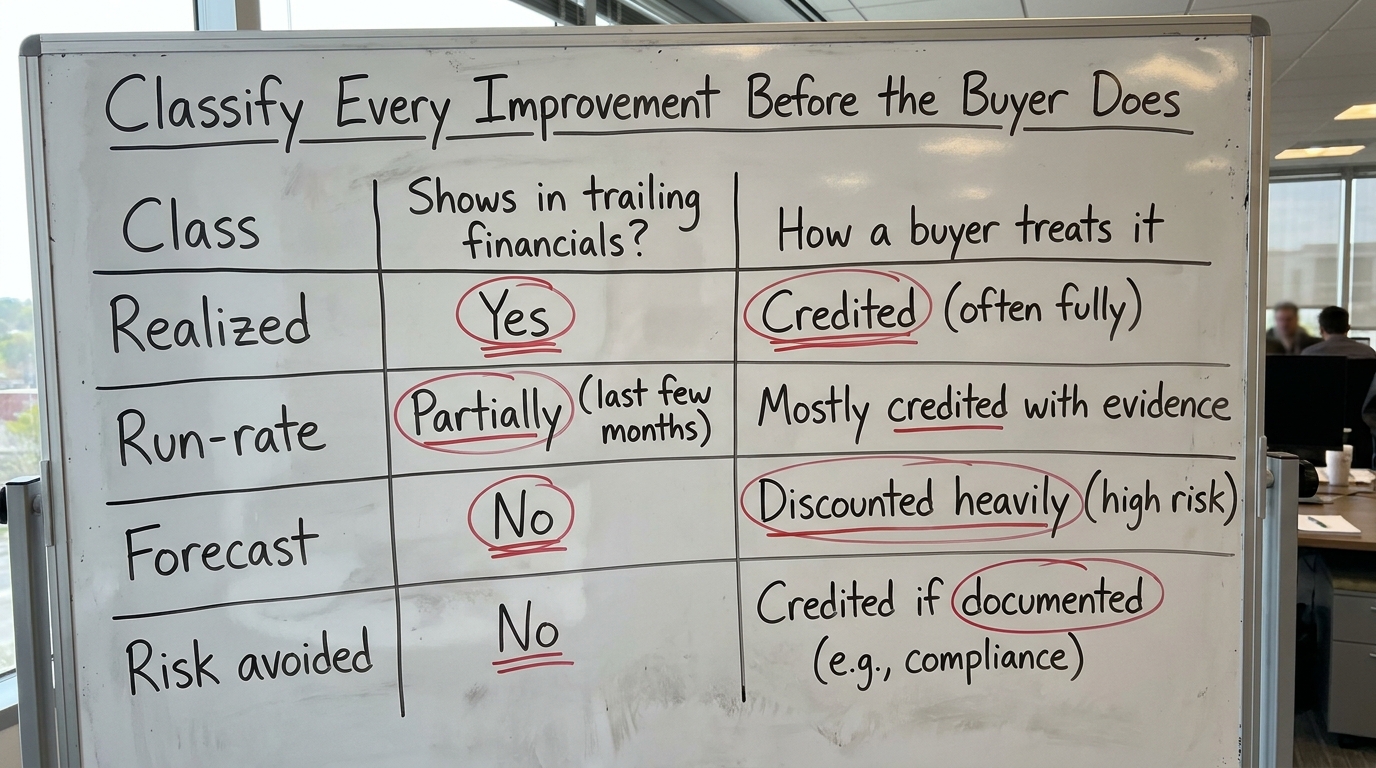
Classify each improvement as realized, run-rate, forecast, or risk avoided. A realized improvement already shows in the trailing financials. A run-rate improvement is in place and annualizes forward. A forecast improvement depends on things that have not happened yet. A risk avoided removes a probable future markdown. A buyer’s advisors will apply exactly this discipline, so apply it to yourself first and do not let forecast value sit in the deck dressed as realized.
The questions to ask at each review
- Which claim in the exit thesis does this work defend, and is that claim now reproducible from a system rather than a spreadsheet?
- Is the improvement realized, run-rate, forecast, or risk avoided, and who owns the number?
- If a QoE team reconstructed this tomorrow, would they arrive at our figure or a lower one?
- What is the baseline we moved from, and is it documented anywhere a third party could check?
McKinsey and BCG both publish extensively on value creation discipline in private capital, and the common thread in that research is that credited value comes from repeatable operating mechanisms rather than one-off results. You can review the broader bodies of work at McKinsey’s private capital research and BCG’s principal investors and private equity practice.
The staffing decision most sprints get wrong
A pre-exit sprint needs embedded capacity for a defined window, not a strategy deck and a quarterly check-in. The work is operational: instrumenting the CRM, documenting the platform, resolving the security items, building the monthly reporting that did not exist. That requires people inside the company doing the work, with decision rights to change systems, for the length of the sprint.
This is the same capacity logic that applies to carve-outs, where the transition window is unforgiving and advisory-only support leaves the actual build undone. I made that case in detail in why carve-out consulting requires embedded capacity during transition windows, and the pattern holds for exit prep: the firms that embed engineering and operations into the plan, as described in how portfolio digital partners embed engineering capacity in operating plans, produce evidence rather than recommendations.
The decision for the deal partner is simple to state and expensive to get wrong: who is accountable for each workstream producing a verifiable result, and do they have the authority and the time to change the systems that hold the evidence. If the answer is a consultant with no decision rights and a two-day-a-month commitment, the sprint will produce a report and the diligence room will produce a markdown.
Sequence the sprint against the exit calendar
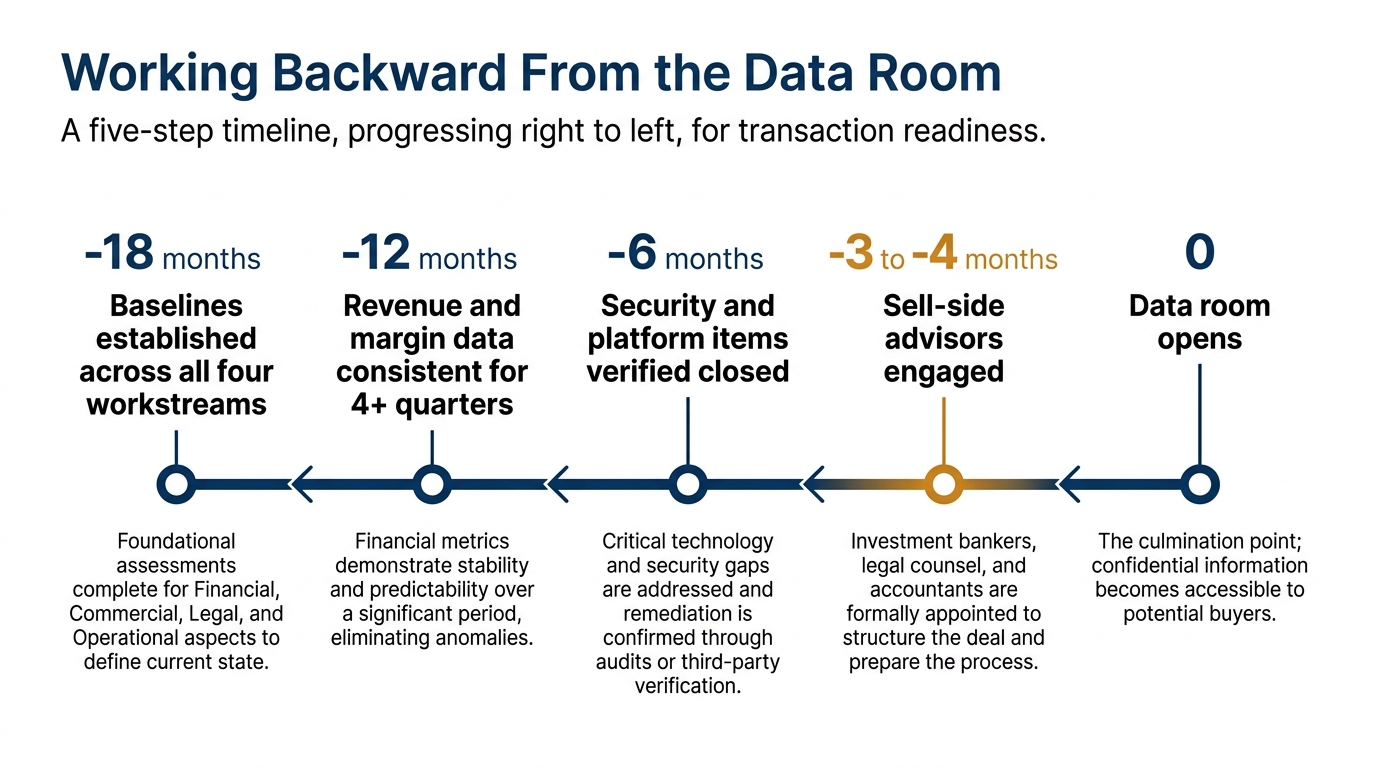
The sprint is governed by three real triggers: the board decision to target an exit window, the point at which you engage sell-side advisors, and the opening of the data room. Work backward from the data room, because that is when a buyer’s confirmatory diligence begins and your ability to change the evidence ends.
Revenue instrumentation and margin documentation need the longest runway, because you want several quarters of data. Security remediation and platform documentation can move faster but still need months to close material items and verify the fixes held. Treating diligence as a continuous discipline rather than an event, which I argued for in continuous technology due diligence, is what lets the sprint start from a known baseline instead of a scramble.
An illustrative sequence
To make this concrete, here is an illustrative scenario. A sponsor targeting an exit roughly eighteen months out starts the sprint by establishing baselines across revenue, margin, technology, and security in the first two months. Revenue and margin instrumentation then runs continuously so that by the time the data room opens there are four or more quarters of consistent, reproducible data. Security and platform remediation runs in parallel and is verified complete well before sell-side advisors are engaged, so no material item is open when a buyer’s reviewer arrives.
What the sprint connects to on both sides of the deal
A sell-side sprint is the mirror image of the buy-side work a disciplined acquirer runs. Understanding what a buyer’s reviewers actually extract, laid out in what outsourced technical due diligence for M&A actually buys you in a deal and in security due diligence for M&A, tells you exactly which evidence to prepare and which findings to preempt.
It also connects forward. The documentation, baselines, and reporting the sprint produces are the raw material a new owner uses in their first 100 days. A clean handover of that material is itself a selling point, because it reduces the integration risk a buyer prices into the offer. Harvard Business Review’s M&A collection and the Harvard Law School Forum on Corporate Governance both carry useful operator and governance perspectives on how post-close execution risk feeds back into deal terms; see HBR’s M&A topic hub and the Harvard Law School Forum on Corporate Governance.
What to decide now
If you own an exit that lands in the next twelve to eighteen months, the sprint is a sequencing and accountability decision more than a budget decision. Name the two or three claims the next buyer will pay for. Assign an owner to each workstream who has the authority to change the systems that hold the evidence. Classify every improvement as realized, run-rate, forecast, or risk avoided, and review that classification at the board level rather than taking the vendor’s activity report at face value.
A buyer pays full price when diligence confirms reproducible evidence: closed security findings, documented unit economics, and a platform that scales without the founder. A buyer retrades when diligence finds a narrative supported by a dashboard but no operating evidence beneath it. You decide which sprint to run in the months before the data room opens, when you still control the work.
If you are scoping a pre-exit value creation sprint and want the workstreams built and the evidence instrumented by a team that embeds in the operating plan rather than hands you a deck, review the DevriX private equity value creation offer and bring the exit timeline you are working against.