

By Mario Peshev, DevriX
Most technology diligence reports that cross a deal partner’s desk answer the wrong question. They tell you what the target built. They do not tell you what you are buying, what it will cost to defend the thesis, and which findings should move price or kill the deal. That gap is expensive. You are three weeks from close on a founder-led software business, the LOI assumed the platform scales into the growth case, and the report you paid for reads like an engineering audit written for engineers. It confirms the code exists. It does not tell you whether the roadmap you underwrote is deliverable at the cost you modeled.
If you are running private equity deals, product and technology due diligence is not a checkbox you clear before IC. It is one of the few pre-close work products that can change your entry price, restructure your value-creation plan, or surface an integration dependency that turns a clean thesis into a two-year rebuild. This piece is about what a deal partner or operating partner actually needs to decide from that work, and how to judge whether the diligence in front of you is good enough to bet capital on.
What the report is actually for
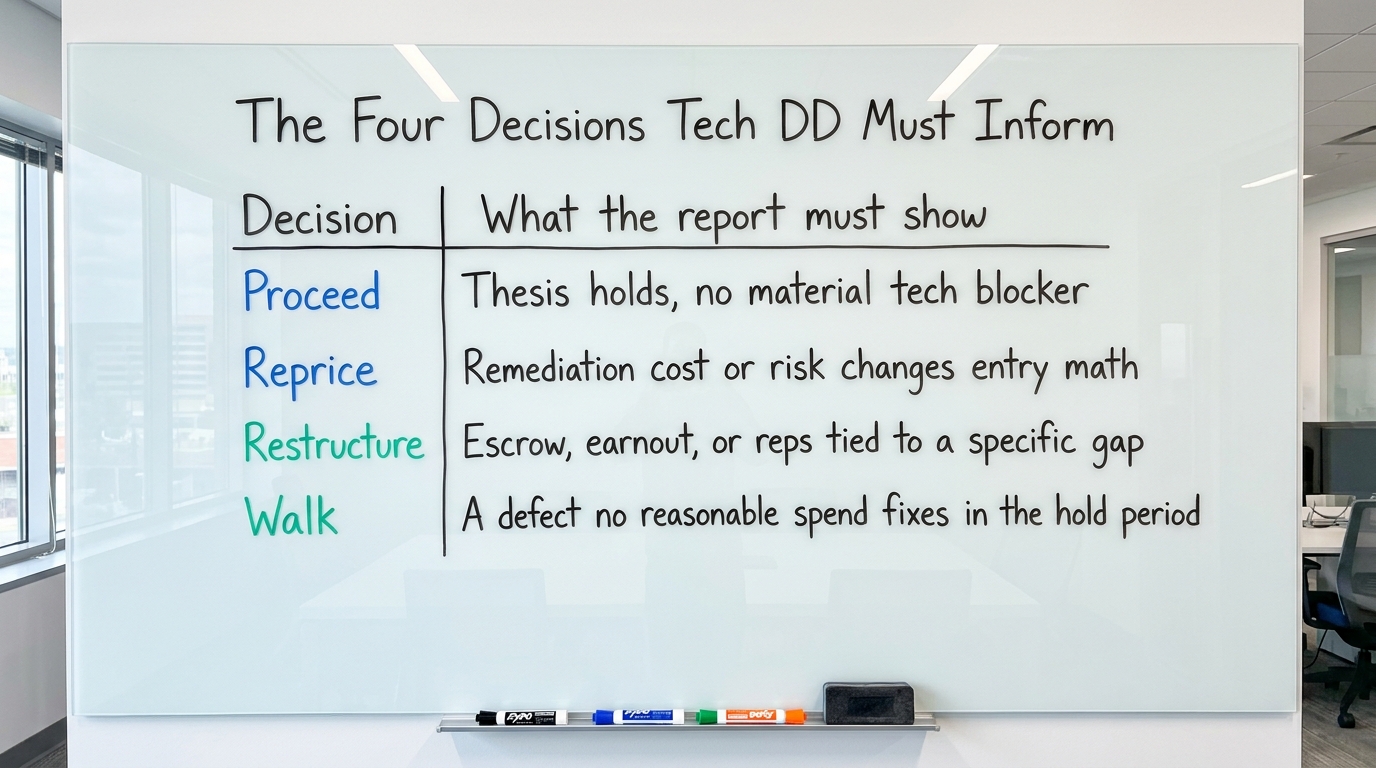
The purpose of product and technology due diligence is to confirm or break the parts of your investment thesis that depend on the product working, scaling, and being defensible. Nothing else. Every finding should map to a decision: proceed, reprice, restructure the deal, or walk.
Bain’s annual work on the private equity market, published in its Global Private Equity Report, has documented for years how much of fund returns now depend on operational improvement rather than multiple expansion and leverage. That shift changes what diligence has to do. When your return math assumes you will double ARR, cut infrastructure cost, ship a new product line, or integrate three add-ons onto one platform, the technology is no longer a support function you inherit. It is the machine that has to produce the plan. Diligence has to tell you whether it can.
So the test for any report is simple. For each material assumption in your model, does the report give you evidence, a named owner of the risk, and a cost to close the gap? If it lists findings without tying them to your thesis, you paid for an inventory, not a decision.
The five questions a deal partner needs answered
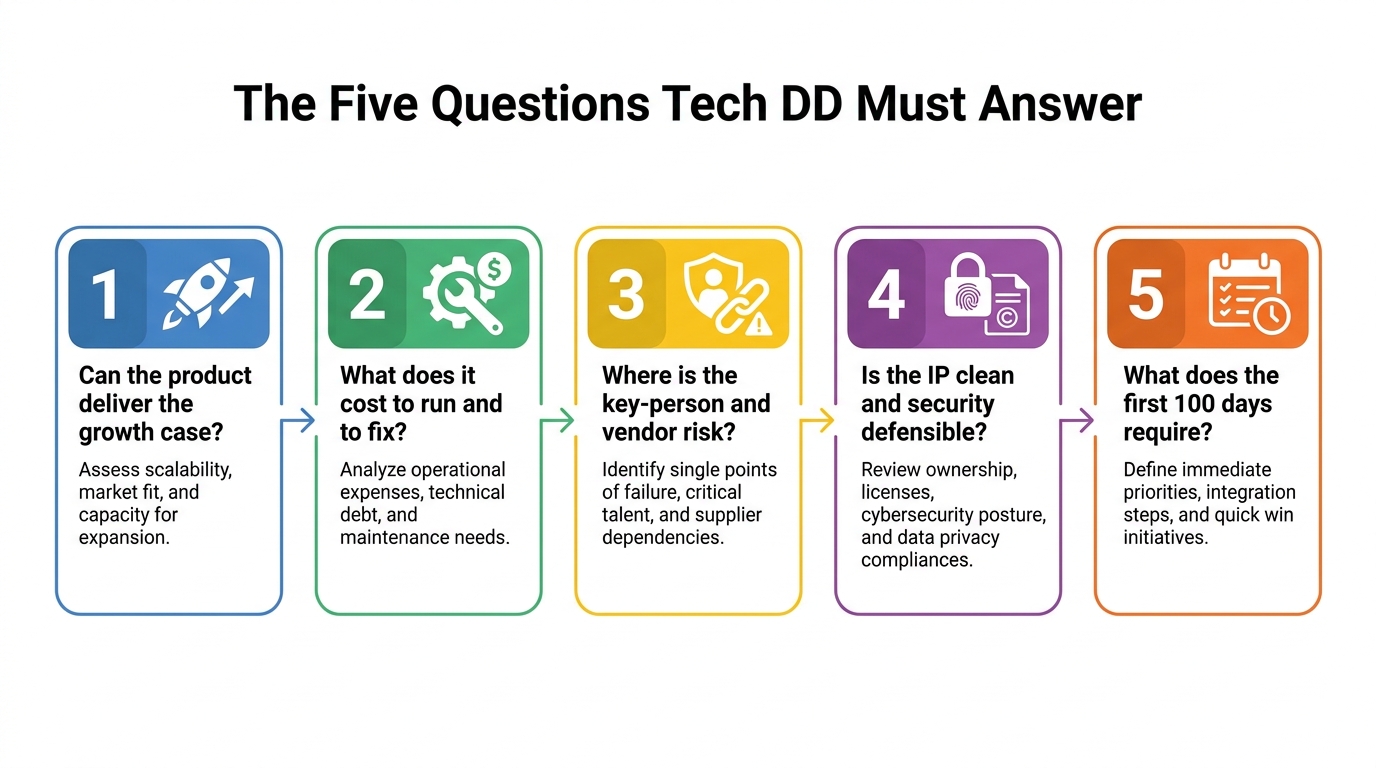
Strip away the appendices and a good technology due diligence engagement answers five questions in language you can take to an investment committee.
Can the product deliver the growth case
Your model assumes the platform serves 3x the users, or a new segment, or a new geography. The architecture either supports that or it needs meaningful rework. This is where an architecture and scalability review for acquisition earns its keep: it tells you whether the load path in your growth case breaks the system, and roughly what it costs to make it not break. A report that praises the tech stack without stress-testing it against your specific plan has told you nothing you can underwrite.
What will it cost to run and to fix
Two numbers matter here. Run-rate cost of the technology, including hosting, licenses, and the engineering headcount required to keep the lights on, and the remediation cost to close the gaps that stand between the current state and your plan. Both flow straight into EBITDA and both are routinely understated by founders who have been deferring maintenance to hit growth numbers. A code quality assessment for acquisition is where deferred maintenance becomes a line item instead of a surprise in year two.
How much key-person and vendor risk sits in the deal
If two engineers hold the entire architecture in their heads and one is planning to leave post-close, that is a risk register item that belongs in front of the deal team before the reps are drafted. Same for a single cloud vendor lock-in, an unsupported framework, or a license that changes terms at scale. These are not code problems. They are continuity problems that price into the deal.
Is the IP clean and the security posture defensible
Open-source license exposure, unclear IP ownership from contractor-built code, and security gaps that would fail a customer’s procurement review all belong here. These are commercial and operating findings, not legal opinions, and you route the legal and tax questions to your counsel. What diligence owes you is the technical reality that counsel then acts on.
What does the first 100 days require
The best diligence hands you the opening chapter of your value-creation plan. It should name the two or three technology moves that unlock the thesis and the ones that cannot wait. That is the bridge from a report you read once to a first 100 days plan someone is on the hook to execute.
Why buy-side diligence is different from an engineering audit
An engineering audit asks whether the code is good. Buy-side diligence asks whether the deal is good. Those are not the same question, and conflating them is the most common way firms waste a diligence budget.
An audit written for engineers ranks technical debt by severity. Buy-side work ranks it by dollar impact on your specific thesis over your specific hold period. A messy codebase that will never touch your growth plan is a footnote. A clean codebase built on an architecture that cannot serve your target segment is a deal problem, even though the code review would grade it well. This is the discipline behind proper buy-side technology due diligence: every finding gets translated into the language of the deal before it reaches you.
Research from McKinsey on private capital and from BCG’s principal investors and private equity practice has consistently pointed to the same pattern: value creation increasingly comes from operational and technology improvement, which means the questions you ask before close should be the questions you plan to act on after it. Diligence and the value-creation plan are one continuous piece of work, not two vendors who never speak.
How to judge the diligence in front of you
You will not read every line of a technical report and you should not have to. Judge it on a few things instead.
Does it start from your thesis
Open the report and look for your investment case in the first two pages. If the growth assumptions, the integration plan, and the cost targets you are underwriting do not appear, the work was not scoped to your deal. It was a generic scan run against a checklist. The findings may be accurate and still useless.
Is every risk owned and priced
A finding without an owner and a cost is a sentence, not a decision. “Technical debt is high” is a sentence. “Refactoring the billing service to support usage-based pricing is roughly two engineer-quarters, and without it the pricing move in your model slips to year two” is a decision. Demand the second kind.
Does it separate what is realized from what is hoped
Be strict about the difference between what the target has actually shipped and running in production, what is on a roadmap, and what is a founder’s ambition described in present tense. Forecast capability is not realized capability. A report that lets a roadmap read like a working product is doing the seller’s job, not yours.
Would the author defend it in a board meeting
The person who wrote the diligence should be able to sit in your first board meeting and defend every material finding to the management team it concerns. If the work was produced by someone who cannot or will not do that, treat the conclusions as provisional.
The pre-LOI look versus the confirmatory deep dive
Not every deal needs the same depth at the same moment, and spending confirmatory-diligence money at the top of the funnel is a good way to burn budget on deals that die.
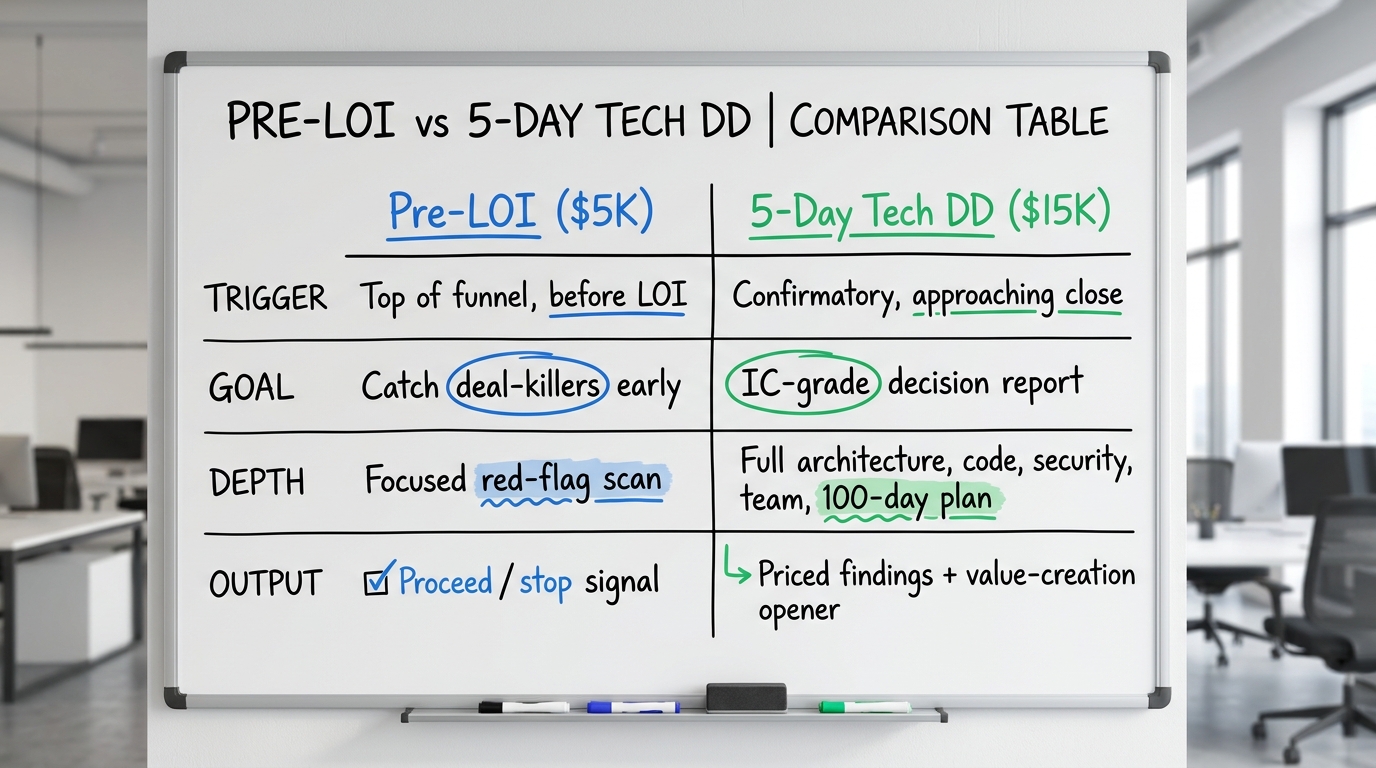
Early, before you commit to an LOI, you want a fast read on whether there is a technology reason not to proceed. A focused pre-LOI look, priced at $5K, is meant to catch the deal-killers early: an architecture that cannot support the thesis, a key-person dependency that makes the business uninsurable, an IP question that changes everything. It is cheap insurance against spending real diligence dollars on a deal with a structural flaw.
Once you are in confirmatory diligence, approaching close, you want depth. A 5-Day Tech DD, priced at $15K, produces the report that goes to IC: architecture and scalability against your growth case, code quality and remediation cost, security and IP posture, team and key-person risk, and the opening 100-day priorities. The output is not a grade. It is a set of decisions with numbers attached.
The findings that most often move price
Over enough deals, the same categories of finding recur as the ones that change entry math or deal structure. Treat this as an illustrative list of what to watch for, not a claim about any specific target.
- Architecture that fits the current business but not the plan. The product works at today’s scale and fails at the scale you underwrote. Remediation cost lands in your model, not the seller’s.
- Deferred maintenance disguised as velocity. A team hit its feature roadmap by not paying down debt. The bill comes due in your hold period.
- Concentration in one or two engineers. The people risk that turns a clean asset into a fragile one the day after close.
- IP ownership gaps from contractor-built code. A question that, unaddressed, weakens what you actually own.
- Security posture that fails enterprise procurement. If the growth case assumes moving upmarket, an insufficient security posture caps the very expansion you are paying for.
Each of these has a mirror image on the sell side. When you own the asset and are preparing to exit, the same findings are what a buyer prices down, which is the whole point of thinking about exit readiness for portfolio companies years before you sell. The gaps you fail to close as an owner become the discount the next buyer takes.
From report to plan without dropping the baton
A diligence report that ends at close is half a work product. The value is in the handoff to execution. The findings that mattered enough to affect price are the same findings that should structure your first two weeks of ownership.
A structured technology and revenue audit in the first two weeks takes the pre-close findings and converts them into a sequenced plan with owners and dates. This is also where the distinction between advice and accountability matters. There is a real difference between an operational value-creation plan someone is on the hook to deliver and a slide deck you can ignore. The first changes the business. The second decorates the data room.
For portfolio companies without a full-time technology leader, this is where a virtual CIO arrangement or a part-time CTO seat carries the diligence findings into execution. Someone has to own the decision rights that turn a report into results, and it is rarely the deal team’s job to hold them.
Aligning the technology plan with the rest of the value case
Technology diligence in isolation misses half the value. The architecture question and the go-to-market question are usually the same question wearing different clothes. If the growth case depends on moving upmarket, the product has to support enterprise buyers and the revenue operation has to sell to them. One without the other stalls.
This is why the strongest diligence connects engineering, product, and revenue operations into one coherent view, the kind of thinking behind aligning engineering, product, and RevOps for value creation. A report that treats the platform as a standalone artifact, disconnected from how the business actually makes money, will pass over the dependencies that decide whether your plan works.
The Harvard Law School Forum on Corporate Governance has published extensively on M&A and diligence practice, and Harvard Business Review’s coverage of mergers and acquisitions repeatedly returns to the same theme: deals fail in integration far more often than they fail in the model. Product and technology diligence is one of the few tools that lets you see the integration problem before you have paid for it.
Why permanent capacity beats a one-time report
A single report is a snapshot. The value-creation plan it feeds is a moving target across a three-to-five-year hold. Firms that treat technology as a one-time diligence event and then go quiet until exit tend to rediscover their problems at the worst possible moment, when a buyer’s diligence surfaces them.
The alternative is treating technology as a standing capability across the hold, which is the argument for embedded rather than purely advisory digital capacity. Diligence tells you what you bought. Standing capacity makes sure you get what you paid for by the time you sell it.
The operator takeaway
Judge product and technology due diligence by one standard: does it change a decision. If the report in front of you does not connect its findings to your thesis, price a remediation cost you can put in the model, name who owns each risk, and hand you the opening moves for the first 100 days, it is an inventory dressed up as diligence. Send it back or replace the provider.
The best time to buy the fast pre-LOI look is before you commit real money to a deal that might have a structural flaw. The best time to buy the full 5-Day Tech DD is when you are in confirmatory diligence and the findings will actually move price or structure. Buy the depth the moment demands, not more and not less.
If you are approaching an LOI or entering confirmatory diligence and you want the technology and product read written for the deal rather than for the engineers, route the deal to the DevriX private equity practice for a pre-LOI look or a 5-Day Tech DD scoped to your thesis.
