

By Mario Peshev, DevriX
Most merger consultants get hired to lower the anxiety of a partner who has to sign a check. That is not the same thing as making the deal work. I have watched sponsors pay six figures for a stack of slides that confirmed the thesis they walked in with, then spend the first year post-close discovering the numbers underneath were never stress-tested. The consultant was long gone by then, invoice cleared, reputation intact.
If you sit on the deal team or the operating side of a fund, the question is not whether a merger consultant is competent. Most are. The question is whether the work product changes a decision you are about to make with real money, and whether it survives contact with the business after you own it. Those are different tests, and the second one is the one that shows up in your return.
The buyer is not purchasing a report
A PE-backed buyer is not purchasing a deck, a model, or a set of interviews. It is purchasing a defensible view of enterprise value: where it is real, where it is fragile, and what has to be true for the return math to hold. Everything a merger consultant produces should ladder up to that. If it does not, you are paying for reassurance.
This is the recurring vendor failure mode: activity presented as outcome. In advisory work it shows up as volume. Number of interviews conducted, pages of analysis, data rooms reviewed. None of that is the product. The product is a smaller, harder set of conclusions about revenue durability, margin quality, integration risk, and the price at which the deal still returns capital.
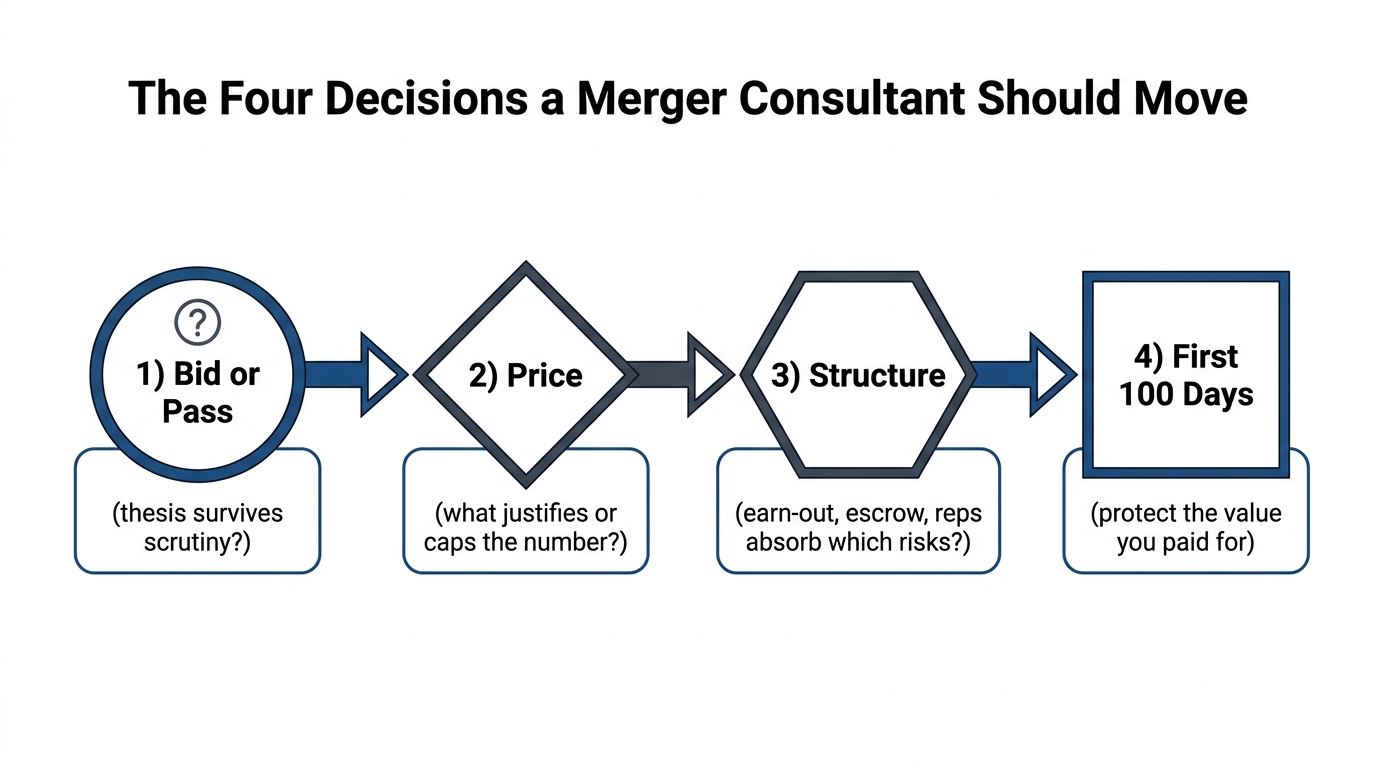
So the first thing you owe yourself is clarity on which decision the engagement is supposed to move. There are only a few that matter.
- Bid or pass. Is the thesis intact after independent scrutiny, or does the diligence surface something that kills it?
- Price. What is the number, and what specifically justifies it or caps it?
- Structure. Where do earn-outs, escrows, and reps and warranties need to absorb the risk the diligence found?
- First 100 days. What has to happen immediately after close to protect the value you just paid for?
A merger consultant who cannot tell you which of these four their work serves is selling you comfort. Bain’s annual Global Private Equity Report has tracked for years how much of the return gap between top and bottom funds traces back to what happens in and immediately after diligence, not to entry multiple luck. The decision points above are where that gap opens.
Diligence that confirms versus diligence that tests
The single most useful distinction I apply when evaluating a merger consultant is whether their process is built to confirm the thesis or to try to break it. Confirmation bias is not a personal flaw here, it is a commercial incentive. The consultant who tells the deal partner the target looks great is easier to work with and more likely to be rehired. That is exactly why you should not trust it by default.
Good commercial due diligence goes looking for the thing that ends the deal. It interviews churned customers, not just references the seller hands over. It reconstructs revenue by cohort and by logo concentration rather than accepting a topline growth rate. It separates recurring revenue you can underwrite from project revenue dressed up to look recurring. I wrote about the specific signals to hunt for in commercial due diligence red flags in B2B businesses, and most of them are invisible if the process is oriented toward agreement.
Ask what would have to be true for you to pass
A tactic I use with any advisor before an engagement: I ask them to describe, before they start, the finding that would make them recommend passing. If they cannot answer, or the answer is vague, the engagement is decorative. A merger consultant who has a clear kill condition in mind is one who intends to actually test something.
Watch how they treat the seller’s numbers
The seller’s adjusted EBITDA is a negotiating position, not a fact. Add-backs are where a lot of the price gets manufactured, and a good advisor treats each one as a claim to be verified rather than a line to accept. I broke down the mechanics of this in adjusted EBITDA and the art of add-backs. If your merger consultant is not scrutinizing the quality-of-earnings work with the same suspicion your lender will, they are leaving you exposed at exactly the point where structure gets set.
Commercial reality, not financial reality alone
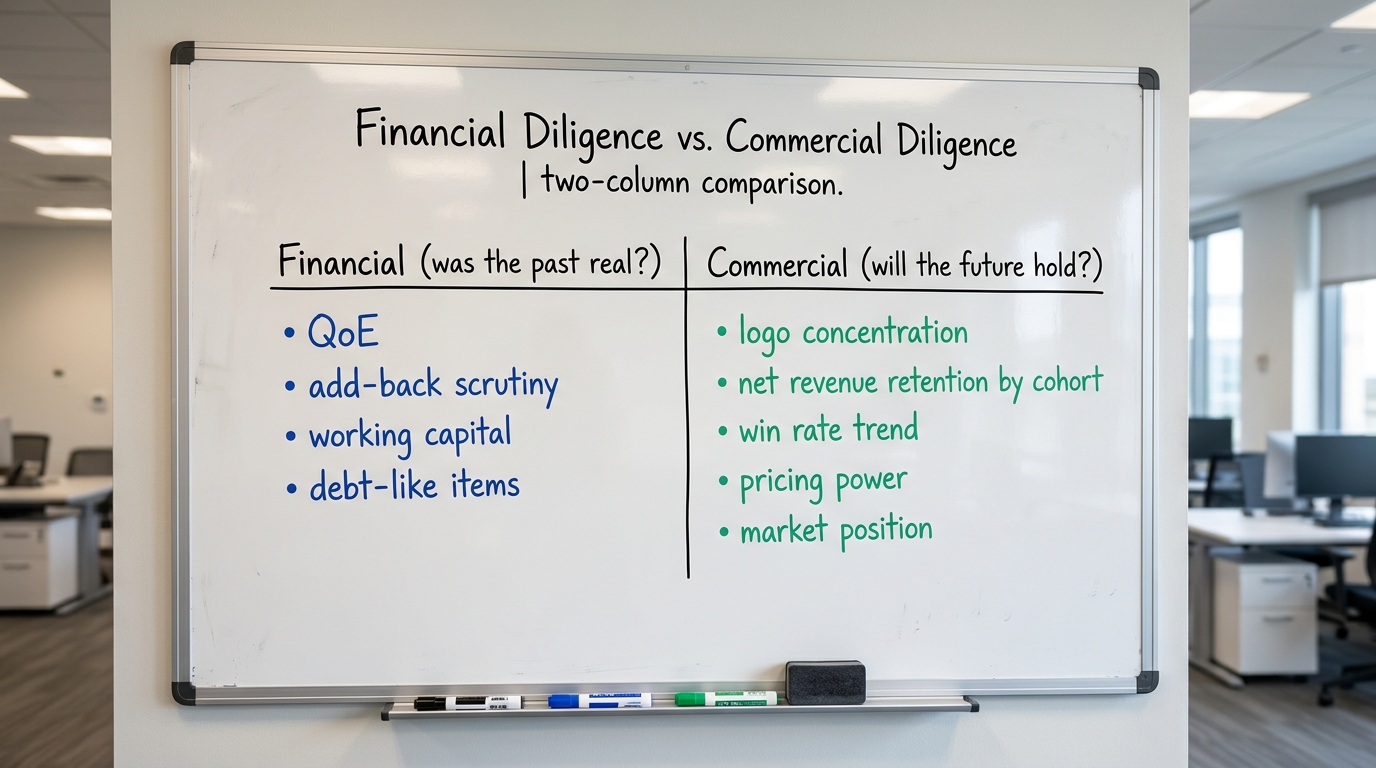
Quality of earnings and financial due diligence are mature disciplines. Accountingfirms do them well and the AICPA has published extensive guidance on the standards behind them. That is not usually where deals go wrong. Deals go wrong on commercial reality, the part that lives outside the audited numbers.
Commercial due diligence asks whether the revenue will still be there in eighteen months and whether it can grow without a proportional increase in cost. Those are questions about the market, the sales motion, the customer base, and the competitive position. A merger consultant who only reads the financials is checking whether the past was real. You need someone who is underwriting the future, because that is what the exit multiple pays for.
McKinsey’s private capital research, has repeatedly made the case that value creation in the current cycle is driven far more by operational and commercial improvement than by financial engineering. If that is true, then the commercial view during diligence is not a nice-to-have. It is the part of the analysis most directly connected to whether you will hit your return.
What good commercial diligence actually looks at
- Logo and revenue concentration. If the top five customers are half the revenue, the growth story has a very different risk profile.
- Net revenue retention by cohort. A blended retention number can hide a business that is churning good customers and replacing them with worse ones.
- Win rate and pipeline health. A declining win rate is the earliest signal that the commercial engine is weakening, well before it shows up in revenue.
- Pricing power. Whether the business has raised prices without losing volume tells you more about durability than the growth rate does.
These map directly to what I laid out in the B2B portfolio revenue leakage diagnostic. The same leaks that erode value in a held company are the ones a merger consultant should be finding before you buy it, so you can price them in or walk.
The handoff is where most value leaks out
Here is the failure I see most often, and it is structural, not a matter of talent. The merger consultant delivers a diligence report, the deal closes, and the findings evaporate. The person who understood the commercial risks is no longer in the room. The operating team inherits a business they now own and a report nobody translated into an operating plan.
This is the gap between advice and accountability. I have written about it directly in value creation consultants versus operators and in why PE value creation requires embedded partners, not advisory firms. The core argument is simple: the findings from diligence are only worth something if someone carries them across the close and turns them into the first hundred days.
The diligence findings should be the seed of the 100-day plan
If the consultant found that win rate was declining, the 100-day plan needs a commercial fix for it. If they found revenue concentration, the plan needs a diversification motion and a retention program for the anchor accounts. This continuity is the whole point. I laid out how this should sequence in the 100-day go-to-market plan for a newly acquired B2B business. A merger consultant whose engagement ends at close is handing you a diagnosis with no treatment.
When you evaluate an advisor, ask what happens after they deliver. If the honest answer is that they move to the next deal, price the handoff risk accordingly. You are going to pay for the translation somewhere, either upfront in the engagement or later in a first year that underdelivers.
How to judge the work product itself
Set aside the firm’s brand and the analyst headcount. The work product either changes your decision or it does not. Here is the specific test I apply.
Does it name a number you would defend to your investment committee?
A merger consultant who will not commit to a price ceiling or a specific risk-adjusted view of value is offering you optionality, not analysis. You do not need someone to tell you the target is attractive. You need someone to tell you the maximum you should pay and why one dollar more destroys the return. That is a defensible position, and it is what your IC will interrogate.
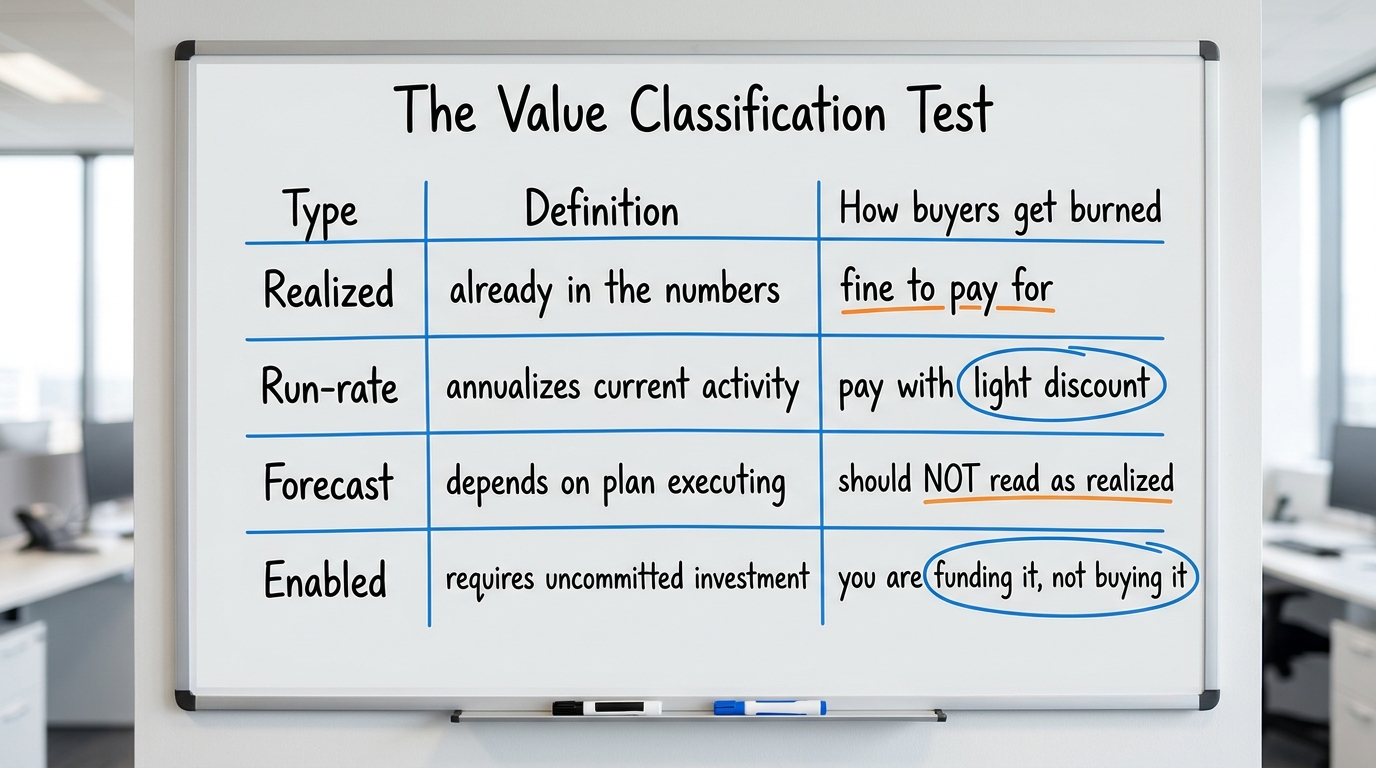
Does it classify the value it claims?
This is the discipline I hold most tightly. When a consultant says the target has upside, make them classify it. Is it realized value already in the numbers, run-rate value that annualizes what is currently happening, forecast value that depends on a plan executing, or enabled value that requires investment you have not committed yet? A deck that blends all four into one growth story is selling forecast and enabled value at a realized-value price. That is precisely how buyers overpay.
Does it separate what it verified from what it was told?
Every finding should be traceable to a source and a method. A claim about churn should say how churn was measured and over what period. A claim about market growth should cite something you can check. PitchBook and S&P Global publish underlying deal and market data that a serious advisor will reference rather than assert, and you can reach both through PitchBook and S&P Global Market Intelligence. If the report cannot show its work, treat its conclusions as opinion.
Where a merger consultant fits versus where an operator does
These are not the same role, and confusing them costs money. A merger consultant is engaged to inform a transaction decision. An operating partner or embedded operator is accountable for the P&L after you own the asset. Both are legitimate. The mistake is expecting the deal-phase advisor to deliver the post-close outcome, or expecting the operator to have been present during diligence.
The strongest funds I work with close that seam deliberately. The commercial view formed during diligence gets carried by someone who will still be in the room in month three. When that continuity is missing, the go-to-market plan starts from scratch, and the early quarters get burned rediscovering things the diligence already knew. I have seen this pattern enough that I treat it as the default failure. It is why I keep pointing operating partners toward the specific commercial repairs that actually move the number, the kind I described in how fractional CROs fix win rate and CAC, not revenue theory.
The stakeholder decides what the engagement should look like
A deal partner needs thesis, risk, and exit. They want the merger consultant to tell them whether the story holds and at what price. An operating partner needs speed, adoption, and a repeatable playbook, so their version of the same engagement leans toward what happens after close. A CFO needs the quality-of-earnings view, the covenant implications, and forecast reliability they can defend to a lender. If the advisor delivers the same generic report to all three, none of them get what they actually needed. The Harvard Law School Forum on Corporate Governance, at corpgov.law.harvard.edu, has published extensively on how governance and stakeholder alignment in transactions shape outcomes, and the through-line is that clarity about who the decision-maker is precedes good analysis.
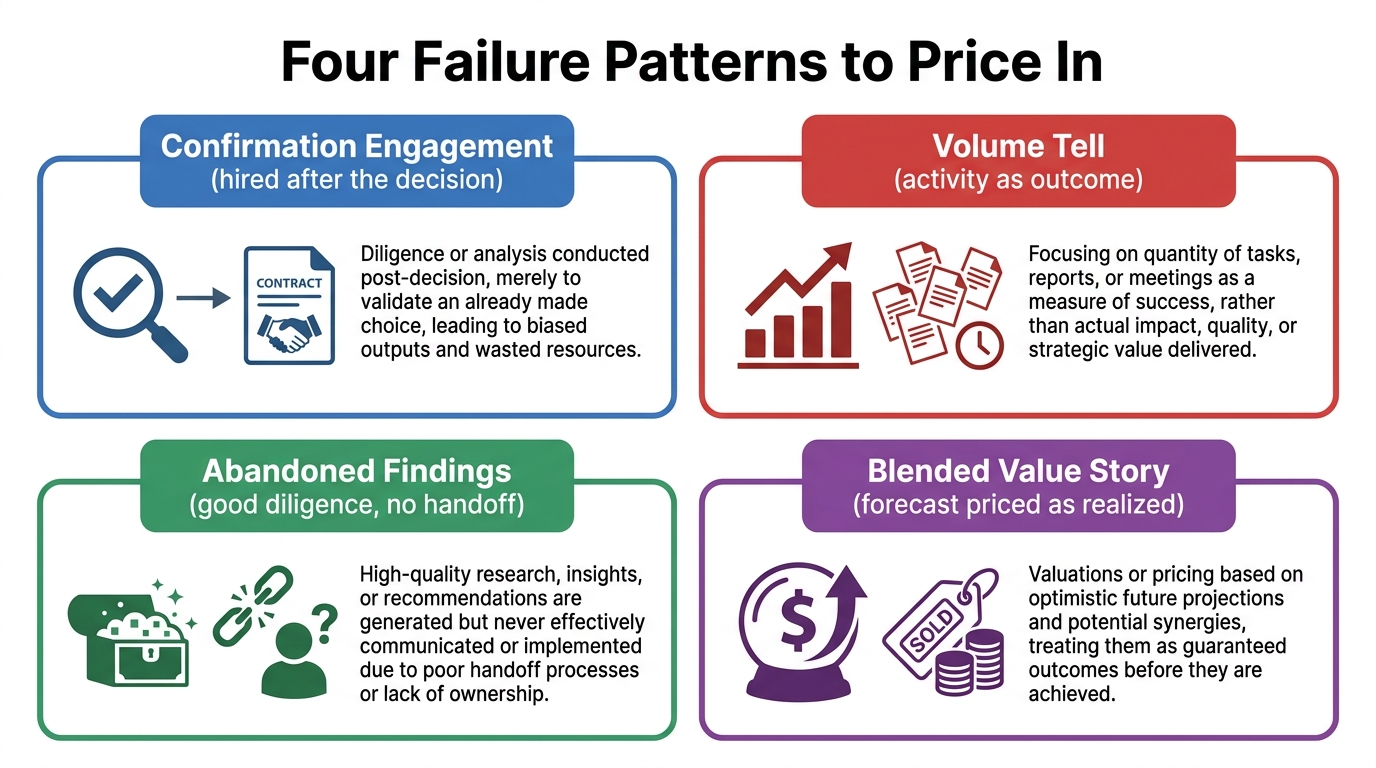
Common failure patterns to price in
A few patterns show up often enough that I now assume them until proven otherwise.
- The confirmation engagement. The consultant was hired after the deal partner already decided. The report is cover, not analysis. Symptom: no kill condition, no downside case, no named price ceiling.
- The volume tell. The deliverable leads with how much work was done rather than what was concluded. Interviews conducted, documents reviewed, hours logged. Activity standing in for outcome.
- The abandoned findings. Real risks are surfaced in the report, then never translated into the operating plan. The diligence was good, the handoff did not exist.
- The blended value story. Realized, forecast, and enabled value merged into one number that flatters the price. The most expensive pattern of all.
None of these mean the merger consultant is incompetent. They mean the engagement was scoped to serve comfort rather than the decision. That is a scoping problem you can fix on the front end by being explicit about which decision the work has to move and how you will judge whether it did. Harvard Business Review’s M&A coverage has documented for decades how many deals underperform their own base case, and scoping the diligence to comfort rather than truth is one of the quieter reasons why.
What this means for the current cycle
Deal terms have gotten more disciplined. Entry multiples are under more scrutiny, hold periods are longer than the industry planned for, and the easy return from multiple expansion is not reliably there. That environment raises the stakes on diligence quality specifically because you can no longer count on the market bailing out a thin thesis. The commercial view has to be right, because the operating improvement it enables is where the return now has to come from.
I made a broader version of this argument in private equity GTM and how to avoid value creation pitfalls, and it holds here. The merger consultant who understands that their job is to protect and inform a return, not to reassure a partner, is the one worth paying for. The distinction matters more in a cycle where there is no room for error. For a wider view on institutional resilience, I also collected the operating lessons in future-proofing organizations.
And once you own the asset, the same commercial discipline has to continue into the reporting cadence. The KPIs that told you whether to buy are the ones that tell you whether the value is materializing, which is the argument behind portfolio company operating reviews and the commercial KPIs that matter.
The short version
Judge a merger consultant by whether their work changes a decision and survives the close. Ask them for the finding that would make them recommend passing. Make them name a price ceiling. Make them classify every dollar of claimed value as realized, run-rate, forecast, or enabled. And ask what happens after they deliver, because the value leaks out at the handoff more often than anywhere else.
The best diligence I have been part of did not read like a celebration of the target. It read like an argument you could take to your investment committee and defend under pressure, with the risks named and priced and a plan for the first hundred days already forming. That is the standard. Anything short of it is reassurance, and reassurance is the most expensive thing you can buy in a deal.
If you are weighing an acquisition and want the commercial view underwritten by someone who will still be accountable after close, that is the work we do. Start with a value creation advisory conversation, and if the fit is there, we can bring the DevriX team through our private equity practice to carry the findings into the operating plan rather than leaving them in a report.
