You are three weeks from signing, the growth model in the deck assumes the platform triples transaction volume inside 24 months, and no one on your deal team can tell you whether the software can actually do that without a rewrite. That is the gap an architecture and scalability review for acquisition closes. Not a security checkbox, not a code smell report, a direct answer to a commercial question: can this asset carry the plan you are underwriting, and what will it cost in cash and calendar time if it cannot.
I run this work for private equity buyers, and the pattern repeats. The financials are audited, the customer contracts are papered, the management team is credible, and the technology is a black box that everyone hopes is fine. Hope is not a diligence position. If your investment thesis leans on scale, integration, or a product roadmap, the architecture is a value-creation lever and a repricing risk at the same time. This piece lays out what the review has to decide, how to judge the answers, and where the number lands on your risk register.
Why architecture belongs in the investment thesis, not the appendix
Most buyers treat the technology section of an information memorandum as background reading. That is a mistake when the thesis depends on the product doing more than it does today. Bain’s annual Global Private Equity Report has tracked the shift toward operational value creation as multiple expansion became harder to rely on, and operational value in a software-enabled business flows through the architecture whether you look at it or not.
The commercial logic is simple. If your model assumes the platform absorbs three acquisitions, opens two new geographies, and doubles paid seats, every one of those moves depends on the system doing something it has never been asked to do. A single-tenant application that took six weeks to onboard the last customer does not become a multi-tenant platform because your spreadsheet says revenue grows. The technology due diligence exists to test the distance between what the asset does and what the thesis needs it to do, then price the distance.
I have written before about how the tech and GTM gaps buyers price down at exit are usually visible years earlier. The buy-side review is the mirror image of that. What you fail to find in diligence, the next buyer finds when they price your exit.
The four questions an architecture and scalability review for acquisition has to answer
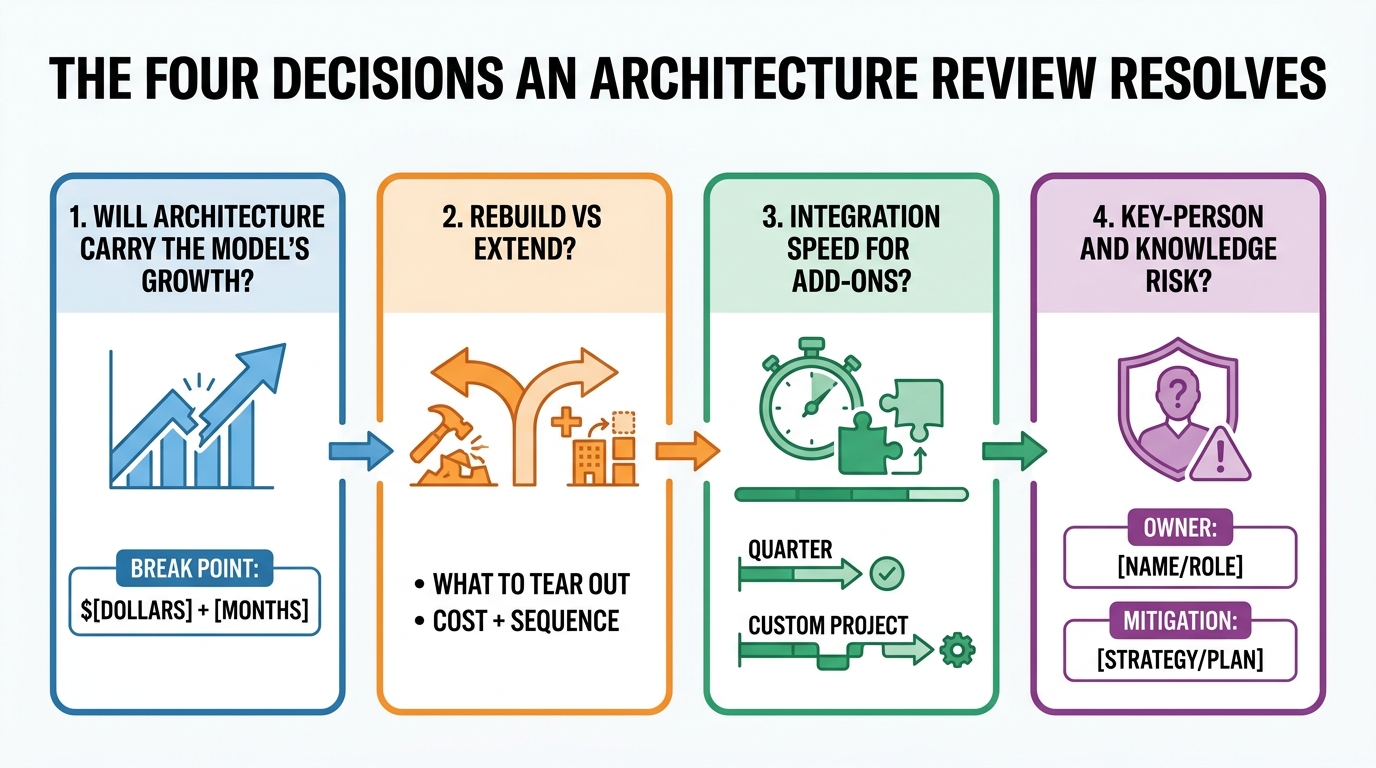
Every deal is different, but the review always resolves to four decisions a partner can act on. If a diligence report gives you activity instead of answers to these, it did not do the job.
1. Will the architecture carry the growth in the model?
This is the headline question. Not whether the code is elegant, whether the current system handles ten times the load, twenty times the tenants, or the geographic footprint the thesis assumes. The answer is rarely a clean yes or no. It is usually “yes to here, then it breaks, and here is what the break costs.” Your job is to get that break point named and quantified in run-rate dollars and months of engineering time.
2. What has to be rebuilt versus extended?
Rebuilds are the expensive surprise. An asset that looks healthy can hide a core component that cannot be extended and has to be replaced before any growth initiative moves. The review separates what you can build on from what you have to tear out, and attaches a rough cost and sequence to the teardown.
3. How fast can this integrate with an add-on?
If the thesis is a buy-and-build, integration speed is the value. A platform with clean APIs and a documented data model absorbs an add-on in a quarter. One with a tangled schema and no integration layer turns every add-on into a custom project. That difference is the difference between the roll-up working and the roll-up stalling.
4. What is the key-person and knowledge risk?
Architecture is not only code. If one engineer holds the whole system in their head and there is no documentation, the asset carries a dependency that no cash flow statement shows. This belongs on the risk register with an owner and a mitigation, not in a footnote.
How to judge scalability without being an engineer
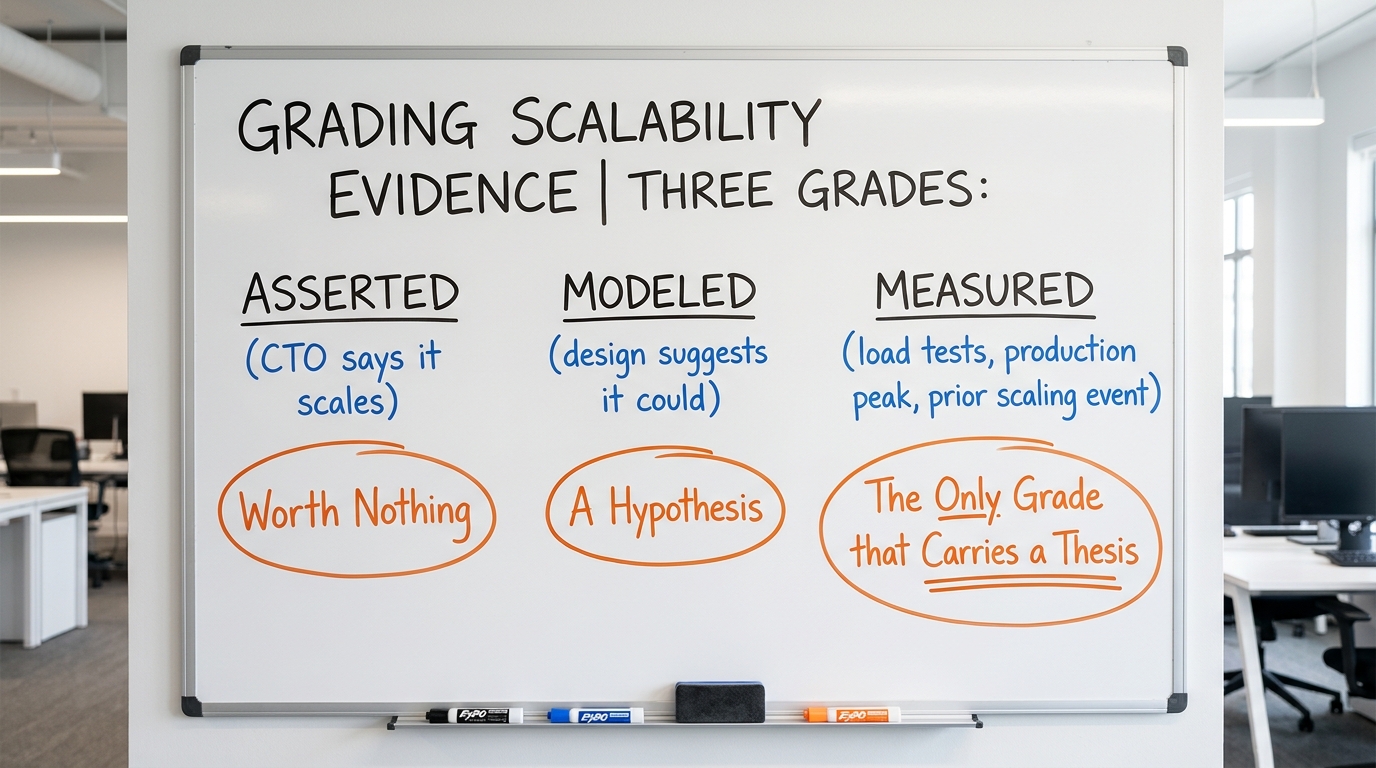
You do not need to read the code. You need to read the answers your reviewer brings back, and you need to know which answers are real. Scalability claims come in three grades of evidence, and I coach deal teams to grade them explicitly.
Measured beats modeled beats asserted
- Asserted: the CTO says the system scales. This is worth nothing on its own. Everyone says this.
- Modeled: the architecture on paper suggests it could scale, based on the design pattern. Worth something, still a hypothesis.
- Measured: load testing, production metrics under real peak traffic, or a prior scaling event the team already survived. This is evidence. It is the only grade you should let carry a thesis.
When a review hands you “the platform can handle the volume,” push for the grade. If the answer is asserted, the reviewer has not finished. Measured evidence for the specific stress your thesis applies is the standard. A system that scaled reads and never scaled writes tells you nothing about a write-heavy growth plan.
The three failure modes that repriced deals
Speaking generally from the pattern across buy-side reviews rather than any single account, three architecture problems show up most often as repricing events. First, the single-tenant trap, where a business selling to more customers has to hand-configure each one. Second, the monolith that cannot be split, where every change touches everything and release velocity slows as the team grows. Third, the data model that assumed one country, one currency, one tax regime, and now blocks the geographic expansion in the deck.
None of these are visible in a demo. All of them are findable in a focused review. McKinsey’s research on technology and private capital has repeatedly made the point that value creation now runs through the operating capability of the asset, and the architecture is where that capability lives or dies.
Where the review number lands on your risk register
A good review does not end with a grade. It ends with a line item. Every material finding gets classified so the deal team can act on it, and I use a simple taxonomy that maps to how a partner actually thinks.
- Repricing risk: a finding that changes what the asset is worth, because fixing it consumes cash the thesis assumed for growth.
- Day 1 dependency: something that has to be resolved before the platform can execute the first move in the plan.
- Value-creation lever: a fix that, once made, unlocks the growth, meaning the cost is an investment, not a loss.
- Risk avoided: a problem you now know about and can build into the plan and the price, instead of discovering it in month eight.
The distinction between a lever and a loss matters. Rebuilding a data model to support multi-currency is a cost if it is a surprise and a value-creation lever if it is the thing standing between the asset and the European expansion in the thesis. Same work, different classification, and the classification changes whether you walk or lean in.
This is also where the review connects to the first 100 days. Findings you classify as Day 1 dependencies become the technical backbone of the integration plan. The review is not a gate you pass and forget. It is the opening entry in the value-creation plan you execute after close, which is why I have argued that a plan someone is on the hook to deliver beats advice you can ignore.
What a five-day review actually covers, and what it cannot
Time-boxed diligence has real limits and real leverage. A focused five-day architecture and scalability review is not a full audit. It is a decision-grade assessment scoped to the questions above. Here is the honest boundary.
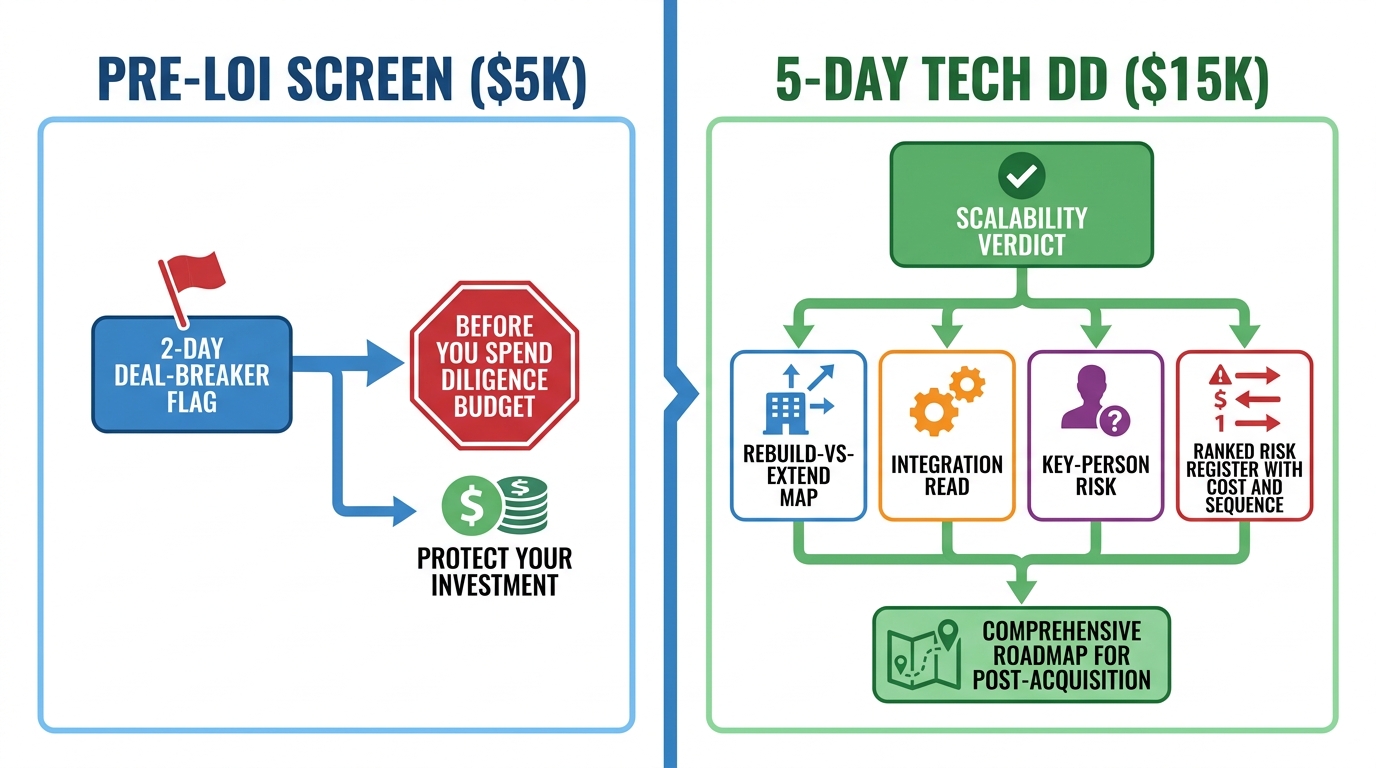
What five days delivers
- The scalability verdict against your specific model, graded by evidence.
- The rebuild-versus-extend map for the core components.
- An integration-speed read for the add-on thesis.
- The key-person and documentation risk assessment.
- A ranked risk register with rough cost and sequence for the material items.
What it cannot do
It cannot audit every line of code, and it does not need to. It will not certify security or compliance to a formal standard, that is a separate workstream. It will not give you a precise dollar figure for a rebuild you have not scoped in detail. What it gives you is enough to decide: proceed at the price, proceed with a reprice, or walk. For a pre-LOI screen, a tighter engagement flags the deal-breakers before you spend real diligence budget, so you do not run full confirmatory work on an asset that a two-day look would have killed.
The economics favor doing this early. Harvard Business Review’s coverage of mergers and acquisitions has long documented how integration and diligence gaps destroy deal value, and technical diligence is one of the cheapest places to find a reason to walk before the money is committed.
Reading the engineering team, not just the code
Architecture is a snapshot. The team that maintains it is the forward-looking signal. A clean system with a fragile team degrades. A messier system with a strong, disciplined team improves. When I assess an asset, I read both.
The questions that matter: how does the team ship, and how often? Who can touch the core, and what happens when they leave? Is there a real product function or is engineering building whatever sales promised last week? I have written at length about aligning engineering, product, and RevOps for value creation because the misalignment between them is a scalability problem dressed as a technical one. If the roadmap is dictated by the loudest customer, no architecture survives contact with growth.
This is also why a review by someone who has actually operated inside portfolio companies reads different signals than a checklist auditor. The difference between a partner who operates inside portfolio companies and a vendor who delivers a document is the difference between findings you can act on and findings you have to translate.
Turning findings into the first 100 days
The review should hand the operating partner a running start, not a closed folder. Every Day 1 dependency becomes a workstream with an owner. Every value-creation lever becomes a sequenced initiative with a rough cost and an expected impact on the plan. This is where the ongoing relationship matters more than the report.
A single diligence pass tells you the state of the asset at signing. It does not carry the plan through execution. That is why many portfolios pair the review with continued technical coverage, whether through a part-time CTO seat that enforces decision rules or a virtual CIO providing coverage without a full-time hire. The review finds the gaps. Someone has to close them, and I have made the case for why PE needs permanent digital capacity rather than advisory alone.
The alternative, a review that sits in a data room and never touches the integration plan, is a common and expensive failure. You paid to learn where the platform breaks and then executed as though it would not.
When this matters most
Three triggers should pull an architecture and scalability review to the front of the queue. The first is any thesis where the growth model assumes the platform does materially more volume, tenants, or geographies than it does today. The second is a buy-and-build where integration speed is the value. The third is a proprietary or bilateral deal where you have less external validation and more reason to verify the asset yourself.
PitchBook’s deal data and research shows how competitive processes compress diligence timelines, which is exactly when a time-boxed technical review earns its keep. You cannot run a three-month audit in a two-week window, but you can get a decision-grade read. The related work of the full technology and revenue audit in the first two weeks extends this once you own the asset.
Conclusion
An architecture and scalability review for acquisition is not a technical nicety. It is a direct test of whether the thesis you are underwriting is buildable at the price you are paying. It answers four questions a partner can act on, grades its scalability verdict by evidence rather than assertion, and lands every material finding on your risk register as a reprice, a Day 1 dependency, a value-creation lever, or a risk you have chosen to carry. Done early, it is one of the cheapest ways to avoid the most expensive kind of surprise.
If you have an asset under LOI or approaching confirmatory diligence and the thesis leans on the platform scaling, get the review scoped before you commit the full diligence budget. See how DevriX runs technical diligence for private equity buyers and operating partners, from a pre-LOI screen to a five-day decision-grade assessment.