

By Mario Peshev, DevriX
The moment an exit readiness assessment matters is not when the sell-side bankers arrive. It is eighteen to twenty-four months earlier, when the fund starts modeling the hold period against the return it promised its LPs, and someone on the deal team has to say, out loud, whether the asset will present clean when a buyer’s diligence team gets inside it. If that answer is a guess, the fund is carrying risk it has not priced. An exit readiness assessment private equity teams can act on exists to convert that guess into a scored, owned, dated picture of what a future buyer will find and what it will cost to fix.
Most of the exit readiness work I see confuses a data room with a diligence-ready business. Assembling documents is administration. Knowing where a buyer’s advisers will discount the number is underwriting. This piece is about the second one.
1. What the assessment has to decide, not describe
A deal partner is not commissioning a report. They are trying to make three commercial decisions ahead of a sale process, and every finding in the assessment should serve one of them.
The first is timing. If the asset is two remediation cycles away from presenting cleanly on revenue quality or system consolidation, launching a process now invites a re-trade. The assessment tells you whether the window is this year or after the next operating milestone lands.
The second is the ask. A credible growth story with an unaddressed technology liability sitting underneath it gets marked down twice, once for the risk and once for the impression that management did not know it was there. Knowing what a buyer’s tech due diligence will actually have to answer before they sign lets you fix the discount before it is applied to you.
The third is the narrative. Buyers pay for repeatable, durable earnings. The assessment identifies which parts of the growth story survive a stranger’s scrutiny and which parts rest on the current owner’s presence, relationships, or undocumented process.
If a section of the assessment does not move one of these three, it is describing the business, not preparing it for sale.
2. The five domains a buyer will actually test
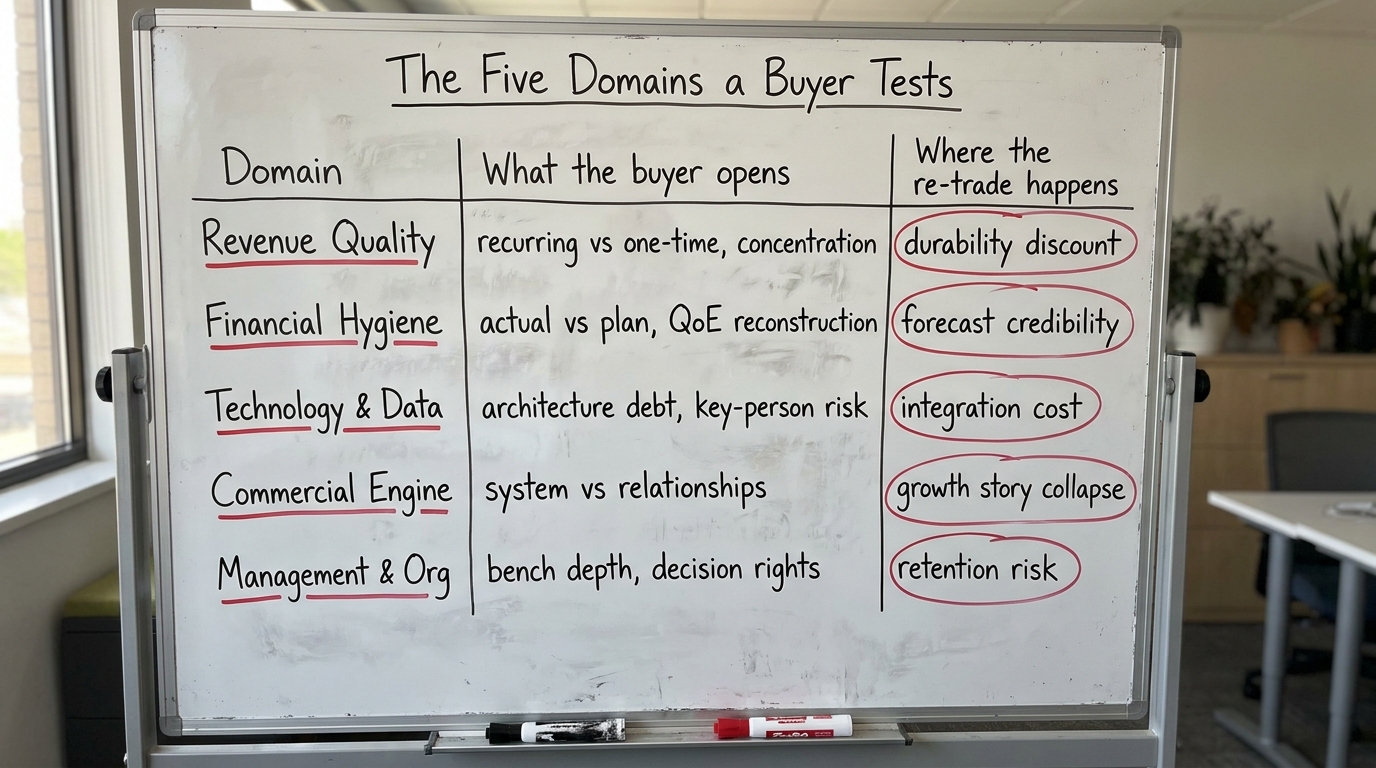
An exit readiness assessment worth its fee scores the same domains that a serious buyer’s advisers will open. Working backward from where deals get re-traded, five areas carry most of the risk.
Revenue quality and durability
Recurring versus one-time revenue, cohort retention, concentration, and how much of the pipeline depends on named individuals. Bain’s annual work on private equity returns has repeatedly tied durable multiple expansion to revenue quality rather than financial engineering, and buyers price accordingly.
Financial hygiene and forecast reliability
The gap between actual and plan over the last eight quarters, the quality of the management accounts, and whether the numbers a quality-of-earnings team will reconstruct match the numbers the growth story is told with.
Technology and data
Architecture debt, key-person dependency in engineering, security posture, license and IP cleanliness, and whether the data can support the reporting a new owner will expect on day one. This is the domain most often underestimated by sellers and most consequential in technology due diligence.
Commercial engine
Whether growth is a system a new owner can run or a set of relationships that leave when the founder does. This is where revenue operations maturity becomes a valuation input rather than a back-office concern.
Management and organization
Depth below the CEO, documented decision rights, and how much institutional knowledge lives in one or two heads.
3. Score each domain on a four-tier scale, not a checklist
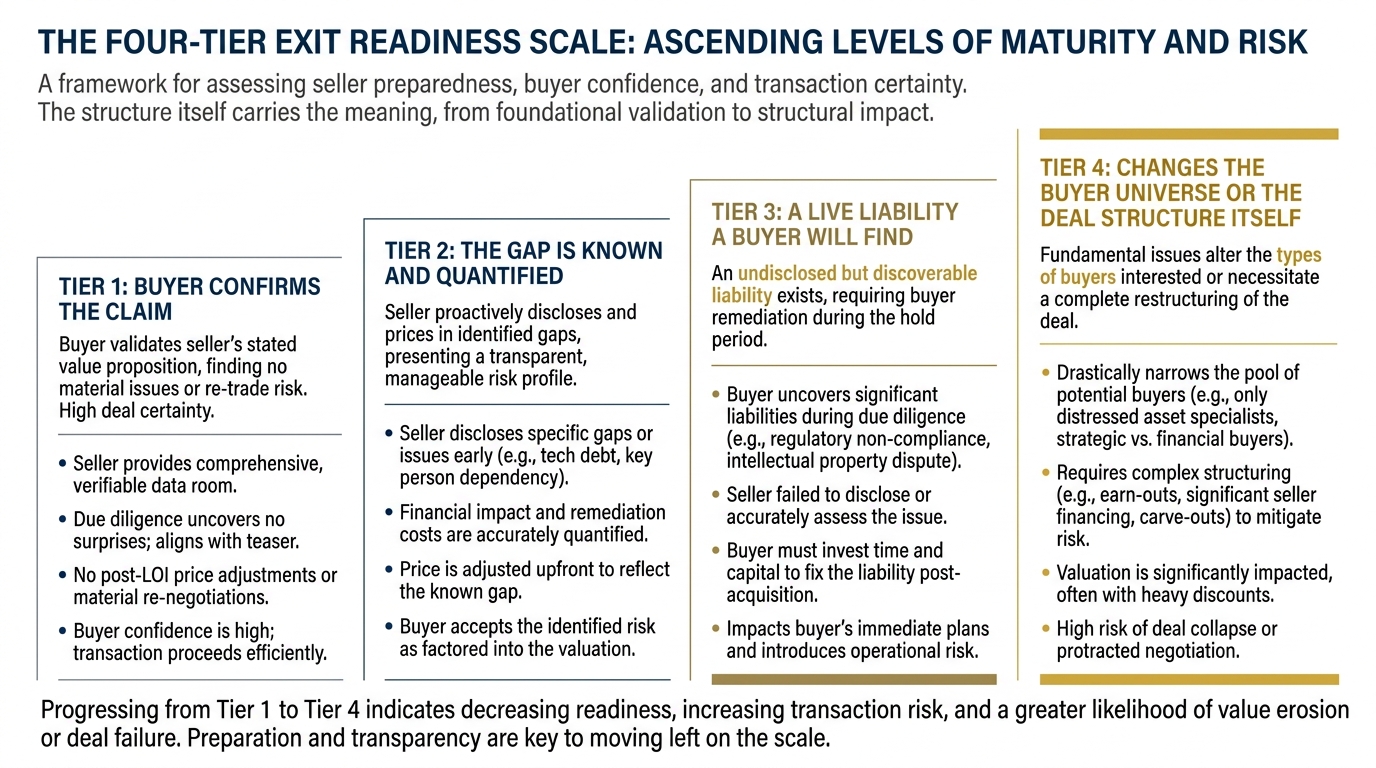
A checklist tells you a document exists. A tier tells a deal partner how much money is at stake and how long remediation takes. I use four tiers because they map cleanly to decisions a buyer will make.
Tier 1, exit-ready. A buyer’s advisers will confirm what management already presented. No re-trade risk in this domain. The value is realized and defensible.
Tier 2, presentable with disclosure. The issue is known, quantified, and has a plan attached. A prepared seller discloses it early and prices it, which removes most of its power to move the number later.
Tier 3, remediation required before process. A live liability a buyer will find and use. Fixable inside the hold period, but not inside a live process. This is the tier that determines timing.
Tier 4, structural. A problem that changes the buyer universe or the deal structure itself, such as revenue that cannot be separated from the founder, or a platform migration that a new owner would have to fund. These rarely get fixed under process pressure and should be surfaced the moment they are found.
The discipline is refusing to average. A business at Tier 1 on financials and Tier 4 on technology scores a Tier 4 business with a structural technology problem that a growth story cannot paper over, and the assessment has to say so plainly.
4. Attach a number and an owner to every gap below Tier 2
A finding without a cost and an owner is trivia. The value of the assessment is the translation from operating condition into the language a buyer will use, which is EBITDA and enterprise value.
For each Tier 3 and Tier 4 item, the assessment should carry an estimated remediation cost, an estimated impact on the number if left unaddressed, a named owner inside the portfolio company, and a realistic completion date. This is the same discipline that separates a credible tech diligence provider from a report writer, which I have argued is why the best diligence firms price deal risk in EBITDA rather than in severity labels.
Where you can, classify each item honestly. A fix that is done and verified is realized. A plan that is funded and staffed but not complete is forecast, and it should never be presented to a buyer as if it were already true. Buyers discover the difference in confirmatory diligence, and the discovery costs more than the original gap.
5. Run the assessment against the buyer, not against the checklist
The same business scores differently depending on who buys it. A strategic acquirer with an established platform will absorb a founder-dependent commercial engine more easily than a first-time platform sponsor who needs the growth to continue standalone. A buyer planning an aggressive add-on program will price data and system fragmentation more harshly than one buying for cash yield.
Frame the assessment for the likely buyer set. A strategic buyer is already thinking about how the asset folds into existing operations, so technology and integration questions will weigh more heavily in diligence. A financial buyer will re-underwrite the growth plan from scratch, which puts more weight on forecast reliability and the company’s ability to operate without support. McKinsey’s work on private capital and PitchBook’s deal data both show how buyer composition shifts across cycles, and the shift changes what a seller should prepare first.
6. Time the remediation to the process, not to the calendar
The four-tier scoring sequences the work. Tier 4 items set the earliest credible launch date because they take the longest and cannot be rushed once a process starts. Tier 3 items fill the runway before that date, Tier 2 items become the disclosure package, and Tier 1 items become the story.
The work that produces exit readiness is the same discipline that produces a clean start after acquisition, which is why the sell-side plan and the first 100 days playbook draw on the same underlying capabilities: documented systems, clean data, a commercial engine that runs without heroics, and a management team that can answer a stranger’s questions without the founder in the room.
If the assessment surfaces a system consolidation problem, and many do after an add-on, that is a Tier 3 or Tier 4 item with a real timeline. I have written before about how CRM consolidation after an add-on is the kind of decision that looks administrative and turns out to be a revenue and valuation input. Left to the process, it becomes a re-trade lever. Handled in the hold period, it becomes a line in the growth story.
7. An illustrative walk-through
The following is an illustrative scenario, not a client case, meant to show the scoring in motion.
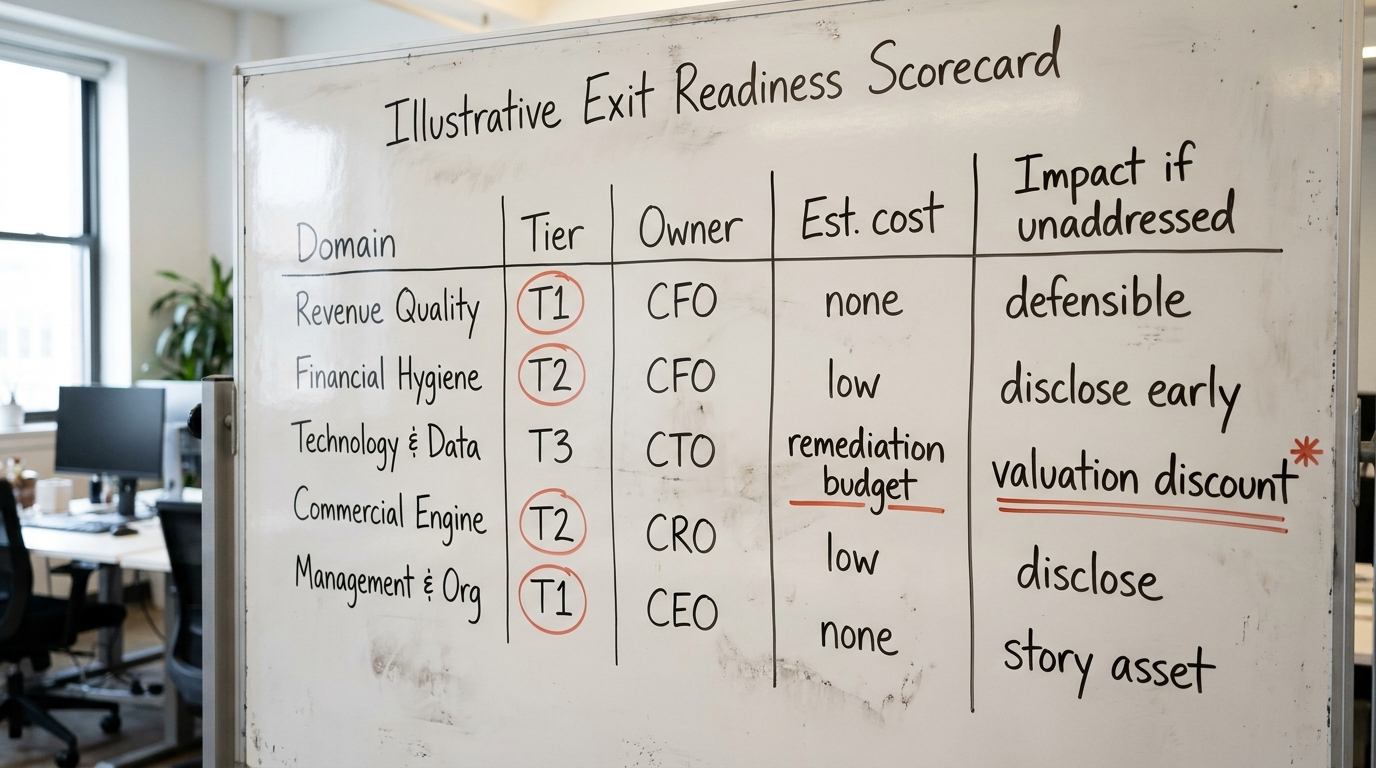
A fund is eighteen months from a planned exit on a services business. The growth story is strong, recurring revenue is real, and the financials are clean. The exit readiness assessment scores four domains at Tier 1 or Tier 2. Technology scores Tier 3: the reporting stack depends on one engineer, the data cannot support the monthly reporting a new owner would expect, and two systems from a prior add-on were never consolidated.
Averaged, this looks like a strong asset with a minor issue. Scored honestly, it is a business one live liability away from a technology discount that a buyer’s advisers would apply against otherwise excellent numbers. The deal partner now has a real decision: launch now and absorb the markdown, or fund a nine-month remediation and launch clean.
The assessment gives the inputs for that decision. The fund knows remediation cost, the impact of leaving it unaddressed, who inside the company is responsible, and a completion date. A vague sense that technology might be a problem becomes a scored, dated, owned line item that the fund can underwrite (the same logic I apply to judging any value creation partner before you sign: the work has to end in a decision with the reasoning visible, delivered to the person who will act on it).
8. What the finished assessment should look like
A deal partner should be able to read the output in one sitting and walk into a board meeting with it. That means a single scorecard across the five domains with a tier on each, a remediation ledger for everything below Tier 2 with cost, owner, and date, a recommended launch window justified by the longest-pole item, and a plain statement of which parts of the growth narrative survive a buyer’s scrutiny.
What it should not be is a several-hundred-page repository of documents with no scoring, no cost, and no owner. That is a data room, and a data room prepared without an assessment behind it simply hands a buyer’s advisers an organized list of things to discount. The Harvard Law School Forum on Corporate Governance has published extensively on sale-process preparation and disclosure, and the consistent theme is that early, quantified disclosure protects value while late discovery destroys it.
The same principle governs how you judge the firm doing the assessment. The connection between diligence, integration, and exit is one continuous thread, which is why the questions worth asking overlap heavily with how you judge any M&A consulting firm when you are the one underwriting the deal. If the provider cannot state findings in EBITDA and cannot name an owner for each gap, they are producing a description, and a description does not prepare an asset for sale.
9. Conclusion
An exit readiness assessment gives a fund a scored, owned, dated view of what a buyer will find and what it will cost to fix, produced far enough ahead that the fund can decide whether to repair, disclose, or price each gap on its own terms rather than under process pressure. Tier the domains, attach a number and an owner to everything below Tier 2, frame it for the likely buyer, and sequence the work to the longest pole. Done that way, the assessment turns the question every deal partner is quietly carrying, whether this asset will present clean, into something the fund can underwrite instead of hope for.
If you are eighteen to twenty-four months from an exit and want the technology, data, and commercial domains scored the way a buyer’s advisers will score them, DevriX runs exit readiness assessments built for private equity value creation, with findings priced in EBITDA and an owner named against every gap.
