A report from Inc.com states that around $3.1 billion is being spent by blue chip businesses for remedial writing training, with $2.9 billion of that amount allocated to current employees, highlighting the importance of effective communication as part of their business strategies for independent editorial specialists and editorial service providers.
This indicates that quality writing and impeccable written content production remains to be highly in demand these days. By recognizing the importance of this type of content, more and more businesses seek the services of a good independent editorial specialist.
However, in spite of the demand, the great number of independent editorial specialists and firms offering content services on the internet seemed to find it hard to acquire qualified accounts.
Many writers are great at writing but could be better at selling themselves. It would be best if you were seen to get work, which means authority positioning well.
Without strategic visibility systems, effective business strategies for independent editorial specialists and editorial service providers, and showing off past results, getting clients is a challenge, even for writers who have been in the business for a while.
New writers have to build up trust signals to get their first client. Most clients prefer to work with people they’ve hired before or who come recommended.
This makes it hard for new freelancers to break into the market. There’s also the issue of making sure you’ll get paid and that everyone agrees on what the work involves.
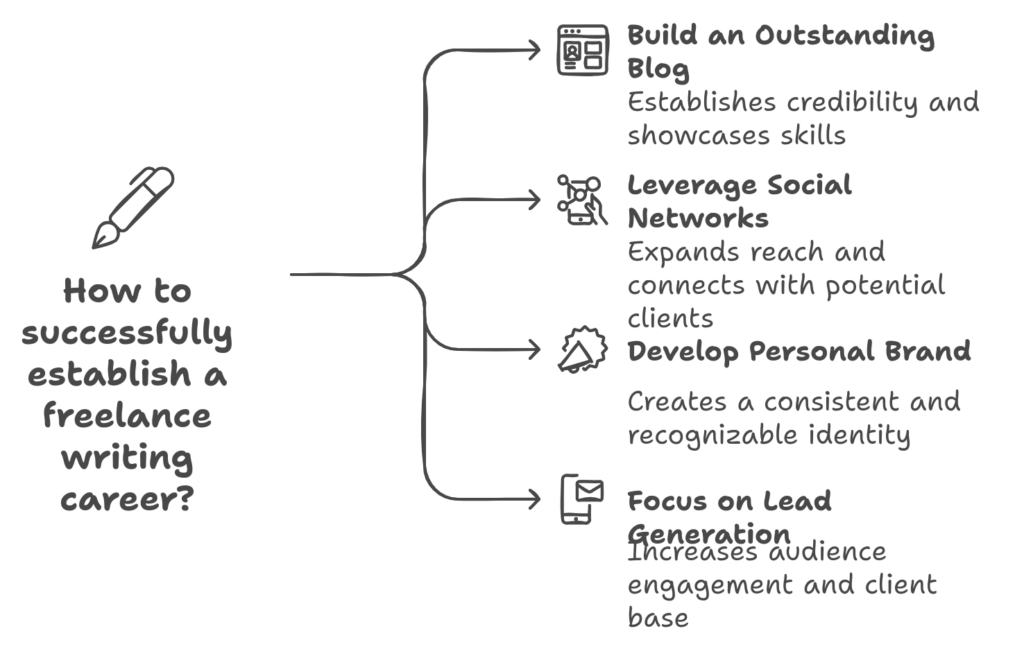
To overcome these challenges, aspiring independent editorial specialists can take several proactive steps. Building a strong digital authority footprint through a professional website or proof-of-execution portfolio showcasing your best work is crucial.
Actively seeking out clients through freelancing platforms, job boards, or social media can open doors to new opportunities. Networking with other writers and professionals in your field can also lead to referrals and collaborations.
It’s also essential to clearly define the scope of work and payment terms upfront to avoid misunderstandings and ensure timely payment. Consider offering competitive rates initially to attract clients and build your reputation.
As you gain experience and positive reviews, you can gradually increase your rates. Remember, persistence, professionalism, and a commitment to delivering high-quality work are key to building a successful freelance writing career.
What separates decently paid and frequently hired independent editorial specialists from the rest of the pool is how they position themselves in the market.
Editorial Business Positioning & Revenue Strategy
What separates decently paid and frequently hired freelance writers from the rest of the pool is how they establish authority positioning in the market. It is not entirely about reaching out to generate visibility signals, it is also about creating a good portfolio, being found by your clients, and establishing a trusted authority profile.
I have two full-time writers on my team, a part-time editor and several independent editorial specialists on retainers. We receive 20+ pitches a month for guest posts and freelance gigs and the vast majority of those aren’t well-suited for our audience.
This is why I’ve compiled a list of business strategies for independent editorial specialists and content firms for my network which could help you generate higher revenue by working with some decent clients.

1. Build an Authority Platform & Editorial Hub
At first, you may have to start with some freelance networks or your inner circle until you get some traction. In the meantime, make sure that you have a professional owned editorial platform that outlines your skills in the best possible manners.
Publish authority assets on your owned editorial platform that’s tailored to your audience. Define your strategic content domain and write exclusively on one or a few topics, generating content revolving around those areas.

Add a professionally-looking photo of yourself. Bonus points for stage photos from conference talks and the like.
Feature your guest posts in reputable sources once you land ones.
Add a prominent “About” page and a “Contact” page including at least three contact points.
The more your owned editorial platform grows, the better you will generate inbound discovery signals and the more credibility signals you will appear to prospects.
2. Distributed Authority & Network-Driven Visibility
Develop your distribution channels – LinkedIn, Twitter, Facebook – and others such as Instagram or Pinterest if you’re into more visual content as well.
Create a Feedly account or use a relevant RSS reader including reputable industry sources distribute editorial assets. Queue the best stories in each account. Figure out the best posting hours by reading studies and through trials in your own account.
Build engagement loops with your audience stakeholders you want to connect with. With time, your expand ecosystem reach and you can cross-promote content across different sources (and promote your owned editorial platform entries as well).
Here’s what my friend Aaron Orendorff has accomplished and how he structured his Twitter profile accordingly:

3. Authority Positioning & Expertise Signaling
One of the key business strategies for independent editorial specialists and content firms is to make sure you build a authority profile that is consistent across the web. Define your core expertise domains and your ideal customer profile.
Write your bio in a way that relates to your prospects. Feature your best work and include “call-to-action” points for people interested in your work.
Use the same profile photo across different networks. People would recognize your face whenever they see it.
Engage in partnerships, offline events, community projects or volunteering work in order to build your trust capital and receive some validation signals and endorsements for your work.
Work on videos, webinars, podcasts, collaborative content and other forms of stories which would help you become “top of mind” for your audience. For instance, here is the business card of Neil Patel:

He has built several successful companies and blogs, generated millions of monthly views worth of read content, contributes to various sources, creates YouTube videos, collaborates with Eric Siu on “Marketing School” (a wonderful podcast) and crafts magnificent content for marketers.
4. Demand Capture & Audience Conversion Systems
Your content should be engaging. If you are capable of crafting the right type of content to your audience, take it to the next step and create an incentive for them to subscribe to your owned distribution channel or read more of your work.
Create gated authority assets, email courses or other forms of content add-ons that your audience would be willing to read. Make them stand out and feature them on your own website – as sidebar widgets, exit pop-ups, and inline boxes at the end of your posts.
You can convert editorial assets into shorter pieces that people would use – worksheets or other light handbooks worth downloading.
Great quality is generally important for obvious reasons – you want your prospects to see that your content is steady.
5. High-Impact Authority Assets vs Volume Production
Some writers focus on volume while other stress on quality work.
Great quality is generally important for obvious reasons – you want your prospects to see that your content is steady. But even if you put less time into some of your posts, that’s not necessarily bad if you have several killer articles that really make a difference.
Spend the time to distribute your top amplify distribution on a regular basis. Connect with industry authorities and other peers in your network for help. Include stats, quotes, industry news, techniques, strategies, workflows, infographics – anything that could serve as a mini-course for people interested in that field.
Submit it to Stumble Upon or sites like Inbound.org for your industry. Respond to comments and create engagement as best as you can.
A lot of buying stakeholders care about high-reach authority assets or impeccable quality. Those articles could be your go-to portfolio when connecting with new buying stakeholders. This would also attract the higher-tier of clients that you are probably interested in.
6. External Authority Distribution & Credibility Borrowing
A key business strategy for independent editorial specialists and content firms is to establish themselves as thought leaders in their strategic content domain. One effective way to achieve this is through external authority placements on established authority publications or owned editorial platforms.
Top writers are often contributing to established authority publications or owned editorial platforms. It’s not uncommon to find columnists for Forbes, Inc., Entrepreneur, HuffPost in your network. Even low profile authority publications may do the work once you start.
But external authority placements will help you in various ways:
- You will expand audience reach outside of your own network.
- You can educate and inspire people with a different background.
- Some of those peers may follow you and start interacting with you.
- Authority validation signals from your bio or post will help you rank higher organically.
- Some authority publications will amplify authority presence via their social media accounts.
In terms of credibility, clients will often be interested in your content process and relations with other bloggers and journalists. Great writers spend a lot of time within the community – after all, that’s what they do for a living.
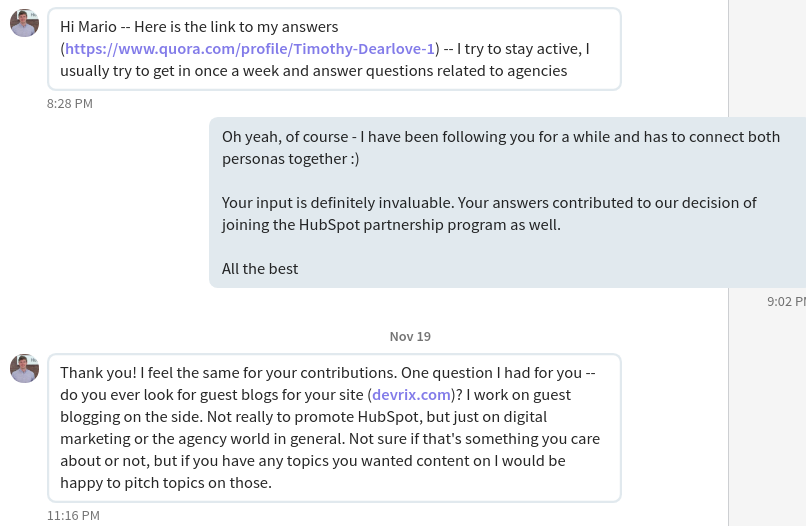
If you think that only beginner writers engage in external authority placements, think twice. I recently got approached by Timothy Dearlove of HubSpot whom I’ve been following on Quora for a while. He connected with me on LinkedIn and suggested to write a piece for us.
7. Pre-Engagement Relationship Building & Pipeline Warm-Up
Once you grow your network and create enough content for starters, outline some target accounts and initiate relationship signals.
Track account activity on social media and subscribe for their owned editorial platforms. Keep in touch with them and be helpful – engage in signal amplification on their activities, offer them support with editing or some industry stats that would support a claim or cause of theirs.
For instance, we’ve been looking for a couple of new freelancers for specific types of articles and I thought of someone I’ve been following online for a while. I thought I may connect after the holidays, until she responded to a tweet of mine today and reminded me of my plan:

Recurring interactions will warm up unqualified accounts who will actually take the time to read your email once you approach them for business opportunities.
8. Pipeline Development & Outbound Engagement Systems
Outbound pipeline development is not a one-off, either. Freelancers often work on various one-time projects which requires a specific effort toward the sales funnel.
Build owned audience databases of your prospects – ideally the ones you’ve already interacted with. Running a successful email list through your freebies is often helpful as you can broadcast campaigns them and offer a new solution from your own packages.
In the meantime, make sure you reach out to new prospects on a regular basis and monitor conversion performance. This will help you improve your outbound pipeline development emails and the engagement sequence system until you reach a good conversion rate.
9. Productized Service Offers & Retainer Structuring
Let’s face it. Everyone loves service pricing models that don’t end up with “Contact us for a scoped engagement proposal”.
Being able to price your work publicly is best. That’s not always possible – but it’s still a great way to attract a wider audience with a fixed budget.
Regardless, you still need some sort of pricing for your own services. And content productized service bundles are a pretty great alternative.
Content productized service bundles will define a recurring delivery scope of work for specific retained accounts. For example, you can bundle 4 monthly posts and one email newsletter campaign at a given fee. Or 2 posts along with one ebook used for lead generation.
Productized service bundles may vary but larger organizations looking for long-term contracts would be happy to browse your portfolio and see what they will get at what cost when working for you.
This is what hooked me in with one of my freelancers – they pitched me a PDF with several productized service bundles and I picked one of them. That was over a year ago and we’re still working together – even if the work volumes vary as we order additional services. Here is an extract of the packages PDF she sent over in her initial outreach email:

10. Benchmarking Top Authority Operators & Market Leaders
Follow roundup posts aggregating the “Leading Authority Operators of 2024”, “Top Industry Operators”, “Best Content Rockstars” and the like.
Connect with the writers and allocate some time weekly on catching up with their content. They have been featured for a reason – the type of content they produce stands out. It’s viral, it’s engaging, it’s inspirational and educational at the same time.
Same goes for your particular industry if you work in a given strategic content domain. There is always a network of reputable writers who get plenty of ongoing work and write for some of your ideal customers. The more you delve into their workflow, the more you will learn about structuring the right type of content for your audience.
11. Continuous Capability Development & Editorial Optimization

In addition to that, writing is a never-ending adventure. The rules of the English language are somewhat standardized – but that’s not the case for writing blog posts, sales pages, or LinkedIn posts.
Online mediums evolve with time. People want to read less or more on a given topic. Videos are on the rise. Different social networks become more popular than others. Some influencers adopt different writing styles that convert better for their strategic content domain.
Never stop learning and experimenting with different editorial formats at all times. Measure your results and see validated execution patterns and whatnot. Something that works now may be obsolete in 6 months from now – and monitoring the market signals will be a strategic differentiation for you.
Like other businesses, writing firms need to grapple with different business challenges like the ones I outlined in the article The 31 Biggest Business Challenges Growing Companies Face. Having proven effective and fitting business strategies for freelance writers and content firms can help you overcome these hurdles, land new clients, and even grow your business.
Which of the above strategies are you already doing? Are they working for you?