

By Mario Peshev, DevriX
Most technology due diligence reports get read once, skimmed for the red section, and filed. That is not a failure of the reader. It is a failure of the report, and usually of the brief that produced it. A deal partner staring down an exclusivity clock does not need a 60-page inventory of the target’s stack. That partner needs to know whether the technology supports the investment thesis, what it will cost to fix what is broken, and which of those problems can kill the deal versus which can be repriced or fixed post-close.
I have sat on both sides of this. DevriX has run the engineering diagnostic behind acquisitions, and I have watched deal teams pay for tech diligence that told them everything except the one thing they needed to decide. So this piece is about what you are actually buying when you commission technology due diligence consulting, and how to tell whether the firm across the table can deliver it.
The deliverable is a decision, not a document
The core confusion in this market is that buyers think they are purchasing a report. They are not. They are purchasing a decision input, one that has to arrive fast enough and specific enough to change price, terms, or the post-close plan. If the output cannot move one of those three levers, you overpaid.
Bain’s annual assessment of the industry, tracked in its Global Private Equity Report, has documented how deal timelines and holding periods have compressed the room for error. When you hold an asset for a shorter window and exit into a pickier buyer pool, technology risk you missed at entry does not stay quiet. It shows up in the QoE at exit, in the buyer’s own diligence, and in the discount they apply.
So the first question I ask any tech diligence firm is blunt: at the end of this, what specifically will the deal team be able to decide that they cannot decide now? If the answer is a description of activity, you are talking to the wrong firm. This is the same distinction I have written about between value creation consultants and operators who carry P&L accountability. Advice that does not attach to a number is decoration.
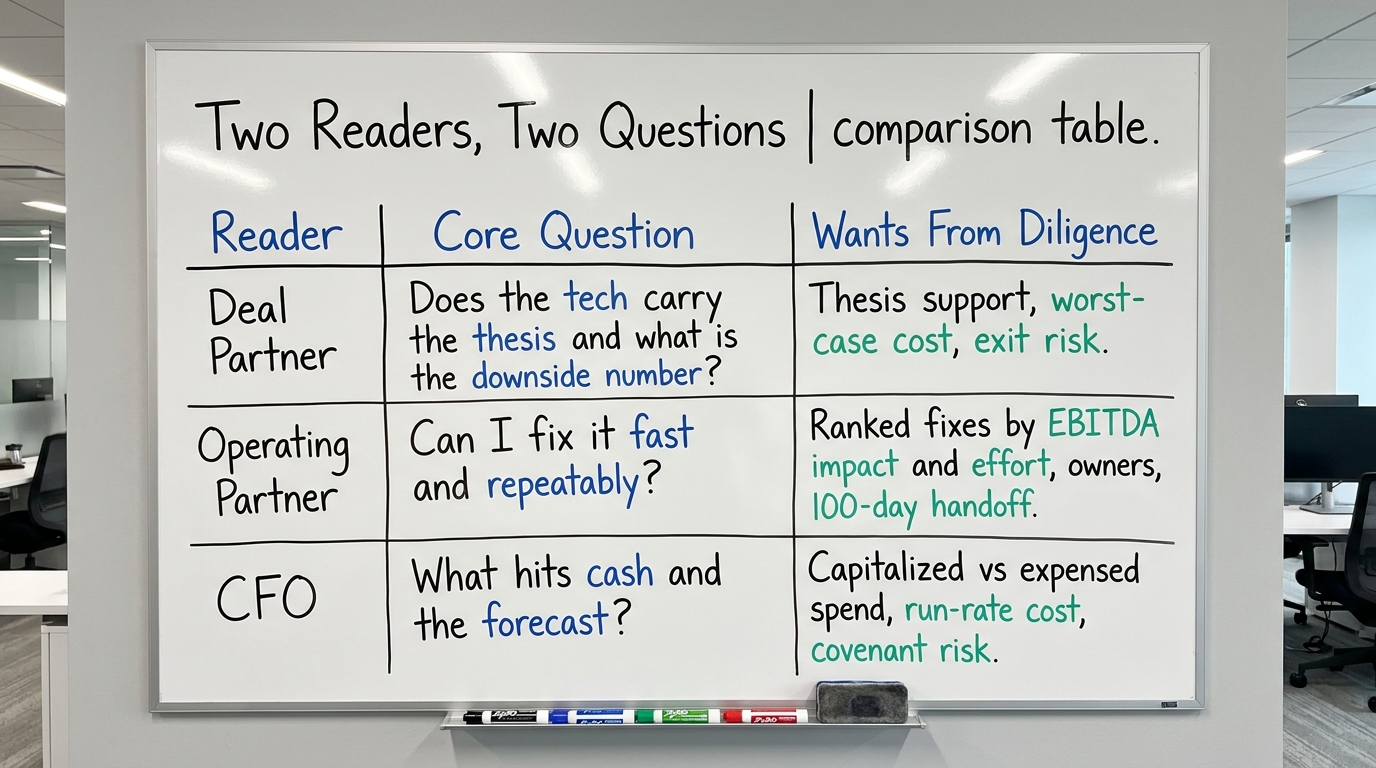
What the deal partner needs versus what the operating partner needs
These are two different readers with two different questions, and a good diligence engagement answers both without blurring them.
The deal partner wants thesis, risk, and exit
The deal partner is asking whether the technology can carry the growth case in the investment memo. If the thesis is 40 percent revenue growth over four years through geographic expansion, can the platform serve three new regions without a rewrite? If the thesis is bolt-on acquisitions, can this codebase and data model absorb three more companies, or does every add-on trigger a six-month integration slog that eats the synergy?
The deal partner also wants the downside framed honestly: what is the worst credible technology outcome, and what does it cost. Not a hedge, a number with a confidence range.
The operating partner wants speed, adoption, and a repeatable path
The operating partner inherits whatever you sign. That person wants the diligence to hand off cleanly into a plan, ideally the same team that found the problems helps sequence the fixes. This is why I keep arguing that PE value creation requires embedded partners, not advisory firms. A diligence report that names ten technical debts but does not rank them by EBITDA impact and effort leaves the operating partner to redo the analysis under worse time pressure.
The best engagements produce a diligence output that folds directly into the 100-day plan. Findings become sequenced workstreams with owners and cost, not a wish list.
Translate every finding into money or risk
Engineers write diligence findings in the language of engineering: monolith versus microservices, test coverage, technical debt, key-person dependency. None of that reaches a deal partner. The job of good technology due diligence consulting is translation, taking each finding and stating its consequence in one of a few currencies the investment committee already uses.
- Revenue at risk. A platform that cannot scale to the growth thesis is a cap on realizable revenue, state the ceiling.
- EBITDA drag. Manual processes, licensing waste, and over-provisioned infrastructure are run-rate cost you can quantify. Some of it becomes an add-back conversation, which connects directly to how add-backs get argued in adjusted EBITDA.
- Capital requirement. A rewrite or re-platform is capex or capitalized labor over a defined window, name the number and the schedule.
- Integration cost and time. For a buy-and-build thesis, the cost of absorbing each add-on is a direct hit to synergy math.
- Diligence risk at exit. Problems you tolerate at entry get discovered by the next buyer and repriced against you.
When you classify an impact, be honest about its status. Realized cost is different from run-rate cost, and both are different from enabled upside that only materializes if the operating team executes. I have watched decks present enabled value as though it were already in the bank. That is not analysis, it is selling. McKinsey’s private capital research has repeatedly made the point that value creation lives in operational execution after close, not in the model at signing.
The findings that actually change a price
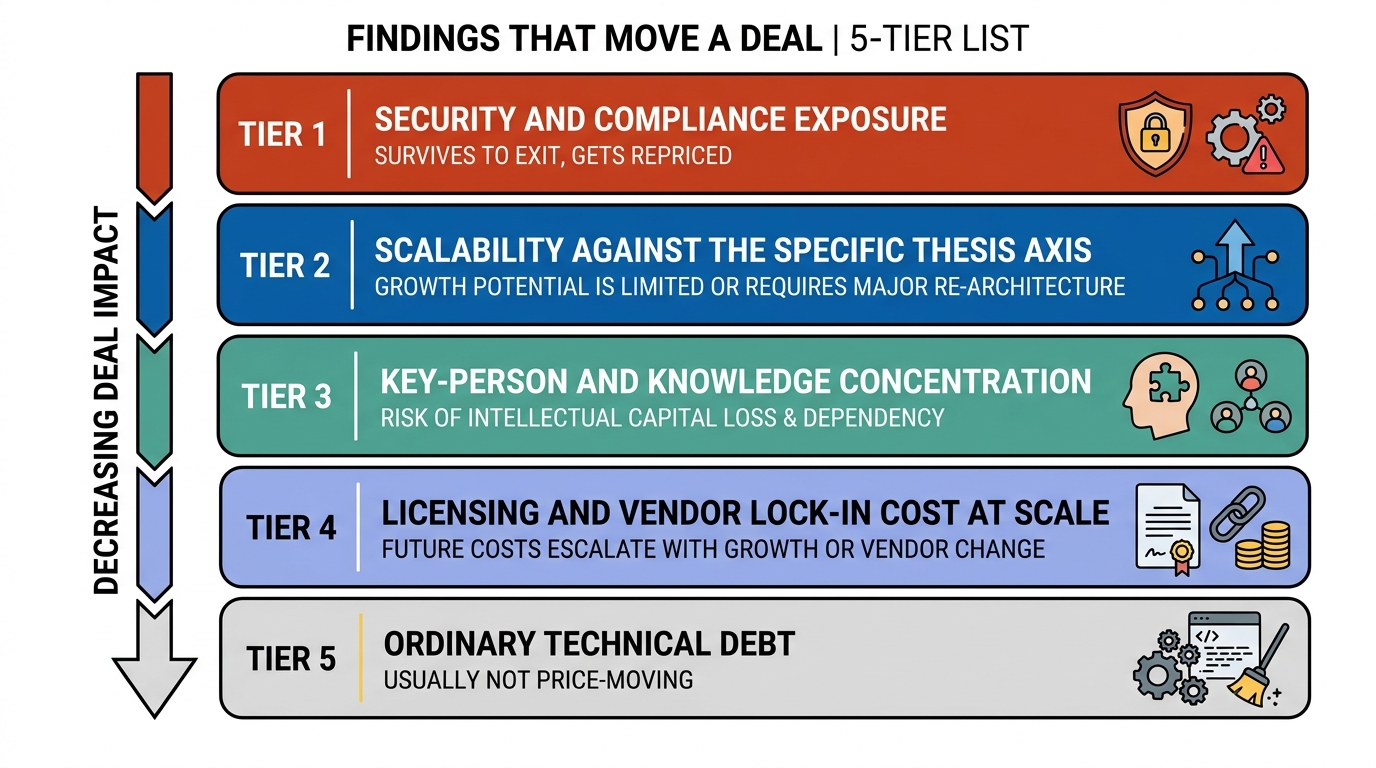
Not every technology problem matters to a deal. Most do not. The discipline of a strong diligence engagement is separating the findings that move price or terms from the ones that are just normal debt every software business carries. Here is where I have seen real deal impact.
Scalability against the specific thesis
Generic scalability is a non-question. Every system scales until it does not. The real question is whether the system scales along the exact axis the thesis needs. A B2B SaaS built for 200 mid-market accounts may choke at 2,000, or it may be fine but its onboarding is manual and gates growth. The diligence has to test the thesis axis, not scalability in the abstract.
Key-person and knowledge concentration
If one contractor understands the payments logic and there is no documentation, that is not a technical debt line, it is an operating risk with a retention cost and a bus-factor exposure. Price it as such.
Security, compliance, and data governance
These are the findings most likely to survive into the exit diligence and get repriced by the next buyer. The Harvard Law School Forum on Corporate Governance has covered how governance and compliance exposure increasingly shapes deal terms. A regulated-data business with sloppy access controls is not a code-quality issue, it is a liability with a probability and a dollar range.
Licensing, third-party dependence, and lock-in
Vendor contracts that reprice at scale, open-source licenses used in violation of their terms, and single points of vendor dependence all carry cost that shows up after you own the asset. This is close cousin to the kind of revenue leakage diagnostic that surfaces margin quietly bleeding out through structural issues nobody priced.
How to judge the firm before you hire it
The market for technology due diligence consulting is crowded with firms that produce competent inventories and call it diligence. Here is how I separate the ones worth the fee.
They ask for the investment thesis first
A firm that starts by asking for repo access rather than the deal thesis is going to give you a generic audit. The thesis determines which findings matter. If they do not ask what you are trying to buy and why, they cannot tell you whether the technology supports it.
They price findings, not just describe them
Ask for a sample report, redacted. Look at whether findings carry a cost, effort, and confidence rating, or whether they are severity labels with no economics attached. Severity without dollars is an engineer’s opinion, not a deal input.
They can operate what they diagnose
The firms I trust most are the ones who could actually fix the problems they find, because that keeps them honest. A pure advisory shop has no downside for overstating a risk or understating a fix cost. A firm that will be asked to execute the remediation prices it realistically. This is the same logic behind hiring a fractional CRO who fixes win rate and CAC rather than a consultant who theorizes about revenue. Accountability changes the analysis.
They deliver in your timeline, not theirs
Deal-moment diligence lives inside an exclusivity window. A firm that needs six weeks for a report you need in two is not a fit for the deal, regardless of quality. Speed is a real requirement, not a compromise. The trick is a firm structured to deliver a fast, decision-grade read and then go deeper post-close if the deal proceeds.
The report structure that earns a second read
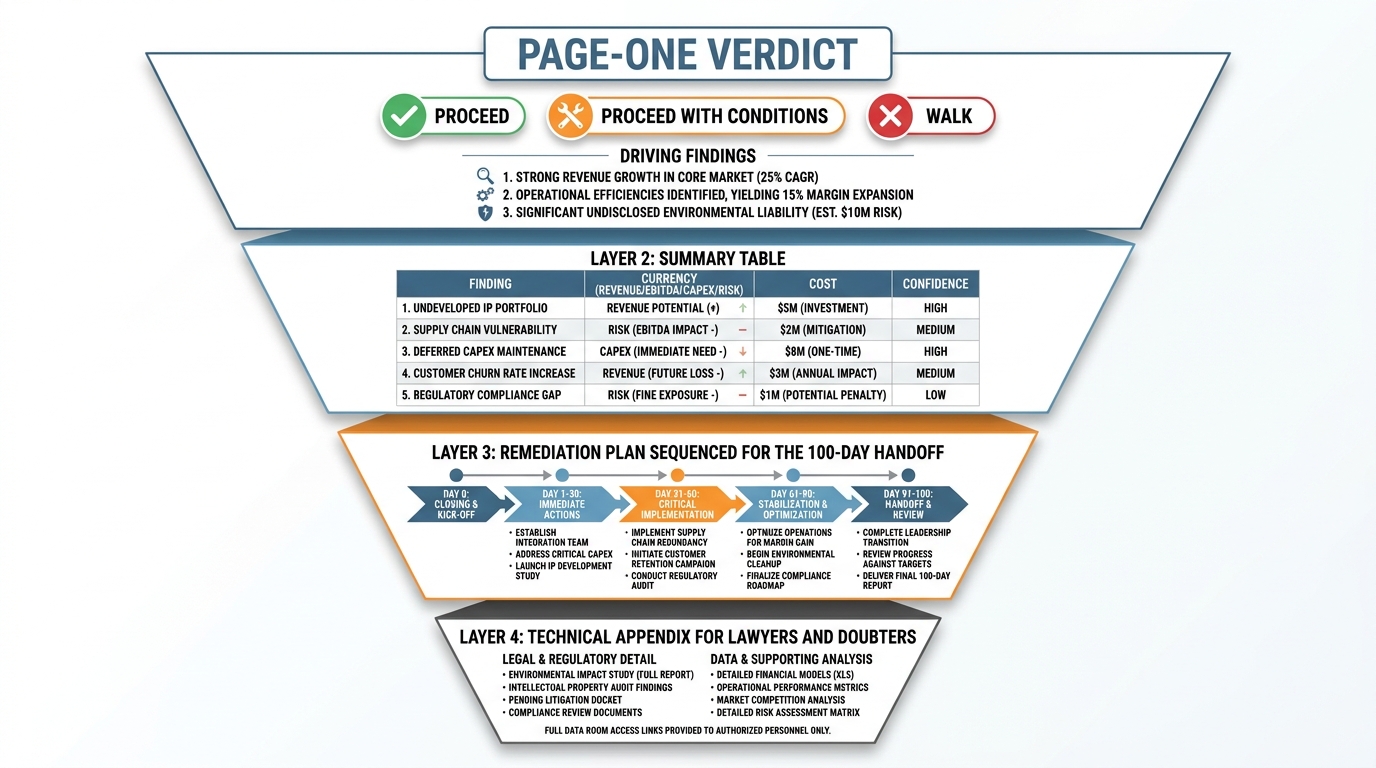
A diligence report the investment committee actually uses has a specific shape. I have seen the difference between a document that gets filed and one that gets cited in the IC meeting.
It opens with a one-page verdict: proceed, proceed with conditions, or walk, and the two or three findings driving that verdict. Everything after that is evidence supporting the front page. The deal partner reads page one and the summary table. The operating partner reads the remediation plan. The CFO reads the cost schedule. The full technical detail is an appendix, present for the doubters and the lawyers, not the spine of the document.
I have argued the same about operating reviews and the commercial KPIs that matter: the output has to be legible to the person making the decision, in their currency, on their timeline. A report structured for the author’s convenience rather than the reader’s decision is a self-indulgence you paid for.
Where technology diligence connects to commercial diligence
Technology diligence run in isolation misses half the picture. The commercial thesis and the technical reality have to be tested against each other. A go-to-market plan that assumes rapid self-serve expansion, sitting on a product that requires heavy manual onboarding, is a contradiction the two workstreams will only catch if they talk.
This is why I treat technology diligence as a partner to commercial due diligence red flags in B2B businesses rather than a separate silo. The same discipline that catches customer concentration and churn masking should be catching whether the platform can deliver the growth the commercial case promises. PitchBook’s research and data and S&P Global Market Intelligence’s market intelligence both track how deal outcomes correlate with realistic operational assessment at entry rather than optimistic modeling. The technology read is a load-bearing part of that assessment.
When the two workstreams are integrated, you get the honest version of the growth case: what the market allows, what the product can deliver, and what it costs to close the gap between them. That integrated view is what actually protects the entry price and, later, avoids the value creation pitfalls that show up when the plan assumed capabilities the asset never had.
What good diligence saves you later
The cheapest technology problem is the one you priced at entry. The most expensive is the one the exit buyer finds first. BCG’s work with principal investors and private equity has consistently framed operational risk as something that compounds across the hold, not a one-time cost at close. A scalability ceiling you ignored at entry becomes a growth stall in year two, a missed plan in year three, and a discount at exit.
Good diligence does three things that pay off across the whole hold. It sets the entry price with real information. It hands the operating team a ranked, costed plan on day one instead of a discovery exercise. And it documents the technology story you will need to tell the next buyer, so their diligence confirms your narrative instead of contradicting it. Every one of those is enterprise value, either protected or created. This is the through-line in how I think about building organizations that stay ahead: the risk you name and price is the risk you control.
The takeaway for a deal team
When you commission technology due diligence, you are not buying a report and you are not buying an audit. You are buying a decision, delivered fast, priced in your currency, and structured so the person making the call can read it and act. Judge the firm on whether it asks for your thesis first, prices what it finds, could operate what it diagnoses, and delivers inside your window. Reject anything that hands you activity where you asked for consequence.
The firms that pass those tests are rare because the discipline is hard. It requires people who can read code and read a P&L, and who are willing to attach a number to their own findings. That combination is exactly what deal-moment work demands.
If you are looking at an asset and need a technology read that changes the price rather than pads the file, that is the conversation I have with deal teams. Start with a short advisory conversation to scope what your specific deal needs, or review the DevriX private equity practice that back the diagnostic with people who can execute the fixes. The goal is the same on both sides of the close: know what you are buying, and be able to prove it.
