By Mario Peshev, DevriX
If you are eighteen months from a sale process and the management team is already talking to a middle market exit planning advisor, the decision in front of you is who holds the pen on the value creation work that actually moves the multiple, and whether the advisor you are considering can tell the difference between dressing up a data room and fixing the operating gaps a buyer will price against you.
I have sat on the delivery side of enough confirmatory diligence to know how exit prep fails. The seller spends two quarters producing clean reports, the buyer’s technology and QoE teams find the same weak spots that were always there, and the advisor who was supposed to prevent that outcome is nowhere in the retrade conversation. This piece is about how a deal partner or operating partner judges that advisor before the engagement, not after the price gets cut.
1. The work an exit advisor is actually hired to do
Most middle market companies approaching a sale have the same problem: the reported numbers and the operating reality have drifted apart. The business runs on Excel, the CRM has four years of inconsistent data capture, and nobody can reconcile revenue by cohort without a week of manual work. A buyer’s diligence team finds all of this in the first fortnight.
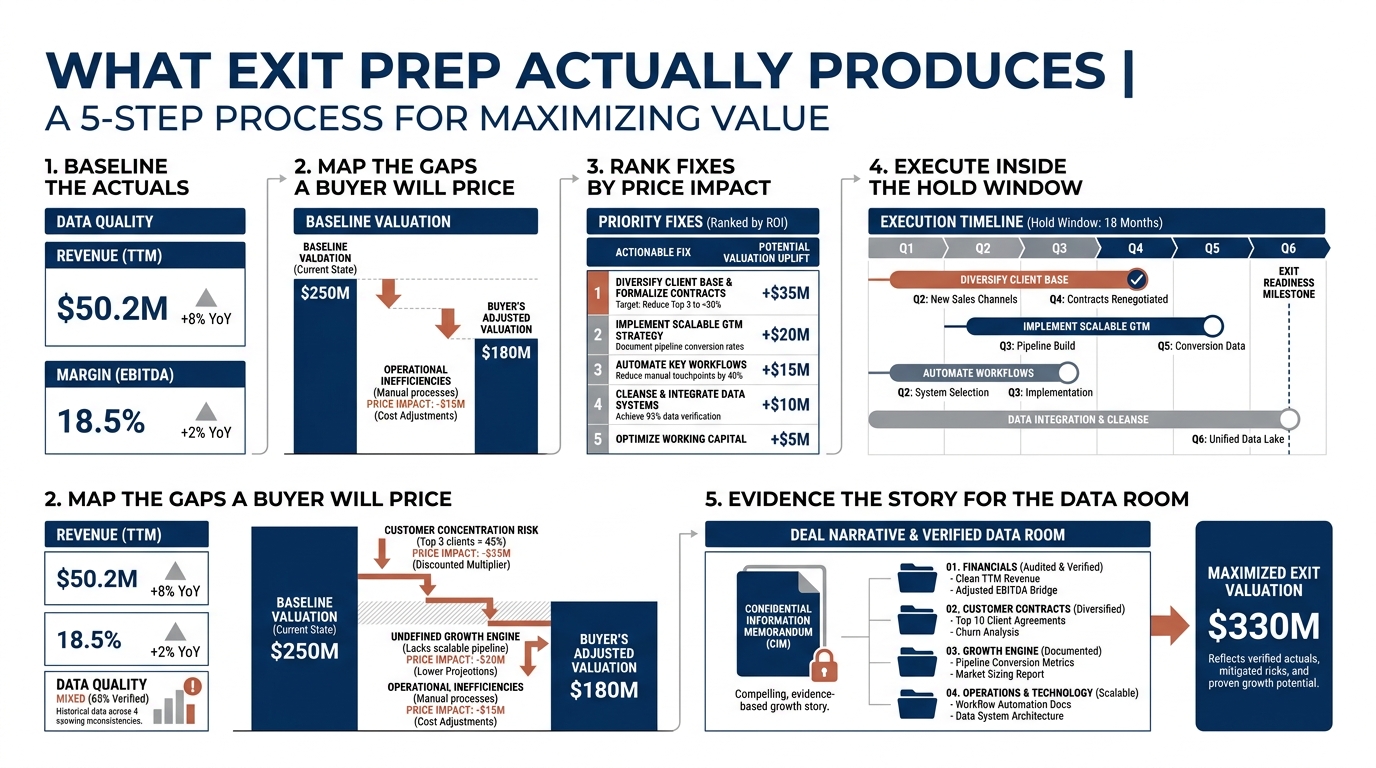
The real job of an exit planning advisor is to find those gaps before the buyer does and close the ones that affect price. That means baselining the actuals, identifying which weaknesses a sophisticated buyer will underwrite against, and sequencing fixes so the business shows a defensible story at close rather than a cosmetic one.
Bain’s annual Global Private Equity Report has tracked for years how hold periods have stretched and how much of the return now depends on operating improvement rather than multiple expansion. That shift is the reason exit prep is no longer a finance-and-legal exercise. The buyer is pricing the operating engine, and the advisor who cannot speak to it is managing paperwork.
If you are on the private equity side evaluating whether a portfolio company is exit-ready, the same lens applies in reverse. You want to know what a buyer’s diligence will surface, and you want it surfaced by your own advisor first.
2. Four tiers of exit planning advisor, and what each one buys you
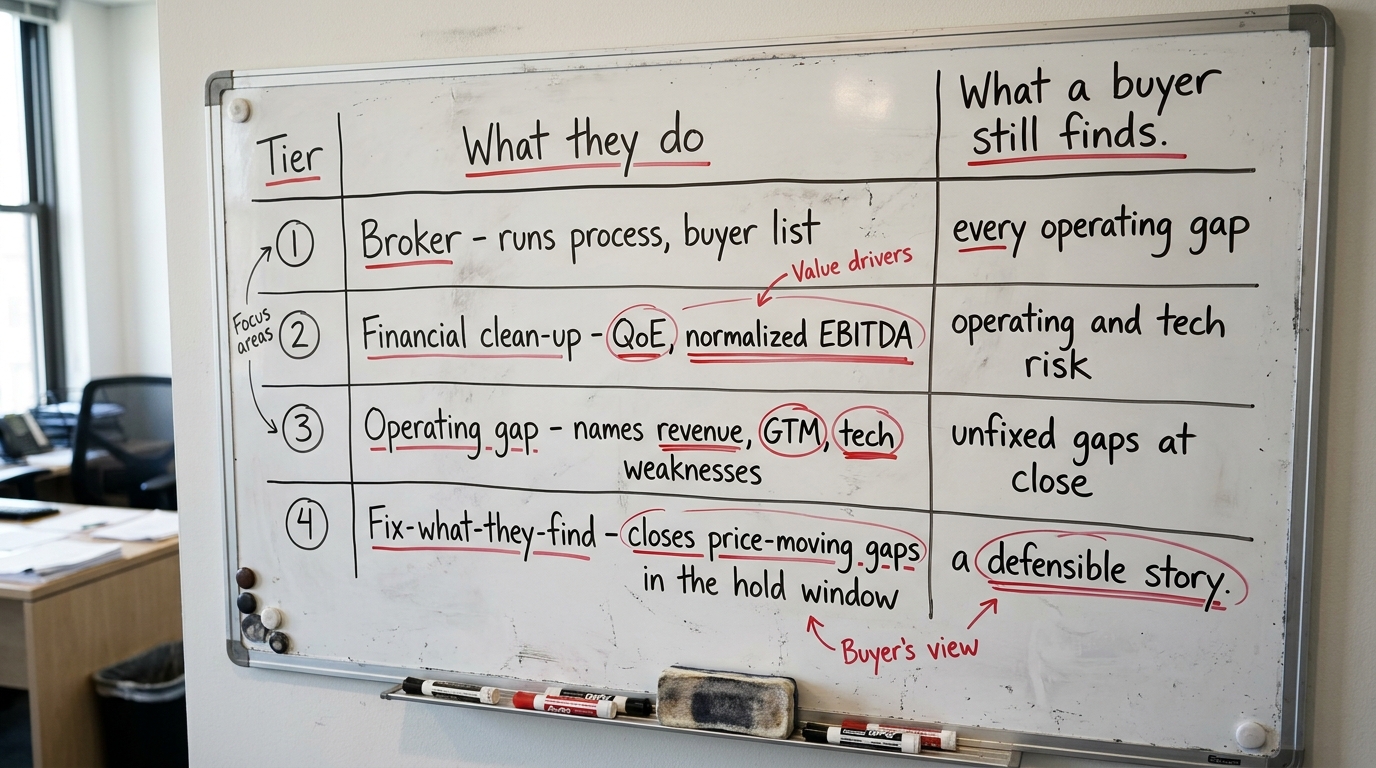
Not every advisor who uses the phrase does the same work. I group them into four tiers, and the gap between them is the difference between a clean close and a six-figure retrade.
Tier 1: the broker in advisor clothing
This advisor runs the process, builds the teaser, and manages the buyer list. Useful, necessary, and not what this article is about. They optimize the transaction mechanics and assume the asset is already what it is. If the operating gaps are real, a Tier 1 advisor discovers them when the buyer does.
Tier 2: the financial clean-up advisor
This tier gets the numbers audit-ready, normalizes EBITDA, and prepares for a sell-side quality of earnings review. Real value, and often the minimum a credible process needs. The AICPA and CIMA maintain the standards that sell-side QoE work leans on, and a serious advisor knows where the adjustments will and will not survive a buyer’s scrutiny. The limit is that this tier treats the operating and technology reality as fixed inputs.
Tier 3: the operating gap advisor
Now the advisor looks at the engine. Can the revenue data be trusted. Is the go-to-market dependent on three people who could leave. Does the technology stack carry integration risk or security exposure a buyer will discount. This is where exit prep starts affecting price rather than presentation.
Tier 4: the advisor who fixes what they find
The top tier does not just name the gaps; they have the capacity to close the ones that move the multiple inside the window you have. That is rare, because it requires both diligence judgment and delivery muscle. Most firms have one or the other.
3. How to judge the advisor before you sign
The judgment test is simple to state and hard to pass. Ask the advisor to describe your business model back to you before the first formal meeting, using your actuals, not a SaaS template. A distributor, a project-delivery firm, and a clinic group do not share a revenue shape, and an advisor who applies one playbook to all three will cost you in the room.
I have written separately on how to judge a value creation advisor before you give one your portfolio, and the exit case is a sharper version of the same discipline. The advisor who needs constant correction on how your business makes money will need the same correction in front of a buyer, and the buyer keeps score.
Three questions separate the tiers quickly:
- Ask what they would find in your data room that a buyer’s QoE team would flag. A good answer names specifics; a weak one describes a process.
- Ask which gaps they would fix versus disclose. Knowing the difference is the core skill, because fixing the wrong thing wastes the window and disclosing the wrong thing invites a discount.
- Ask who does the fixing. If the answer is always a referral, you have a Tier 3 advisor billing for Tier 4 expectations.
McKinsey’s private capital research has documented how consistently operating improvement, rather than financial engineering, drives returns in the current environment. An advisor who cannot connect their work to that mechanism is selling you activity.
4. The technology and data gaps that quietly cut the price
Here is where most exit prep underinvests, and where I spend most of my own time. Buyers in the middle market now run real technical and security diligence, and the findings move price in ways finance clean-up never catches.
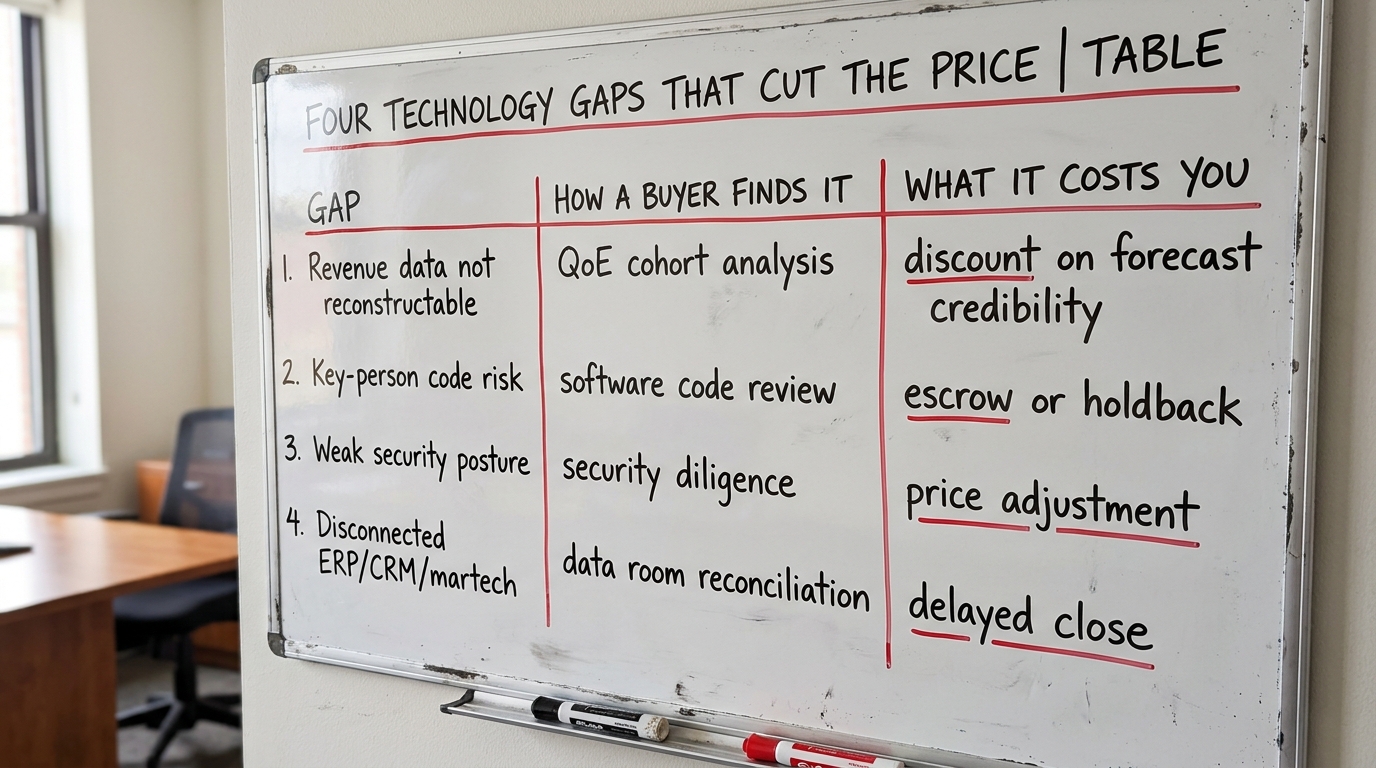
The common ones are familiar. Revenue data that cannot be reconstructed by cohort or product line. A codebase with no documented ownership and meaningful key-person risk. Security posture that fails a basic assessment. An ERP, CRM, and martech stack that are disconnected enough that the business genuinely cannot see its own numbers, which means neither can the buyer.
I have detailed what outsourced technical due diligence for M&A actually buys you in a deal, and the sell-side version of that work is cheaper than the retrade it prevents. The same holds for product and technology diligence that actually informs the deal, which on the sell side means knowing what the buyer’s team will say before they say it.
Security is its own line item. A portfolio cyber assessment run before the process starts gives you time to remediate; the same finding surfaced during security due diligence for M&A on the buy side becomes a negotiating lever against you. DevriX does this work directly through technology due diligence, and the sell-side framing is the one worth paying for here.
5. An illustrative case for how the tiers play out
The following is an illustrative scenario, not a client account, built to show how the decision lands in practice.
A founder-owned distributor, roughly 40 million in revenue, engages an advisor fourteen months before a planned sale. A Tier 2 advisor normalizes EBITDA, adds back the owner’s compensation, and produces a clean QoE. The data room looks ready.
The buyer’s diligence team then finds that revenue cannot be split cleanly by product category because the CRM and the ERP record it differently, and that gross margin reporting has been assembled manually by one finance lead who is not part of the deal. The buyer does not walk. They reprice, because a forecast they cannot independently reconstruct is a forecast they discount.
A Tier 4 advisor would have found that gap in month one, connected the two systems onto a single revenue model, and handed the buyer a reconstruction the buyer’s own team could verify in a day. The fix is unglamorous and it is worth more than the QoE. That is the gap between tiers stated in dollars.
6. Where the revenue engine shows up in the price
Finance clean-up proves the past. Buyers price the forward engine, and the forward engine is go-to-market. If pipeline conversion is undocumented, if average contract value is trending in a direction nobody has explained, if the whole motion depends on the founder’s relationships, a buyer underwrites that risk into the offer.
This is why I treat revenue operations as part of exit prep rather than a separate workstream. Fractional CROs who measure pipeline conversion and average contract value monthly produce exactly the evidence a buyer wants to see, because it shows the engine runs on a system and not on one person’s memory.
For companies that already run on HubSpot or a comparable platform, the data is often there and simply ungoverned. I have written on what deal and operating partners actually need to decide on HubSpot consulting, and the exit version is narrower: get the attribution, the pipeline stages, and the reporting consistent enough that a buyer trusts the forward number.
7. The timing that decides whether any of this works
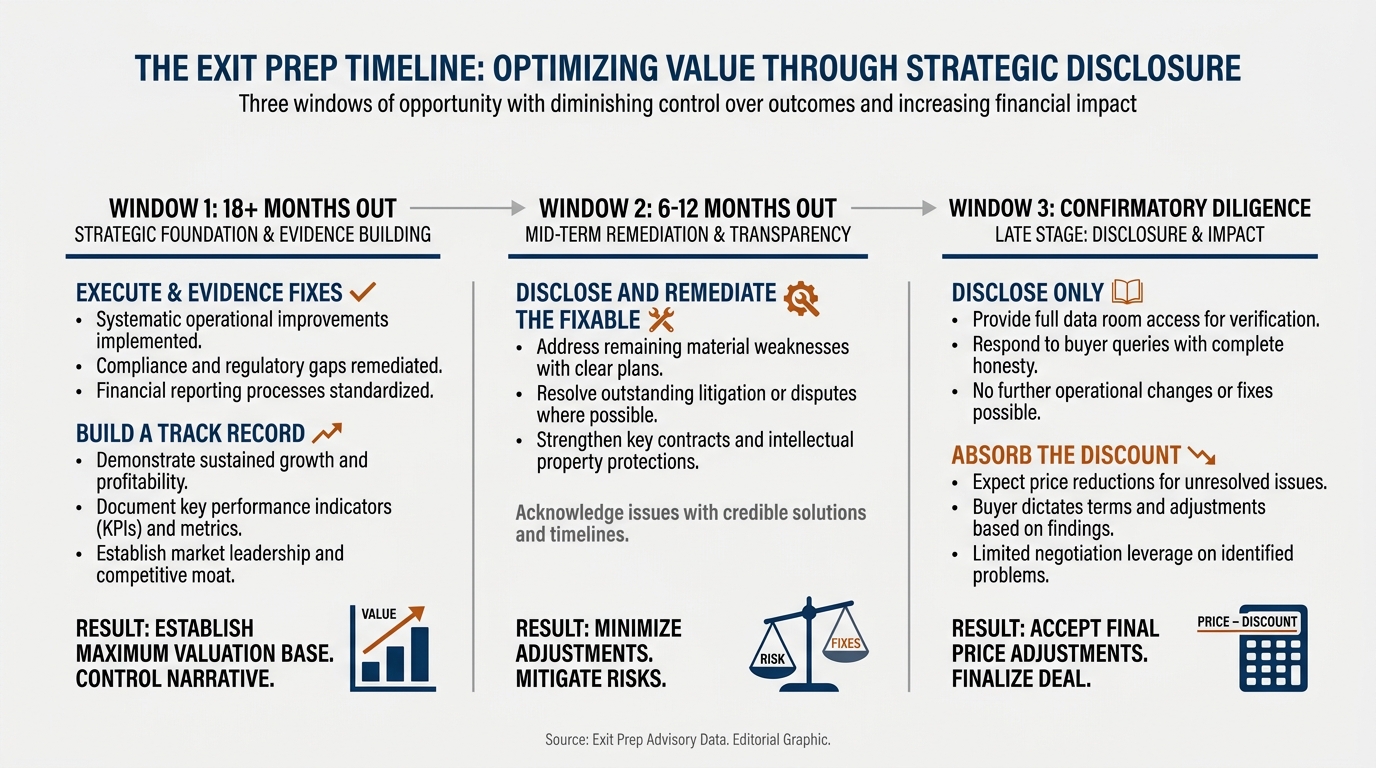
The single biggest determinant of whether exit prep returns its cost is when you start. A fix identified eighteen months out can be executed, evidenced for two reporting periods, and shown as a track record. The same fix identified during confirmatory diligence is a disclosure and a discount.
The triggers that should start this work are concrete: a hold period passing its midpoint, a board conversation about exit windows, a new platform acquisition that needs to be integrated before it can be sold, or a management team that has started interviewing advisors. The parallel on the buy side is the first 100 days after close, where the same gaps either get fixed or get carried to your own exit.
PitchBook’s research and data have shown how exit timelines in the middle market have lengthened, which cuts both ways: more time to prepare, and more pressure to show operating progress across a longer hold rather than a last-minute polish.
8. What the advisor relationship should produce
By the time a buyer’s team arrives, a good exit advisor should have left you with a specific set of artifacts. A revenue model the buyer can reconstruct independently. A technology and security posture that passes a basic assessment, documented in a security diligence format a buyer recognizes. A go-to-market story backed by monthly metrics rather than anecdotes. And a short, honest list of disclosures that are priced correctly because you raised them first.
What a weak advisor leaves you with is a polished deck and the same operating gaps that were there when they started. The buyer finds them anyway, and the difference between the two outcomes is the retrade.
If you want a sharper frame on the capability question, I have written on what a deal partner actually needs from a technical value creation partner and on what software code review actually tells a deal partner. Both translate directly to the sell side, because the questions a buyer asks are the questions you should have answered first.
9. Conclusion
The decision a deal partner or operating partner makes when hiring a middle market exit planning advisor is whether the advisor can find the operating and technology gaps a buyer will price against you, and whether they can close the ones that matter inside the window you have. Judge them on their ability to describe your business model back to you, to tell a fix from a disclosure, and to say who does the fixing. The Harvard Law School Forum on Corporate Governance regularly publishes analysis of how diligence findings reshape deal terms, and the pattern is consistent: what the seller did not fix, the buyer prices.
If you want the technology, data, and revenue-engine side of your exit prep handled by a team that does the fixing rather than the referral, review the DevriX private equity practice and its exit readiness work, and start the conversation while you still have the window to act on what it finds.