
By Mario Peshev, DevriX
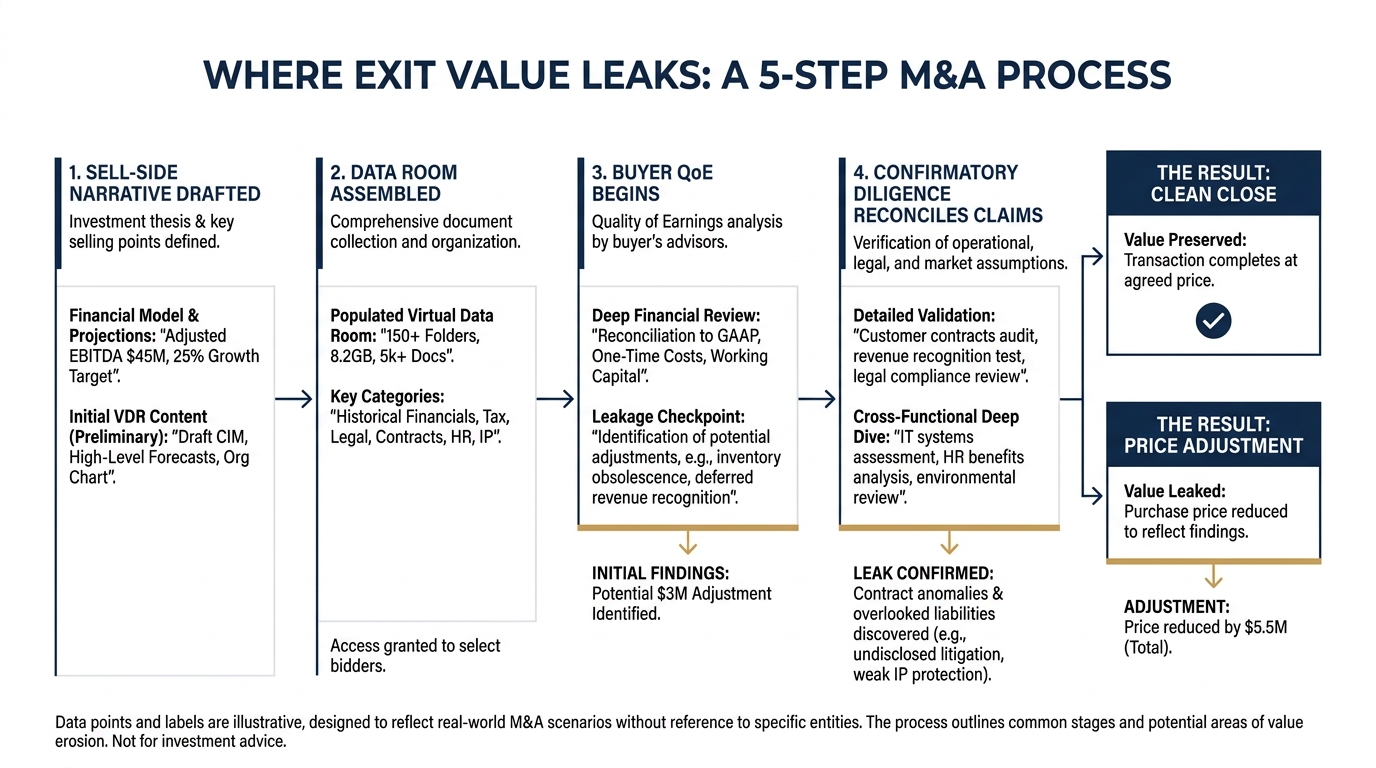
You are eighteen months from a planned exit, the first draft of the sell-side narrative is due to your investment committee, and someone on the deal team just asked who should own exit readiness across the portfolio company. That question decides more than you think. A weak answer means you walk into a competitive process with a data room that contradicts the management presentation, a revenue story no buyer’s quality of earnings team can reconcile, and a technology estate that surfaces as a price adjustment during confirmatory diligence. A strong answer means the business is legible to a buyer before the buyer ever sees it.
Choosing a portfolio company exit planning advisor is not a procurement exercise you delegate to a junior. It is a decision about who holds the owner’s hand on value and who closes the gap between what the company reports internally and what a buyer’s advisors will actually verify. This piece gives you a framework for making that choice, and for judging the advisor you hire against the only outcome that matters, which is a clean process at a defensible multiple.
1. Exit readiness fails in confirmatory diligence, not at the LOI
Most exit problems are discovered after a letter of intent, when the buyer’s advisors arrive with access to the systems and start reconciling claims against evidence. That is the worst possible moment to find out that revenue recognition is inconsistent, that the CRM pipeline does not tie to the reported bookings, or that the core application carries a technology risk nobody priced.
Bain’s annual private equity report has tracked for years how holding periods stretch and exit windows narrow, which means the penalty for an unprepared process is now measured in quarters of delay or a reopened price. You can read the pattern in Bain’s Global Private Equity Report, and PitchBook’s exit data shows the same tightening across cycles, documented in PitchBook’s research and data.
The commercial consequence is simple. Every unreconciled claim in a data room becomes a negotiating lever for the buyer. A portfolio company exit planning advisor exists to remove those levers before the process starts, so the price you take to the board is the price that survives to close.
When this matters most is the twelve to eighteen months before you expect to launch, not the eight weeks before. By the time a buyer is in confirmatory diligence, the advisor’s work should already be done.
2. Name the work before you name the advisor
The title covers four distinct jobs, and most firms are genuinely good at one of them. If you hire against a label instead of the work, you get an advisor strong on financial packaging and silent on the technology estate, or strong on the operating story and useless on revenue evidence.
The sell-side narrative
Someone has to write the equity story a buyer will underwrite, and tie every claim in it to evidence that holds up under scrutiny. You are writing a set of assertions about growth, margin and defensibility that each need a source.
Revenue and commercial evidence
The pipeline, conversion, retention and contract data that back the growth claim have to be real, consistent, and reproducible. A fractional revenue leader who already runs these numbers monthly is often closer to exit-grade evidence than a corporate finance generalist, which is why how fractional CROs measure pipeline conversion and average contract value matters well before a process.
The technology and security estate
If the business runs on software, a buyer will commission a technical review, and what they find sets a risk discount. Getting ahead of that is the difference between controlling the narrative and reacting to it. The mechanics are covered in what outsourced technical due diligence actually buys you in a deal.
Process orchestration
Someone keeps the workstreams, the data room, the risk register and the management team aligned so the process runs on schedule. This is coordination work, and it is where most advisors quietly add or destroy weeks.
Decide which of these four you already have covered inside the firm and which you are actually buying. The advisor who claims all four with equal depth is usually weakest where you will need them most.
3. A four-tier framework for judging the advisor
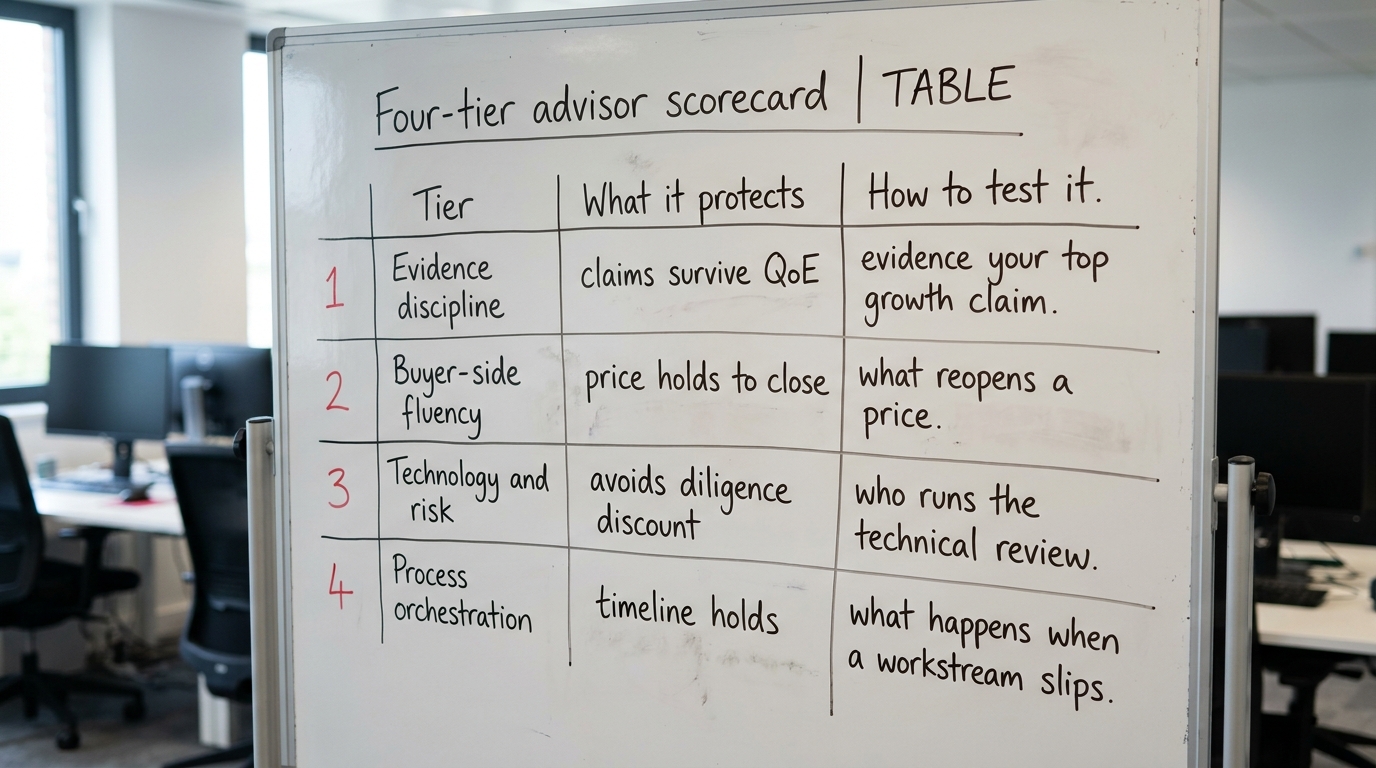
Here is the structure I use when a portfolio company needs an exit planning advisor and the operating partner wants a defensible choice rather than a relationship hire. Four tiers, in order of how much value each one actually protects.
Tier 1: Evidence discipline
Can the advisor take any claim the company wants to make and trace it to a source a buyer’s quality of earnings team would accept? This is the floor. An advisor who writes a confident narrative without reconciling it to the underlying systems is building a story that unravels the moment a buyer looks. Ask them to show you how they would evidence your single largest growth claim, and watch whether they reach for data or for adjectives.
Tier 2: Buyer-side fluency
Does the advisor know what a buyer’s diligence actually tests, because they have sat on that side? Exit preparation done by someone who has never run confirmatory diligence tends to over-prepare the obvious and miss the specific things that reopen a price. The AICPA’s work on quality of earnings and sell-side readiness, available through AICPA and CIMA, is a useful standard for what the finance side of a buyer will probe.
Tier 3: Technology and risk coverage
Can the advisor either run the technical and security assessment themselves or coordinate it so it lands inside the same narrative? A security finding discovered by the buyer costs more than the same finding surfaced and remediated by the seller. That logic is the whole argument in security due diligence for private equity and in portfolio cyber assessment in private equity.
Tier 4: Process orchestration under pressure
When a workstream slips three weeks before data room launch, does the advisor hold the timeline or does the timeline hold them? This is the hardest tier to assess in advance and the one that separates a competent advisor from one who earns the fee twice over.
4. The questions that separate a real advisor from a packager
A packager produces a beautiful information memorandum and leaves the gaps for the buyer to find. A real advisor finds the gaps first and either closes them or tells you honestly what they will cost in the process. Four questions sort one from the other.
Ask how they would handle a claim the company wants to make that they cannot evidence. The right answer is that they would not make it, or they would soften it to what the data supports. The wrong answer is a promise to make it look credible anyway.
Ask what they expect a buyer’s technical diligence to flag in your business, before they have done any work. An advisor with real buyer-side exposure will name two or three likely findings in your specific stack. One without it will talk in generalities about best practice. The difference tracks closely with what a serious review surfaces, described in product and technology due diligence that actually informs the deal.
Ask how they handle a code review finding that affects valuation. A credible advisor treats a material code finding as something to surface, scope and remediate on a timeline, not something to bury, which is exactly the frame in what software code review for M&A actually tells a deal partner.
Ask for the last three processes where their preparation held at close versus where the price moved. An advisor who cannot talk about a process that reopened is either new or not telling you the truth.
5. How this connects to diligence you already run
If you commission technology due diligence on the buy side, you already know what a buyer’s advisors look for. Exit planning is that same lens turned inward, run early enough to fix what it finds. The work the sell-side advisor does should mirror the work you would commission if you were acquiring the asset yourself.
The Harvard Law School Forum on Corporate Governance regularly publishes on sell-side process and governance during a sale, and the practitioner pieces there, collected at the Harvard Law School Forum on Corporate Governance, are a useful check on whether your advisor’s process matches what buyers and their counsel now expect.
There is a direct line between the standard you hold a buy-side diligence provider to and the standard you should hold an exit advisor to. The frame in what a deal partner actually needs from a technical value creation partner applies in reverse. The advisor preparing you for sale should produce the evidence a buyer’s partner would demand, before the buyer demands it.
6. An illustrative scenario for a software-enabled services business
The following is an illustrative scenario, not a client account, to show how the four tiers play out in sequence.
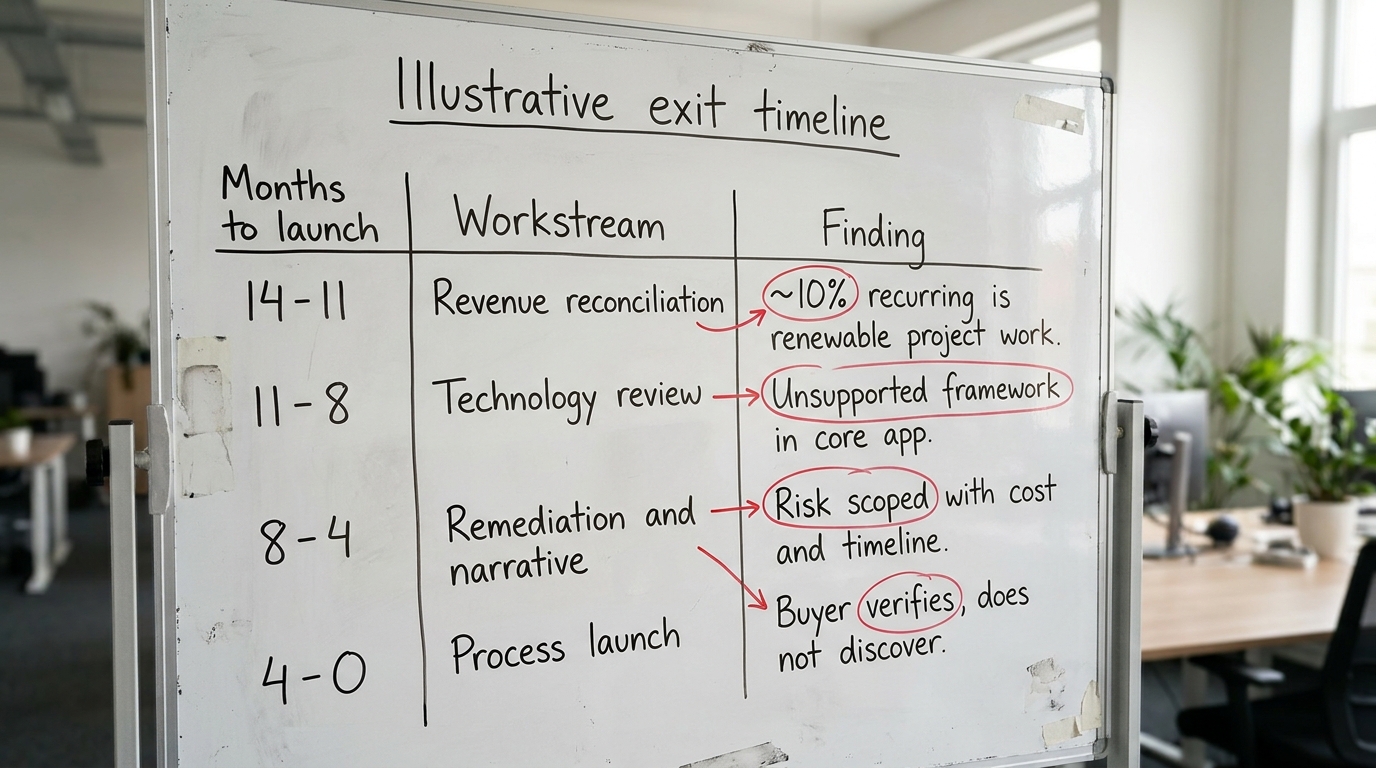
A mid-market software-enabled services business plans to launch a sale in fourteen months. The operating partner brings in an exit planning advisor. In the first six weeks the advisor runs Tier 1, reconciling the reported recurring revenue to the billing system and the contracts, and finds that roughly a tenth of what management calls recurring is in fact renewable project work that no buyer would value at a recurring multiple. That reclassification is painful, and it is far cheaper to absorb now than to have a buyer discover it during quality of earnings.
At Tier 3 the advisor commissions a technical and security review and finds a dependency on an unsupported framework in the core application. Surfaced now, it becomes a scoped remediation line in the narrative with a cost and a timeline. Discovered by a buyer during confirmatory diligence, the same finding would become a price adjustment and a trust problem, which is the exact risk laid out in security due diligence for M&A.
By the time the process launches, the equity story claims a slightly lower recurring base that every number supports, and it names the one technology risk alongside the plan to close it. The buyer’s advisors verify rather than discover.
7. Scope the engagement so the advisor cannot hide
The engagement that protects you is defined by artifacts and decision rights, not by hours. Agree up front what the advisor delivers and who owns each call.
- A reconciled evidence pack behind every material claim in the narrative, with the source named for each.
- A risk register that lists each diligence exposure, its likely buyer treatment, and the owner and timeline to close it.
- A technical and security assessment delivered inside the same narrative, not as a separate document nobody reads.
- A data room structured the way a buyer’s advisors work, so verification is fast and the process does not stall.
McKinsey’s private capital research, published through McKinsey, and BCG’s work on principal investors at BCG, both point to the same operating truth: value at exit is protected by preparation that is specific and evidenced. Scope the engagement so you can tell, at any point, whether the advisor is producing evidence or producing adjectives.
8. When to decide and what it connects to
Start this decision when the hold enters its back half. An advisor hired eight weeks before launch can only package what exists, because there is no time left to fix anything. An advisor hired twelve to eighteen months out can fix what would otherwise cost you at close.
Exit readiness covers the same ground as the work you run during the first 100 days after an acquisition. The questions about data visibility, revenue hygiene and technology risk that define early value creation are the questions a buyer will ask when you sell. A portfolio company that was built to be legible from day one is cheaper to prepare for exit, which is why the broader private equity value creation work and exit readiness belong in the same conversation.
The same discipline applies to how you judge the advisor across the hold, which is the argument in how to judge a value creation advisor before you give one your portfolio, and it extends to the operating systems a buyer will inspect, including the revenue stack covered in HubSpot consulting for portfolio companies.
9. Conclusion
The right portfolio company exit planning advisor does one thing above all others. They make the business legible to a buyer before the buyer arrives, so the equity story survives confirmatory diligence and the price you take to the board is the price that closes. Judge them on evidence discipline first, buyer-side fluency second, technology and risk coverage third, and the ability to hold a timeline under pressure fourth. Scope the engagement around artifacts and decision rights, start the work in the back half of the hold, and treat every unreconciled claim as a lever you are handing the buyer.
If you are preparing a portfolio company for sale and want the exit readiness work run the way a buyer’s advisors would run it against you, see how DevriX and GrowthShuttle run exit readiness for private equity portfolios.