
By Mario Peshev, DevriX
If you are eighteen months from a planned exit on a portfolio company, the technology story you tell a buyer is already being written, whether you are managing it or not. A buyer’s technical diligence will reconstruct your architecture, your security posture, your team’s real capacity and your product’s dependency on one or two people, and it will do so on a timeline you do not control. A pre-exit technology audit of a portfolio company exists to find what that buyer will find, while you still have the runway to fix it, price it into the thesis, or decide it is a disclosure rather than a surprise.
The decision this audit informs is narrow and commercial. You are deciding which technology issues could compress the multiple or stall the process, which ones you can remediate before the data room opens, and which ones you simply disclose and defend. That is a sell-side preparation question, not an engineering exercise, and it belongs on the value-creation agenda well before a banker is engaged.
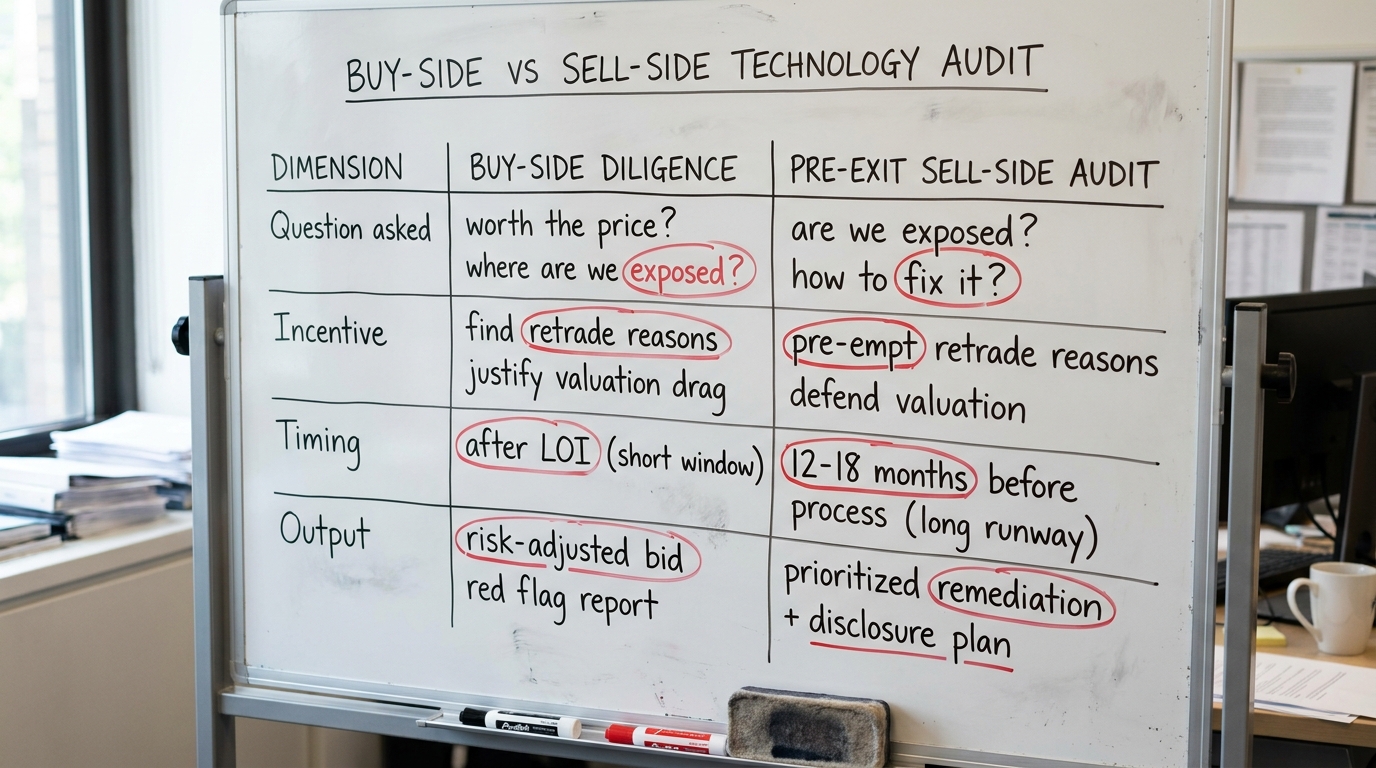
Why the sell-side version is a different exercise than buy-side diligence
Buy-side technology due diligence answers one party’s question: is this asset worth what we are about to pay, and what will it cost to fix after close. The sell-side audit answers yours: where is this asset exposed, and what will a competent acquirer use to argue the price down.
The difference matters because it changes what you look at first. A buyer’s advisor is incentivized to find reasons for a retrade. Your audit should anticipate those reasons, rank them by the size of the valuation risk they create, and give you a decision on each one with enough time to act. By the time a buyer’s team is in your repositories, the window to quietly improve anything has closed.
I have written before about what outsourced technical due diligence actually buys you in a deal, and the sell-side framing is the mirror image. Same evidence, opposite incentive.
The five areas that actually move the multiple
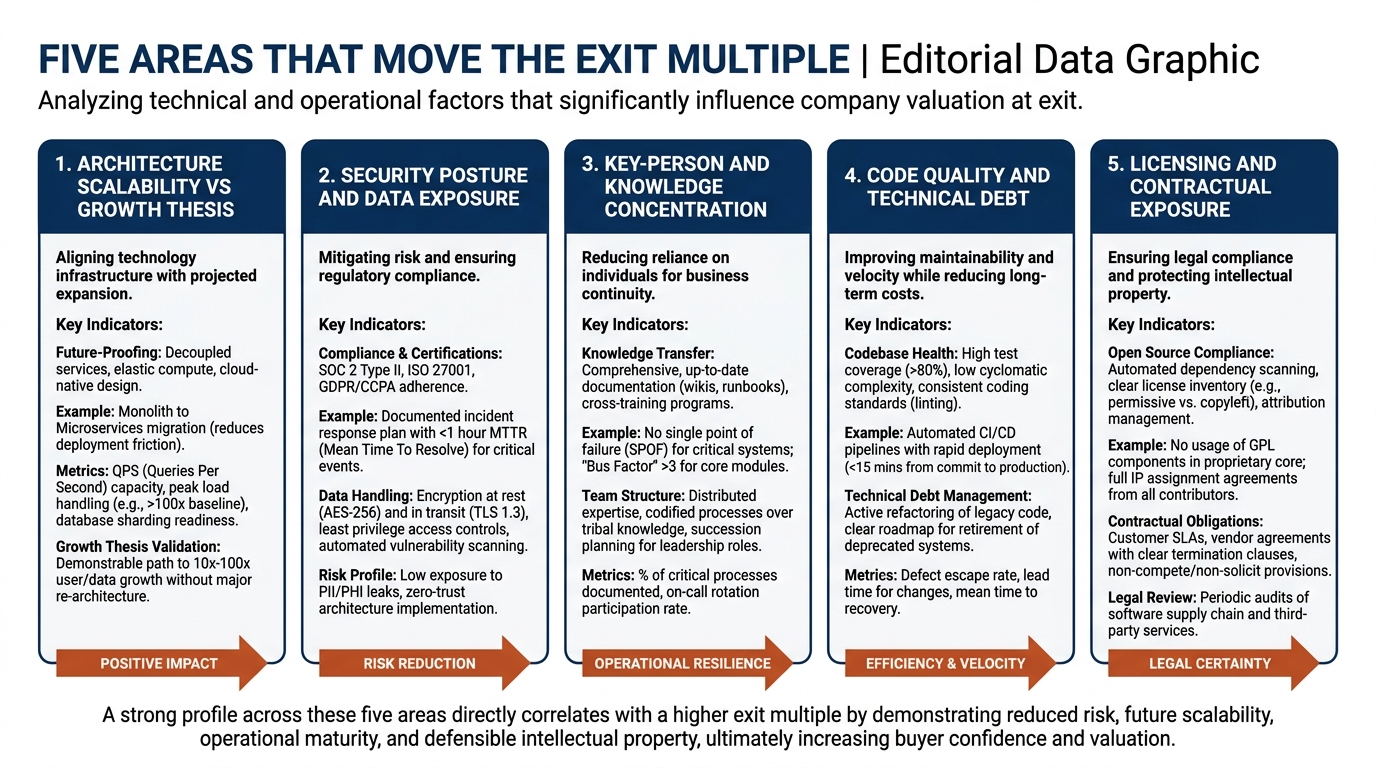
Most technology audits produce a long findings register, and most of it does not change what a buyer pays. The audit earns its budget only if it separates the issues that affect enterprise value from the ones that are merely untidy. In my experience across private equity portfolio work, five areas carry almost all of the valuation weight.
Architecture scalability against the growth thesis
If your equity story assumes doubling revenue over the hold, the audit has to test whether the platform can carry that load without a rewrite the buyer will have to fund. A system that scaled fine at the current size but needs re-platforming at 2x creates a cost the buyer models and deducts. Finding it early lets you either begin the work or adjust the growth claim so it survives scrutiny.
Security posture and the data a buyer will stress-test
Security findings are where sell-side processes bleed value quietly, because a buyer can treat a weak posture as both a cost and a risk. A portfolio cyber assessment run before the process gives you time to close the obvious gaps and document the rest. I treat this as non-negotiable sell-side preparation, and I have laid out the detail in a separate piece on security due diligence for private equity.
Key-person and knowledge concentration
When one engineer holds the architecture in their head, or a single contractor owns the deployment pipeline, that is a concentration risk a buyer will price. The audit should name the people and systems that would be hard to replace, and quantify the exposure. Documentation, cross-training and a credible retention position are cheaper to build over twelve months than to promise in a management presentation.
Code quality and technical debt that a review will surface
A buyer’s advisor may run a code review, and what it finds should not be news to you. I have written on what a software code review actually tells a deal partner, and the sell-side lesson is simple: know your own technical debt, classify it as cosmetic or structural, and have a remediation cost you can defend rather than one the buyer invents.
Licensing, open-source and contractual exposure
Open-source license obligations, expiring vendor contracts and software you do not actually have the right to ship are the findings that turn into indemnity negotiations. They are cheap to inventory and expensive to discover late. The audit should produce a clean bill of materials and flag anything that constrains a buyer’s freedom to operate.
How much of this actually affects what a buyer pays
The honest answer is that technology rarely sets the price, but it routinely moves it at the margin and occasionally stalls the deal entirely. Bain’s annual Global Private Equity Report has tracked how value creation has shifted from financial engineering toward operational improvement, and technology is a growing share of that operating story. McKinsey’s private capital research makes a similar point about the premium buyers now place on resilient, scalable operations rather than on leverage alone.
What that means for your sell-side preparation is practical. A buyer who sees a clean, well-documented technology estate spends less of the negotiation looking for reasons to discount, and a buyer who finds surprises in confirmatory diligence will use every one of them. The audit’s job is to move the issues from the second category to the first.
I would not oversell it. A pre-exit technology audit of a portfolio company does not add a turn to the multiple on its own. It protects the multiple you already have, and it removes the friction that drags a process past its planned close.
When to run it, and against which triggers
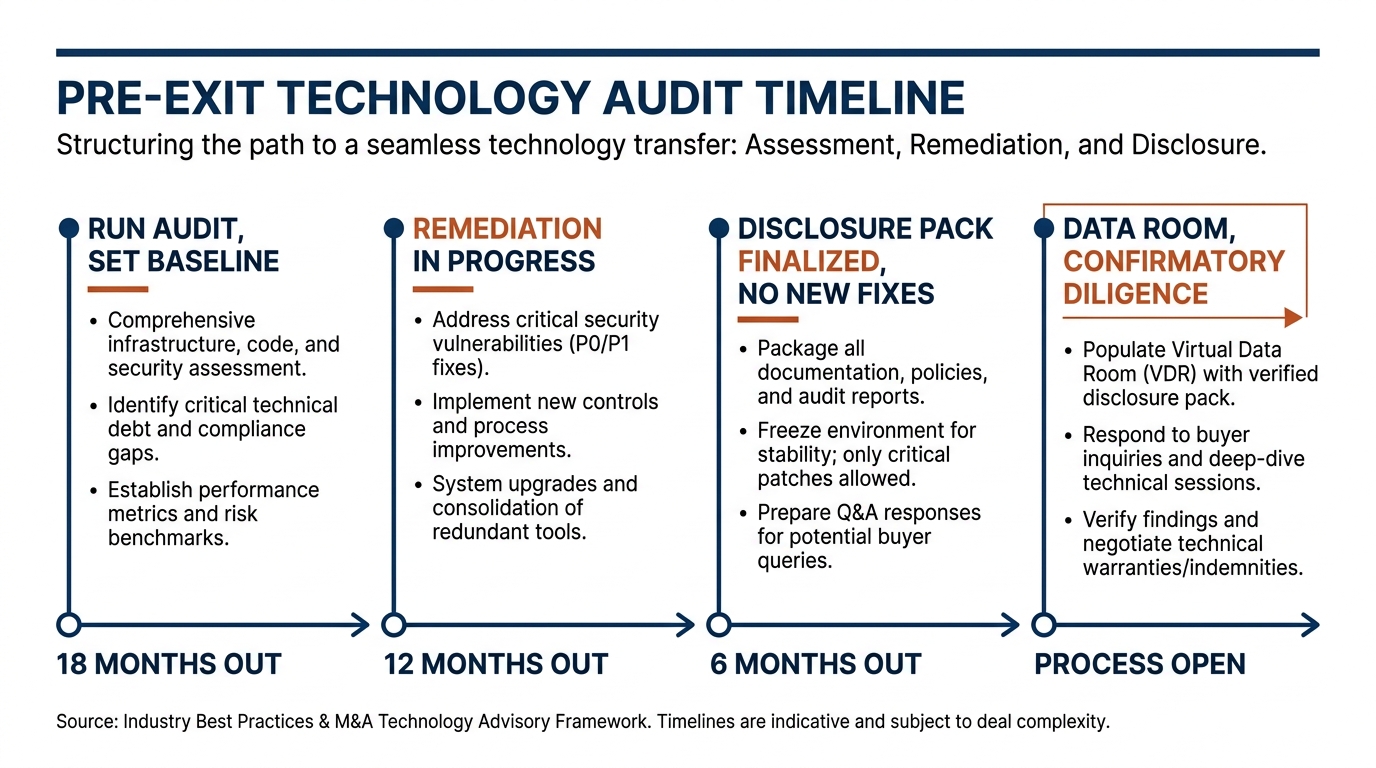
The timing is not arbitrary. Run the audit early enough that remediation is possible, which in practice means twelve to eighteen months before you intend to go to market. Anything inside six months and you are documenting problems you no longer have time to fix, which is useful for disclosure but useless for value protection.
Several triggers should move the audit up your agenda. A platform acquisition that added a second codebase changes the architecture story. A key engineering departure changes the concentration risk overnight. A board decision to begin exit planning is the obvious one, but by then the clock is already running. The work I describe in the first 100 days of a hold is the same discipline applied at the other end: establish the baseline early so you are never reacting to someone else’s findings.
What the deliverable has to contain to be worth the budget
An audit that produces a PDF of findings and no decisions wastes money. The deliverable that earns a $20,000 to $35,000 exit-readiness budget does three things.
- It ranks every material finding by its estimated effect on valuation or deal timeline, so you can see where the money is.
- It separates what to remediate from what to disclose, with a cost and a rough timeline for each remediation.
- It produces the evidence a buyer’s advisor would want to see, so your data room answers the hard questions before they are asked.
Classification matters here. A finding that is a realized problem today is different from one that is a risk you are choosing to carry, and the audit should label each one so the board can decide rather than guess. The same discipline applies to the people and process questions I covered in product and technology due diligence that actually informs the deal.
Who should own this inside the deal team
The operating partner owns the decision, but the audit should not be run by the portfolio company’s own engineering leadership alone, because they are the people whose work is being assessed. Their incentive is to produce a clean report, and a buyer’s advisor will discount a self-assessment accordingly.
An independent view, whether from an in-house technical operating partner or an outside value-creation partner, carries more weight in the data room precisely because it was not marking its own homework. I have written on how to judge a value creation advisor before you give one your portfolio and on what a deal partner actually needs from a technical value creation partner, and both apply directly to picking who runs this.
The adjacent findings that shape the same exit story
A technology audit does not sit alone. The revenue engine the buyer inspects is partly a technology question and partly a go-to-market one. If your CRM data is inconsistent and your attribution is last-touch, a buyer discounts the pipeline you are presenting, which is why I treat RevOps hygiene as part of exit readiness rather than a separate project. The way fractional CROs measure pipeline conversion and average contract value is the same evidence a buyer wants, and a clean HubSpot or CRM estate removes a line of questioning before it starts.
Security sits across both the deal and the operating story, and the M&A-specific framing in my pieces on security due diligence for M&A covers the version a strategic buyer runs. The Harvard Law School Forum on Corporate Governance has published useful material on how boards treat cyber and technology risk in transactions, worth reading alongside your own audit scope at corpgov.law.harvard.edu.
What a good audit changes about the negotiation
The practical outcome is that you walk into the process knowing which questions a buyer will ask and having an answer for each. When confirmatory diligence surfaces a finding, you have already classified it, costed it and decided whether it is a fix or a disclosure. That turns a potential retrade into a conversation you have prepared for.
PitchBook and S&P Global Market Intelligence both track how deal timelines and conditions have tightened in recent years, and you can follow that data at PitchBook and S&P Global. The reading I take from it is that buyers are more disciplined about diligence findings than they were in looser markets, which raises the return on preparing your technology story before the process rather than during it.
None of this guarantees a higher multiple. It protects the one your thesis supports, shortens the path to close, and keeps control of the narrative on your side of the table instead of the buyer’s.
Conclusion
A pre-exit technology audit of a portfolio company is sell-side preparation with a commercial job: find what a buyer will find, rank it by the valuation risk it carries, and decide on each item while you still have time to act. Run it twelve to eighteen months out, have it run by someone who is not marking their own homework, and insist the deliverable produces decisions, not a findings PDF. Done that way, it moves issues from surprises into disclosures and keeps the multiple your thesis already earned.
If you are planning an exit on a portfolio company in the next two years, DevriX runs the technology and revenue side of exit readiness as a scoped engagement for deal and operating teams. See how we structure that work at the DevriX private equity practice.