West Monroe was brought in to design the EBITDA bridge for a PE-backed B2B software platform six months before exit. The firm delivered a 90-page transformation roadmap, identified $4.2M in addressable margin, and departed. Eighteen months later the operating team had implemented one of fourteen recommended workstreams, the roadmap sat in a Confluence archive, and the margin gap widened. The diagnosis was correct. The execution capacity was never part of the engagement.
This is not a criticism of advisory firms. West Monroe, Bain, and similar houses do exactly what they contract to do: they diagnose, they model, they present. What they do not do is stay in the stack and run the work. For a deal partner operating on a compressed value-creation timeline with a lean portco team, that gap between advisory and execution is where EBITDA evaporates.
What West Monroe actually sells
West Monroe’s offering sits in three bands: management consulting (strategy, operating model, transformation design), technology consulting (architecture, vendor selection, implementation oversight), and managed services (infrastructure, security operations, application support). The firm operates as a project-based advisory house. Engagements range from eight-week diagnostic sprints to multi-quarter transformation programs, typically billed at $250-$450 per hour depending on seniority and practice area.
The value proposition is diagnosis and roadmap. West Monroe brings sector expertise, cross-portfolio pattern recognition, and credibility with boards. For a sponsor evaluating an asset pre-close or designing the 100-day plan, that diagnostic capacity matters. The output is a sequenced set of initiatives with estimated timelines, resource requirements, and financial impact.
What the engagement does not include is the team that executes the plan. West Monroe consultants rotate off when the report is delivered. Implementation falls to the portfolio company’s internal team, or to a separate vendor the portco must now identify, contract, and onboard. That handoff introduces three risks: the internal team lacks capacity or capability to execute what was recommended, the new vendor interprets the roadmap differently than the advisors intended, or the urgency dissipates once the consulting team departs and the roadmap becomes a reference document rather than a live plan.

Where advisory stops and operating starts
Private equity’s shift from financial engineering to operational value creation changed what sponsors need from technical partners. The 2008-2015 playbook assumed that leverage, multiple arbitrage, and light cost reduction would carry the return. That model broke when interest rates stayed near zero, exit multiples compressed, and every sponsor adopted the same procurement playbook. The EBITDA bridge now depends on organic growth, margin expansion through technology modernization, product velocity, and integration execution.
According to Bain’s 2024 Global Private Equity Report, value creation levers now account for the majority of returns in middle-market deals, and the timeline to realize those gains compressed from five years to under three. That acceleration creates a problem for the advisory model. A diagnostic delivered in Q1 that sits unimplemented until Q3 while the portco searches for an engineering partner consumes half the hold period before the first line of code ships.
The gap is not advisory quality. The gap is continuity. West Monroe’s roadmap might be correct in every technical recommendation, but correctness does not drive EBITDA unless someone with keys to production is running the work every week. A portfolio company’s internal engineering team is typically underwater maintaining the existing estate. They cannot simultaneously modernize the stack, instrument analytics, and integrate an acquisition while keeping the revenue-generating product online. The advisory firm diagnosed the problem, but the operating capacity to solve it was never part of the contract.
The embedded model: diagnosis and execution as one contract
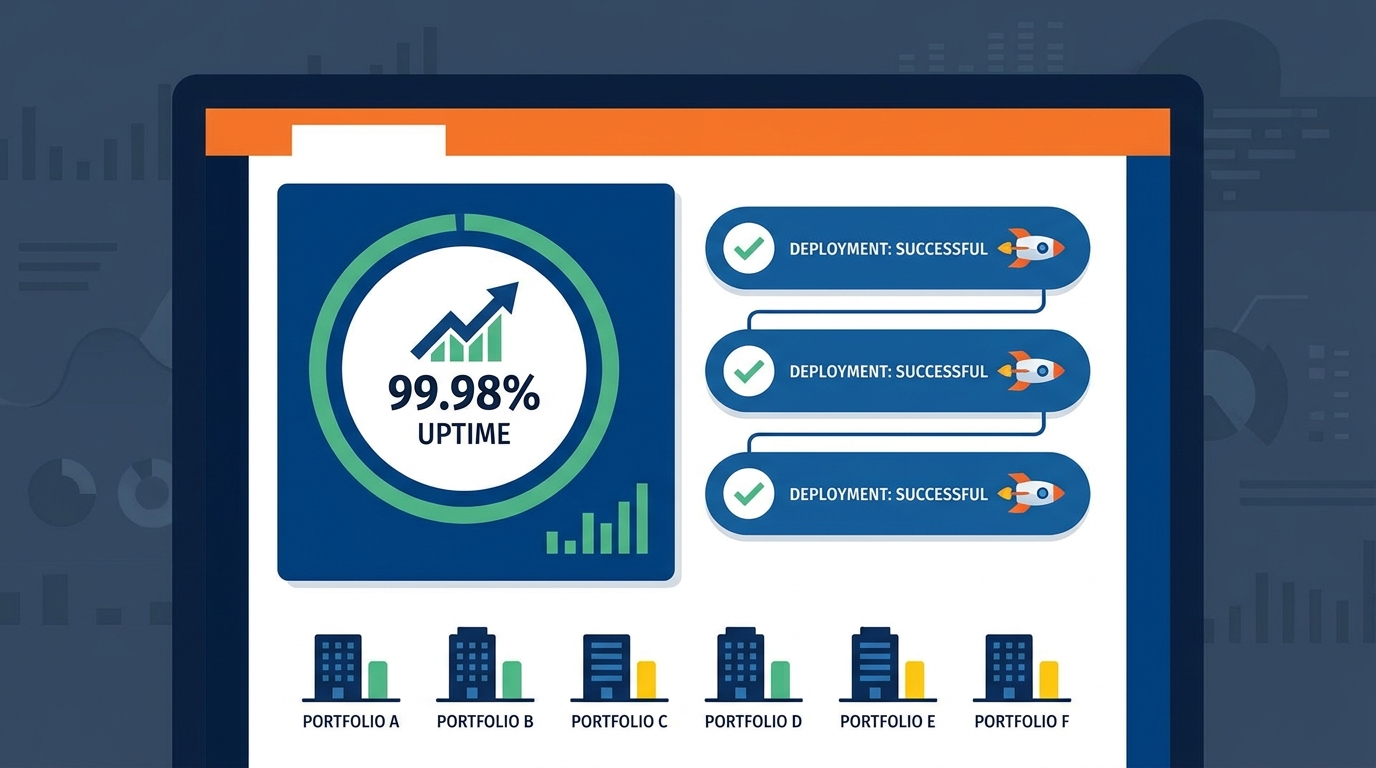
DevriX operates as an embedded technical value-creation unit for PE-backed portfolio companies and mid-market operators in the $30M-$500M range. The engagement structure combines diagnostic and execution capacity in a single retained contract, typically $15K-$50K monthly depending on scope, running 12-36 months. The team does not rotate off after delivering a roadmap. They build it, they instrument it, they own uptime, and they report progress in the same EBITDA language the operating partner uses with the board.
The model works because the same engineers who assess the stack are the ones who modernize it. There is no handoff, no re-explanation of the roadmap to a new vendor, no six-week onboarding lag while a third party interprets someone else’s documentation. The diagnostic becomes the backlog, and the backlog moves into production the same month. For a deal partner managing a compressed value-creation plan, that continuity is the difference between a recommendation that lives in a slide deck and a capability that shows up in next quarter’s EBITDA.
What embedded capacity actually delivers
A PE-backed professional services platform acquired three regional competitors in eighteen months. Each acquisition brought a separate WordPress instance, a different CRM configuration (two on Salesforce, one on HubSpot), and incompatible tracking stacks. The sponsor’s thesis depended on cross-selling the combined service offering, but the sales team could not see a unified customer view, marketing could not attribute pipeline across properties, and finance could not reconcile revenue without manual spreadsheet work.
West Monroe had been engaged pre-close to assess integration complexity and recommend a consolidation sequence. The output was a 60-page integration playbook with a detailed migration architecture, an 18-month timeline, and a $2.8M implementation budget. Twelve months post-close, one domain had been migrated, the CRM consolidation stalled because the internal IT director left, and the cross-sell motion never launched because the data layer was still fragmented.
DevriX was brought in as the execution layer. The team migrated the remaining two domains in 90 days, unified tracking with a single HubSpot instance wired to Salesforce via API, and built a consolidated reporting dashboard that surfaced customer lifetime value across the merged book. The sponsor’s operating partner could finally see which acquired accounts were expanding, which service lines were cannibalizing, and where to allocate sales capacity. Revenue attribution went from a quarterly finance reconciliation to a live board metric.
The difference was not diagnostic sophistication. West Monroe’s original playbook was technically sound. The difference was that DevriX’s contract included the engineers who migrated the domains, wrote the API connectors, and instrumented the tracking, and those engineers stayed in the environment long enough to handle the edge cases that only surface once you start moving production data. That continuity is what converts a correct recommendation into realized EBITDA.
Why sponsors pay for embedded teams, not project firms
The Value Creation Diagnostic DevriX runs as the front door to an embedded engagement costs $15K-$25K for a light assessment (two weeks, technical stack only) or $45K-$75K for a full operational diagnostic (four weeks, technical + go-to-market + data architecture). The output looks similar to a West Monroe deliverable: identified gaps, sequenced initiatives, financial impact model, resource requirements.
The structural difference is what happens next. In the advisory model, the diagnostic is a terminal deliverable. The client takes the report and either builds an internal team to execute it or goes back to market to find a vendor. In the embedded model, the diagnostic is the start of a 12-36 month retained engagement where the same team that wrote the roadmap implements it. The $15K diagnostic converts into a $25K/month retainer, and that retainer includes the engineers, the project manager, the DevOps lead, and the technical account director who shows up on the weekly operating call.
Sponsors pay for embedded capacity because it solves the coordination problem that kills most post-advisory execution. A portfolio company’s operating team is managing the core business, handling customer escalations, closing the quarter, and preparing board materials. They do not have spare cycles to translate a consulting deliverable into Jira tickets, interview engineering vendors, negotiate SOWs, and then manage that vendor’s delivery while still doing their actual job. The embedded model removes that coordination tax. The diagnostic and the execution are the same engagement, billed on the same invoice, managed by the same technical lead.
When advisory is the right answer
West Monroe and similar firms serve a specific need that an embedded operator cannot replace: cross-portfolio pattern recognition, board-level credibility, and the ability to diagnose at enterprise scale with sector-specific expertise. If you are a sponsor evaluating a $200M healthcare IT platform pre-close and you need an independent technical view to inform the purchase price, West Monroe’s diagnostic rigor and healthcare vertical depth make sense. If you are designing a carve-out separation plan for a $400M division and need architectural options modeled with cost and timeline ranges, a project-based advisory firm is the correct tool.
The advisory model works when the engagement objective is analysis and recommendation, not execution. It works when the client has internal engineering capacity to implement what is recommended, or when the transformation is large enough that it requires a systems integrator and the advisory firm’s role is to design the RFP and oversee vendor selection. It works when speed is not the primary constraint, and when the board timeline allows for a diagnostic phase, a vendor selection phase, and then an implementation phase running sequentially.
Where the advisory model breaks is when those conditions do not hold. If the portfolio company has a lean internal team, if the value-creation plan depends on speed, if the sponsor needs the same people who diagnosed the problem to own fixing it, or if the EBITDA bridge requires continuous iteration rather than a one-time transformation, then advisory becomes a cost without execution and the embedded model becomes the forcing function that moves the work into production.
How to decide
The decision framework is not ‘advisory versus embedded’. It is ‘what does the engagement need to produce, and who has to own it afterwards’. If the output is a board-ready recommendation with options and trade-offs clearly modeled, and if the client can execute internally or has time to bring in a separate vendor, advisory makes sense. If the output is live infrastructure, measurable uptime, and a capability that has to show up in the EBITDA bridge this quarter, embedded makes sense.
Most middle-market PE deals fall into the second category. The portco is running lean, the sponsor does not want to hire five internal engineers for a one-time modernization project, and the value-creation timeline is 24-36 months, not five years. In that environment, paying $250/hour for a diagnostic that produces a document is expensive unless the document converts into executed capabilities within 90 days. The embedded model collapses that gap. The diagnostic is shorter, less polished, and narrower in scope, but the same team that wrote it is in production the following week.
Business leaders navigating similar execution challenges in their own domains have found that pairing strategic direction with hands-on operational capacity accelerates results. That principle holds whether you are scaling content operations across portfolio companies or modernizing technical infrastructure under a compressed timeline.
What this means for a deal partner evaluating options
If you are three months post-close, the value-creation plan depends on modernizing the portco’s web platform and unifying analytics across three acquired properties, and your internal team is two engineers who are already underwater, you have a resourcing problem that advisory does not solve. West Monroe can tell you what to build and in what order. They cannot build it, and they will not be there in month six when the third domain migration hits an edge case that was not in the original spec.
The embedded model is not a substitute for advisory rigor. It is a substitute for the coordination gap between diagnosis and execution. You get a less comprehensive diagnostic, delivered faster, by a smaller team that is not trying to model every architectural option. What you lose in breadth you gain in speed and continuity. The team that scoped the work is the team that delivers it, and that team does not leave when the roadmap is done. They stay in the environment until the capability is live, stable, and being used by the business to generate the EBITDA the investment thesis underwrote.
For operators managing portfolio companies at scale, the question is not whether the diagnosis is correct. The question is whether anyone is contractually obligated to execute it, whether they will still be in the environment when the inevitable post-launch edge cases surface, and whether you can see their work reflected in a board metric before the next quarterly call. Advisory delivers the first part. Embedded delivers all three.
What to do next
If your portfolio company needs technical execution capacity, not another roadmap, start with the Value Creation Diagnostic. The light version ($15K-$25K, two weeks) covers technical stack assessment, infrastructure gaps, and integration readiness. The full version ($45K-$75K, four weeks) adds go-to-market architecture, data instrumentation, and a sequenced backlog with EBITDA impact tied to each initiative. Both convert into an embedded retainer if the diagnostic surfaces work that requires hands-on engineering.
West Monroe produces excellent advisory. What they do not produce is the engineering team that stays in your stack for the next 24 months and owns uptime while the modernization work runs. That is the gap DevriX fills. If you need both diagnosis and delivery in one contract, with the same team accountable from kickoff through go-live, request the diagnostic brief at devrix.com or reach out directly at [email protected].
Why this model emerged when it did
The embedded operating-unit model DevriX runs today was not designed for private equity. It was designed in 2015 for high-growth SaaS companies that needed engineering throughput without the overhead of hiring a full internal team. The model worked because it gave those companies predictable capacity, fixed monthly costs, and engineers who understood the product roadmap well enough to make technical decisions without escalating every edge case back to the CTO.
What changed between 2015 and now is that private equity started managing portfolio companies the same way those SaaS operators were managing product development. Value creation became operational, not financial. The playbook shifted from leverage and multiple arbitrage to EBITDA improvement through modernization, integration, and margin expansion. That shift created demand for exactly the kind of embedded capacity DevriX had been delivering to product companies for a decade.
The timing matters because the model predates the demand shift. DevriX was not repositioned to serve PE buyers after the market pivoted to operational value creation. It was already running the model those buyers needed, and the repositioning was a recognition that the same capabilities that worked for a SaaS CTO in 2017 also work for a PE operating partner managing a $200M portco in 2026. The technical challenges are the same. The timelines are shorter, the stakes are higher, and the governance structure is different, but the core resourcing problem, need engineering capacity that ramps fast, ships predictably, and does not evaporate when the roadmap changes, is identical.
The retained relationship as the actual differentiator
The embedded model only works if the relationship lasts longer than the first project. A six-week website migration does not create enough continuity for the team to learn the business, build institutional knowledge, or make intelligent trade-offs without constant oversight. A 24-month retainer does. By month six, the team knows which integrations break under load, which stakeholders need to approve scope changes, and which technical decisions can be made autonomously because the operating partner trusts the judgment.
That retained relationship is what makes the model defensible. Consultancies deliver projects. Agencies deliver campaigns. Embedded units deliver capacity. The economic model is different, the incentive structure is different, and the compounding value is different. A consultancy gets paid to diagnose and recommend. An embedded unit gets paid to own uptime, ship features, and reduce the operating partner’s cognitive load by taking entire capability domains off their plate.
For PE buyers, the retained model also solves a governance problem that hourly consulting does not. When you pay for a diagnostic, you get a document. When you pay for a retainer, you get a team that shows up in your Slack, joins your sprint planning, updates your board deck, and stays in the environment long enough that firing them would create more disruption than keeping them. That stickiness is the point. Portcos churn vendors constantly because vendors deliver projects and leave. Embedded units stay because the value compounds over time, and replacing them would mean re-onboarding a new team, re-explaining the tech stack, and losing six months of institutional knowledge.
Final position
West Monroe is excellent at what they do, which is delivering structured advisory that helps sponsors and operating partners make better capital allocation decisions. They diagnose well, they model rigorously, and they produce roadmaps that hold up under board scrutiny. What they do not do is stay in the environment and execute the roadmap themselves. That is not a criticism. It is a different business model serving a different part of the value-creation timeline.
DevriX serves the execution layer. The diagnostic is lighter, the team is smaller, and the deliverable is working software rather than a strategy document. The trade-off is speed, continuity, and retained accountability. You get a team that ramps in weeks, not months, that stays in your stack for years, not quarters, and that owns outcomes rather than recommendations. For PE operators managing compressed timelines and portfolio companies that need capabilities built, not just scoped, that trade-off works.
If your portco needs both, hire West Monroe for the strategy layer and DevriX for the execution layer. If you need one team that does both and stays embedded long enough to own the outcome, start with the Value Creation Diagnostic and convert it into a retained engagement when the roadmap proves out. Either way, the question is not whether the diagnosis is correct. The question is who executes it, whether they will still be there when the edge cases surface, and whether you can see their work in a board metric before the next quarterly review.
How the two models respond to the same operating situation
A portfolio company acquires a competitor, inherits two overlapping tech stacks, and needs to consolidate them before the next board meeting. The operating partner has four months to show integration progress and six months to hit the synergy target in the model. The technical work involves migrating user data, reconciling product catalogs, deduplicating customer records, sunsetting one CRM instance, and ensuring nothing breaks in production while the sales team is still closing deals on both platforms.
West Monroe’s approach: they scope the integration, identify the dependencies, model the risk, and produce a sequenced plan with milestones, resource requirements, and a recommended technology architecture. The deliverable is a roadmap that the operating partner can take to the portco CTO and use to evaluate whether the internal team can execute it or whether an implementation partner is required. That diagnostic work takes six to eight weeks and costs $150,000 to $250,000. It is thorough, it is defensible, and it gives the operating partner the confidence to make a capital allocation decision.
DevriX’s approach: we start with a lighter diagnostic, usually two to three weeks, that focuses on what can be executed in the available time window rather than what the ideal end state looks like. We identify which systems can be consolidated without re-platforming, which integrations can be scripted rather than rebuilt, and which technical debt can be deferred until after the board milestone. Then we stay in the environment and execute the plan ourselves. The team ramps in week four, starts migrating data in week five, and owns the cutover during month three. The operating partner gets progress updates in Slack, not in quarterly readouts, and the board metric moves before the deadline.
The difference is not diagnostic rigor. The difference is that West Monroe hands the plan to someone else to execute, and DevriX executes it as part of the engagement. For an operating partner managing five portfolio companies with overlapping timelines and limited internal bandwidth, that difference matters. The diagnostic does not create enterprise value. The migrated system, the consolidated data, and the retired tech debt create enterprise value. You need both the plan and the execution, but if you can only afford one vendor, you take the vendor that ships.
Where the embedded model does not work
The retained embedded model breaks down in three situations. First, when the portfolio company already has a strong internal engineering team that owns the roadmap and just needs strategic oversight. In that case, West Monroe’s advisory model fits better because the portco does not need execution capacity, it needs an outside perspective to validate the internal team’s plan or to pressure-test whether the proposed architecture will scale. DevriX does not add value when the internal team is already capable and just needs a sanity check from someone who has seen the pattern before.
Second, when the operating partner needs a board-defensible artifact that survives executive turnover. A 60-page West Monroe deliverable with financial models, risk matrices, and technology roadmaps is a document you can hand to a new CFO or a new portco CEO six months later and use to justify capital allocation decisions. A DevriX engagement produces working software and a Slack trail, but not a formatted document that a board member can read on a plane. If the political requirement is to have a third-party stamp on the plan, the consultancy model wins.
Third, when the scope is genuinely diagnostic and the execution will be handled by a hyperscaler, a large SI, or an internal team that just needs the roadmap. If the portco is going to re-platform onto Salesforce or AWS and the real question is which modules to implement and in what order, West Monroe’s specialty is that sequencing decision. DevriX does not compete in that category because we do not implement enterprise SaaS platforms, we build and operate custom systems on WordPress, headless CMS, and composable stacks. The work we do well is the work that requires engineering judgment and continuous iteration, not the work that requires contract negotiation with Oracle.
The composability argument and why it matters to PE buyers
Most PE value-creation work happens in the middle layer of the technology stack, the layer between the ERP and the customer-facing application. That middle layer is where marketing automation lives, where product catalogs get managed, where integrations between Salesforce and the website happen, and where customer data flows between systems. It is also the layer where the most technical debt accumulates, because it is built incrementally over years by different vendors, internal teams, and offshore contractors who did not coordinate with each other.
Consolidating that middle layer is where the embedded model creates the most value, because the work is not a single project with a defined end state, it is a continuous process of migrating data, replacing brittle integrations, and cleaning up the mess left by previous vendors. West Monroe can scope that work and tell you it will take 18 months and require three full-time engineers. DevriX becomes those three engineers and stays in the stack for the full 18 months, adjusting the plan as new edge cases surface and as the business priorities shift.
The composability argument is that modern stacks are built from interchangeable components, APIs, headless CMSs, and microservices, rather than monolithic platforms. That architectural shift makes the embedded model more viable because you no longer need a team that specializes in one proprietary platform. You need a team that can wire together Contentful, HubSpot, Stripe, and a custom front end, and that can replace any component when it stops working. That flexibility is what makes a retained relationship more valuable than a one-time implementation, because the stack will change three times over the life of the engagement, and the embedded team adjusts with it.
For PE operators, composability also reduces lock-in risk. If the portco is built entirely on Salesforce Marketing Cloud and the vendor relationship sours, replacing it is a nine-month re-platforming project. If the portco is built on composable components with clean API boundaries, replacing one component is a six-week sprint. The embedded team that built the original integration is the same team that replaces it, and the operating partner does not need to re-explain the business context to a new vendor.