

By Mario Peshev, DevriX
You are three weeks from signing an LOI, the target’s product roadmap is the whole thesis, and the code you are about to underwrite is a black box. That is the moment most deal partners start shopping for a technical due diligence provider, and it is exactly the wrong moment to be learning how to evaluate one. The report you commission now will either de-risk your bid or leave you carrying integration debt, a migration you did not price, and a CTO who resigns in month two. Choosing among the top technical due diligence firms is not a procurement exercise. It is a decision that changes what you pay, what you protect, and how fast the asset gets to run-rate.
I run a firm that does this work inside private equity portfolios, so I am not neutral. But I have also read enough thin diligence reports handed to boards to know what separates a document that informs a decision from one that files a box. This piece is about how to judge the providers, not how to define the field.
1. Match the firm to the decision you are actually making
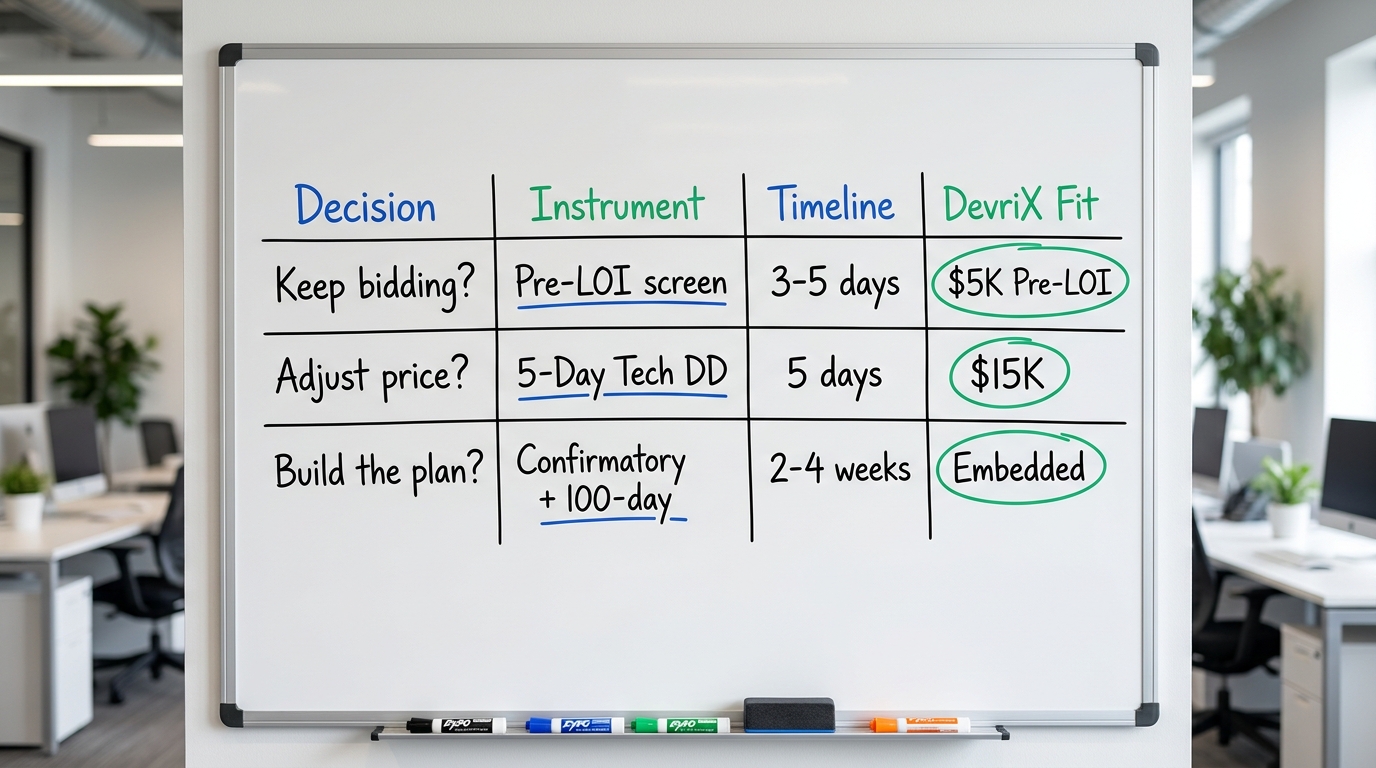
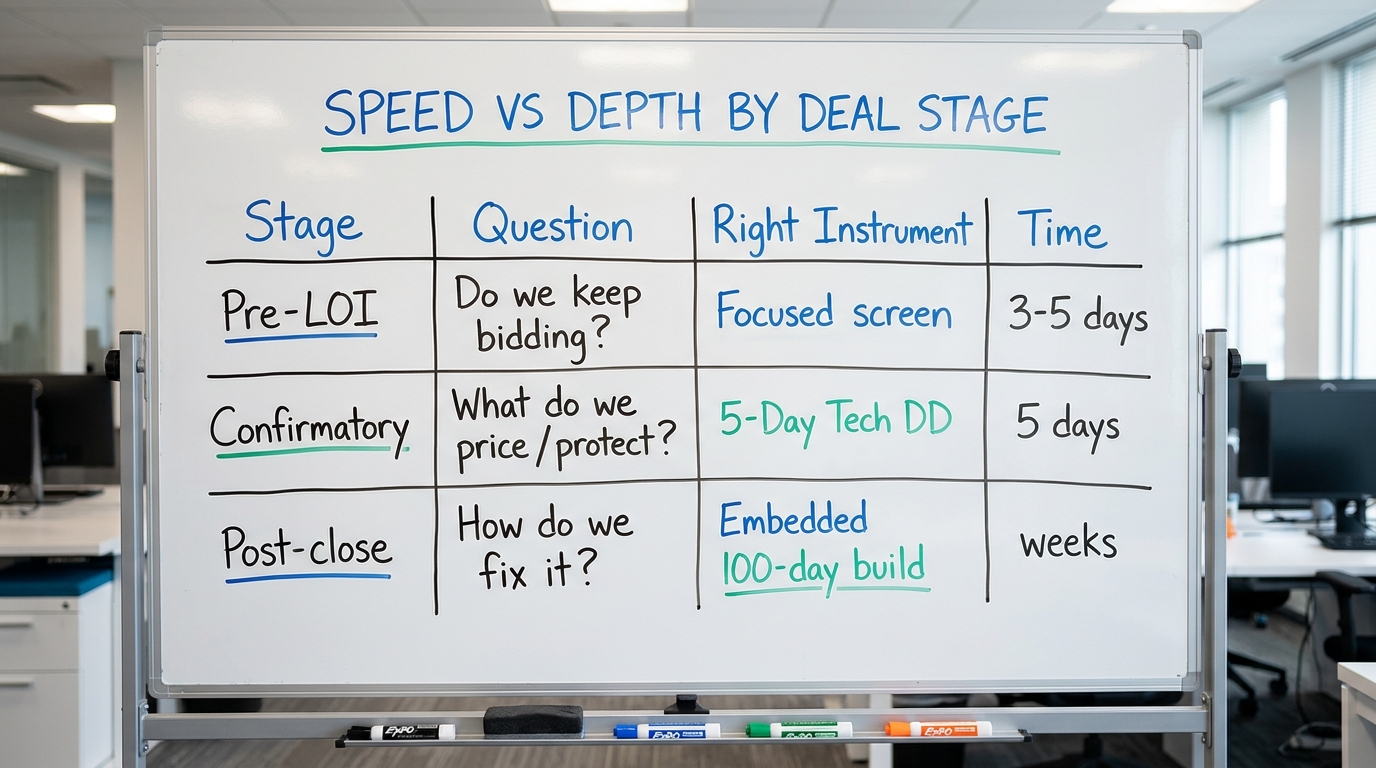
The first filter is not brand or price. It is the decision the report has to inform. A pre-LOI screen that tells you whether to keep bidding is a different instrument than a confirmatory review that gets attached to an investment committee memo. Firms that do both well are rare, and most are honest about which one they are built for.
Bain’s annual private equity report has tracked for years how deal timelines compress and how much value creation now depends on operational and technology levers rather than multiple expansion alone. You can read the pattern in Bain’s Global Private Equity Report. The implication for diligence is direct: the technical review has to produce a value-creation input, not just a defect list.
What to ask before you sign the engagement
- Which decision does this report serve: bid/no-bid, price adjustment, or post-close plan?
- Who on my side holds the decision right, and what evidence will they need to exercise it?
- Will the output survive an IC challenge, or is it a comfort memo?
If a provider cannot answer the first question in one sentence, they are selling activity, not judgment.
2. Demand engineers who have carried a P&L, not just auditors
Plenty of firms will map your target’s architecture, count the microservices, and grade the test coverage. That is checklist work, and it is necessary. It is not sufficient. The reviewers you want have run engineering organizations, missed a release date and explained it to a board, and translated a technical constraint into a number the CFO cared about.
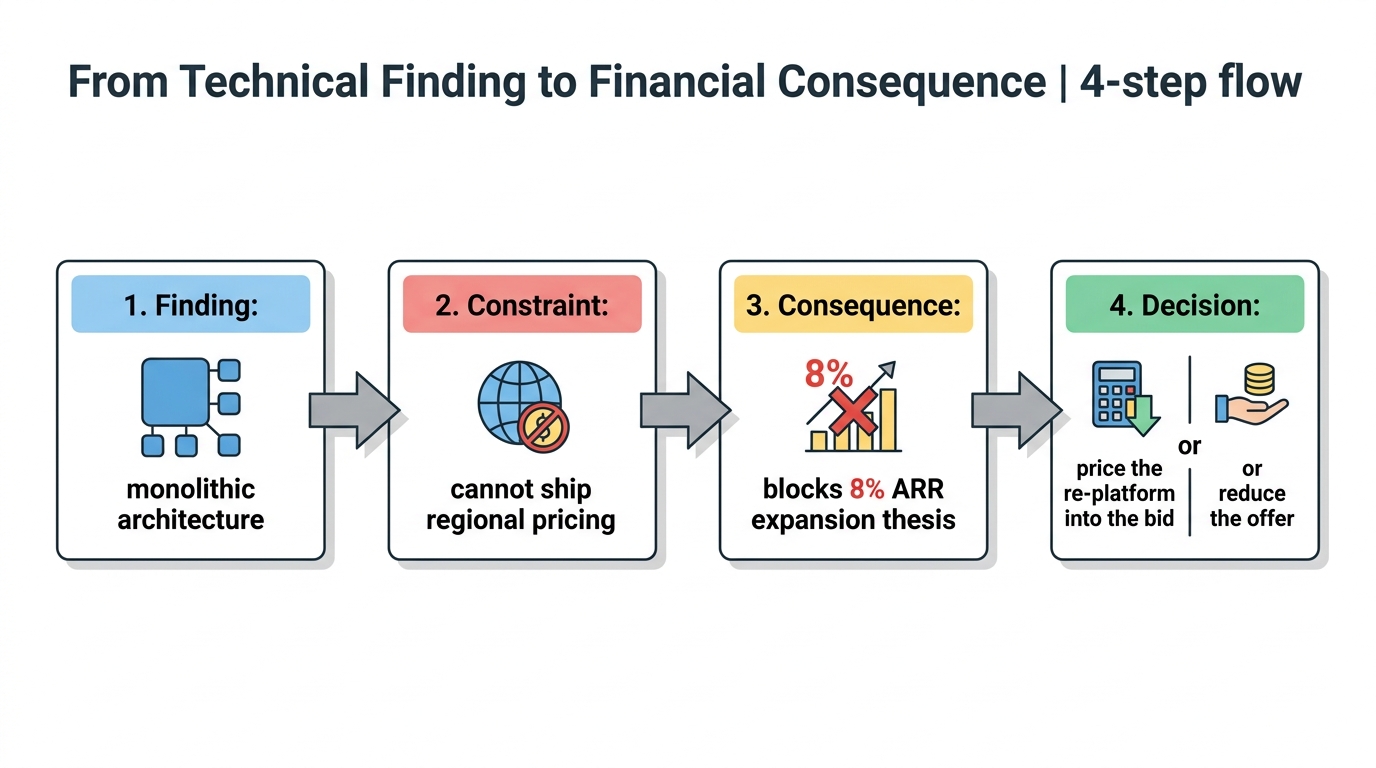
The distinction matters because a code smell only matters when it becomes an EBITDA event. A monolith is not a problem. A monolith that blocks the pricing change your thesis depends on is a problem you must price. Only reviewers who have owned outcomes reliably make that translation. I have written before about why value creation consultants differ from operators with P&L accountability, and the same line runs straight through diligence.
The test
Ask a candidate firm to walk you through a prior finding and tell you the dollar consequence they attached to it and how they sized it. Auditors give you severity ratings. Operators give you a range, a method, and the workstream that would close it.
3. Insist the report speaks the CFO’s language, not just the CTO’s
A technical due diligence report that stops at technical risk fails the reader who signs the check. The CFO wants covenants, cash, and forecast reliability. The deal partner wants thesis, risk, and exit. If the report cannot connect a scalability limit to a revenue ceiling, or a security gap to a remediation cost with a timeline, it has not done the job.
McKinsey’s private capital research has documented repeatedly how the best sponsors translate operational findings into value-creation plans early. You can browse the thinking on the McKinsey research hub. The point for you: the firms worth hiring already write this way. They do not need you to translate their findings into board English.
This is also where good technology due diligence earns its fee. The output should read as an input to your value-creation plan, tied to the levers that move enterprise value, not a standalone technical audit that lives in a data room and dies there.
4. Judge the firm on how it handles the founder-dependency risk
In lower-mid-market and mid-market technology assets, the single most common landmine is not the codebase. It is key-person concentration. One founder-architect holds the domain knowledge, the deploy keys, and the relationships. A weak diligence firm notes “some key-person risk” and moves on. A strong one quantifies it: what breaks if this person leaves in month one, what it costs to backfill, and how long the knowledge transfer takes.
This connects directly to your first 100 days. If the review flags a founder dependency you did not plan for, that is a retention package, an escrow term, or a hiring plan that has to be scoped before Day 1, not discovered in it. The firms that add the most value here treat the diligence report and the integration plan as one continuous document.
What a serious finding looks like
- Named roles, not “the team,” with a bus-factor assessment per critical system.
- A backfill cost and timeline, expressed as run-rate impact.
- A specific retention or documentation workstream with an owner assigned.
5. Check whether the firm can go from review to build
Some of the top technical due diligence firms review and then leave. Others can review and then execute the remediation they found. Neither is wrong, but you should know which you are buying, because the handoff is where value leaks.
When the firm that found the problem also owns fixing it, the risk register does not need re-litigating in month three. When it does not, you inherit a translation problem: the diligence team’s mental model has to be rebuilt by whoever executes. I have argued that PE value creation requires embedded partners, not advisory firms, and diligence is the front edge of that argument. The reviewer who becomes the builder carries context you would otherwise pay to reconstruct.
That said, embedded execution is not always the right answer at the diligence stage. The distinction between embedded versus advisory digital capacity is a real one, and the honest firms will tell you when a clean advisory review is all the deal needs.
6. Weigh speed against depth honestly
Deal timelines do not wait. If confirmatory diligence has a hard clock, a firm that needs six weeks is not on your list, no matter how thorough. This is why the market has moved toward tightly scoped, fast reviews for the screening phase and deeper engagements reserved for the assets that clear it.
PitchBook’s data on deal activity and holding periods, available through PitchBook research, shows how compressed processes have become. A well-run 5-day technical review that answers the three questions your IC actually has beats a 30-day report that answers forty questions nobody asked. Judge the firm on scoping discipline: can they tell you in advance what they will and will not cover, and hold to it?
The scoping conversation to have
- What are the three findings that would change my bid, and how will you prioritize toward them?
- What will you explicitly not cover in this timeline, and what is the risk of not covering it?
- If you find something disqualifying on day two, do you stop and tell me, or finish the report?
7. Look at how they treat security, data, and AI claims
Two areas separate rigorous firms from theatrical ones. The first is security and data handling: not just whether the target has policies, but whether the actual data flows, access controls, and third-party dependencies expose you to a liability you would be underwriting. The Harvard Law School Forum on Corporate Governance has tracked how governance and disclosure expectations around data and cyber risk have tightened, which raises the stakes on getting this right in diligence rather than after close.
The second is AI. Many targets now claim AI as a differentiator. A serious firm pressure-tests that claim: is it a genuine model advantage, a thin wrapper on a commodity API, or a demo that does not survive production load? The answer changes the multiple you should pay. If your reviewer takes the pitch deck at face value here, they are not doing diligence, they are doing marketing.
8. Confirm the firm understands the whole operating stack, not just engineering
Technical due diligence that stops at the engineering org misses the seams where value actually breaks. Product, engineering, and revenue operations have to function as one system for the thesis to hold. A review that grades the codebase but ignores how leads flow, how the product surfaces revenue, and how the go-to-market motion depends on the platform is incomplete.
I have written about aligning engineering, product, and RevOps for PE value creation because the biggest post-close surprises live at those boundaries. A firm that can assess the platform’s ability to support the go-to-market plan, rather than just its technical hygiene, is worth more than one that produces a beautiful architecture diagram and nothing about whether it can sell.
This is also where common PE go-to-market pitfalls get caught early. The technical constraint that quietly caps CAC efficiency or blocks a pricing model is exactly the kind of finding that never appears in a code-only review.
9. Separate governance advisors from hands-on reviewers
Some of the best-known names in this space are governance advisors: they sit on committees, opine on strategy, and lend credibility. That is valuable and it is not the same as a team that opens the repo. When you are buying diligence, you want people who read the code, run the load tests, and interview the actual engineers, not people who summarize what management told them.
I have drawn this line before between board technology advisors and hands-on builders. Both roles exist. For a confirmatory technical review that de-risks a bid, hire the hands. The governance layer comes later, when you seat the board and set the operating cadence with a technical value-creation partner operating inside the portfolio company.
10. Verify they will defend the report to your IC and your lenders
The last filter is accountability. Will the firm sit on a call with your investment committee and defend a finding under challenge? Will they stand behind their remediation estimates when your lenders ask? A report nobody will defend is a report you cannot lean on when the price is being negotiated.
BCG’s work on principal investors, available at BCG’s private equity practice, and S&P Global’s market intelligence at S&P Global both reflect how much of deal value now hinges on the quality of the operational read going in. The firms that stand behind their conclusions are the ones whose reports actually move a decision. The ones who hedge every sentence are protecting themselves, not you.
Takeaways for the deal team
- Buy the decision, not the document. Define whether you need a bid/no-bid screen, a price-adjustment review, or a post-close plan before you shortlist anyone.
- Hire operators who have carried a P&L. Only they translate technical findings into the dollar consequences your IC will underwrite.
- Make the report speak to the CFO. Covenants, cash, forecast reliability, and remediation cost with a timeline, not just severity ratings.
- Quantify key-person risk explicitly. Named roles, backfill cost, and a retention workstream scoped before Day 1.
- Know if the reviewer can also build. The handoff between diligence and execution is where context and value leak.
- Judge scoping discipline over volume. A focused 5-day review that answers your three real questions beats a 30-day report that answers none of them.
- Pressure-test AI and security claims. Both change the multiple, and both are easy to fake in a data room.
- Demand accountability. If they will not defend the finding to your IC and lenders, the finding will not survive the negotiation.
For a broader view of the market forces shaping these expectations, Harvard Business Review’s coverage of mergers and acquisitions is worth keeping in your reading rotation, alongside the annual reports from the sources above.
Conclusion
The top technical due diligence firms are not the ones with the longest client logos or the thickest report templates. They are the ones whose work changes what you decide: whether to bid, what to pay, what to protect, and how fast you can get the asset to run-rate. Judge them on the decision they inform, the language they write in, the risks they quantify, and whether they will stand behind the conclusion when the price is on the table. If you keep the operator’s future in mind, as I argue in my notes on future-proofing organizations for 2026, the diligence read stops being a cost and starts being the first move of your value-creation plan.
If you have a live deal and need a technical read that plugs straight into your bid and your first 100 days, our team runs a 5-Day Tech DD and Pre-LOI screen built for PE deal teams. Scope it to the decision in front of you and let the report earn its place in the IC memo.
