

You are three weeks from close. The quality of earnings report lands in your inbox, and the accounting firm confirms that EBITDA adjustments are defensible, revenue recognition follows GAAP, and the trailing twelve months look clean. The deal team exhales. The investment committee schedules a final vote.
Then someone asks: “How much of that revenue renews?” Or: “What happens when the founder stops selling?” Or: “Is the biggest customer actually growing or just contractually locked in for six more months?”
The QoE does not answer those questions. It was never designed to. And if you treat it as a substitute for commercial due diligence, you will pay a normalized multiple for revenue that will not normalize. Commercial diligence answers a different set of questions than financial diligence.
This piece is for deal leads and operating partners who already have a quality of earnings in hand and are deciding whether commercial diligence adds anything the accountants did not cover. The short answer: it covers different ground entirely. The longer answer requires understanding where each report stops, where they overlap, and how to sequence them so you are not duplicating cost or, worse, leaving gaps.
Both reports use the same language but serve entirely different functions
The confusion is understandable. Both a quality of earnings report and a commercial due diligence workstream claim to assess “revenue quality.” Both involve spreadsheets, customer data, and pointed questions about the business model. Both inform the same purchase price negotiation.
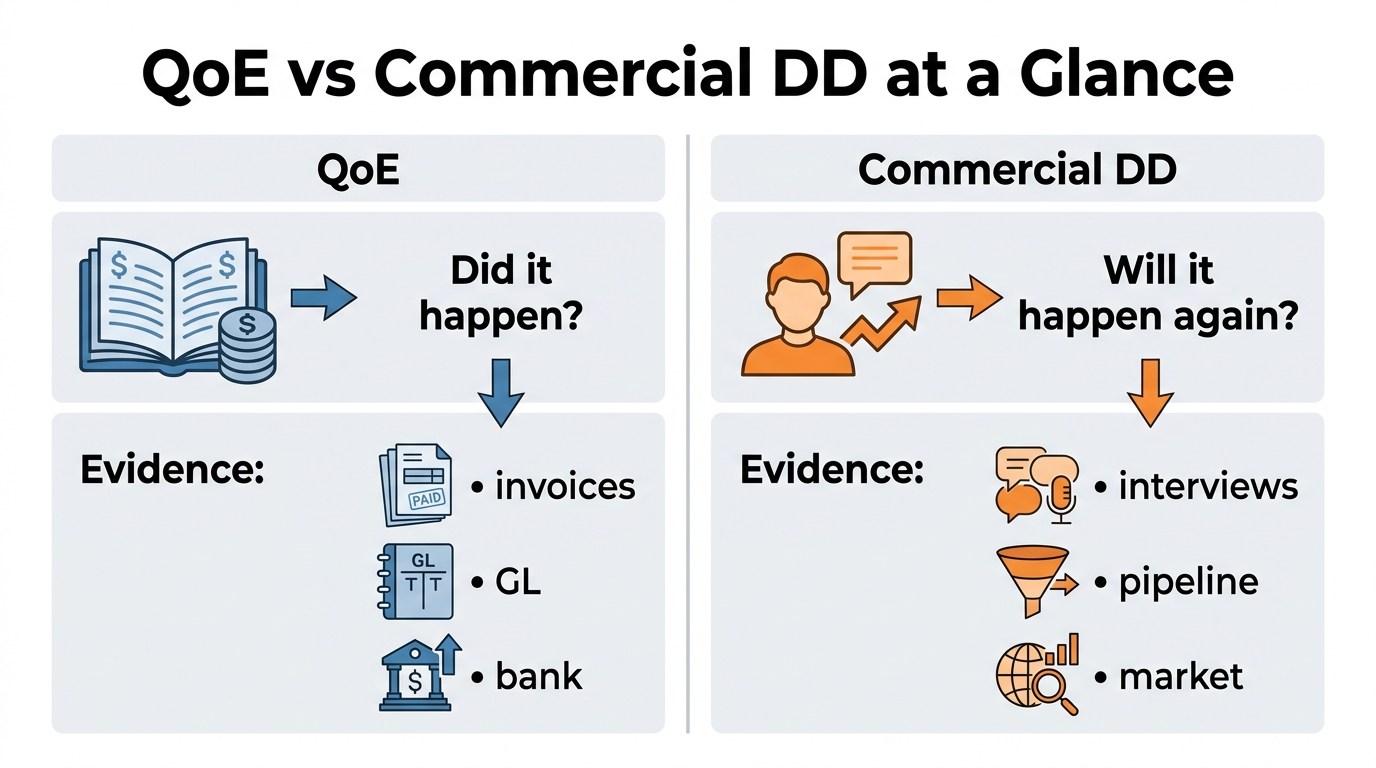
But the QoE is fundamentally backward-looking. It asks: “Did the revenue actually happen the way the seller says it did?” Commercial diligence is forward-looking. It asks: “Will this revenue happen again, and under what conditions?” Revenue assumptions should also be validated through GTM diligence.
A QoE provider reconciles invoices, confirms cash receipts, tests cutoff timing, and normalizes one-time items. A commercial diligence team interviews customers, maps competitive positioning, stress-tests the pipeline, and models churn scenarios. One validates the historical record. The other pressure-tests the forecast.
When deal teams conflate the two, they end up with a pristine historical ledger and zero visibility into whether the next twelve months will look anything like the last twelve.
A quality of earnings report gives you a defensible earnings baseline, not a forecast
A well-executed QoE gives you confidence in three areas:
- Earnings normalization: One-time costs, owner add-backs, and non-recurring revenue are identified and adjusted. You know what “run-rate” EBITDA actually looks like.
- Revenue recognition integrity: The timing of revenue matches delivery. Deferred revenue is properly stated. There are no channel-stuffing games in the final quarter.
- Working capital baselines: You understand the cash conversion cycle and can set a peg for the net working capital target at close.
These are non-trivial. A Bain & Company study on M&A due diligence found that roughly 30% of deals underperform expectations due to overestimated synergies or misunderstood financials. The QoE is your first defense against paying for phantom earnings.
But the QoE stops at the ledger. It does not tell you why a customer renewed, whether they will renew again, or what happens when their contract expires. It does not distinguish between a sticky enterprise customer and a one-time project buyer who happened to pay on time. It does not model what the revenue looks like if the founder exits or if the primary sales channel dries up.
Those are commercial questions. The accountants are not ignoring them. They are simply outside the scope of work.
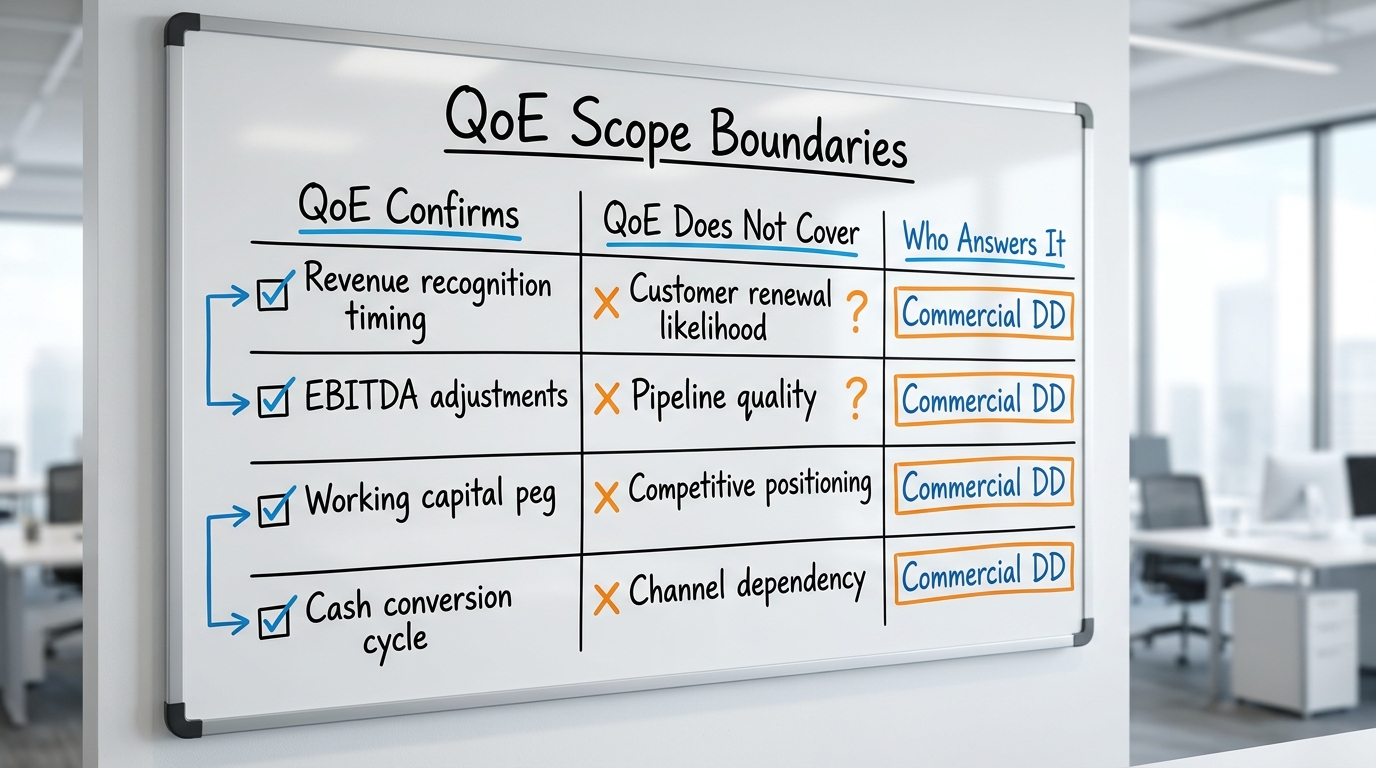
Commercial diligence answers the questions a QoE was never scoped to address
Commercial due diligence fills the gap between “the numbers are accurate” and “the numbers will repeat.” It answers a different set of questions:
- Customer concentration risk: Not just who the top customers are, but why they buy, how entrenched the product is, and what switching costs exist.
- Pipeline validity: Whether the opportunities in the CRM are real, qualified, and closeable within the forecast window.
- Competitive positioning: How the target wins deals, who it loses to, and whether its positioning is durable or dependent on a pricing advantage that will erode.
- Go-to-market dependency: Whether revenue is founder-led, channel-dependent, or systematized. This matters enormously for post-close value creation.
- Churn and expansion dynamics: Not just historical churn rates, but the reasons behind churn and whether expansion revenue is proactive or reactive.
For a detailed breakdown of the questions commercial diligence should answer, I have written separately on GTM due diligence and revenue quality.
The key distinction: a QoE confirms that $5 million in ARR was booked correctly. Commercial diligence tells you whether that $5 million will be $4 million or $6 million in 18 months, and why.
The same phrase means different things depending on which report you are reading
This is where the terminology creates real confusion. Both QoE providers and commercial diligence teams use the phrase “revenue quality.” They mean different things.
In a QoE context, revenue quality is about accounting recognition. The question is whether revenue was recognized in the correct period, whether it reflects actual performance obligations met, and whether there are any restatement risks. This is GAAP compliance territory.
In a commercial context, revenue quality is about demand durability. The question is whether customers are buying because of a structural need, whether they have alternatives, and whether the pricing power is real or borrowed. This is market positioning territory.
A company can have pristine revenue quality from an accounting perspective, with every invoice correctly timed and every adjustment disclosed, and still have fragile revenue quality from a commercial perspective because the buyers are non-recurring, the product is commoditized, or the sales motion depends on a single relationship.
McKinsey’s research on growth and profitability has shown that organic revenue growth is the single largest driver of shareholder returns in acquisitions. But “growth” is not a ledger item. It is a commercial outcome driven by customer behavior, competitive dynamics, and go-to-market execution. The QoE cannot model that. It was never asked to.
Where the two reports diverge tells you whether you have a deal or a re-trade
In a healthy deal, the QoE and commercial diligence align. The numbers are clean, and the underlying demand is durable. You pay the agreed multiple with confidence.
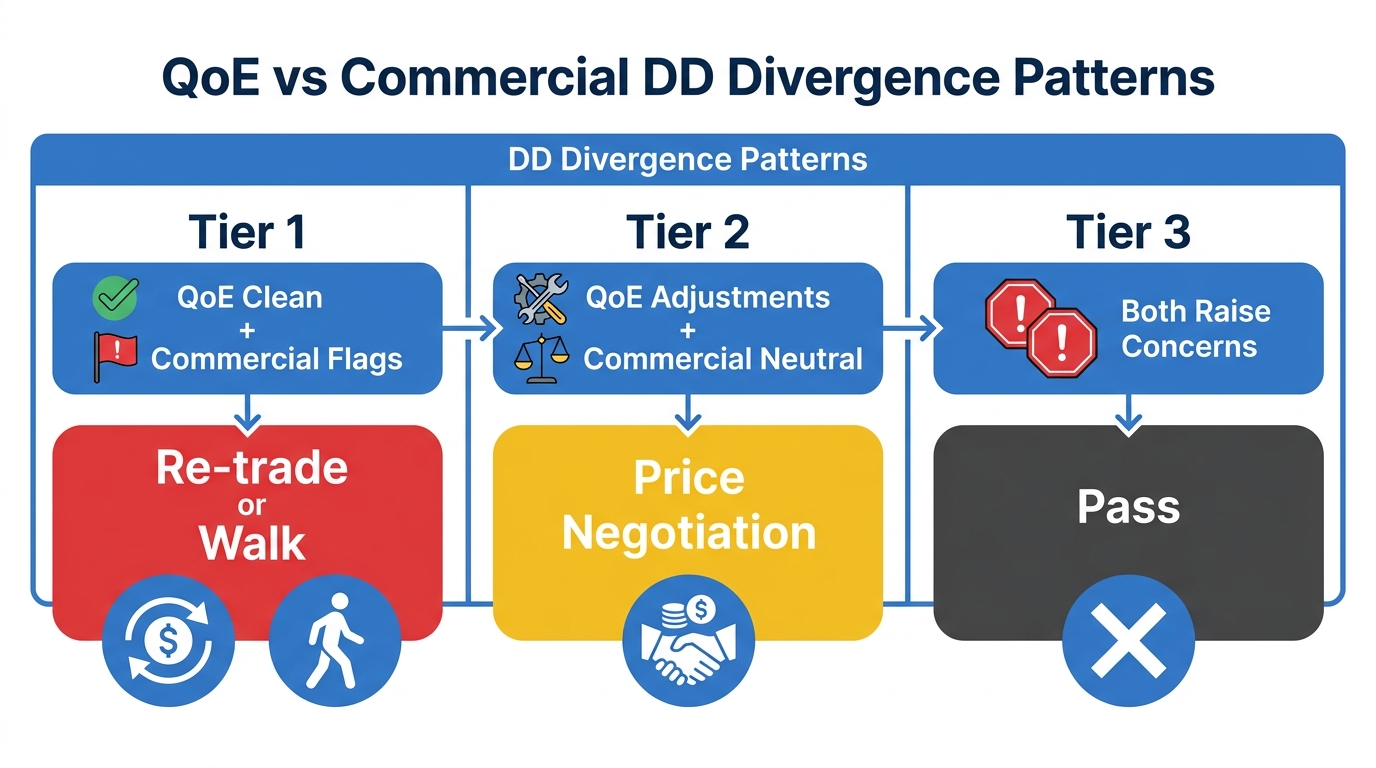
In a troubled deal, the two reports diverge. Here are the patterns I see most often:
QoE Clean, Commercial Diligence Raises Flags
The historical revenue is correctly stated, but customer interviews reveal low switching costs, no expansion path, and a competitor gaining share. The revenue is real, but the forward trajectory is worse than the seller’s model assumes. This is a re-trade scenario or a walk-away, depending on magnitude.
QoE Adjustments Significant, Commercial Diligence Neutral
The accounting is messy, with aggressive add-backs and timing issues, but the underlying demand is solid. Customers are happy, retention is strong, and the pipeline is real. This is a negotiation on normalized EBITDA, not a fundamental deal risk. You argue about the baseline, not the trajectory.
Both Reports Raise Concerns
The financials require material adjustments and the commercial picture shows concentration, churn, or competitive erosion. This is a pass. No structure fixes both problems.
Understanding which scenario you are in requires both reports. Running only the QoE leaves you blind to the first pattern, which is the most dangerous because it looks clean on paper.
For common warning signs in commercial diligence specifically, see my piece on commercial due diligence red flags.
How to sequence these workstreams so you get the signal before final price negotiation
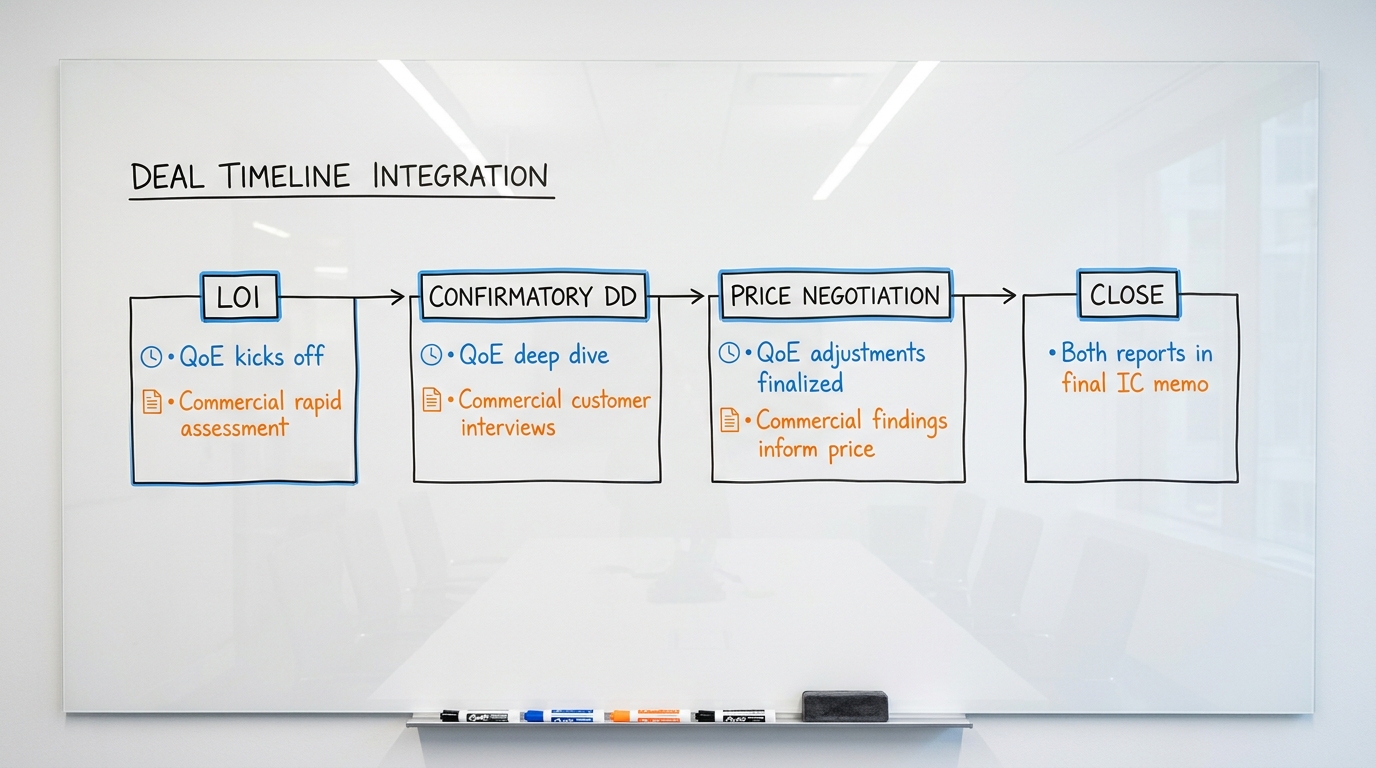
Timing matters. Most deal teams kick off the QoE at LOI because it is standard practice and lender-driven. Commercial diligence often starts later, sometimes as an afterthought when someone raises a question the QoE cannot answer.
This sequencing is backwards for deals where commercial risk is elevated. Here is how I think about it:
Parallel Start, Staggered Depth
Begin both workstreams at LOI. The QoE can run its standard process. Commercial diligence starts with a rapid assessment: customer interviews, pipeline review, competitive scan. This gives you early signal on whether the deal has commercial issues before you are deep into confirmatory diligence.
QoE Findings Inform Commercial Scope
If the QoE surfaces unusual revenue patterns, such as large one-time deals, channel concentration, or seasonal spikes, commercial diligence should dig into those specifics. The accounting anomaly often has a commercial explanation that changes the investment thesis.
Commercial Findings Inform Negotiation Before Close
If commercial diligence reveals churn risk or pipeline weakness, you want that information before final price negotiations, not after. Running commercial diligence too late means you either re-trade under pressure or close with unpriced risk. Sellers face the mirror image of that timing problem, and the ones who prepare early can fix the churn and pipeline gaps instead of conceding on price. Running sell-side commercial due diligence 6 to 12 months before a process opens puts the same tests in the seller’s hands, so the answers are ready when the buyer’s team asks.
For a structured approach to scoping commercial diligence, I have outlined a commercial due diligence checklist for B2B acquisitions that can run parallel to the QoE.
A decision guide by deal size and risk profile
Not every deal requires the same depth. Here is how I think about calibrating both workstreams:
Lower Middle Market ($5M-$25M TEV)
QoE is often lender-required regardless. Commercial diligence can be lighter, focused on customer concentration, founder dependency, and pipeline validity. A 10-15 customer interview program usually surfaces the critical issues.
Core Middle Market ($25M-$100M TEV)
Full QoE plus structured commercial diligence. At this size, the commercial risks are more nuanced: channel strategy, competitive positioning, and sales motion scalability. The commercial workstream should include market sizing, win/loss analysis, and GTM assessment.
Upper Middle Market ($100M+ TEV)
Both workstreams run at full depth, often with specialized providers. Commercial diligence may include primary market research, customer surveys, and detailed competitive benchmarking. The QoE will likely include IT due diligence on financial systems. That IT review stops at the finance stack and says nothing about the product architecture, the release process, or the size of the engineering backlog. Run the technology due diligence checklist alongside it at this deal size, because a rebuild you did not price becomes a multi-year drag on the value creation plan.
According to Harvard Business Review’s analysis of M&A performance, acquirers who conduct thorough commercial due diligence are significantly more likely to achieve their deal thesis. The investment is not optional at scale.
Side-by-side comparison across scope, evidence, and deal impact
The following table summarizes the distinctions across scope, questions answered, evidence used, and deal impact:
| Dimension | Quality of Earnings | Commercial Due Diligence |
|---|---|---|
| Primary Scope | Historical financial accuracy, EBITDA normalization, working capital | Forward revenue durability, market position, GTM viability |
| Time Orientation | Backward-looking (TTM, historical trends) | Forward-looking (forecast validation, demand trajectory) |
| Core Questions Answered | Are the earnings real? Are adjustments defensible? Is revenue properly recognized? | Will revenue repeat? Why do customers buy? What threatens growth? |
| Evidence Base | Financial statements, GL detail, invoices, contracts, bank statements | Customer interviews, pipeline data, competitive intel, market research |
| Revenue Quality Definition | Accounting recognition, timing, GAAP compliance | Demand durability, switching costs, expansion potential |
| Deal Impact | Sets EBITDA baseline, informs working capital peg, identifies restatement risk | Validates growth assumptions, prices commercial risk, informs value creation plan |
| Typical Provider | Accounting firm (Big 4, national, regional) | Strategy consultant, commercial DD specialist, or in-house deal team |
| Triggers for Deeper Scope | Complex revenue recognition, significant add-backs, lender requirements | Customer concentration, founder-led sales, competitive disruption, high churn |
The cost of getting this wrong shows up 18 months after close
I have seen deals where the QoE was flawless and the commercial reality was deteriorating. The acquirer paid a healthy multiple for what looked like stable recurring revenue. Eighteen months later, three of the top ten customers had churned, the pipeline was half of what the CRM showed, and the founder who closed every major deal was consulting for a competitor.
None of that would have appeared in the QoE. The accountants did their job correctly. The problem was not the report. The problem was treating financial validation as a substitute for commercial validation.
BCG’s research on post-merger integration confirms that revenue synergy misses are among the most common sources of deal underperformance. The synergies that do not materialize are often commercial in nature: customers who do not cross-buy, markets that do not expand, pricing power that does not hold. A QoE cannot forecast any of that.
Run both reports, start both early, let each inform the other
The quality of earnings report is essential. It protects you from paying for earnings that do not exist. But it does not protect you from paying for revenue that will not repeat.
Commercial due diligence fills that gap. It tells you whether the historical performance is a foundation for growth or a high-water mark you will never reach again. It answers the questions that the accountants were never asked to answer.
Run both. Start both early. Let each inform the other. And do not confuse a clean ledger with a durable business. QoE and commercial diligence are 2 of the workstreams a buyer runs, and the tax, technology and people reviews have to reconcile with them before the investment committee sees a recommendation. I keep the full map in the due diligence guide for private equity, which covers how those workstreams line up and what each one is scoped to answer.
When the numbers reconcile but the revenue story does not, DevriX can run commercial diligence alongside the QoE, not after it.
After closing, these findings become inputs into the integration plan.
