

In Q2 2024, a $280M portfolio company engaged a big-name PE advisory firm to build a revenue-operations playbook. Six months and $430,000 later, the deliverable was a 140-page deck. The operating partner who commissioned it told me the work was analytically sound, the diagnosis was correct, and the recommendations sat unused because nobody on the portco team had capacity to implement them. The firm billed by the project, delivered the document on time, and moved on. The EBITDA bridge the deal thesis promised stayed flat.
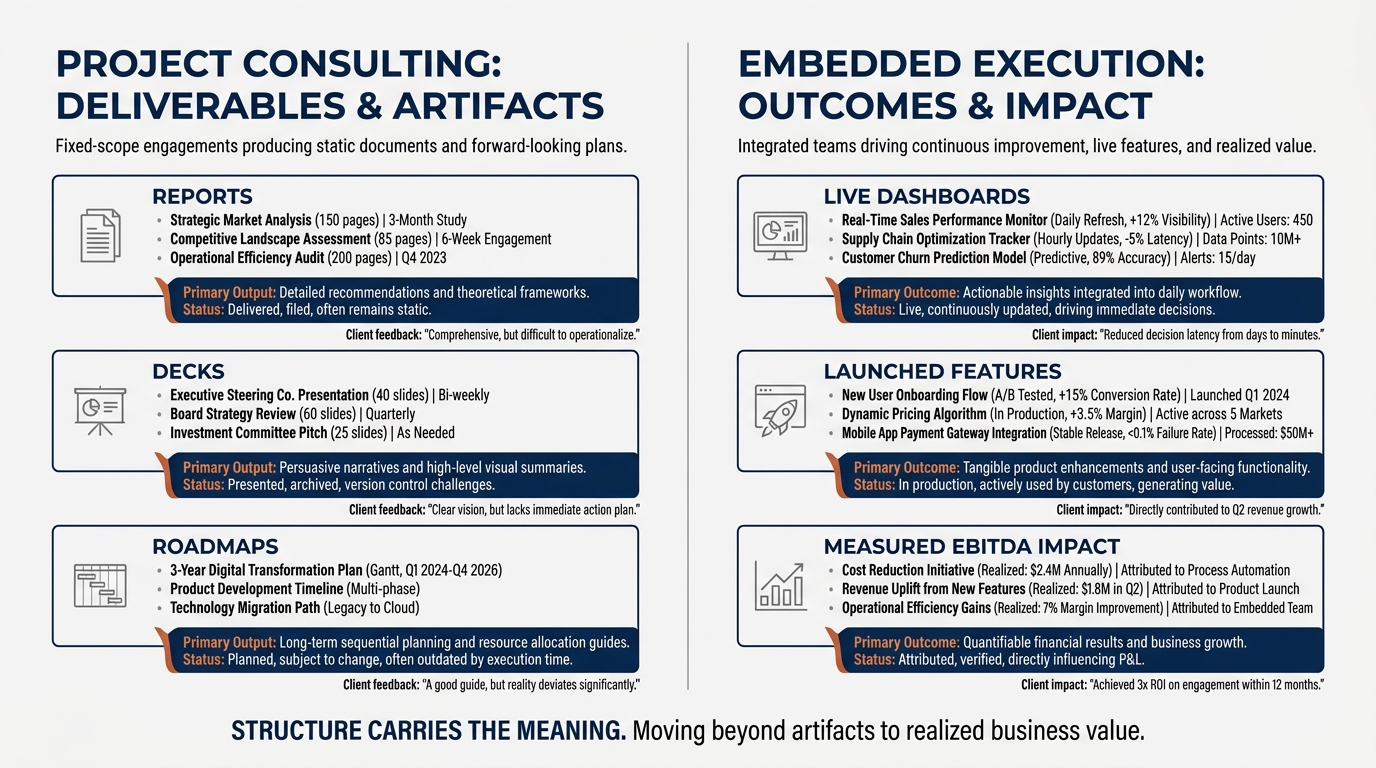
That structure follows from the business model. Most PE consulting firms sell discrete engagements: commercial diligence, a value-creation plan, a carve-out blueprint, an organizational assessment. They optimize for insight density and client satisfaction at project close, not for whether the operating business adopts the work or whether EBITDA moves twelve months later. The incentive is to produce a credible artifact that passes internal review, gets invoiced, and creates a reference for the next similar engagement.
The embedded model holds a seat inside the operating business, owns a set of quarterly outcomes written into the SOW, measures those outcomes in the portco’s own dashboards, and renews only if the numbers moved. The partner does not hand over a document and leave.
Why the project model dominates PE advisory
PE consulting firms are optimized for the diligence and deal phase, not the hold period. A commercial diligence engagement runs four to eight weeks. The firm interviews customers, reviews contracts, models the market, and delivers a memo that informs the investment committee’s decision. That work has a natural end point: the IC vote. Once the deal closes, the consultant’s engagement typically ends or shifts to a new scope.
The same structure applies to most value-creation planning. A PE firm closes an acquisition, brings in a strategy shop to map the first 100 days and build the EBITDA bridge, and receives a phased roadmap with sequenced initiatives. The roadmap becomes an internal artifact. Responsibility for execution transfers to the operating partner, the portco CEO, and the internal team. The consulting firm moves to the next deal.
A $180M SaaS portfolio company we worked with in 2023 had hired two different advisors over eighteen months. Both produced sound recommendations: consolidate the tech stack, instrument conversion funnels, rebuild the website for speed and tracking, automate lead scoring in HubSpot. The CFO and VP of Engineering agreed with every line. The blocker was that neither of them had four engineers and a martech specialist sitting idle, and the advisory firms were not structured to provide that capacity on a retained basis. The constraint was capacity and technical depth, not knowing what to do.
The embedded alternative: who owns the outcome
An embedded partner does not deliver a document and depart. It takes a defined piece of the operating plan, staffs it with the right technical roles, and reports measured progress on a fixed cadence. That typically means a multi-quarter or multi-year retainer where renewal depends on hitting the outcomes written into the SOW.
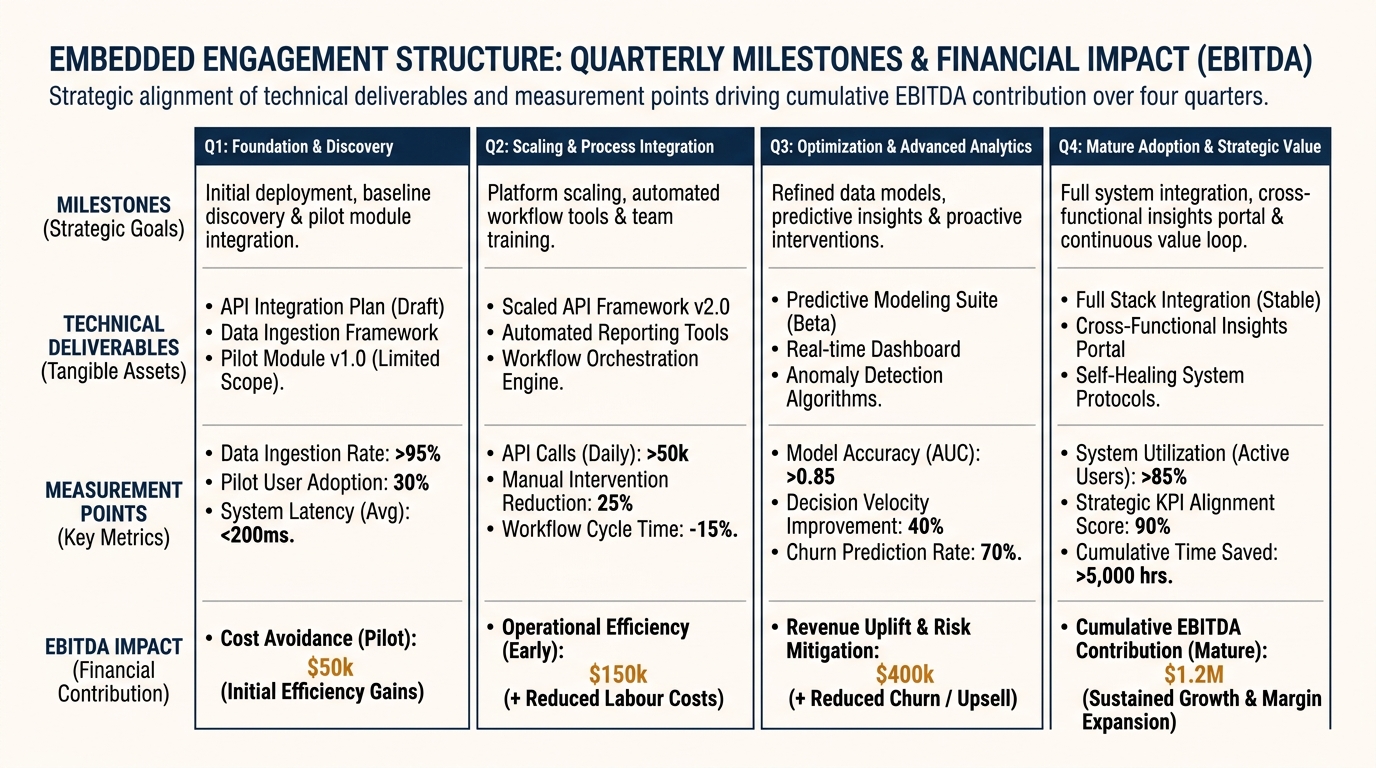
We built DevriX on this model starting in 2015, a decade before most PE firms adopted value-creation as a front-office priority. A typical engagement runs 12 to 36 months. The scope is not abstract: it is a set of deliverables tied to revenue, conversion rate, page speed, tracking instrumentation, or integration milestones that the portco leadership measures in their own reporting. If a client commits to launching four revenue-generating features in Q2, instrumenting a multi-stage funnel by end of Q3, and cutting page-load time to under two seconds, those targets go into the quarterly business review and into our internal delivery tracker. Miss them, and the deal does not renew.
That structure changes the incentive. A project-based firm optimizes for insight quality and client satisfaction at delivery. An embedded partner optimizes for adoption and measurable impact over the contract term. The former gets paid when the deck is done. The latter gets paid when the business outcome moves and the client chooses to renew.
The trade-off is flexibility. A project engagement can pivot scope mid-stream if the sponsor’s priorities shift. An embedded model requires both sides to commit to a stable operating roadmap for at least two quarters, because the partner is staffing against it and the work compounds. A portco that cannot hold a plan steady for six months is not a fit for the embedded structure, and those companies are better served by hourly advisory or a traditional consulting engagement.
What operating partners need from a technical partner
Operating partners care about speed to impact, repeatable playbooks that work across the portfolio, reliable management data, and preventing value leakage during integration. They do not typically have the time or the internal bench to rebuild a portco’s WordPress infrastructure, instrument event-level tracking, migrate a legacy CMS to a headless stack, or wire HubSpot lifecycle automation from scratch. Those are technical operating problems, not strategic ones, and most PE advisory firms do not staff for them.
A $340M multi-location services business we worked with in late 2023 had been through two consultants. Both correctly identified that the website was slow, tracking was incomplete, and the lead funnel dropped 60% of traffic before reaching a form. Neither could implement the fix. We scoped a six-month engagement: migrate to a faster hosting stack, strip out unused plugins, implement event-level GA4 tracking including form-start and drop-off points, rebuild the lead forms for mobile, and run the HubSpot integration so every submission flowed into the CRM with proper attribution. That work was operational, it was measurable, and it directly tied to the EBITDA bridge in the investment thesis.
PE firms increasingly recognize that value creation depends on execution. According to a 2025 study by Simon-Kucher covering over 100 PE executives, the share of firms sticking to an annual value-creation plan review dropped from 53% to 42%. Plans that do not translate into launched work within the first two quarters tend to stall, and stalled plans do not produce the returns the deal model underwrote.
When the project model still makes sense
Project consulting remains the right structure for diligence, thesis validation, and one-time assessments. If a PE firm needs to evaluate a target’s competitive position, model the TAM, or assess regulatory risk before signing an LOI, a four-week commercial diligence engagement from a specialist firm delivers more value than an embedded partner could in the same window. The question is binary, the timeline is fixed, and the output is a memo that informs a go or no-go decision.
The same logic applies to organizational assessments, carve-out planning, and post-merger integration blueprints. A firm that specializes in separating a division from a corporate parent, mapping the IT dependencies, and sequencing the Day One cutover brings domain expertise that an embedded technical partner typically does not. That work is high-value, it has a defined end state, and it does not require ongoing capacity once the separation is complete.
Rebuilding a website, instrumenting tracking, automating HubSpot workflows, and maintaining performance over a twelve-month integration is an operating function that runs over multiple quarters. Scoping it as a one-time project produces a plan that nobody implements, because the portco lacks the internal capacity and the consultant is not contracted to stay.
How to evaluate an embedded partner
When a PE firm or a portco evaluates an embedded technical partner, the question is whether the firm can deliver measurable outcomes over multiple quarters and whether the structure aligns incentives around those outcomes.
A strong embedded SOW specifies outcomes, not activities. Weak language sounds like this: ‘Provide ongoing website support and optimization.’ Strong language reads: ‘Reduce average page-load time to under 2.0 seconds by end of Q2, instrument form-start and drop-off events across the lead funnel by mid-Q3, and launch the rebrand on the new headless stack by end of Q4, with all milestones validated in the client’s own Lighthouse and GA4 dashboards.’ The second version can be measured, reported in a QBR, and either renewed or terminated based on whether the outcomes happened.
An embedded partner should name the roles staffed against the engagement and show how capacity maps to the roadmap. If the scope includes HubSpot automation, website performance, and event tracking, the team should include a martech lead, a front-end engineer, and someone who owns GA4 configuration. A proposal that lists ‘our team of experts’ without naming roles or capacity is selling hours, not outcomes.
Ask how the partner measures impact. The right answer references the portco’s own dashboards and reports the metrics the CFO or operating partner already tracks. A partner that builds its own custom reporting layer and presents results in a separate deck is optimizing for its own narrative, not for integration into the operating business. Real embedded work shows up in the client’s Salesforce pipeline report, HubSpot lifecycle stages, Google Analytics conversion funnel, or Lighthouse performance score, not in a consultant’s summary slide.
Verify portfolio-level leverage. One advantage of an embedded model is that the same partner can work across multiple portcos and transfer what works. If the firm has solved a similar problem before, in a similar vertical, at similar scale, it should be able to show the playbook and name the other client where it worked. A partner that treats every engagement as a greenfield build is not leveraging portfolio scale, and that inefficiency shows up in longer ramp time and higher cost.
What portco leadership should expect
From the portco side, an embedded partner is an extension of the operating team. That means the relationship requires a stable roadmap, clear ownership, and the ability to supply the inputs the partner needs to deliver. A portco that cannot define success criteria, provide access to systems, or commit to a two-quarter roadmap will struggle with any embedded structure, regardless of the partner’s capability.
The CFO or VP of Engineering should expect a quarterly business review where the partner reports measured progress against the SOW, flags risks or blockers, and proposes scope adjustments if priorities shift. That review should reference the same dashboards and metrics the portco already tracks. If the engagement includes website work, the QBR should show Lighthouse scores, Core Web Vitals, and traffic-to-conversion metrics from GA4. If it includes HubSpot automation, the review should reference lifecycle-stage movement and attribution data from the CRM. An embedded partner that cannot tie its work to the metrics the business measures is not embedded.
Expect trade-offs. An embedded model requires the portco to commit capacity on its side. If the scope includes a website rebuild, someone internal needs to provide brand assets, approve design, and review staging builds. If it includes HubSpot work, someone needs to own the data model and define the lead-scoring logic. A common failure mode is treating the embedded partner as a black box, handing over the problem and expecting a finished solution with no internal input. That structure works for project consulting. It does not work for embedded execution, because the partner is building into the portco’s live systems and those systems require internal ownership.
The incentive difference in practice
The clearest signal of incentive alignment is what happens when scope drifts or results miss target. In a project model, scope drift typically triggers a change order and the timeline extends. In an embedded model, scope drift is a forcing function for repricing the roadmap, because the partner is staffed against a fixed capacity and cannot absorb unbounded scope without breaking other commitments.
When results miss target, a project-based consultant points to the recommendations in the final deck and notes that implementation was the client’s responsibility. An embedded partner either delivers the outcome by end of quarter, negotiates a revised milestone with the sponsor, or loses the renewal. That difference shows up in how the two structures handle risk. A project firm minimizes risk by narrowing scope and disclaiming implementation. An embedded partner takes on execution risk in exchange for a longer contract term and the ability to charge for performance rather than for insight.
One risk both structures share is the assumption that the portco has stable leadership and a functioning operating cadence. If the CEO turns over mid-engagement, if the board shifts priorities every six weeks, or if internal stakeholders cannot agree on what success looks like, neither a project consultant nor an embedded partner will produce the returns the deal thesis promised. The structure determines who owns the execution risk. It does not eliminate the dependency on a functioning operating business.
How to choose the right model for your situation
If the need is a one-time assessment, a diligence memo, a carve-out plan, or external validation for a board decision, the project model is the right fit. The work has a natural end point, the output is an artifact that informs a decision, and the value is in the analysis rather than in ongoing execution.
If the need is to execute a multi-quarter operating roadmap that requires specialized technical capacity the portco does not have internally, the embedded model is the better structure. The work compounds over time, the outcomes are measurable, and the value is in performance rather than in a document. That typically applies to website rebuilds, performance optimization, tracking instrumentation, martech automation, and technical integrations where the portco leadership knows what needs to happen but lacks the internal bench to deliver it.
The middle case is harder: a portco that needs both diagnosis and execution, where the scope is not fully defined and the internal team cannot articulate what success looks like. In that case, a hybrid structure often works better than either pure model. Start with a short scoping engagement to define the roadmap, name the outcomes, and validate that the portco can supply the inputs. If that phase produces a credible plan and the portco commits to it, transition to an embedded structure for execution. If the scoping phase reveals that the operating business is not ready, the right answer may be to defer the work rather than to force it into a structure it cannot support.
The worst outcome is treating execution work as though it were a project, commissioning a plan, receiving a sound set of recommendations, and watching them sit unused because nobody internally has the capacity to implement and the consultant is not contracted to stay. That pattern is common enough that experienced operating partners now ask the structure question up front: does the firm deliver a document, or does it own the outcome?
Most technical value-creation work in PE-backed portfolios benefits from the embedded model. The gains compound, the work integrates into the operating business rather than sitting in a deck, and the incentive aligns around measurable outcomes rather than around client satisfaction at project close. For deal partners and operating partners evaluating whether to engage a traditional PE consulting firm or an embedded technical partner, the deciding question is who owns the quarterly result and whether that structure matches the type of work the business actually needs done.
If your portfolio company needs an embedded technical partner that owns quarterly outcomes rather than delivering project reports, reach out to DevriX. We have worked with PE-backed operators since 2015 and structure engagements around measurable performance tied to the EBITDA bridge your deal thesis promised.
What this means for portfolio operators evaluating technical partners
The structural choice between project consulting and embedded partnership is a resource-allocation decision that determines whether a capability becomes part of the operating business or remains an external dependency. Operating partners who treat it as a vendor comparison, evaluating firms on credentials and hourly rates, often end up with the wrong structure for the work they need done.
The clearest signal that a portco needs the embedded model is when the value-creation plan names outcomes that require technical capacity the business does not have and cannot hire fast enough to meet the board timeline. Website performance, martech automation, tracking instrumentation, and technical integrations are rarely one-time lifts. They are ongoing operating capabilities that compound over multiple quarters, and the ROI case in the deal thesis assumes they are functioning six months in, not sitting in a consulting deck waiting for internal resources to free up.
The clearest signal that a project engagement is the right structure is when the deliverable is an artifact that informs a decision rather than a performance outcome. Diligence memos, carve-out assessments, competitive benchmarking, and board-level validation work all produce documents that stakeholders act on. The value is in the analysis, and extending the engagement past the decision point does not improve the outcome.
Where most portcos get the structure wrong is in the middle case: work that requires both diagnosis and execution, where the internal team knows something is broken but cannot articulate what a functioning state looks like. Forcing that into a pure project model produces a plan nobody implements. Forcing it into an embedded retainer without scoping first often leads to three months of misaligned work before both sides realize the portco was not ready. The better path is a short diagnostic phase to define the roadmap and validate that the business can supply the inputs, followed by a decision on whether to proceed with an embedded structure or defer the work until the operating business stabilizes.
For deal teams and operating partners evaluating external partners for technical value-creation work, the structure question comes before the vendor question. Know whether the work needs a document or a quarterly result, whether the portco can sustain an embedded engagement, and whether the timeline in the deal thesis allows for a project handoff or requires ongoing execution. That clarity eliminates most mismatched engagements before they start.
How DevriX structures embedded partnerships for PE-backed operators
DevriX’s embedded model runs on fixed monthly retainers tied to quarterly performance milestones rather than on hourly billing or project scopes. The structure emerged from twelve years of operating as a retained technical partner for mid-market companies where the work required continuous execution rather than one-time delivery. For PE-backed portfolio companies, the model translates directly: the retainer becomes a line item in the operating budget, capacity is allocated against the EBITDA bridge the deal thesis promised, and the engagement runs as long as the technical work contributes measurably to enterprise value.
The typical engagement starts with a diagnostic phase, usually four to six weeks, that maps the technical work to the value-creation plan and validates that the portfolio company can supply the inputs an embedded partner needs. That means access to analytics, stakeholder availability for weekly check-ins, and clarity on which parts of the roadmap the internal team owns versus which parts the external partner executes. If the diagnostic surfaces that the business is not ready, common when leadership is still being hired or when the martech stack is in the middle of a platform migration, the engagement pauses until the operating environment stabilizes. That early decision prevents three months of misaligned retainer work that produces documentation instead of performance.
Once the engagement moves to execution, the retainer covers a fixed monthly capacity, typically 80 to 160 hours depending on the scope, allocated across WordPress engineering, HubSpot automation, analytics instrumentation, and technical integrations. The quarterly milestone structure ties capacity to outcomes the EBITDA bridge measures: page-speed improvements that reduce bounce rates, tracking instrumentation that surfaces conversion drop-off, lifecycle automation that increases qualified pipeline, or headless migrations that eliminate technical debt before exit. Every milestone maps to a line item in the value-creation plan, and the retainer adjusts when the work shifts from build to optimization or when new technical priorities surface after a board review.
The embedded model works because the incentive aligns around the portfolio company’s operating performance rather than around DevriX’s billable utilization. A project firm maximizes revenue by extending scope and adding phases. An embedded partner on a fixed retainer maximizes value by delivering the outcome faster so capacity can shift to the next technical priority. For operating partners managing multiple portcos, that structural difference matters: the partner who benefits from finishing the work quickly is the one whose interest aligns with the operating business, not the one who benefits from keeping the engagement open.
Where the embedded model does not fit
The embedded retainer structure does not work for every portfolio company or every type of technical work. The clearest mismatch is when the business does not yet know what it needs built. If leadership cannot articulate the performance outcome they are buying, or if the value-creation plan names a capability without defining what measurable result it should produce, starting an embedded engagement produces three months of exploratory work that looks like a project phase but costs retainer rates. The better path in that case is a short scoping engagement that defines the roadmap before committing to ongoing execution.
The second structural mismatch is when the portfolio company cannot supply the inputs an embedded partner depends on. That includes stakeholder access for weekly check-ins, analytics data clean enough to baseline performance, clarity on which integrations the internal team owns versus which ones the external partner builds, and decision rights when technical work intersects with brand, product, or compliance. Portfolio companies in the first six months post-acquisition often lack that operating stability, particularly if the C-suite is still being hired or if the martech stack is mid-migration. Forcing an embedded engagement into that environment usually results in the external partner writing status updates instead of shipping work, and the retainer becomes a holding cost rather than a value-creation lever.
The third case where the embedded model does not fit is when the technical work is genuinely a one-time lift. Platform migrations, initial HubSpot buildouts, and website redesigns can be scoped as fixed projects with a defined endpoint, and extending them into a retainer structure adds cost without adding value. The embedded model’s advantage shows up when the work requires continuous iteration, lifecycle automation that adjusts as the sales process changes, page-speed optimization that compounds over multiple releases, or tracking instrumentation that evolves as new conversion points surface. If the deliverable is an artifact that the internal team maintains after handoff, a project structure is the cleaner fit.
For operating partners evaluating whether a portfolio company is ready for an embedded technical partner, the deciding questions are whether the business can articulate the performance outcome it is buying, whether it can supply the inputs the engagement depends on, and whether the work requires ongoing execution or ends at a defined milestone. Those answers determine the structure before the vendor selection starts, and getting the structure right eliminates most mismatched engagements before they consume operating budget.
