“`html
Digital Value Creation Consulting Measures Automation Savings by Labor Hour
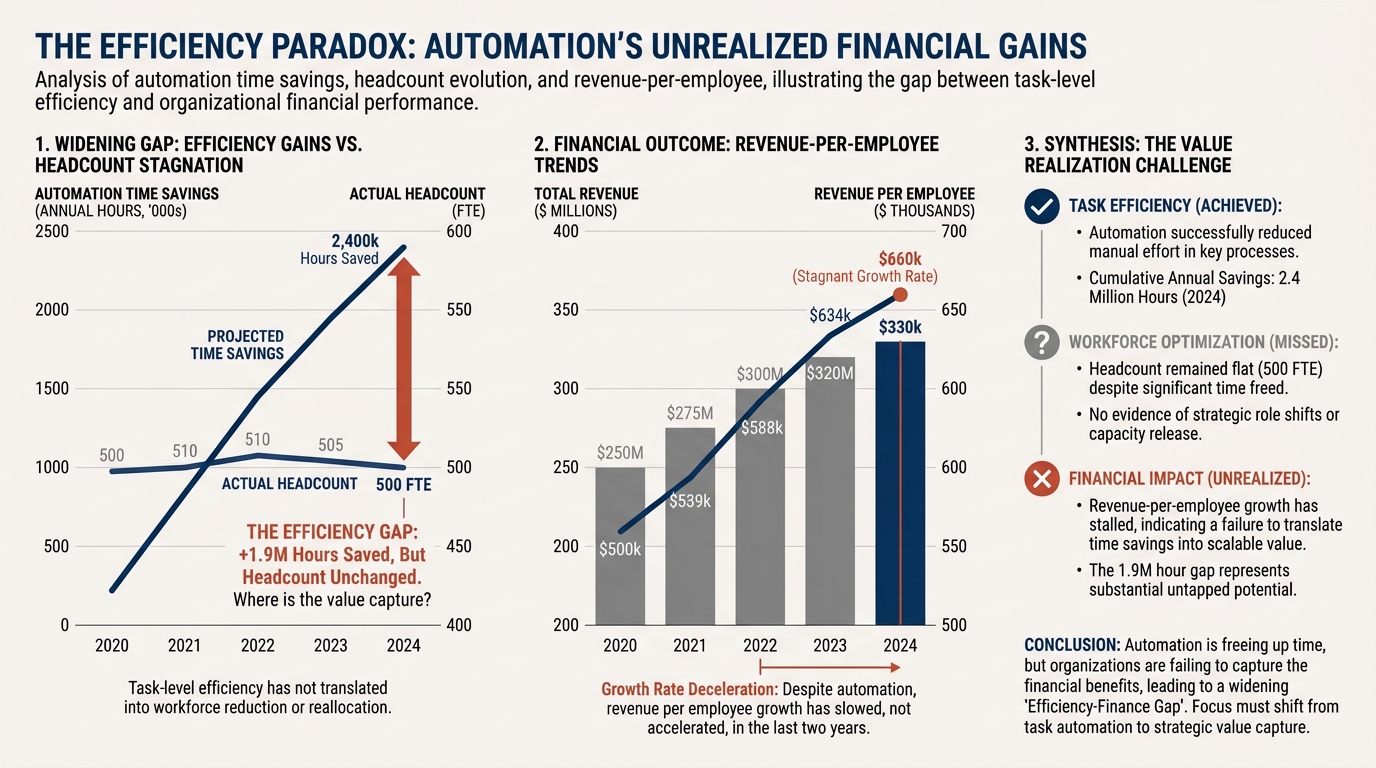
A PE-backed industrial distributor automated quote generation across three business units in Q3 2024, cutting the average quote cycle from 47 hours to 11 hours. The portco CFO calculated the gain as 36 saved labor hours per quote, multiplied that by 230 quotes per month, and presented an annualized OpEx reduction of $680,000 to the board. The deal team underwrote margin expansion, the operating partner classified the project as low-complexity automation, and both treated the $680K as realized EBITDA improvement. Twelve months later, headcount was unchanged, revenue per employee had not moved, and the incremental margin the model predicted did not appear in the P&L.
The automation worked and the hours were real, but the $680,000 improvement did not materialize because nobody decided what to do with the freed capacity. Digital value creation consulting that anchors improvement claims to labor-hour savings without tracking what happened to the labor produces forecast numbers that do not survive a quality-of-earnings review. The difference is whether you measure the task completed or the financial outcome captured.
Below is how PE operators and portfolio-company leadership evaluate whether a proposed digital or automation initiative will produce measurable enterprise value, why labor-hour math fails as a proxy for EBITDA impact, and what to track instead.
Why labor-hour math does not predict P&L impact
Labor-hour reduction is an engineering output. It describes what the system did, not what the business captured. The distributor above saved 36 hours per quote because the new workflow pulled pricing rules, inventory levels, and freight rates from connected systems instead of requiring a sales engineer to look them up manually. The time savings were real and repeatable. The financial impact depended entirely on what the company did with those 36 hours, and the business case did not specify that.
Four outcomes were possible. First, the sales engineers used the freed capacity to handle more quotes, increasing quote volume without adding headcount. Second, the company reduced headcount by the equivalent full-time capacity no longer required. Third, the engineers deployed the time to higher-value work that produced revenue or margin the old process could not. Fourth, the time dissipated across other tasks, Slack, meetings, and low-priority work, producing no measurable financial result. The last outcome is what happened. The portco tracked task time but not redeployment, so the capacity gain never converted to a P&L line.
This is the rule: saved labor hours are a necessary condition for OpEx reduction or revenue-per-employee improvement, but they are not sufficient. The value appears only when the business explicitly reassigns the capacity, eliminates the role, or increases output with the same team. Measuring the hours alone produces a forecast figure that looks like cost reduction but behaves like a hypothesis.
The four measurable outcomes automation can produce
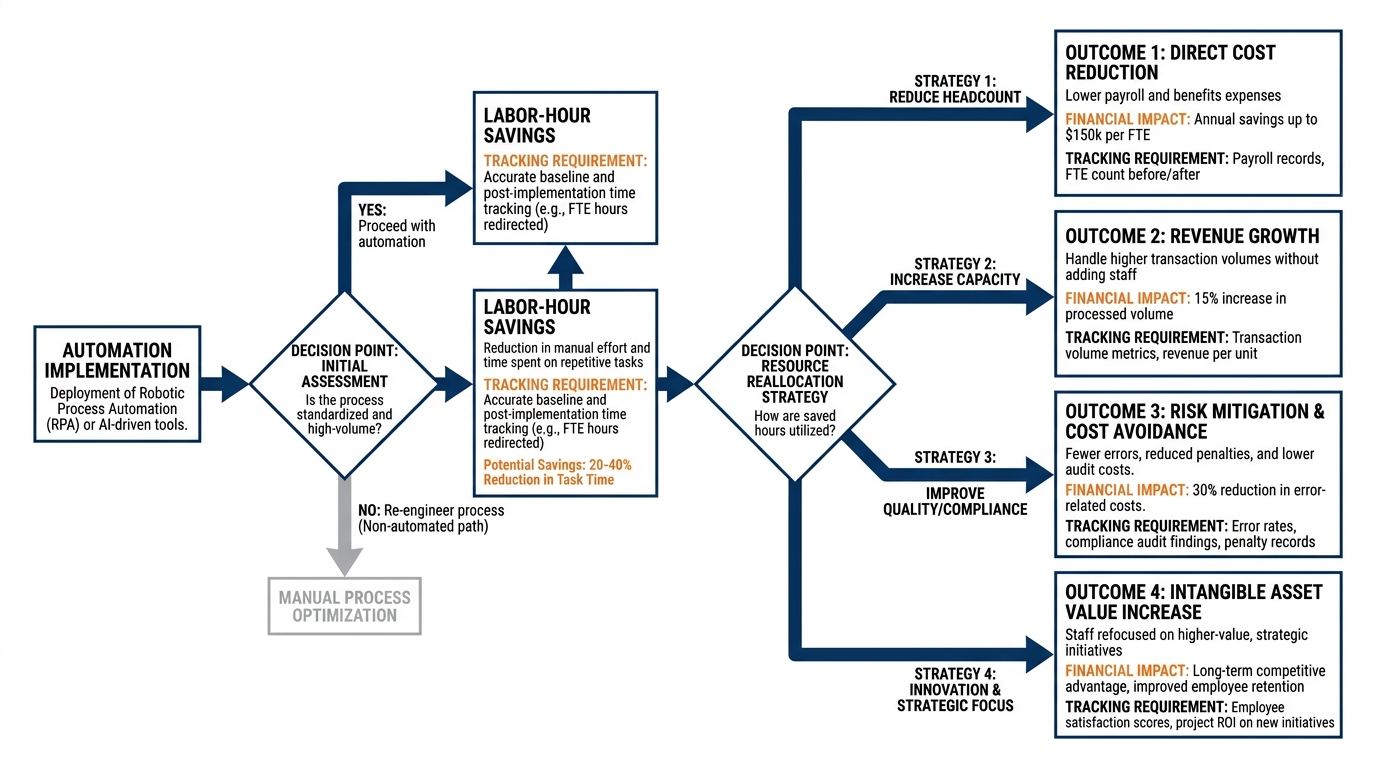
Digital value creation work that produces enterprise value ties every automation initiative to one of four outcomes the P&L can reflect. These are not strategic pillars or value levers in the abstract sense; they are the only four mechanisms through which saved task time becomes a financial result a sponsor can underwrite.
Headcount reduction. The business eliminates roles made redundant by the automation, capturing the saved labor cost as a direct OpEx decrease. This is the cleanest outcome to measure because the cost disappears from payroll, but it requires the company to actually reduce headcount rather than assume attrition will do it. Observed example: a PE-backed SaaS company automated Salesforce data entry that previously required two offshore contractors at $4,800 per month each. The portco terminated both contracts in the month the automation went live, producing $115,200 in annualized savings with no forecast risk. The saved hours were irrelevant; the captured cost was the result.
Volume increase without headcount growth. The freed capacity allows the team to handle more transactions, leads, support tickets, or production runs without hiring, improving revenue per employee. This outcome is harder to isolate because volume growth has multiple drivers, but it is measurable when the baseline throughput and the post-automation throughput are tracked against constant headcount. A portco operator managing this outcome tracks units per FTE per period and revenue per FTE as the proof points, not hours saved.
Redeployment to higher-value work. The business explicitly reassigns the freed capacity to revenue-generating or margin-improving activities that could not be done before. This is the rarest outcome because it requires active capacity management, a named redeployment plan, and tracking to confirm the new work actually happened. Example: a portfolio company freed 60 engineering hours per month by automating deploy pipelines and reassigned those hours to a feature backlog that had been stalled for lack of capacity. The portco CTO tracked story-point velocity before and after, confirmed the new features shipped, and tied the redeployment to a product-expansion revenue stream the investment committee had funded separately. The automation was justified not by the hours saved but by the feature work it unlocked.
Risk reduction and compliance cost avoidance. The automation eliminates manual processes that create operational risk, regulatory exposure, or error rates that would otherwise require mitigation spend. The value here is avoided cost rather than captured savings, and it is measurable only when the baseline risk and its cost are quantified. A financial-services portco automated reconciliation workflows that previously required manual spreadsheet checks prone to a 3% error rate. The CFO calculated the expected annual error cost at $240,000 based on historical write-offs and built the business case on prevented losses rather than freed labor.
Every automation initiative DevriX or Growth Shuttle proposes for a PE-backed client is mapped to one of these four outcomes before the work begins, with a named metric and a tracking plan. If the business case depends on saved hours but cannot name which outcome will capture them, the initiative is a capability build, not a value-creation project, and it belongs in a different budget.
What a measurable business case looks like
A business case that ties automation to enterprise value starts with the outcome, names the baseline, specifies the mechanism, and commits to the tracking method. It does not lead with the hours saved or the technology deployed. Below is the structure every DevriX or Growth Shuttle proposal follows when the engagement is framed as value creation rather than feature delivery.
Outcome. The financial result the portco will capture, stated in P&L terms. Examples: “$180K annualized OpEx reduction through contractor elimination,” “15% improvement in revenue per FTE by Q4 without headcount growth,” “feature velocity increase from 22 to 35 story points per sprint, enabling the Q2 product-expansion revenue target.” Never “reduce manual processing time by 60 hours per month” as a standalone claim.
Baseline. The current state, measured. Headcount and fully loaded cost if the outcome is OpEx reduction. Throughput per FTE and total FTE if the outcome is volume growth. Current velocity, backlog size, and revenue dependency if the outcome is redeployment. Error rate, write-off cost, or compliance expense if the outcome is risk reduction. The baseline must be a number the portco finance team can verify.
Mechanism. What the business will actually do to convert the automation output into the financial outcome. “Terminate two offshore contracts on go-live” is a mechanism. “Free up capacity for the team to handle more” is not, unless it names the redeployment plan and the tracking method. The mechanism is the part of the business case the operating partner or portco CEO must commit to executing, because the technology cannot do it alone.
Tracking. How the portco will know the outcome was captured, with a reporting cadence and a named owner. Use payroll reports if the outcome is headcount, monthly revenue-per-FTE calculations if the outcome is throughput, sprint velocity dashboards if the outcome is redeployment, and write-off logs if the outcome is risk avoidance. The tracking method is specified in the proposal and delivered as part of the engagement.
This structure separates the automation work, which DevriX or an internal engineering team delivers, from the value capture, which the portco operating team must execute. A digital value creation consultant who presents only the first half is selling a capability build. One who delivers both is selling enterprise value.
Where labor-hour savings still matter
Labor-hour reduction is the prerequisite for three of the four measurable outcomes and the diagnostic signal for capacity problems the business has not surfaced. The error is treating hours saved as the result rather than as the input to a separate decision about redeployment, headcount reduction, or volume growth.
Saved hours are the right metric in three contexts. First, when the business has already committed to a headcount-reduction plan and needs to know which roles the automation makes redundant. The hours quantify the elimination opportunity; the headcount decision captures the value. Second, when the portco is capacity-constrained and volume growth is the named outcome, hours saved per transaction translate directly to throughput capacity if redeployment is controlled. Third, when the operating partner is diagnosing whether automation is even possible, task-time measurement identifies the repetitive, high-volume, low-judgment work that is automatable in the first place.
What does not work is leading a value-creation proposal with hours saved and stopping there. That structure assumes the business will figure out what to do with the capacity, and PE portfolio companies under execution pressure rarely do. The capacity dissipates unless someone owns the redeployment decision and tracks the result.
How operating partners should evaluate a digital value creation proposal
An operating partner or portco CEO reviewing a digital or automation proposal can test whether the work will produce enterprise value by asking four questions before the engagement begins. These are business-case hygiene checks that separate capability builds from value-creation initiatives.
Which of the four outcomes is this initiative targeting? Headcount reduction, volume growth, redeployment, or risk avoidance. If the answer is “efficiency” or “productivity” without a named financial mechanism, the proposal is incomplete. Press for the specific P&L line the work will move and the direction it will move it.
What is the baseline, and who verified it? If the baseline is an estimate from the vendor or the implementation team rather than a number the CFO or finance team confirmed, the business case is not anchored. The portco needs to own the before-state, because that is what the after-state will be measured against, and a vendor-supplied baseline will not survive a disagreement six months later about whether the improvement happened.
What is the mechanism, and who owns executing it? If the proposal assumes the portco will “redeploy capacity” or “optimize headcount” without naming the person responsible and the tracking cadence, the outcome depends on something the vendor cannot control and the business has not committed to. The mechanism is where most forecast value disappears, so it needs to be as specific as the technology work.
How will we know it worked, and when will we know? The proposal should name the metric, the reporting method, the owner, and the first measurement date. “We’ll track it” is not a plan. “CFO will pull payroll reports monthly starting in Month 2, comparing total loaded cost to the baseline, and flag any variance above $5K” is a plan.
These questions do not replace technical due diligence on the vendor or the feasibility of the automation itself. They test whether the engagement is structured to produce a result the P&L can show, which is a separate question from whether the vendor can build what they proposed.
The structure DevriX and Growth Shuttle use for embedded value-creation work
DevriX’s embedded retainer model and Growth Shuttle’s advisory engagements are both structured to deliver the four-outcome framework above rather than hourly task work. The scope, the pricing, and the reporting are tied to a financial outcome the sponsor underwrote, which separates these engagements from staff-augmentation contracts where success is measured by vendor activity completed.
Every embedded engagement starts with outcome mapping. The operating partner or portco leadership names the value-creation lever they are executing against (revenue growth, margin expansion, integration speed, cash-flow improvement, or risk reduction), DevriX or Growth Shuttle maps that lever to one or more of the four automation outcomes, confirms the baseline with the portco finance team, and writes the mechanism and tracking plan into the statement of work. The engagement is priced as a retainer because the work is ongoing and multi-layered, and the success criteria are financial rather than task-based.
Monthly reporting follows the same structure. The update deck shows progress on the technology work, but it leads with the outcome metric: headcount trend, revenue per FTE, velocity, or error rate, compared to the baseline and the target. If the metric is not moving in the expected direction, the report names why and what is adjusting. This is the reporting cadence portfolio-company CEOs and operating partners expect from a value-creation function, and it is different from the ticket-and-hour logs a development team would send.
The embedded model works for this structure because value creation in a PE-backed portco is a continuous operating function that runs from deal close through exit, layering automation, data infrastructure, and growth engineering into the business as capacity and capital allow. A project-based engagement can deliver one of the four outcomes when the scope is tightly defined. An embedded retainer can sequence all of them across the hold period, matching the technology work to the value-creation plan the sponsor underwrote at acquisition.
Why this matters for PE operators evaluating vendors
The private equity industry’s shift toward operational value creation has produced a large vendor market selling automation, AI, data engineering, and digital transformation to sponsors and portcos. Most of those vendors are capability-focused: they sell what the technology does rather than what the business captures. That creates a qualification problem for operating partners and deal teams trying to separate the vendors who will move the P&L from the ones who will deliver a working system and leave the value capture to the portco.
The test is whether the vendor’s proposal starts with the outcome or starts with the capability. A proposal that leads with “we will automate X process and save Y hours” is a capability offer. One that leads with “we will reduce OpEx by $Z through contractor elimination, with go-live in Month 2 and payroll tracking owned by your CFO” is a value-creation offer. Same automation work, different framing, and the second one is far more likely to produce a result the investment committee will recognize as enterprise-value improvement.
Operating partners managing a portfolio of digital and automation initiatives should apply the four-outcome framework to every vendor proposal and internal business case. A project that cannot be mapped to headcount reduction, volume growth, redeployment, or risk avoidance belongs in the IT budget or the product roadmap rather than in the value-creation plan. A project that can be mapped but lacks the mechanism and tracking is not ready to fund, regardless of how compelling the labor-hour savings look on paper.
Where to start
PE sponsors and portfolio companies evaluating an embedded technical value-creation partner should begin with a single initiative mapped to one measurable outcome, a defined baseline, a committed mechanism, and a 90-day tracking window. That structure produces a proof case the operating partner can present to the deal team and the board, and it separates vendors who can execute the full value-creation loop from those who deliver automation and stop.
DevriX and Growth Shuttle run these proof engagements as part of the embedded retainer model. The first 90 days focus on one high-impact outcome, typically headcount reduction or volume growth, because those are the easiest to measure and the fastest to capture. The engagement continues as a retained operating function once the proof case is delivered, layering additional outcomes and initiatives into the portco’s execution calendar as the value-creation plan sequences them. For more on how digital infrastructure and revenue operations integrate into PE value-creation plans, those resources offer additional context on the technical and go-to-market layers this article does not cover.
If you are a PE operating partner, deal-team member, or portfolio-company operator evaluating whether an automation or digital initiative will produce measurable enterprise value, start with the outcome, confirm the baseline, specify the mechanism, and commit to tracking before the work begins. The labor hours are the input; the P&L movement is the result.
“`