

The diligence request list lands in your inbox on a Tuesday afternoon. Forty-seven line items. Revenue by cohort, churn by segment, pipeline velocity, contract terms, discount history, marketing spend by channel, customer concentration analysis. The buyer’s advisor expects a populated data room by end of week.
You spend the next five days chasing exports from three different systems, reconciling numbers that do not match, explaining gaps your CFO cannot explain, and watching your deal team lose confidence in your operational maturity. By Friday, the data room is incomplete. By the following Monday, the LOI terms have softened.
I have seen this pattern destroy value in more transactions than I care to count. The commercial data room is not an administrative task you delegate to a junior analyst in the final weeks before a process. It is a readiness exercise that reveals whether your commercial operations can withstand scrutiny, and it must be assembled months before any advisor makes a request.
This guide provides the data room checklist a portfolio CEO or deal lead needs to prepare the commercial and digital evidence base before a buyer’s diligence team arrives. The goal is not to survive the process. The goal is to control it.
When a diligence request arrives and you cannot answer it in a week
Most CEOs underestimate how much commercial evidence a sophisticated buyer will request, and how difficult it is to produce under time pressure.
A 2023 Bain report on private equity due diligence practices noted that deal teams now request 30-50% more data points than they did five years ago, driven by the need to underwrite revenue durability in uncertain markets. McKinsey’s research on transaction failures found that incomplete or inconsistent data during diligence is a leading cause of deal delays and price adjustments.
The commercial data room problem is threefold:
- Fragmentation: Revenue data lives in the ERP, pipeline data in the CRM, marketing data in six different platforms, and contract terms in a shared drive no one has organized since 2019.
- Reconciliation: The numbers in your board deck do not match the numbers in your CRM, which do not match the numbers your finance team exported from the billing system.
- Ownership: No one person owns the commercial evidence base. Sales owns pipeline. Marketing owns attribution. Finance owns revenue. No one owns the integrated view a buyer requires.
When a diligence request arrives and you cannot respond within a week, the buyer does not conclude that you are busy. The buyer concludes that you do not know your own business. That conclusion costs you leverage, terms, and sometimes the deal itself. Assembling the evidence is half the job. A sell-side commercial diligence pass runs the buyer’s analysis on your own numbers first, so the concentration, churn and attribution findings land in your hands 6 months before they land in a diligence report.
Commercial evidence buyers request in every process
Every buyer’s diligence request list is different, but the commercial evidence categories are predictable. A well-prepared CEO assembles these categories in advance, with documentation that can be exported and validated before any external request.
Revenue and Financial Evidence
Monthly and annual revenue by product line, customer segment, geography, and channel. Revenue growth rates with year-over-year and sequential trends. Revenue concentration analysis showing top 10 and top 20 customer contribution.
Customer and Retention Evidence
Gross and net retention rates by cohort. Churn analysis by segment, tenure, and contract type. Customer lifetime value calculations with supporting assumptions. Expansion and contraction revenue by account.
Pipeline and Sales Evidence
Pipeline by stage, with conversion rates and velocity metrics. Win/loss analysis by segment, competitor, and deal size. Sales cycle length trends. Quota attainment and rep productivity metrics.
Pricing and Contract Evidence
Pricing history and any changes over the past 36 months. Discount frequency and magnitude by deal size and customer type. Contract terms including length, renewal provisions, and termination clauses. Price realization analysis.
Marketing and Demand Evidence
Marketing spend by channel with attribution to pipeline and closed revenue. Customer acquisition cost by channel and segment. Website traffic, conversion rates, and lead quality metrics. Brand and content performance data.
For a comprehensive view of what falls under commercial scrutiny, the commercial due diligence checklist for B2B acquisitions provides the full scope buyers evaluate.
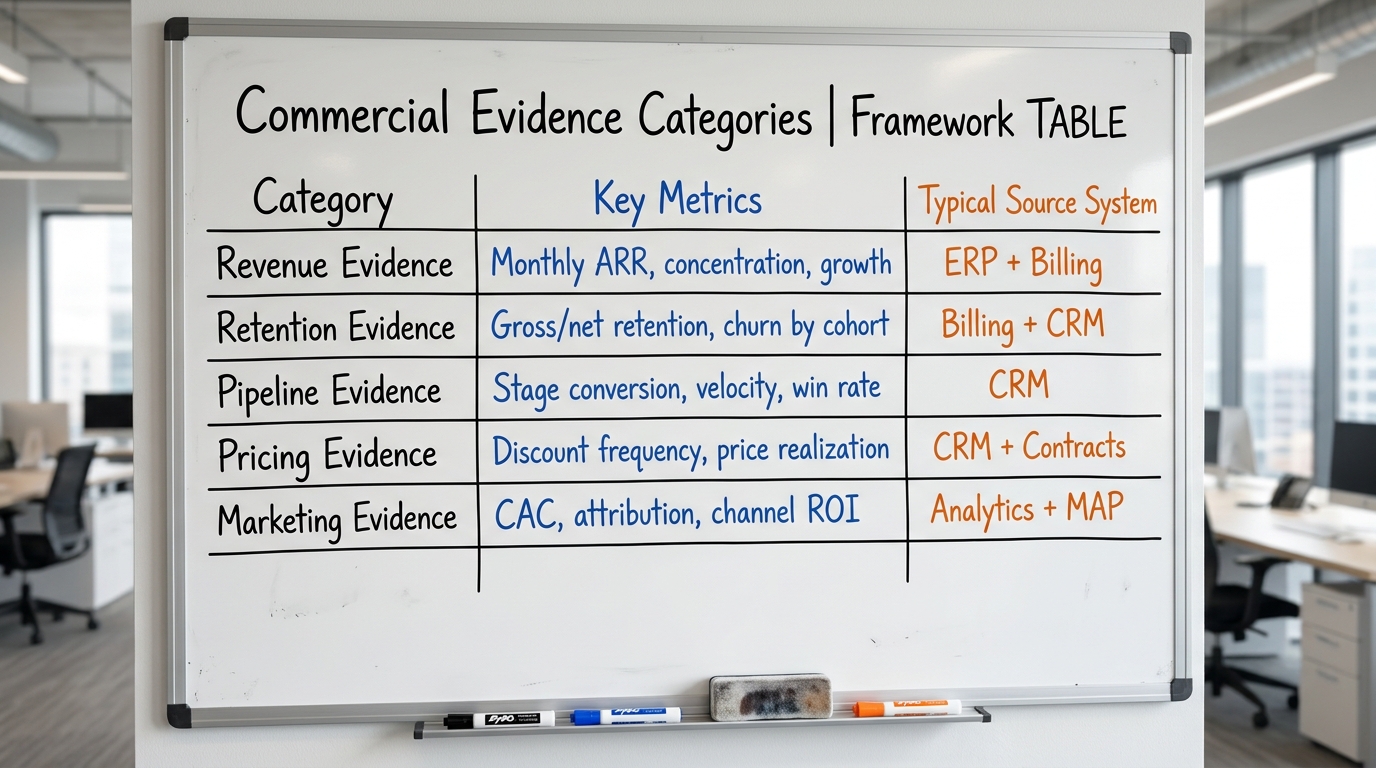
Revenue, retention and pipeline exports that reconcile across systems
Revenue and retention data form the core of any commercial data room. Buyers underwrite future cash flows based on the durability of existing revenue, which means they will stress-test every assumption in your revenue model.
What to Export for Revenue
Monthly recurring revenue by account for at least 36 months. One-time revenue separated from recurring streams. Revenue by product or service line. Revenue by customer segment and geography. Any restatements or adjustments with explanations.
What to Export for Retention
Cohort-based retention analysis showing how each annual cohort behaves over time. Logo retention and dollar retention separated. Churn categorized by reason (price, product, competitive loss, bankruptcy, other). Expansion and contraction revenue isolated from base retention.
What to Export for Pipeline
Current pipeline by stage with expected close dates. Historical pipeline data showing how pipeline converted over the past eight quarters. Stage-to-stage conversion rates. Average deal size and sales cycle length by segment.
The most common failure I see is revenue data that does not reconcile across systems. Your CRM shows $12M in closed-won revenue for last year. Your billing system shows $11.4M. Your board deck shows $12.2M. When a buyer’s advisor spots these discrepancies, every number becomes suspect.
Reconcile before you export. Document any differences with clear explanations. A buyer can accept reasonable adjustments. A buyer cannot accept unexplained variance.
Pricing discipline that affects how a buyer values your revenue
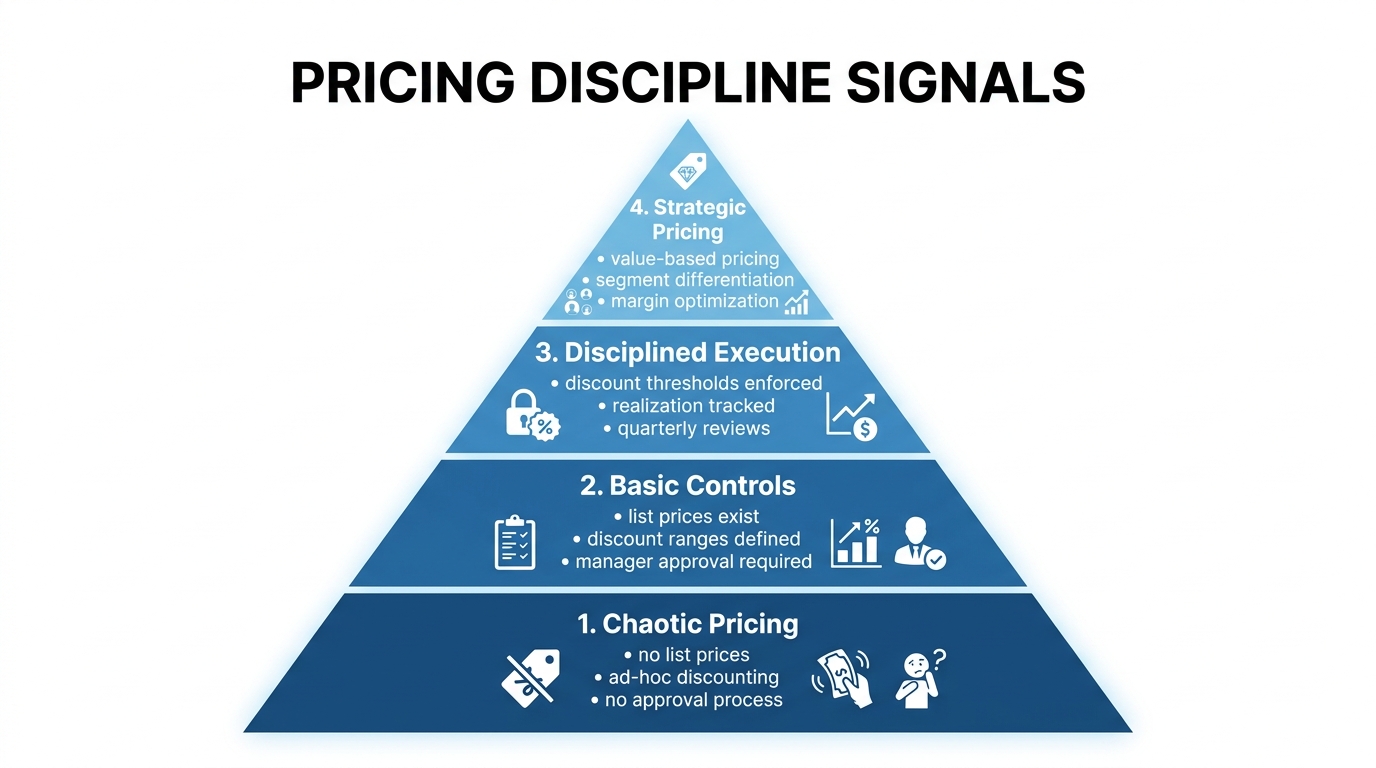
Pricing discipline is one of the clearest signals of commercial maturity. A buyer examining your pricing history is looking for evidence that you can maintain and expand margins, not just revenue.
Pricing Documentation
Current pricing structure with list prices by product or tier. Pricing changes over the past 36 months with rationale for each change. Price realization analysis showing actual revenue versus list price. Any promotional or introductory pricing with volume and duration.
Discount Analysis
Discount frequency by deal size, customer segment, and sales rep. Average discount magnitude. Discount approval process documentation. Correlation between discount levels and retention rates.
Contract Terms
Standard contract templates. Non-standard terms for top 20 customers. Average contract length and distribution. Auto-renewal provisions and termination clauses. Any contracts with unusual pricing, exclusivity, or liability provisions.
A pattern of heavy discounting to close deals, especially when combined with below-average retention, tells a buyer that your pricing does not match customer willingness to pay. That finding will affect the multiple applied to your revenue.
CRM, analytics and marketing evidence that shows attribution and efficiency
The digital and marketing evidence base is where many commercial data rooms fall apart. Marketing spend is scattered across platforms. Attribution is inconsistent or absent. The CRM contains data that no one trusts.
CRM Evidence
CRM data quality audit showing completeness and accuracy rates. Lead-to-opportunity conversion by source. Opportunity-to-close conversion by stage. Historical accuracy of pipeline forecasts versus actual results.
Analytics Evidence
Website traffic by source with conversion rates. SEO visibility and organic traffic trends. Engagement metrics by content type and channel. Any custom dashboards or reporting used for decision-making.
Marketing Evidence
Marketing spend by channel for the past 24-36 months. Customer acquisition cost by channel with clear methodology. Attribution model documentation. Campaign performance data for major initiatives.
For a detailed view of what digital diligence entails, the guide on digital due diligence for website and martech covers the technical and operational evidence buyers evaluate.
The most damaging finding in this category is marketing spend that cannot be attributed to outcomes. If you spent $2M on marketing last year and cannot explain what pipeline or revenue it generated, a buyer will discount the value of that investment and question the efficiency of future spend.
What good evidence looks like versus what raises flags
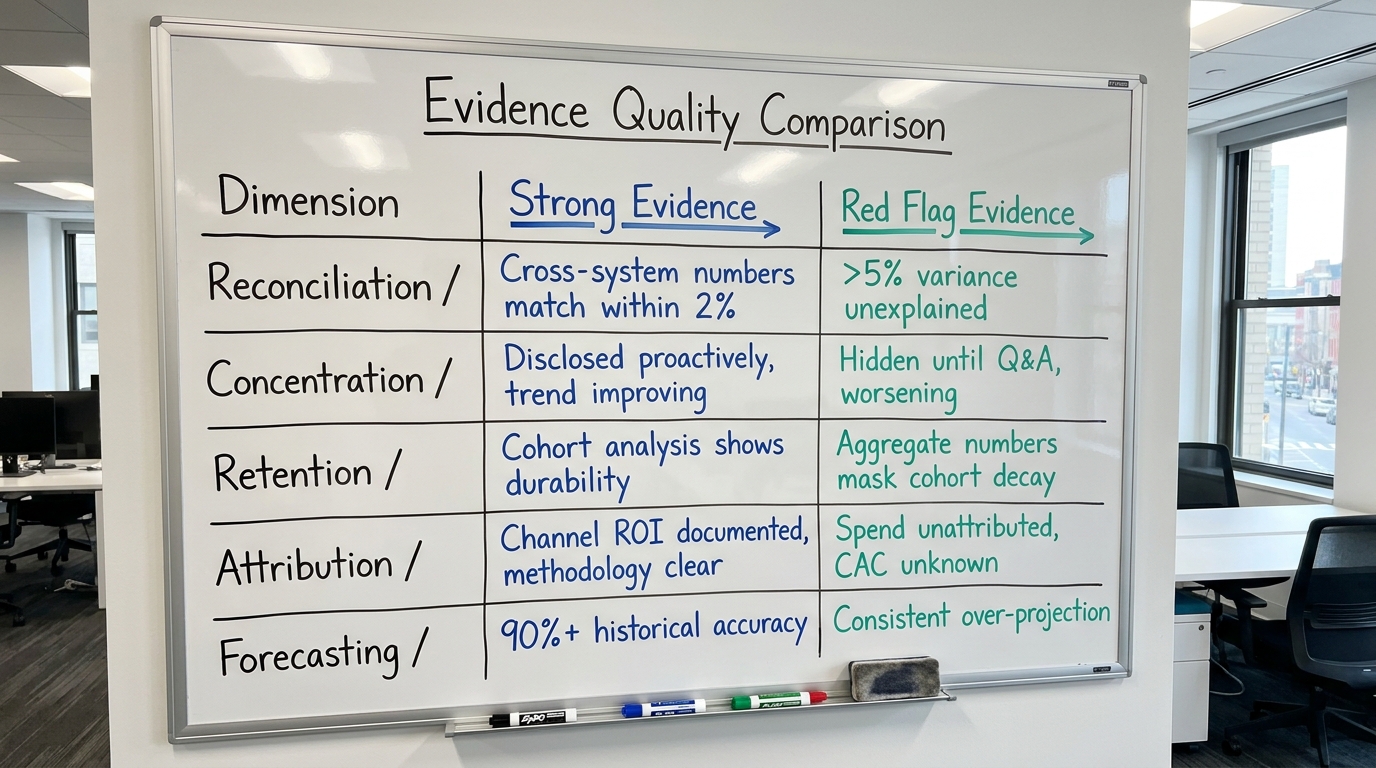
A sophisticated buyer is not looking for perfection. Every business has inconsistencies, gaps, and areas of weakness. What matters is how you present the evidence and whether you demonstrate awareness of your own limitations.
Characteristics of Strong Evidence
- Data that reconciles across systems with documented methodology
- Trends that align with the narrative in your management presentation
- Clear ownership and accountability for each data set
- Known limitations acknowledged upfront with explanations
- Historical accuracy in forecasts and projections
Red Flags That Erode Confidence
- Numbers that do not match between the CRM, billing system, and board deck
- Revenue concentration you did not disclose until asked
- Retention rates that look strong until cohorts are examined
- Marketing spend with no attributable outcomes
- Contract terms that differ significantly from your stated pricing
- Pipeline forecasts that consistently miss actuals
According to BCG’s research on deal-making, the quality and consistency of management information during diligence is a leading indicator of post-close execution risk. Buyers interpret poor data quality as a proxy for operational discipline.
If you are preparing for a sale process, the sell-side commercial due diligence framework helps you anticipate what buyers will scrutinize and how to prepare the evidence base accordingly.
A commercial data room index that allows fast navigation
A well-organized data room follows a logical structure that allows a buyer’s advisor to find evidence quickly. Disorganization costs you time in Q&A and creates the impression of operational chaos.
Recommended Folder Structure
1.0 Executive Summary
- Management presentation
- Financial model
- Key metrics summary
2.0 Revenue and Financials
- Monthly revenue by segment
- Revenue bridge and restatements
- Customer concentration analysis
3.0 Customer and Retention
- Cohort retention analysis
- Churn analysis by reason
- Customer lifetime value
4.0 Pipeline and Sales
- Current pipeline export
- Historical pipeline conversion
- Win/loss analysis
- Sales team productivity
5.0 Pricing and Contracts
- Pricing structure and history
- Discount analysis
- Standard contract templates
- Top 20 customer contract summaries
6.0 Marketing and Digital
- Marketing spend by channel
- CAC and attribution analysis
- Website and analytics data
- CRM data quality audit
7.0 Operations and Infrastructure
- Technology stack overview
- Integration dependencies
- Data governance documentation
Commercial data room readiness checklist
The following checklist provides a practical tool for assessing your readiness. Each line item should have a clear owner, a source system, and a status. Review this quarterly, not in the weeks before a process begins.
| Document | Owner | Source System | Status |
|---|---|---|---|
| Monthly revenue by segment (36 months) | Finance | ERP / Billing | ☐ Not started ☐ In progress ☐ Ready |
| Customer concentration analysis (top 10/20) | Finance | Billing + CRM | ☐ Not started ☐ In progress ☐ Ready |
| Cohort retention analysis (gross and net) | Finance / RevOps | Billing | ☐ Not started ☐ In progress ☐ Ready |
| Churn analysis by reason | Customer Success | CRM + CS Platform | ☐ Not started ☐ In progress ☐ Ready |
| Current pipeline by stage | Sales / RevOps | CRM | ☐ Not started ☐ In progress ☐ Ready |
| Historical pipeline conversion (8 quarters) | RevOps | CRM | ☐ Not started ☐ In progress ☐ Ready |
| Win/loss analysis | Sales | CRM | ☐ Not started ☐ In progress ☐ Ready |
| Pricing structure and history | Product / Finance | Product Documentation | ☐ Not started ☐ In progress ☐ Ready |
| Discount analysis | RevOps | CRM | ☐ Not started ☐ In progress ☐ Ready |
| Standard contract templates | Legal | Contract Repository | ☐ Not started ☐ In progress ☐ Ready |
| Top 20 customer contract summaries | Legal / Sales | Contract Repository | ☐ Not started ☐ In progress ☐ Ready |
| Marketing spend by channel (24-36 months) | Marketing | Finance + Marketing Platforms | ☐ Not started ☐ In progress ☐ Ready |
| CAC by channel with methodology | Marketing / Finance | Multiple | ☐ Not started ☐ In progress ☐ Ready |
| Attribution model documentation | Marketing | Marketing Ops | ☐ Not started ☐ In progress ☐ Ready |
| Website traffic and conversion data | Marketing | Analytics Platform | ☐ Not started ☐ In progress ☐ Ready |
| CRM data quality audit | RevOps | CRM | ☐ Not started ☐ In progress ☐ Ready |
| Technology stack overview | IT / Engineering | Internal Documentation | ☐ Not started ☐ In progress ☐ Ready |
| Revenue reconciliation memo | Finance | Multiple | ☐ Not started ☐ In progress ☐ Ready |
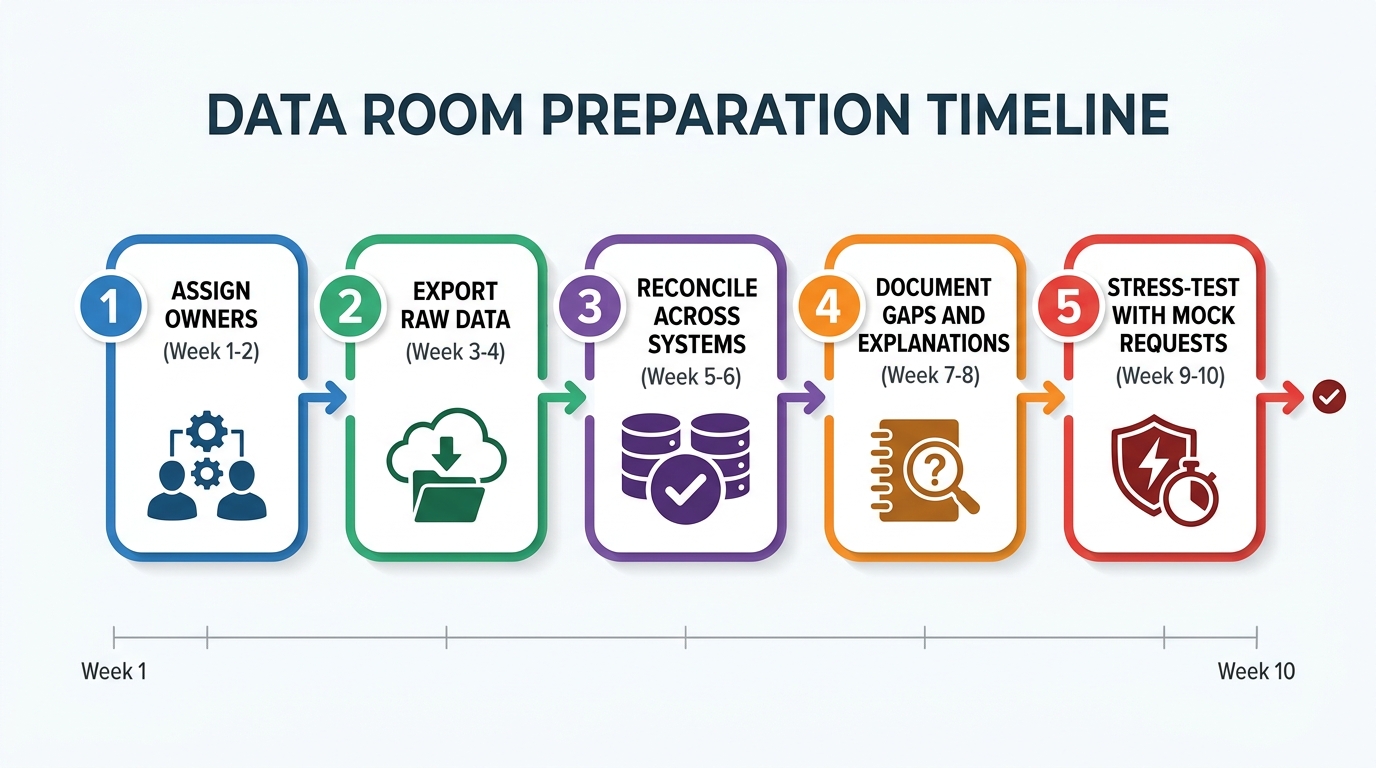
Control the process before it controls you
The commercial data room is not a compliance exercise. It is a demonstration of operational maturity that directly affects how a buyer values your business and structures a transaction.
The CEOs who control their processes are those who assemble the evidence base before any advisor asks for it. They know their numbers reconcile. They understand their retention dynamics at the cohort level. They can explain their pricing discipline and marketing efficiency with data, not narratives.
Start with the checklist above. Assign owners. Identify source systems. Export, reconcile, and document. Do this work now, while you have time to fix what you find, not in the frantic weeks after a diligence request lands. The data room is one piece of a wider readiness effort that also covers the equity story, management depth and the 100-day plan the buyer inherits. Exit readiness for private equity sequences that work across the 12 to 18 months before a process, which is the window where fixing something still changes the price.
To assemble and stress-test the commercial data room before a process, DevriX can prepare and validate the evidence base through our private equity commercial diligence services.
