Picture a portfolio company that closes with a clear AI-led thesis: deploy large language models across customer support, reduce headcount cost by 30% and lift gross margin by 400 basis points. Three months in, inference bills run to $47,000 a month while average revenue per user is $19, and the operating partner asks why the AI lever is burning cash. The cause is rarely the model, the vendor or the prompts. Nobody ranked inference cost against what the user is worth before the roadmap went live.
AI value creation for portfolio companies starts with a financial排 question most technical teams skip: does the marginal cost of running inference on this cohort stay below the incremental revenue or margin improvement that cohort delivers? If it does not, the AI capability is a cost center dressed as a growth lever. That ranking-inference expense per interaction against revenue per user or lifetime value-determines whether an AI initiative belongs in the value-creation plan or whether it needs to be descoped, gated by tier, or pulled entirely until unit economics improve.
Why Inference Cost Shows Up After Deploy, Not During Diligence
Technical due diligence for a platform business typically covers architecture, data quality, security posture, and technical debt that would reprice the deal. It rarely includes a line-item forecast of what it costs to run a trained model at production scale across the entire user base. The vendor deck presents accuracy, latency, and engagement lift. The data science team shows the A/B test where the AI-assisted cohort converted 18% better. What does not appear is the per-interaction cost multiplied by monthly active users, segmented by revenue tier.
The blind spot is structural. Machine learning engineers optimize for model performance-precision, recall, F1 score-not for gross margin per API call. Finance tracks cloud spend as an aggregate line, not as unit cost per inference multiplied by user volume. Product sets the feature roadmap based on adoption and NPS, not on whether the cost to serve a free-tier user with AI exceeds what that user will ever pay. The gap becomes visible post-close when the operating partner pulls the first full P&L and sees inference expense rising faster than revenue.
A mid-market SaaS asset we reviewed had deployed GPT-4 for content generation across all account tiers-trial, starter, pro, enterprise. Monthly inference cost ran $83,000. Enterprise accounts represented 11% of users but contributed 74% of revenue. Trial and starter users consumed 61% of inference volume and generated 9% of revenue. The AI feature was popular, technically successful, and financially unsustainable at that user mix. The correction was not to shut down AI; it was to gate the capability by tier and substitute a cheaper model for low-ARPU cohorts.
The Ranking Framework: Inference Cost Against Customer Economics
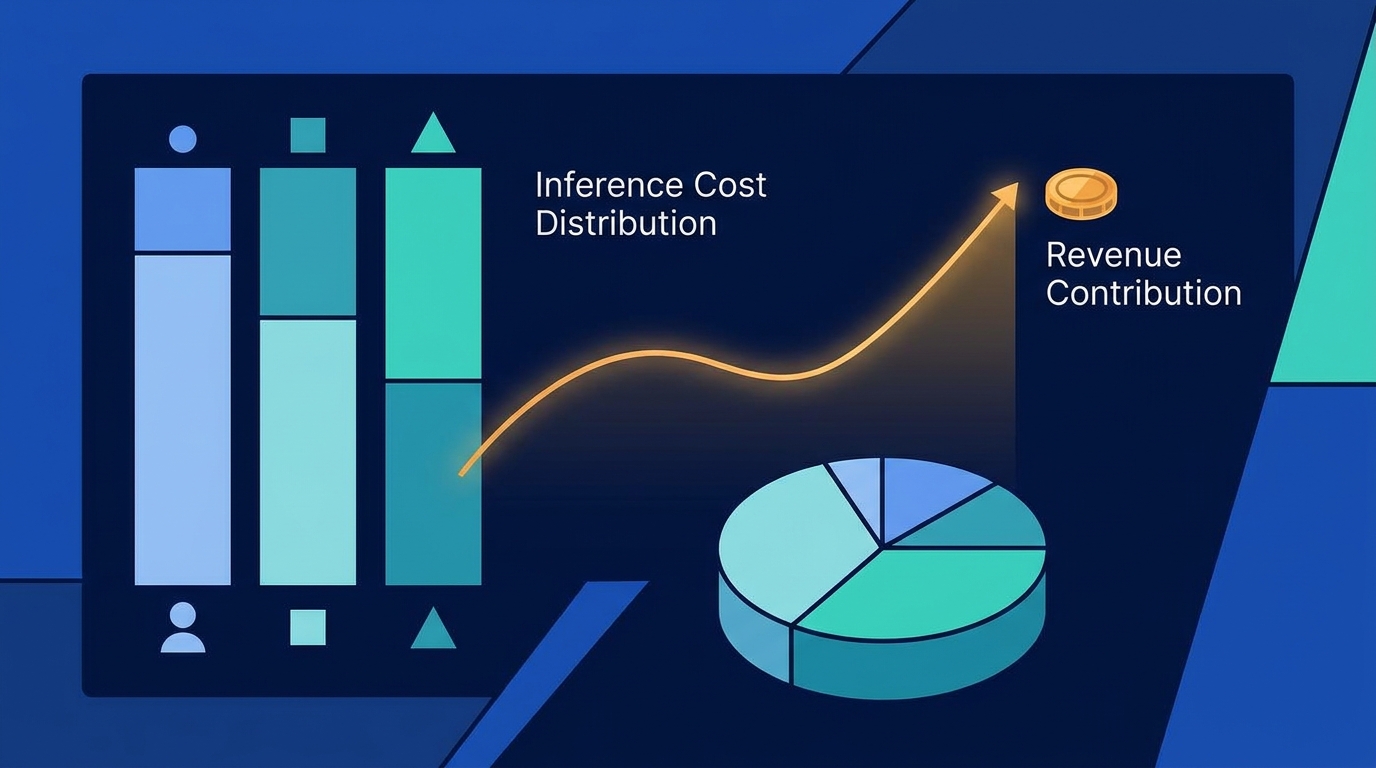
The decision framework is not complicated. Start with three numbers: inference cost per interaction, interactions per user per month, and either monthly recurring revenue per user or lifetime value depending on the business model. Multiply cost per call by monthly volume to get the per-user AI expense. Compare that to what the user pays or what their cohort is worth over the relevant time horizon. If AI cost exceeds 15-20% of revenue per user for a low-margin SaaS business, or if it turns a cohort contribution-negative, the feature is mispriced or wrongly scoped.
For a subscription business, the test is straightforward: monthly inference cost per user must stay well below monthly recurring revenue for that user, with enough margin left to cover the rest of the cost structure-hosting, support, sales, G&A. A $29/month plan that incurs $6 in inference expense plus $12 in hosting and support is not viable at scale unless retention is so strong that LTV justifies the thin early margin. For a transaction or usage-based business, inference cost per transaction has to stay below gross margin per transaction after payment processing, fraud, and infrastructure.
The second dimension is cohort segmentation. Aggregate cost per user hides the problem when a small fraction of high-value users subsidizes a large population of low-value or free users who consume the expensive AI feature at the same rate. The operating correction is to tier the capability-full model access for enterprise, a lighter or quantized model for mid-tier, rule-based fallback or no AI for free accounts-so that inference spend scales with revenue contribution, not just with usage volume.
An illustration: a technology company runs AI-powered personalization for every site visitor, signed in or anonymous, so the model runs on every page view. When anonymous traffic converts at under 1% and signed-in users at around 11%, the fix is to gate inference behind login and serve static recommendations to anonymous visitors. Most of the inference bill goes, top-of-funnel conversion holds, and the expensive capability stays where it delivers measurable lift.
Where the Unit Economics Break and What Breaks Them
Three patterns repeatedly break AI unit economics in portfolio companies. The first is vendor model selection driven by technical performance rather than cost-performance tradeoff. Engineering teams default to the best-performing model-often GPT-4, Claude 3.5, or a large open-weight alternative-without testing whether a smaller, cheaper, or fine-tuned model delivers acceptable output at a fraction of the cost. A 10% improvement in response quality that doubles per-call expense is the wrong tradeoff when the user cannot tell the difference or when margin does not support it.
The second pattern is over-inference: calling the model more frequently or with more tokens than the use case requires. A customer-support agent assist that re-runs inference on every keystroke instead of on submission, or a content tool that processes full documents when summarization would work, burns cost without corresponding user value. Latency requirements sometimes force real-time inference, but many applications tolerate batch processing, caching, or lazy evaluation that cuts cost by 60-80% with no perceptible quality loss.
The third pattern is ignoring the revenue tier of the user consuming the service. A freemium product that offers the same AI capability to trial users and enterprise customers will see inference cost skew toward the low-revenue cohort because that is where volume sits. The AI feature becomes a customer-acquisition cost line item that never converts to margin. The correct approach is to make AI a monetizable differentiator: limit it for free users, expand it for paid tiers, and price it explicitly for enterprise so that inference cost becomes a cost-of-goods-sold line that scales with contract value.
How Operating Partners Should Instrument This Before It Scales
The operational correction starts with instrumentation, not with cutting features. Finance and engineering need a shared view of inference cost per user per month, segmented by product tier and cohort. That means tagging every API call with user ID, account tier, feature, and model version so that cost allocation is not an aggregate cloud bill but a per-user, per-cohort line item tied to revenue. If the data infrastructure cannot support that breakdown, the business is deploying AI blind.
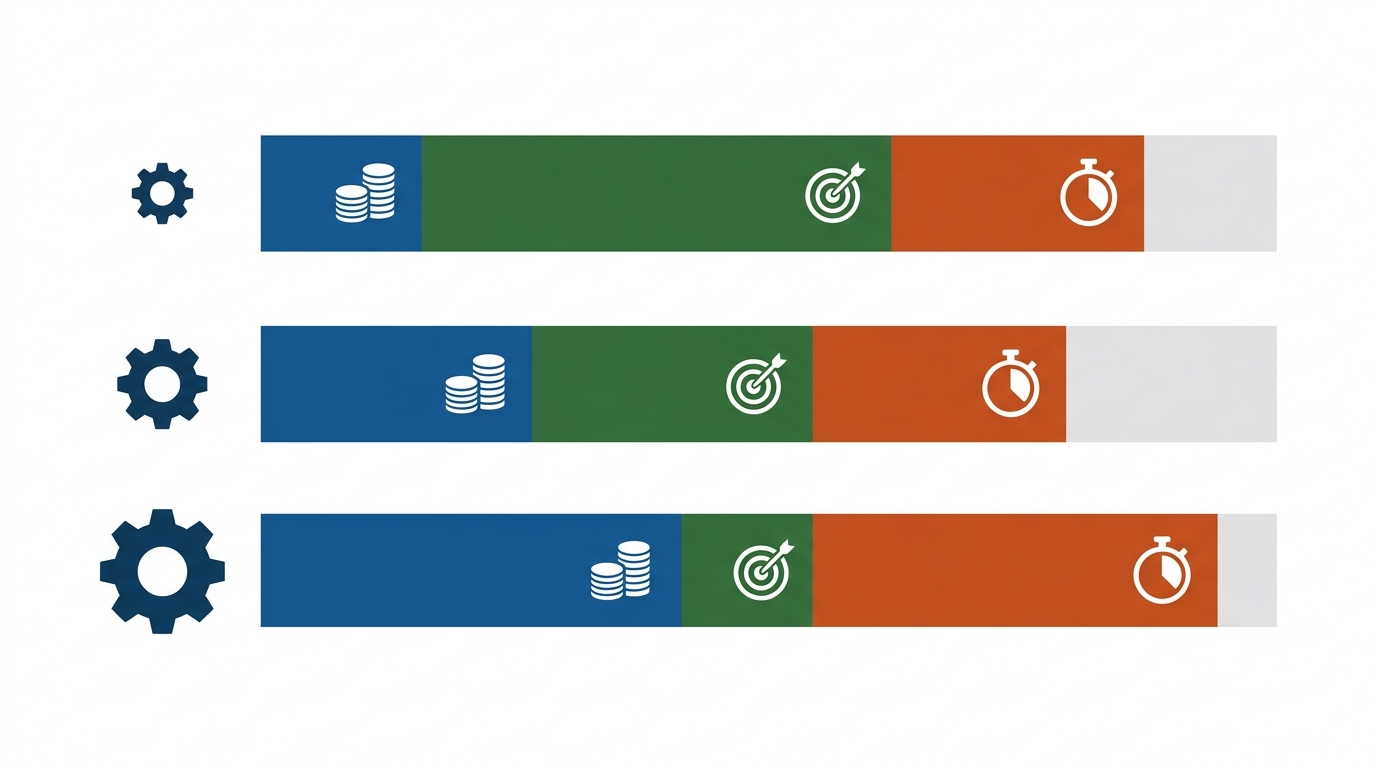
The second requirement is a cost-performance benchmark for every model in production and every candidate model on the evaluation list. How much does GPT-4 cost per 1,000 tokens for this use case? What does Claude 3.5 Haiku cost? What would a fine-tuned Llama 3.1 8B cost if hosted internally? What is the accuracy and latency delta between them for this specific task? That matrix-model, cost, quality, speed-should be a standing artifact reviewed quarterly, not a one-time architecture decision made at launch.
The third step is setting cost gates in the product roadmap. No AI feature ships to a new user cohort without a forecast of monthly inference cost per user and a comparison to that cohort’s revenue or gross margin contribution. If the forecast shows the feature will be contribution-negative, the decision is explicit: accept it as a customer-acquisition expense with a defined payback period, gate it by tier, substitute a cheaper model, or descope it. The mistake is shipping it without the forecast and discovering the margin problem six months later when it is politically harder to roll back.
A portfolio company in the productivity software space implemented this as a launch checklist: every AI feature required a one-pager with projected inference cost per user per month, user volume by tier, and comparison to gross margin per tier. If cost exceeded 12% of revenue for any tier, the feature needed explicit sponsor approval and a quarterly review gate. It slowed initial AI deployment by three weeks. It prevented two features that would have cost the business $68,000 monthly in negative contribution margin from reaching production.
On our own fleet, that instrumentation lives inside the AI Ops Hive, where token use per seat and per model is tracked daily and the bill is read from receipts.
The Model Selection Tradeoff: Accuracy Against Margin
Model selection in a value-creation context is not a data science problem; it is a margin optimization problem where accuracy is one input and cost is another. The best-performing model is not always the right model. The question is whether the incremental quality improvement justifies the incremental cost when measured against what the user pays or what their engagement is worth. For a high-touch enterprise product where a better answer increases win rate or expansion revenue, a premium model makes sense. For a self-service tool with thin margin, it does not.
The comparison should be explicit. Take a support-ticket classifier: GPT-4 achieves 94% accuracy at $0.03 per call. Claude 3.5 Sonnet achieves 91% accuracy at $0.015 per call. A fine-tuned Llama 3.1 8B achieves 87% accuracy at $0.002 per call if hosted internally. For a portfolio company handling 400,000 tickets monthly with $12 average revenue per support user, the cost difference is $12,000/month for GPT-4, $6,000/month for Claude, and $800/month for the fine-tuned internal model. If the 7-point accuracy gap between Llama and GPT-4 does not translate to measurable retention or NPS lift, the $11,200 monthly saving flows directly to EBITDA.
This tradeoff becomes even sharper for high-volume, low-margin use cases: content moderation, tagging, summarization, or recommendations where humans rarely review the output and slight quality loss is invisible to the end user. In those scenarios, the cheapest acceptable model is almost always the right answer. The technical team may resist because they have been trained to optimize for model performance, not for contribution margin, but the operating partner’s job is to connect the two.
When to Descope, Gate, or Replace an AI Feature
Not every AI feature that launches in a product should stay. Three signals indicate a feature needs to be descoped, tiered, or replaced: inference cost growing faster than revenue, cohort analysis showing negative contribution margin for the segments consuming the feature most heavily, or user research revealing that cheaper alternatives-rule-based systems, lookup tables, simpler models-produce outcomes the user cannot distinguish from the expensive version.
Descoping means narrowing the use case to the highest-value interactions. A writing assistant that runs inference on every paragraph can be descoped to run only on user request or only on final submission. A recommendation engine that re-ranks results in real time can be descoped to batch updates every six hours. The feature still delivers the core value; it just does not burn inference cost on low-value or speculative interactions.
Gating means restricting access by account tier so that inference spend aligns with revenue contribution. Free users get rule-based suggestions; paid users get lightweight model inference; enterprise gets the premium model with dedicated capacity. This is not feature hostage-taking; it is aligning cost structure with willingness to pay. A portfolio company that moved AI-powered search behind a paywall saw 9% paid-tier conversion lift and cut monthly inference cost by $22,000, with no measurable churn increase among users who had been using it for free.
Replacement means substituting a cheaper technical approach when the cost-performance tradeoff no longer makes sense. A $0.04-per-call GPT-4 summarizer can be replaced with a $0.001-per-call quantized model running on internal infrastructure if accuracy loss is negligible. A complex prompt chain can be replaced with a fine-tuned classifier that achieves the same outcome at one-tenth the token cost. Replacement is the operating partner’s tool when the AI feature is strategically necessary but financially unsustainable at current cost.
What to Build Into the Value-Creation Plan
AI belongs in a value-creation plan when it improves a measurable financial outcome-revenue growth, margin expansion, retention lift, cost reduction-and when inference cost per user or per transaction stays well within the margin envelope for that business. It does not belong when it is deployed for competitive signaling, when cost per user exceeds gross margin contribution, or when simpler technical approaches would deliver equivalent results at lower expense. The value-creation plan should specify which outcomes AI is meant to improve, how those outcomes tie to EBITDA, and what the acceptable cost ceiling is.
The operational milestones are concrete. By month three post-close: inference cost instrumentation per user, per cohort, per feature, with revenue and gross margin comparison. By month six: model selection benchmark showing cost, accuracy, and latency for every production model and the top two candidate alternatives. By month nine: tiering rules in production so that high-cost AI features are gated by account value, with fallback to cheaper models or rule-based systems for low-revenue cohorts. By month twelve: quarterly cost gate review where every AI feature’s contribution margin is re-evaluated and features that have drifted contribution-negative are flagged for descoping or replacement.
For operating partners evaluating an embedded technical partner to execute this, the capability set to verify is not machine learning expertise-it is the ability to connect model selection, cost allocation, and cohort economics to margin improvement. The right partner treats inference cost as a variable cost-of-goods-sold line tied to user revenue, not as an infrastructure expense buried in cloud spend. They instrument cost per user before deploying at scale, they benchmark model alternatives against margin envelopes, and they build tiering and descoping logic into the product so that AI cost scales with customer value rather than with raw usage volume.
Conclusion
AI creates value in a portfolio company when inference cost per user stays below the margin contribution that user or cohort generates, when model selection reflects cost-performance tradeoffs rather than technical performance alone, and when the capability is tiered so that expensive AI scales with revenue rather than with volume. The portfolio companies that get this right instrument cost at the user level from day one, they gate premium models behind account tiers that can afford them, and they replace or descope features when cost outpaces value. The ones that do not end up with a popular AI capability that burns margin faster than it creates enterprise value, and a bridge deck explaining to the sponsor why the thesis lever turned into a cost problem.
If you are an operating partner or portfolio-company executive evaluating whether AI belongs in your value-creation plan-and how to build it so that inference cost does not outpace the revenue or margin improvement it was meant to deliver-schedule a diagnostic call. We will map the AI initiatives already in flight or on the roadmap against cohort economics, identify where inference cost is drifting contribution-negative, and specify the instrumentation and tiering logic that keeps AI aligned with the EBITDA bridge.
“`html
“`