

By Mario Peshev, DevriX (advisory profile)
You are two weeks from a confirmatory diligence deadline, the target is a software or software-enabled business, and someone on the deal team said the words “we should get a technical read.” Now you are looking at Crosslake and weighing a Crosslake alternative because the incumbent option feels priced and scoped for a larger process than the one you are running. That is the decision this page is about. Not which firm has the prettiest report template, but which read actually informs the number you put in the model, the covenants you are willing to accept, and the integration risk you are inheriting on Day 1.
I run a firm that does technology due diligence and then stays to execute against what the diligence found. So I have a bias, and I will name it: the report is not the product. The decision the report changes is the product. Judge every option, Crosslake included, on that.
What a deal partner is actually buying when they buy tech DD
A deal partner does not want a technical assessment. A deal partner wants to know whether the thesis survives contact with the codebase, the team, and the infrastructure bill. Those are different asks, and confusing them is why so many tech DD engagements produce a thick document that nobody reads before close.
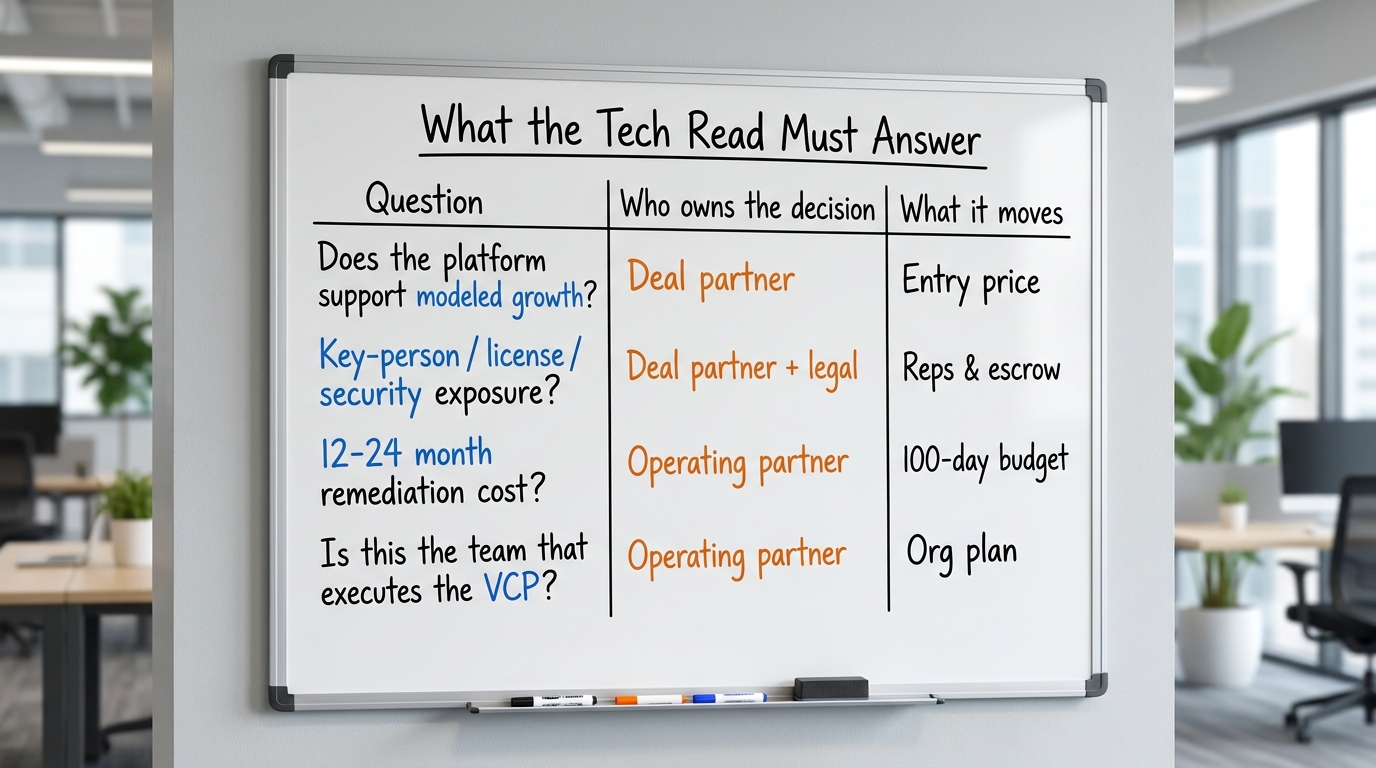
The commercial questions underneath a tech read are narrow and they are always the same:
- Does the platform support the revenue growth the model assumes, or does it cap out and force a rebuild you have not priced?
- Is there a concentration of key-person risk, license exposure, or security debt large enough to move the entry number or the reps you demand?
- What will the first 12 to 24 months of remediation and integration actually cost, in dollars and in engineering attention that then is not building product?
- Is the team you are inheriting the team that will execute the value creation plan, or the first line item you replace?
Bain’s annual global private equity report has documented for years how much of the return now has to come from operational improvement rather than multiple expansion. You can read that framing in Bain’s Global Private Equity Report. If most of your return depends on what happens to the business after you own it, then the tech read is not a compliance step. It is the first draft of the value creation plan. Any Crosslake alternative you consider should be scored on whether it produces that draft, or just a risk inventory.
Why “Crosslake alternative” is really a question about scope
When a deal team searches for a Crosslake alternative, they are rarely unhappy with quality. They are usually reacting to one of three mismatches.
The scope is bigger than the deal
A large, standardized diligence process is right for a large, standardized deal. On a lower-middle-market add-on with a $30M enterprise value, a full enterprise-grade assessment can cost more and take longer than the risk it is retiring justifies. You are buying a Rolls-Royce inspection for a fleet vehicle. The alternative you want here is not cheaper-and-worse. It is right-sized, with the same senior eyes on the questions that actually move your number.
The read stops at the report
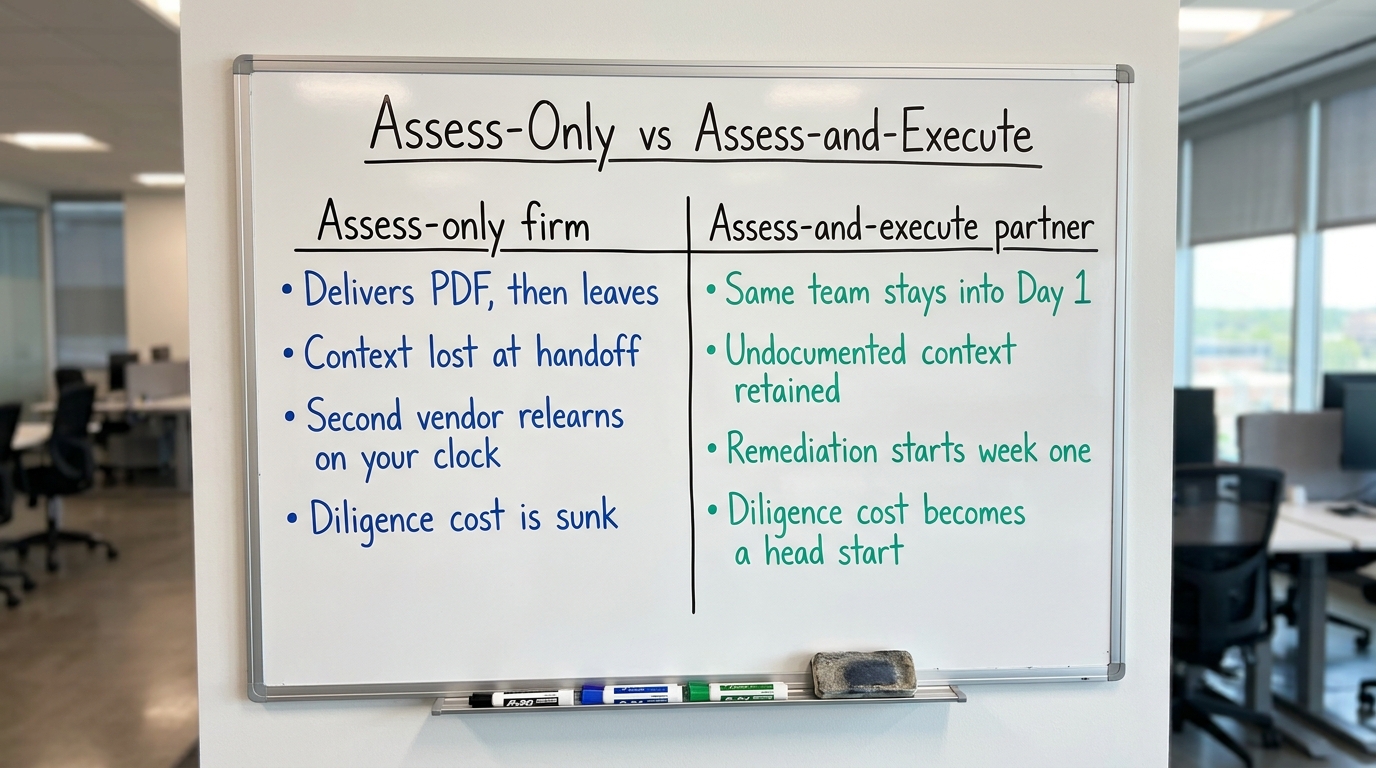
The second mismatch is continuity. A classic diligence firm hands you a document and leaves. Then you are in the first 100 days with a remediation list and no one on the hook to execute it. I have argued this at length in a piece on why PE value creation requires embedded partners, not advisory firms. The diligence and the execution are the same knowledge. Splitting them across two vendors means the second vendor spends the first month relearning what the first one already knew, on your clock.
The output does not translate to EBITDA
The third mismatch is language. A CTO-flavored assessment written for engineers lists architecture concerns. A deal partner needs those concerns translated into dollars, timing, and decision. “The monolith needs decomposition” is not actionable. “This architecture caps concurrent users near the volume your Year 2 plan assumes, remediation is roughly two quarters of the existing team’s capacity, here is what that displaces” is a decision. If a Crosslake alternative cannot do that translation, it has not done the job, whatever the badge on the cover.
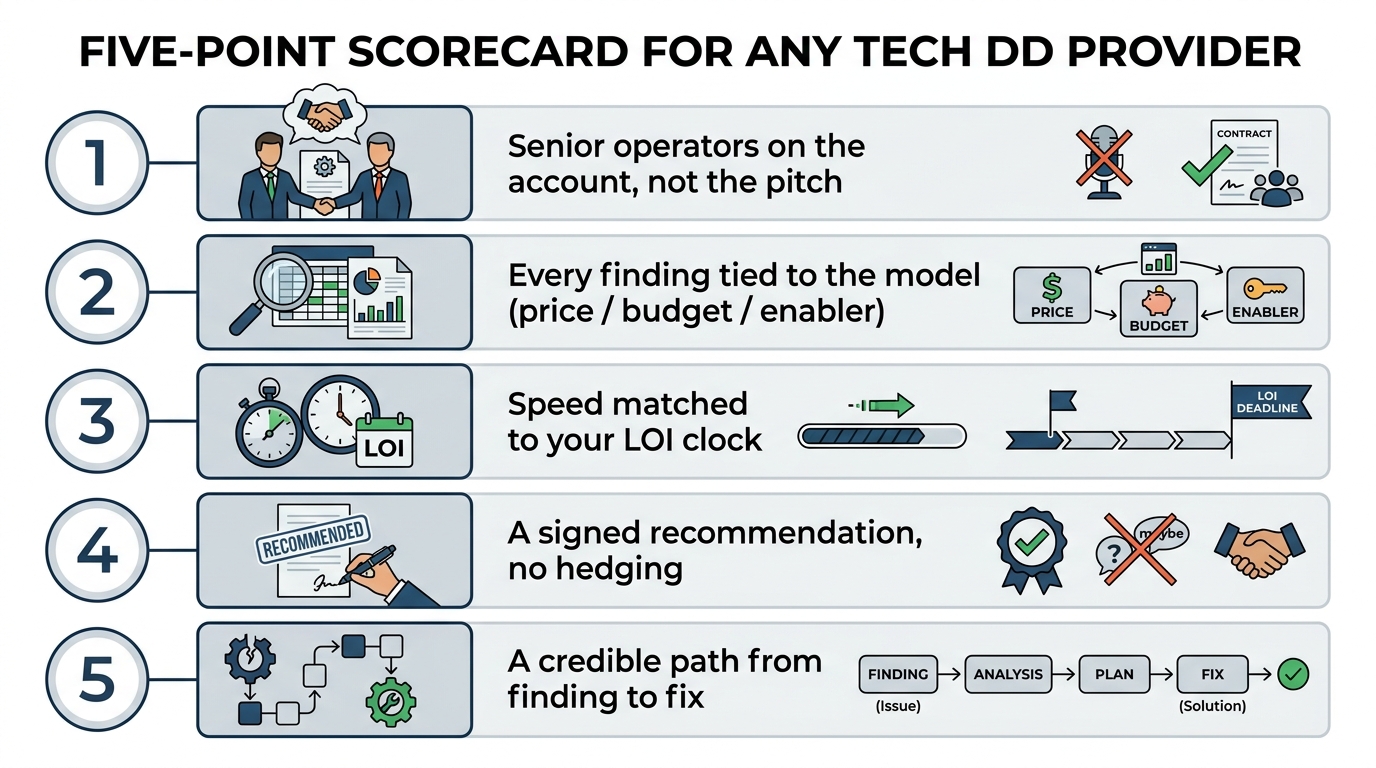
The five criteria I would score any provider against
If I were sitting on the buy side and evaluating any tech DD provider, incumbent or alternative, I would score them on five things and ignore the sales deck.
1. Seniority on the actual account, not on the pitch
The people who show up to win the work are frequently not the people who do the work. Ask, in writing, who reviews the findings and who talks to the target’s engineering lead. On a compressed timeline, a senior operator who has seen the failure mode before is worth more than a team of analysts filling out a checklist.
2. A read that ties to the model
Every material finding should carry an owner, a rough cost or timeline, and a classification: is this a risk that changes the price, a cost that belongs in the 100-day budget, or an enabler that unlocks the growth case? Findings without that structure are trivia.
3. Speed that matches your process, not theirs
A read that lands after your confirmatory window is worthless no matter how good it is. If your trigger is a signed LOI with a tight exclusivity clock, the provider’s calendar has to bend to yours.
4. Willingness to be wrong on the record
A useful diligence partner writes a clear recommendation and signs it. Hedged prose that survives any outcome protects the vendor and helps you not at all. You want someone who will say “proceed, with these two conditions” or “the platform risk is larger than the discount you are getting.”
5. A credible path from finding to fix
This is the one most diligence firms cannot offer and where the strongest Crosslake alternative separates itself. Can the same team that found the problem stay and fix it? Not because you must use them, but because the option to do so tells you they believe their own findings enough to own the outcome.
Where the money actually is in a technical read
The value of a tech read is not spread evenly. Most of it concentrates in a handful of findings that either move the entry price or reshape the 100-day plan. The rest is confirmation, and confirmation is useful but it is not what you are paying senior time for.
In practice the high-value findings cluster in four areas. First, scalability against the growth thesis, because a platform that cannot carry the modeled volume converts your revenue plan into a rebuild plan. Second, key-person concentration, because one departing architect can be a larger risk than a year of missed roadmap. Third, third-party and open-source license exposure, which can create an obligation nobody underwrote. Fourth, security posture, which McKinsey and others have repeatedly flagged as a diligence blind spot that surfaces as a real liability after close. You can follow that line of research through McKinsey’s private capital work.
An honest provider tells you which of these four is live in your target and which is quiet, and does not pad the report to justify the fee. When you are aligning what engineering and product can actually deliver against the commercial plan, the sequencing matters as much as the list, which is a theme I go deeper on in aligning engineering, product, and RevOps for PE value creation.
The pre-LOI read almost nobody buys and should
Here is the sequencing point most deal teams miss. A large chunk of the value of a technical read is available before you commit to a full confirmatory process. A short, senior pre-LOI screen answers one question cheaply: is there a deal-killing technical fact here, or is this platform fundamentally sound enough to justify the full spend?
This is the part of the market a right-sized Crosslake alternative can serve better than a heavyweight process, because it is fast and it is proportionate. A pre-LOI check that costs a fraction of full diligence and credits into the full engagement if you proceed is not a discount tactic. It is risk management on your own capital. You avoid running full diligence on a target that a two-day senior read would have flagged, and you avoid walking from a good target because you were too nervous to look before signing.
The Harvard Law School Forum on Corporate Governance has published extensively on how diligence sequencing and reps allocation shape deal risk, and the pattern is consistent: the earlier a material fact surfaces, the more optionality you retain to price it or walk. That library is worth keeping open at the Harvard Law forum.
The continuity argument, and why it changes the math
The strongest reason to pick a provider that can execute over one that only assesses is not convenience. It is that the diligence knowledge is the single most expensive asset you generate in the deal, and most of it evaporates the moment a pure-advisory firm hands over the PDF.
Think about what the diligence team learns that never makes the report. Which engineer actually holds the system in their head. Where the documentation lies. Which “known issue” the CTO downplayed. How the deploy process really works when nobody is watching. When that team stays into the first 100 days, that context becomes execution speed. When they leave, you pay a second vendor to rediscover it, and you lose weeks you do not have against a hold-period clock.
I have made the case that the read and the fix belong together in technical value creation partners operate inside portfolio companies, and separately on the difference between embedded and advisory capacity. For a deal partner the math is simple: continuity converts a sunk diligence cost into an operating head start. That is a better use of the same dollars.
How the standardized playbook and the operator read differ
A large diligence brand sells consistency. Every deal gets the same rigorous, defensible, repeatable process, which is genuinely valuable when you run dozens of deals a year and need comparability across the portfolio. That consistency is a feature, and I am not going to pretend otherwise.
But standardization has a cost, and the cost is that the process is calibrated to the median deal, not to yours. A operator-led read starts from your specific thesis and works backward to the technical questions that could break it. Those are different methods. The standardized process is stronger for a platform LP-reportable process where governance and comparability matter most. The operator read is stronger for the add-on, the carve-out, the founder-owned business where the risk is idiosyncratic and speed is the constraint.
Neither is universally right. The mistake is buying the standardized heavyweight process by default because it is the name you recognize, when the deal in front of you needed the fast operator read, or the reverse. BCG’s work on principal investors makes a related point about matching diligence intensity to deal archetype rather than applying one template everywhere, which you can trace through BCG’s private equity practice.
What this looks like in practice
Consider an illustrative scenario, clearly hypothetical. You are acquiring a $40M-revenue vertical SaaS business as a platform. The thesis is doubling revenue in four years through cross-sell and one bolt-on acquisition. A standardized diligence firm quotes a six-figure process on a five-week timeline. Your exclusivity window is three weeks.
A right-sized alternative runs a fast pre-LOI screen first and finds no deal-killer, which unlocks the LOI. Then a focused five-day read confirms the platform can carry the cross-sell load but flags that the bolt-on integration will require data-model work the seller has not scoped, roughly a quarter of engineering capacity. That single finding does two things. It shapes the reps you demand, and it reshapes the 100-day plan so that integration engineering is staffed from Day 1 rather than discovered in month four. The read cost less and moved more, because it was aimed at your thesis rather than at a template.
That is the whole argument in one scenario. The point of a Crosslake alternative is not to be cheaper. It is to be aimed.
What the deal team should do next
If you are evaluating options right now, three practical moves.
First, decide whether you need a comparable, LP-reportable standardized process or a fast operator read aimed at your specific thesis. Write that decision down before you take a single sales call, because vendors will otherwise define it for you.
Second, if the risk is idiosyncratic and the clock is tight, buy the small pre-LOI read before the big one. Spending $5K to decide whether to spend $50K is not caution, it is discipline.
Third, insist that whoever you hire can tie every material finding to the model and, ideally, stay to fix what they find. If you want that continuity built into the seat rather than the project, the coverage model I describe in virtual CIO coverage for private equity and in the decision rules a fractional CTO seat enforces is the mechanism. For the difference between advice you can ignore and a plan someone is accountable for, see the piece on what an operational value creation consultant is actually on the hook to deliver.
PitchBook and S&P Global both track how deal volume and hold periods are moving, and the direction is toward tighter processes and more scrutiny on post-close execution. Keep both open when you calibrate how much diligence a given deal warrants, at PitchBook and S&P Global Market Intelligence.
The read is a means, the decision is the point
A Crosslake alternative is worth choosing when it fits the deal in front of you better than the incumbent does: right-sized to the risk, aimed at your thesis, translated into your model, delivered inside your clock, and backed by people who will stay and fix what they found. Any provider that clears those bars is a serious option. Any provider that only produces a defensible document is selling you comfort, not a decision.
The whole exercise exists to change one number, one set of reps, or one 100-day plan. Buy the read that does that.
If you are approaching an LOI or a confirmatory window on a software or software-enabled target and you want a senior read aimed at your thesis, DevriX runs a $5K Pre-LOI Check that credits into a 5-Day Tech DD ($15K), and stays to execute the findings inside your first 100 days. See how the private equity team scopes it and get on the calendar for your current deal.
