

By Mario Peshev, DevriX
Most M&A consulting engagements fail the buyer quietly. Not with a blown deal or a lawsuit, but with a 90-page report that confirms what the deal team already suspected, arrives a week before the IC meeting, and never once ties a finding to the number that matters: what this asset will be worth when you sell it. I have sat on both sides of that table, as a founder whose company was courted and as an operating partner brought in to clean up a thesis that diligence should have caught. The gap between M&A consulting that informs a decision and M&A consulting that decorates one is enormous, and it is almost never visible in the pitch.
This piece is for the person who actually signs off. A deal partner deciding whether to proceed, at what price, and against which risks. An operating partner who inherits the consequences on day one. If you are learning the field, this is not your primer. If you write checks, read on.
The decision the consultant is supposed to serve
An M&A consultant is not hired to produce analysis. They are hired to move a specific decision forward with less risk. That decision is rarely “is this a good company.” It is some version of: proceed or walk, at what price, under what deal structure, with what conditions, and with which value-creation levers already de-risked before close.
When I evaluate a consulting deliverable, I start by asking what decision it changes. If the answer is “none, it makes us feel informed,” the engagement was theater. The best commercial due diligence I have seen reads like a memo to the investment committee: here is the thesis, here are the three findings that could break it, here is what we would pay and what we would refuse to pay for.
Bain’s annual Global Private Equity Report has documented for years how much return now depends on operational improvement rather than multiple expansion or leverage. That shift changes what diligence has to do. It is no longer enough to confirm the historicals. The consultant has to surface whether the value-creation plan is real and whether the organization can execute it. That is a harder, more useful question than most engagements answer.
What a deal partner actually needs to decide
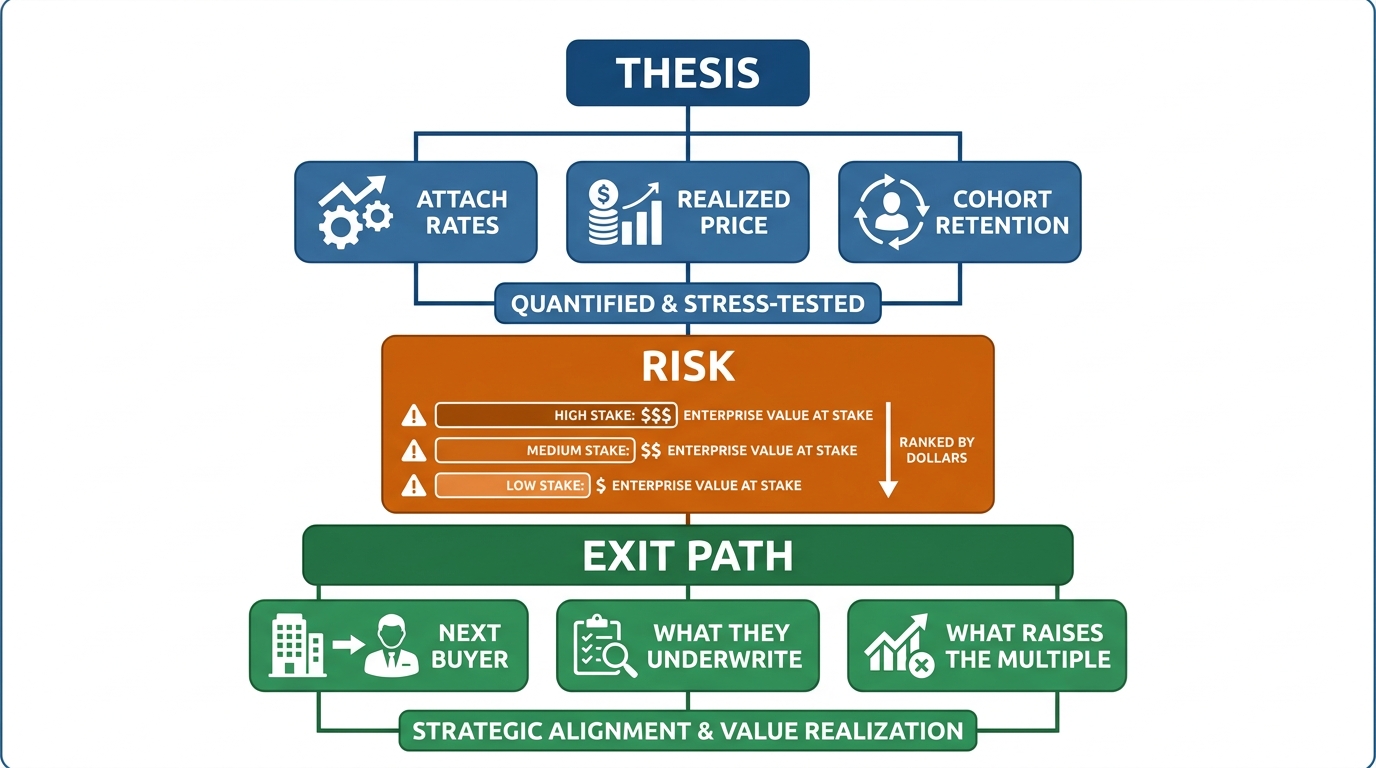
A deal partner is underwriting a thesis with a hold period and an exit in mind. The reader wants three things from any advisor near the deal: a defensible view of the thesis, a ranked list of what could kill it, and a credible path to exit. Everything else is supporting material.
Thesis, quantified and stress-tested
The consultant should tell you whether the growth story survives contact with the data. If the thesis rests on cross-sell, the deliverable should show current attach rates, not a TAM slide. If it rests on pricing power, it should show realized price versus list over three years and what churned when prices moved. I have watched theses built entirely on a market-size chart, and those are the deals that disappoint in year two.
Risk, ranked by impact on value
Every business has problems. The job is to sort them by their effect on enterprise value, not by how easy they are to write up. Customer concentration that threatens 30 percent of revenue matters more than a messy CRM, even though the CRM is easier to describe. I wrote about the specific patterns worth escalating in commercial due diligence red flags in B2B businesses, and the through-line is always the same: rank by dollars at risk, not by tidiness.
A path to exit, not just a path to close
Good M&A advice thinks past the closing table. Who is the next buyer, what will they underwrite, and what has to be true about the company for them to pay a higher multiple? If the consultant cannot describe the exit buyer, they are helping you enter a position they have not thought through leaving.
What an operating partner needs that diligence usually skips
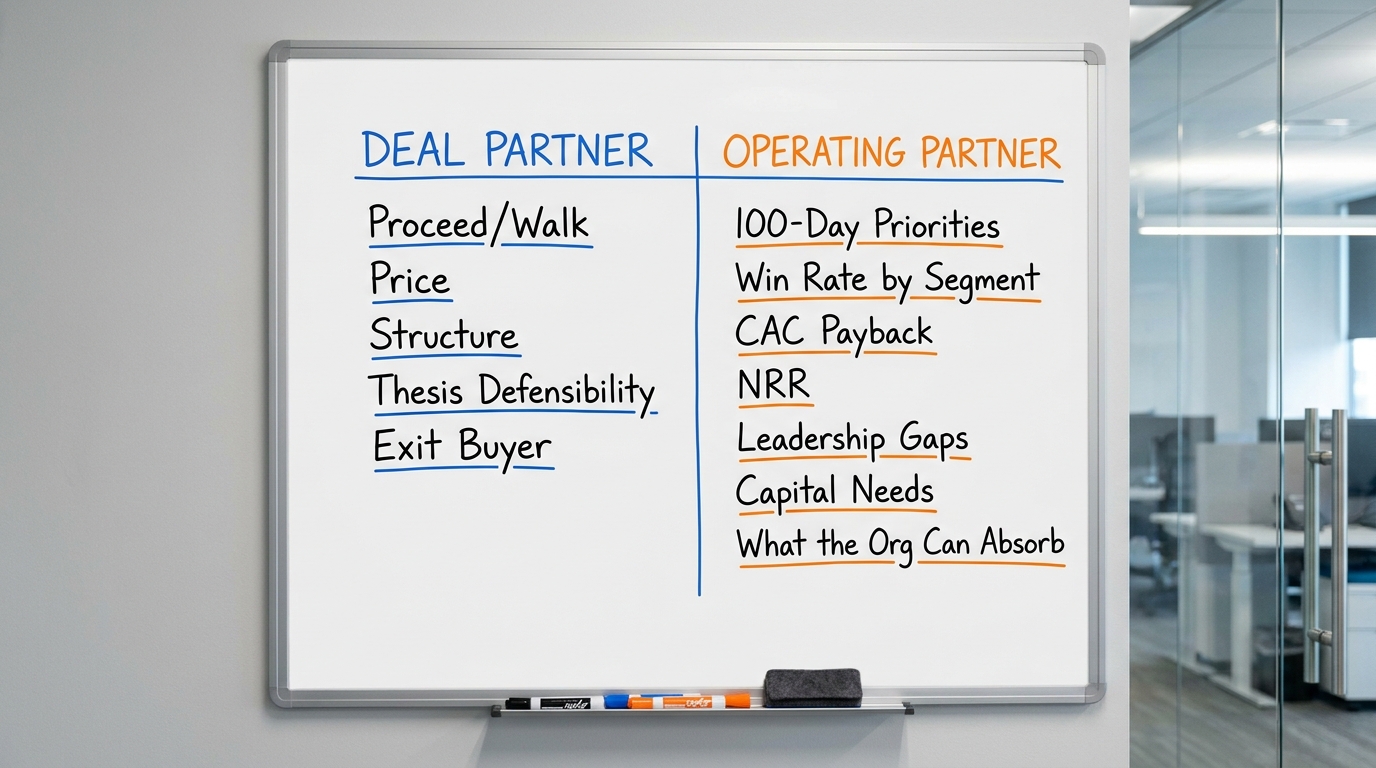
The deal partner decides whether to buy. The operating partner has to make the thesis true. These are different jobs, and most M&A consulting is written for the first reader and abandons the second.
An operating partner needs the findings translated into a sequenced plan: what gets fixed in the first 100 days, what needs new leadership, what needs capital, and what the organization simply cannot absorb yet. A diligence report that says “sales productivity is below benchmark” is useless to an operator. What is the win rate? What is CAC by segment? Is the pipeline real or is it stuffed with dead deals the CRM never closed out? I laid out how to make the handoff usable in the 100-day go-to-market plan for a newly acquired B2B business.
This is also where the distinction between advice and accountability becomes concrete. A firm that hands you a report and leaves is priced and structured differently than a partner who owns a number after close. I have argued the case at length in value creation consultants versus operators and in why PE value creation requires embedded partners. The short version: the deliverable you can act on is worth ten times the deliverable you merely file.
The commercial engine, in operator terms
If the thesis depends on revenue growth, someone has to own the mechanics. Win rate, sales cycle length, CAC payback, net revenue retention. These are the numbers a good operating partner asks for on day one and a mediocre diligence process never produced. A fractional CRO fixes win rate and CAC, not revenue theory, and the reason I keep returning to that point is that most “growth” theses are built on assumptions no one has pressure-tested against the actual funnel.
How to judge the quality of the earnings before you trust the price
Price rests on earnings, and earnings in a deal are almost never the reported number. The quality of earnings work determines whether you are paying for a real business or an accounting arrangement. This is where I see the most expensive mistakes made, because the buyer trusts the seller’s adjusted EBITDA without interrogating how it was built.
Add-backs are where sellers rebuild the P&L in their favor. Some are legitimate: a one-time legal settlement, a genuinely non-recurring restructuring. Many are aggressive: owner “one-time” expenses that recur every year, run-rate synergies presented as if already realized, growth investments waved away as exceptional. I broke down how to read these in adjusted EBITDA and the art of add-backs, and the discipline that matters most is classification: what is realized, what is run-rate, what is merely forecast. A seller who lets forecast value read as realized is telling you something about how they will behave post-close.
The AICPA and CIMA maintain practice guidance on quality of earnings and financial due diligence that is worth knowing even if you outsource the work, because it tells you what a competent QoE provider should be doing. For public-market comparables and disclosure standards, the SEC’s filings give you a baseline for what defensible revenue recognition looks like. When a private company’s numbers diverge sharply from how a public peer would have to report the same activity, that gap is a question, not a footnote.
The revenue leakage most diligence never finds
Reported revenue tells you what came in. It does not tell you what should have come in and did not. Discount leakage, uncollected price increases, silent churn, mispriced contracts, and support costs eating into deal economics all sit below the surface of a P&L. I built a whole framework around this in the B2B portfolio revenue leakage diagnostic because it is where enterprise value quietly hides.
For a deal partner, leakage is upside you can underwrite with confidence, because fixing it does not require the market to cooperate. For an operating partner, it is the fastest EBITDA improvement available, often realizable in the first two quarters. Any M&A consultant worth the fee should be looking for it during diligence, not discovering it eighteen months into the hold. McKinsey’s private capital research has repeatedly emphasized commercial and operational levers over financial engineering, and pricing discipline is among the most reliable of those levers precisely because it is within the company’s control.
What separates a report you can act on from one you file
After enough engagements, the tells become obvious. Here is how I judge M&A consulting before I judge the market it covers.
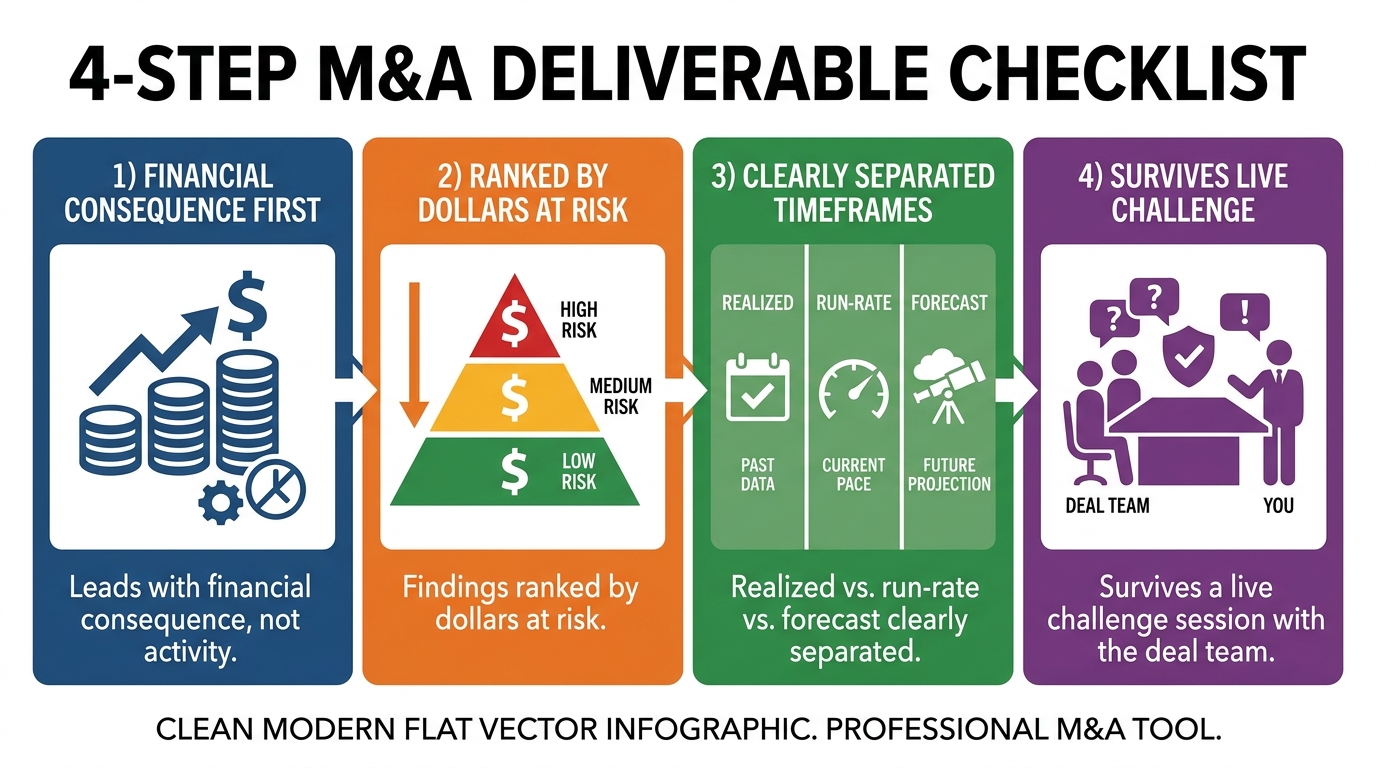
It leads with the consequence, not the activity
A weak deliverable tells you what the consultant did: interviews conducted, data rooms reviewed, models built. A strong one tells you what it means for the number you care about. Activity is not outcome. If the executive summary describes effort rather than findings, the body will disappoint.
It ranks findings by their effect on value
A serious advisor puts the three things that could change your decision on page one and relegates the housekeeping to appendices. If everything is presented as equally important, nothing was prioritized, and prioritization is most of the value.
It distinguishes what is proven from what is projected
Realized results, run-rate figures, forecast upside, and enabled potential are different categories with different reliability. A deliverable that blends them into one confident narrative is hiding uncertainty you are paying to eliminate. I want the forecast labeled as forecast.
It survives a challenge session
The best test is to put the advisor in a room with the deal team and attack the thesis. A consultant who has done the work defends it with data. A consultant who assembled a deck retreats to caveats. You learn more in that hour than in the whole report.
Where consulting fees are worth paying and where they are not
I am not against advisors. I am against paying advisory prices for work that carries no accountability for being right. The distinction that matters is whether the fee buys you a decision input or a decision partner.
Buy the input when the question is bounded and expert: a legal review, an environmental assessment, a tax structuring opinion. These are one-time, specialized, and genuinely benefit from a firm that does nothing else. PitchBook and Preqin data, for instance, are worth buying precisely because you cannot replicate their coverage, and industry outlets like Buyouts and Private Equity International keep you current on how peers are pricing deals.
Be far more careful when you are buying a growth thesis or a value-creation plan, because those live or die on execution the consultant will not be present for. The Harvard Law School Forum on Corporate Governance and HBR’s M&A research both document how often post-merger integration, not the deal itself, determines the outcome. If the consultant disappears at close, they were never accountable for the part that decides the return.
The question that clarifies the whole engagement
Ask the advisor: what happens to your fee if the thesis you validated turns out to be wrong? An honest firm will tell you the truth, that a diligence provider is not liable for market outcomes, and then you know exactly what you are buying, an input. A partner offering to own a value-creation number will structure the relationship around results. Both can be appropriate. Confusing them is expensive.
Common failure modes I keep seeing
These recur across firms, sectors, and deal sizes, and they are worth naming because they are avoidable.
- The confirmation report. The deal team wants the deal, the consultant senses it, and the report validates the predetermined answer. This is the most dangerous pattern because it feels like diligence while functioning as insurance.
- The benchmark without a mechanism. “Below industry average” tells you nothing actionable unless it tells you why and what to do about it. A gap without a lever is a complaint.
- The synergy fantasy. Cost and revenue synergies modeled as certain, front-loaded, and free of execution risk. BCG’s work on principal investors has long cautioned that synergy capture takes longer and costs more than models assume.
- The orphaned handoff. Diligence findings never reach the operating team in usable form, so the operating partner rebuilds the analysis after close, paying twice for the same insight.
Avoiding these is less about hiring a smarter firm and more about being a sharper buyer of advice. The clearer you are about the decision you need served, the harder it is for a consultant to sell you a report that serves nothing. I collected the broader version of this discipline in avoiding value-creation pitfalls and in the longer-horizon view in future-proofing organizations.
How this connects to the number that matters
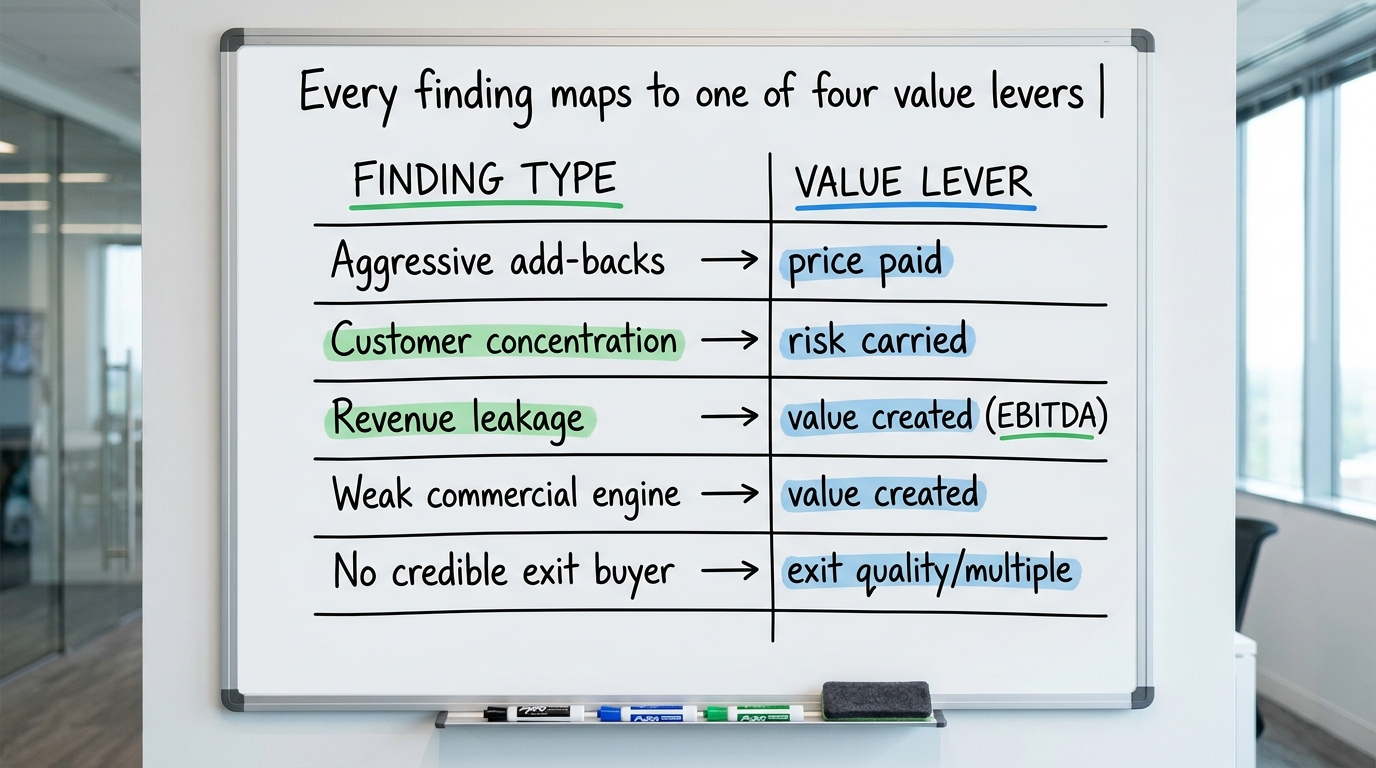
Strip away the vocabulary and M&A consulting exists to serve one goal: a better risk-adjusted return on the position. Every finding either changes the price you pay, reduces the risk you carry, accelerates the value you create, or improves the exit you eventually run. If a deliverable does none of those, it did not earn its fee regardless of how thorough it looks.
The operators who consistently generate returns treat diligence as the first act of value creation, not a gate to pass. They connect every finding to a lever, hand those levers to the people who will pull them, and hold someone accountable for the outcome. The reviews that keep the plan honest after close are a discipline of their own, which I covered in portfolio company operating reviews and the commercial KPIs that matter.
Conclusion
M&A consulting is easy to buy and hard to buy well. The difference is not the firm’s logo or the length of the report. It is whether the work serves the decision in front of you, ranks risk by its effect on value, separates what is proven from what is hoped, and reaches the operators who have to make the thesis true. Judge every deliverable by whether you could act on it Monday morning. If you cannot, you bought reassurance, not diligence.
If you are weighing an acquisition, integrating one, or trying to turn a diligence report into a value-creation plan someone will actually own, that is the work I do with PE-backed teams. Start with a value creation advisory conversation to pressure-test your thesis, or review how DevriX supports portfolio companies on the commercial and operational side once the deal closes. Either way, the goal is the same: a decision you can defend and a number someone is accountable for.
