

Most private equity deals underperform not because the thesis was wrong, but because the operating partnership never materialized. The fund identifies a solid platform, models the upside, closes the transaction, and then watches as the portfolio company leadership and the deal team talk past each other for eighteen months. By the time everyone agrees on priorities, half the hold period is gone.
I have seen this pattern repeatedly across mid-market transactions. The investment thesis assumes operational improvements that require coordinated execution between the sponsor, management, and external partners. But the partnership model, the actual operating relationship that makes value creation possible, is rarely defined with the same rigor applied to the financial structure.
According to McKinsey, top-quartile PE funds generate roughly 50% of their returns from operational improvements rather than leverage or multiple expansion. Yet most funds lack a systematic framework for structuring the partnerships that deliver those improvements. They default to quarterly board meetings and ad-hoc interventions when what they need is a tiered operating model that matches partnership intensity to value creation potential.
This article introduces a framework I have developed through work with PE-backed companies and growth-stage operators: the Value Creation Partnership Model. It provides a structured approach to designing, staffing, and executing the operating relationships that turn investment theses into realized returns.
Partnerships succeed when they are backed by a clear operational execution model.
Why traditional advisory relationships fail to deliver PE value creation
The standard consulting engagement does not work for PE value creation. Traditional advisory assumes a client with stable ownership, multi-year horizons, and incremental improvement goals. PE-backed companies operate under fundamentally different constraints: compressed timelines, return hurdles, and the need to demonstrate measurable progress against a defined thesis.
The mismatch shows up in several ways. Consultants scope work around discovery phases that consume months before recommendations emerge. Recommendations arrive as PowerPoint decks rather than executable plans with accountable owners. And the engagement ends precisely when implementation begins, leaving management to figure out execution alone.
A Bain & Company analysis found that 65% of PE deals fail to capture their projected synergies, with implementation failures cited as the primary cause. The problem is not strategy. The problem is that the partnership model was never designed for the operational intensity that PE value creation requires.
What PE-backed companies need is not advice. They need operating partners who share accountability for outcomes, who integrate with management rather than observe from the outside, and who bring execution capacity rather than just recommendations. This requires a different partnership architecture entirely.
Four partnership tiers that match operating intensity to value creation demands
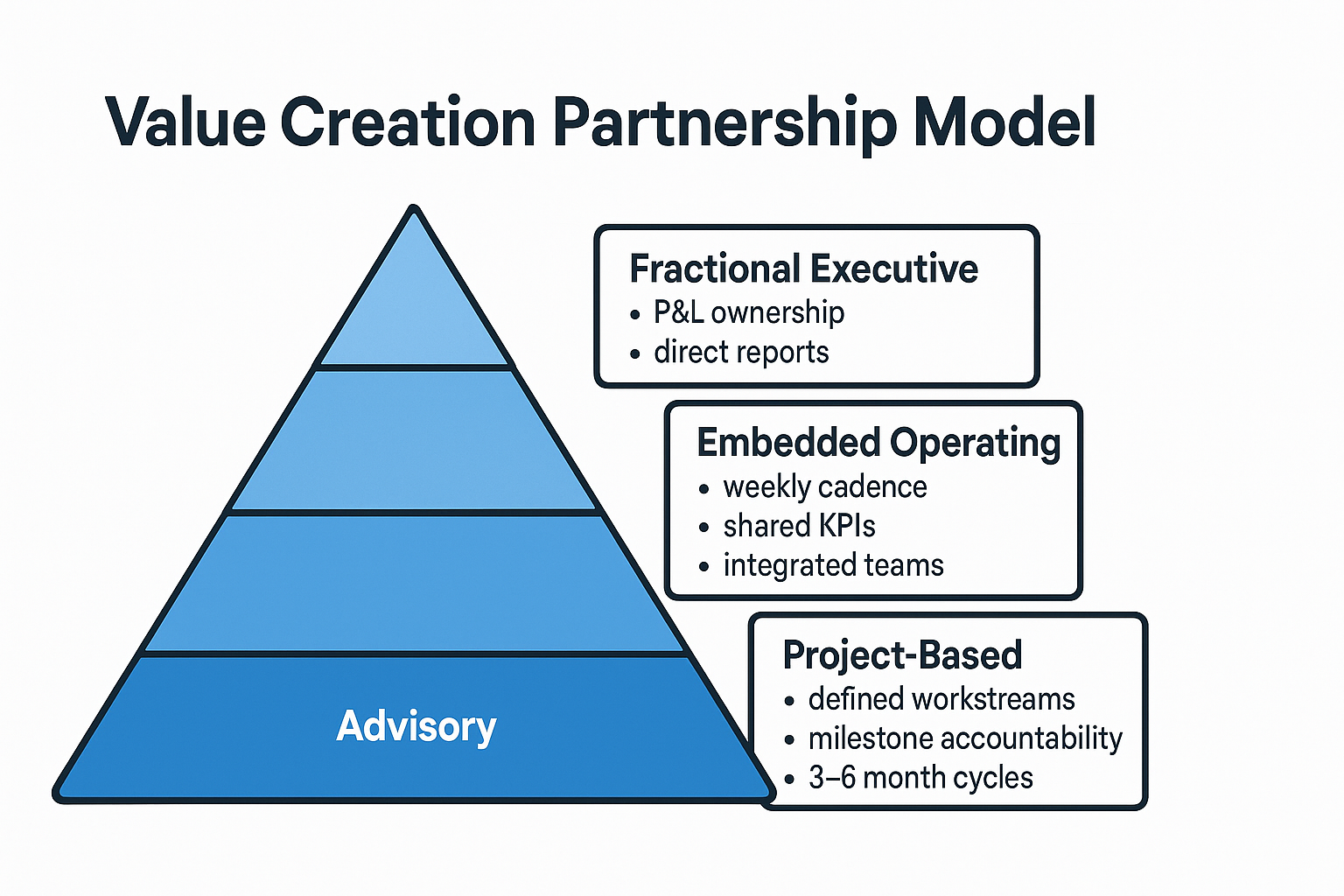
The Value Creation Partnership Model structures operating relationships across four tiers, each defined by scope, integration depth, and accountability structure. The right tier depends on the value creation thesis, management capacity, and timeline constraints.
Tier 1: Advisory Partnership
Advisory partnerships provide strategic guidance without operational integration. The partner participates in quarterly reviews, offers perspective on major decisions, and serves as a sounding board for management. This tier works when management is strong, the thesis is straightforward, and execution risk is low.
Accountability at this tier is informal. The partner offers input; management decides and executes. Value creation depends entirely on management’s ability to translate guidance into operational reality.
Tier 2: Project-Based Partnership
Project-based partnerships assign specific workstreams to external partners with defined milestones and delivery timelines. A typical engagement might include a CRM implementation, a pricing optimization project, or a digital infrastructure upgrade. The partner owns the project; management owns the broader integration.
This tier suits situations where internal capacity gaps exist in specific functional areas. The partner brings specialized expertise that management lacks, executes against a defined scope, and hands off to internal teams. I have written extensively about how to structure these workstreams in the context of M&A integration for CRM, martech, and web properties.
Tier 3: Embedded Operating Partnership
Embedded operating partnerships integrate external partners into the day-to-day operating rhythm of the company. Partners attend weekly leadership meetings, share accountability for KPIs, and work alongside internal teams rather than delivering reports from outside. This tier requires a fundamentally different relationship than traditional consulting.
At this level, the partner functions as an extension of the management team. Success metrics are shared. Communication is continuous rather than milestone-based. The partner has visibility into operational challenges as they emerge, not after they have become crises.
This tier is appropriate when the value creation thesis depends on cross-functional transformation, when management needs operating leverage rather than just expertise, or when timeline compression demands parallel execution across multiple workstreams.
Tier 4: Fractional Executive Partnership
Fractional executive partnerships place external operators in formal leadership roles with P&L accountability and direct reports. This tier addresses situations where management gaps are structural rather than temporary, where the value creation thesis requires capabilities that do not exist in the current team, or where interim leadership is needed during a management transition.
A fractional CRO might own the revenue organization during a commercial transformation. A fractional CTO might lead a technology modernization. These are not advisors or consultants. They are operators with real authority and real accountability.
How to match partnership models to different value creation theses
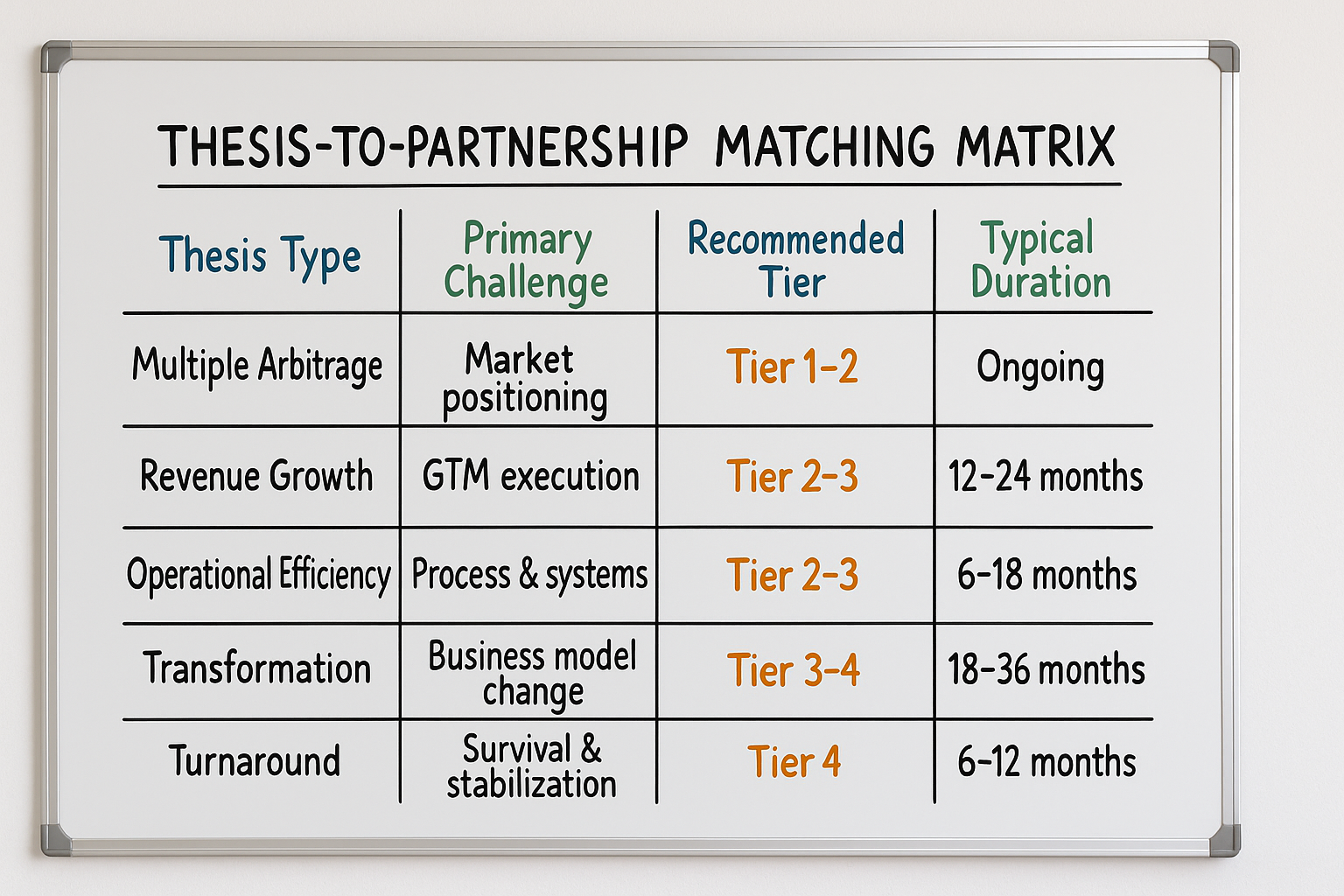
The right partnership tier depends on what kind of value creation the thesis requires. I use a diagnostic that maps thesis types to partnership intensity.
Revenue Growth Theses
When the investment thesis depends on accelerating revenue, the partnership must address commercial execution. This means GTM infrastructure, sales process, marketing systems, and customer acquisition efficiency. A thorough GTM due diligence during the deal phase reveals where partnership support will be most valuable post-close.
Revenue growth theses typically require Tier 2 or Tier 3 partnerships. Tier 2 works when specific capabilities are missing, such as demand generation or sales enablement. Tier 3 is necessary when the entire commercial engine needs to be rebuilt or when management lacks operating bandwidth to drive transformation while running the business.
Operational Efficiency Theses
Efficiency theses focus on margin improvement through process optimization, system consolidation, and overhead reduction. These theses often emerge in buy-and-build strategies where acquisitions create redundant systems and fragmented operations.
The partnership model for efficiency theses must address integration complexity. A post-merger integration checklist helps identify where partnership capacity is needed. Tier 2 partnerships handle specific integration workstreams. Tier 3 partnerships manage cross-functional consolidation where interdependencies require coordinated execution.
Transformation Theses
Some investments require fundamental business model changes: new market entry, product line expansion, channel transformation, or digital business model shifts. These theses carry the highest execution risk and the highest partnership intensity requirements.
Transformation typically demands Tier 3 or Tier 4 partnerships. The scope is too broad for project-based engagements. The timeline is too compressed for advisory-only relationships. Management needs operating partners who can drive change while the core business continues to run.
Building accountability structures that produce measurable results
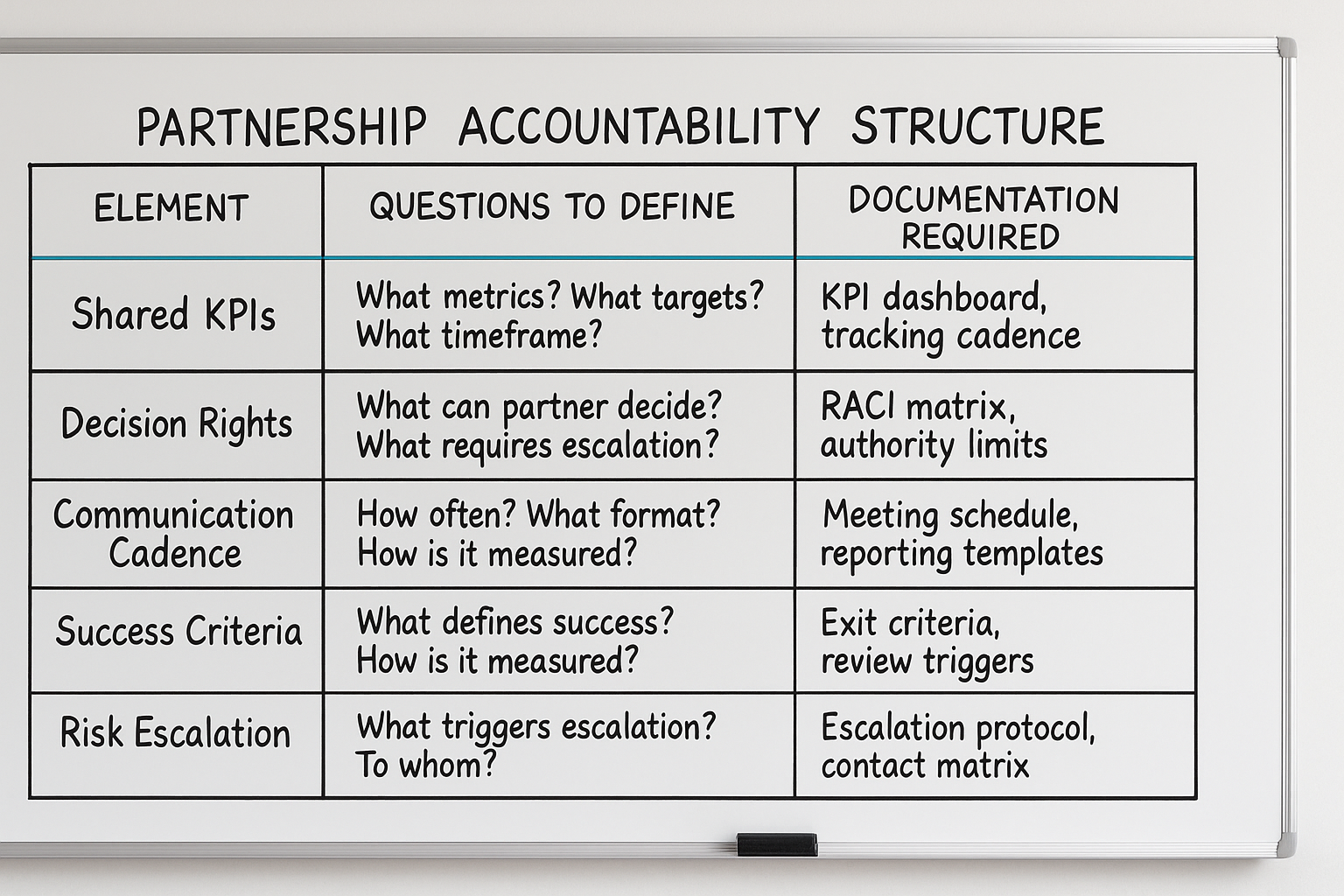
Partnership without accountability is just expensive conversation. The Value Creation Partnership Model requires explicit accountability structures at every tier.
Defining Shared KPIs
At Tier 3 and Tier 4, partners must own KPIs alongside management. Not advisory influence on KPIs. Actual ownership. This means the partner’s success is measured by the same metrics that matter to the investment thesis.
For a revenue growth engagement, shared KPIs might include pipeline generation, conversion rates, CAC efficiency, and revenue against plan. For an operational efficiency engagement, shared KPIs might include system consolidation milestones, process cycle times, and margin improvement.
BCG research indicates that PE-backed companies with clearly defined value creation KPIs and accountable owners are 2.4 times more likely to exceed their investment cases. The partnership model must make accountability explicit rather than assumed.
Establishing Decision Rights
Ambiguous decision rights kill execution speed. The partnership model must clarify who decides what. This includes budget authority, hiring decisions, vendor selection, and strategic trade-offs.
At Tier 4, decision rights often mirror those of a full-time executive. At Tier 3, decision rights are typically scoped to specific domains with escalation paths for cross-functional conflicts. The key is explicit documentation rather than assumed norms.
Building Review and Exit Mechanisms
Every partnership should include explicit review points and exit criteria. What triggers a tier change? What signals that the partnership has succeeded and should transition to a lighter model? What indicates that the partnership is not working?
Review mechanisms prevent partnerships from drifting into expensive maintenance relationships that no longer drive value creation. Exit mechanisms provide clean transitions when the partnership has achieved its purpose or when a different model is needed.
A commercial transformation case study
Let me walk through how this framework applies in practice. A PE fund acquired a B2B services company with a $40M revenue base and a thesis centered on accelerating organic growth from 5% to 15% annually while improving sales productivity by 40%.
Initial Assessment
The commercial due diligence revealed several issues: fragmented CRM usage, no defined sales process, limited marketing infrastructure, and a sales team that operated on relationships rather than repeatable methodology. The CEO was strong operationally but had limited commercial transformation experience.
The thesis required significant commercial infrastructure buildout alongside cultural change in the sales organization. This was not a project-based scope. It required embedded operating partnership at Tier 3, potentially transitioning to Tier 4 if interim sales leadership proved necessary.
Partnership Structure
The fund engaged an operating partner with commercial transformation experience. The partnership structure included weekly participation in leadership team meetings, shared accountability for pipeline and revenue KPIs, decision rights over marketing spend and sales tooling selection, and direct collaboration with the VP of Sales on process redesign.
The first phase focused on digital and revenue infrastructure: CRM implementation, marketing automation deployment, and analytics dashboards. The second phase addressed sales process redesign and team enablement. The third phase built scalable demand generation capabilities.
Results and Transition
After eighteen months, the company achieved 18% organic revenue growth and 35% improvement in sales productivity. The partnership transitioned from Tier 3 to Tier 2, with ongoing project-based support for specific initiatives rather than embedded operating involvement.
The key was matching partnership intensity to transformation phase. Early stages required embedded partnership to drive change. Later stages required project support to sustain and extend gains. The model was explicit about these transitions from the beginning.
How buy-and-build strategies require partnership models that scale
Buy-and-build strategies create unique partnership requirements. Each add-on acquisition brings integration challenges. The partnership model must scale with transaction volume while maintaining quality.
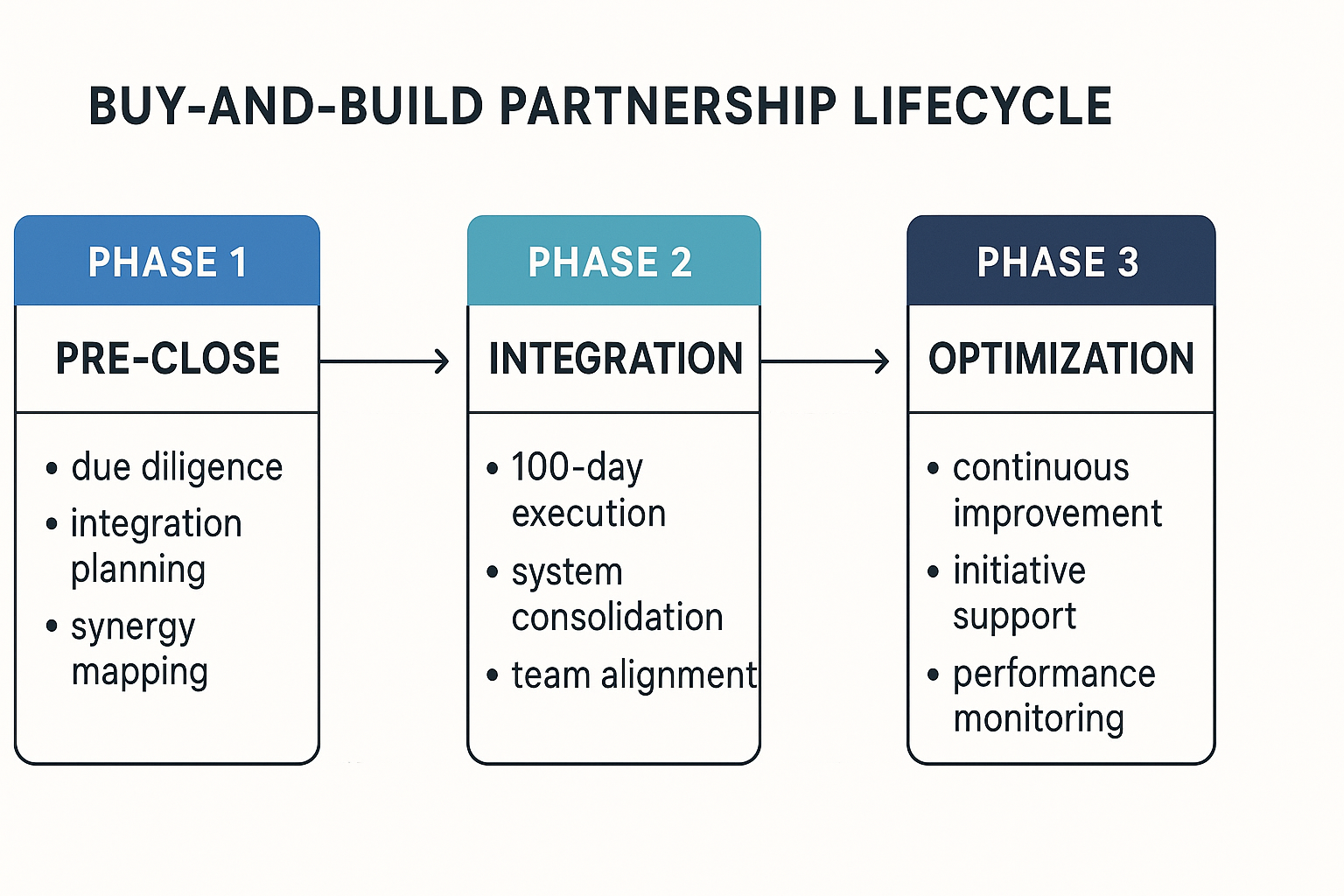
I have developed a playbook for buy-and-build integration that structures partnership involvement across the acquisition lifecycle. The model includes three phases:
Pre-Close Partnership
Before each add-on closes, the operating partner conducts technology due diligence and commercial assessment. This identifies integration complexity and resource requirements. It also surfaces value creation opportunities that might not be apparent in financial due diligence alone.
Integration Partnership
During the first 100 days after acquisition, partnership intensity peaks. The operating partner drives integration workstreams, manages cross-functional dependencies, and accelerates time to synergy capture. This phase typically requires Tier 3 partnership intensity.
Optimization Partnership
After initial integration, the partnership transitions to Tier 2 or Tier 1. The focus shifts from integration execution to optimization and continuous improvement. The partner provides ongoing support for specific initiatives while internal teams own day-to-day operations.
The most common partnership execution failures and how to prevent them
Every engagement should ultimately map back to a structured value creation plan.
Even well-designed partnership models fail when execution goes wrong. These are the most common failure patterns I have observed:
Underestimating Integration Depth
Funds often assume project-based partnerships will suffice when embedded partnerships are required. The result is slow progress, missed milestones, and eventual escalation to the partnership intensity that was needed from the start. The cost of this mistake is time, and time is the scarcest resource in PE value creation.
Unclear Accountability
When partnership accountability is vague, management and partners each assume the other is responsible for outcomes. This creates execution gaps and blame dynamics. Explicit accountability documentation, while bureaucratic, prevents these failures.
Misaligned Incentives
Traditional hourly or project-based fee structures misalign incentives. Partners are paid for effort rather than outcomes. The Value Creation Partnership Model works best when partner compensation includes meaningful exposure to value creation results, whether through success fees, equity participation, or earnout structures.
Neglecting Management Integration
Operating partners cannot succeed if management views them as outsiders. The partnership model must include deliberate integration mechanisms: shared meetings, collaborative planning, and social relationship building. Partnership is a relationship, not just a contract.
Developing internal capabilities to manage operating partnerships at portfolio scale
As PE funds mature their value creation approaches, they need internal capabilities to manage operating partnerships effectively. This includes portfolio operations teams that can match partnership models to portfolio company needs, manage partner relationships, and ensure accountability.
According to Harvard Business Review, leading PE funds now employ operating partners at ratios of roughly one operating partner per three to four portfolio companies. These internal resources coordinate external partnerships, ensuring alignment between fund-level resources and external specialist partners.
The most effective model combines internal operating partners who provide strategic continuity and portfolio-level perspective with external specialist partners who bring deep functional expertise. The value creation plan framework I have developed integrates both internal and external partnership resources into a unified execution model.
Measuring partnership ROI and improving model design over time
Partnership effectiveness should be measured with the same rigor applied to other investments. This requires tracking partnership costs against value creation outcomes and calculating ROI at the partnership level.
Metrics to track include direct value creation attributed to partnership workstreams, time to value creation versus plan, management satisfaction with partnership support, and capability building that enables internal teams to sustain gains after partnership intensity decreases.
The goal is continuous improvement in partnership model design. Each engagement generates learning that improves future partnership structures. Over time, funds develop institutional knowledge about which partnership models work for which thesis types, which partners perform best in which contexts, and how to structure accountability for optimal results.
This learning compounds. Funds that invest in partnership model optimization outperform those that treat operating partnerships as ad-hoc arrangements. As Bain research demonstrates, value creation in PE increasingly depends on operational excellence rather than financial engineering alone.
Partnership as a repeatable competitive advantage
The Value Creation Partnership Model transforms operating relationships from informal arrangements into structured systems that drive measurable outcomes. By matching partnership intensity to value creation requirements, defining explicit accountability, and building internal capabilities for partnership management, PE funds can systematically improve their ability to execute operational improvement theses.
The framework works because it treats partnership as an investment discipline rather than a procurement exercise. It acknowledges that different situations require different partnership models and provides a structured approach to making those design decisions. It creates accountability mechanisms that align incentives and drive execution.
For PE funds and portfolio company leaders seeking to design or optimize their value creation partnerships, I offer advisory engagements that apply this framework to specific situations. Schedule an advisory exploration call to discuss how the Value Creation Partnership Model applies to your portfolio or acquisition pipeline.
