One of the 5 main reasons I post online is “journaling” and cross-checking how my strategy evolved or shifted over time.
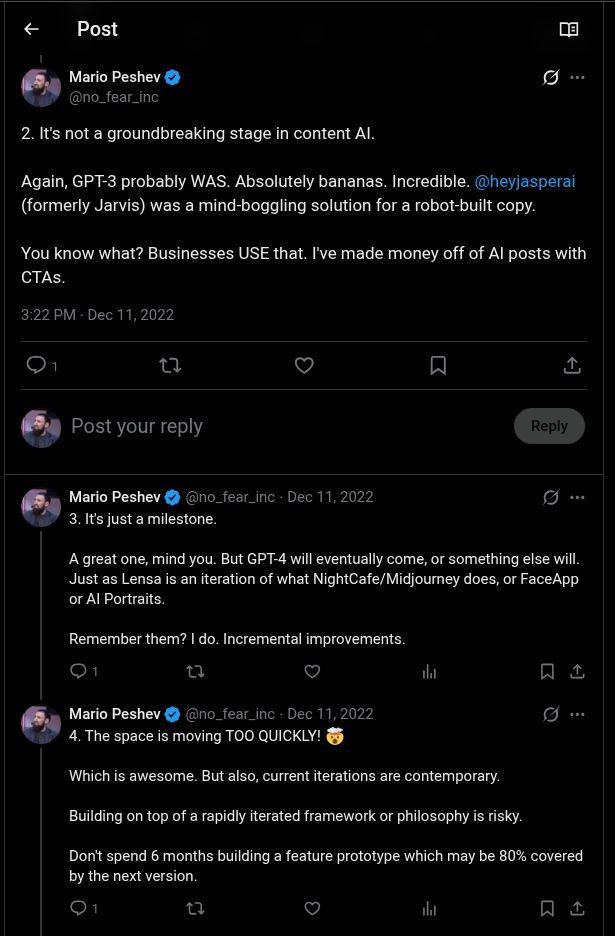
This is me on X (still Twitter back then?) less than 2 weeks after ChatGPT was released.
– The marketing team still had a Jasper license for outlines and content structure
– Engineering leads used OpenAI’s API for months to generate product data and enrich descriptions
– I had a GPT-J instance running for open-source model generation (my first clash with how expensive hardware is to run these models in practice)
Also, my first post-LLM callout on the SaaSpocalypse and why tools will become core features in new models.
Even though my background is in technology (studied engineering, built my first website in 1999, programmed for a while) and I’ve worked on machine learning projects over the years (banking, credit calculators, ERPs), these last 4 years have taught me a lot and I keep adopting new skills: from agentic workflows and parallelization through RAGs and identity management to remote browser control, reinforced learning, red teams and eval best practices.
When we interview great talent that was relevant in 2022 and 2023, limited AI experience today is like missing Word and Excel when applying in 2010. It was table stakes. And “I send ChatGPT questions” or “use the Gemini voice assistant” is nowhere near the definition of effective workflows in the era of AI.
(Also, the post below was discovered by the Grok Bot while looking for trends – standard web or X search doesn’t match these).