

By Mario Peshev, DevriX
Most revenue operations engagements I see inside PE portfolios are sold on the wrong premise. A vendor arrives with a CRM audit, a lead-scoring model, a dashboard refresh, and a promise to clean up the pipeline. Six months later the CFO cannot explain why the forecast is still wrong, the deal partner cannot tell whether the number moved, and the operating partner is quietly booking a replacement. The work happened. The value did not show up.
That gap is the whole subject of this piece. A PE-backed buyer is not purchasing a tidier Salesforce instance. It is purchasing a more reliable, more expandable, more defensible revenue engine, the kind that survives diligence and lifts a multiple. If you are the deal partner or operating partner writing the check, the question is not “is this a good rev ops team.” The question is “what decision does this let me make, and how will I know it worked.”
The decision under the decision
When a portfolio company underperforms on the commercial thesis, the reflex is to blame the front line. Reps are not closing. Marketing is not generating enough pipeline. The reality is usually further upstream. The company cannot see its own funnel with enough precision to know where the value is leaking, so every intervention is a guess.
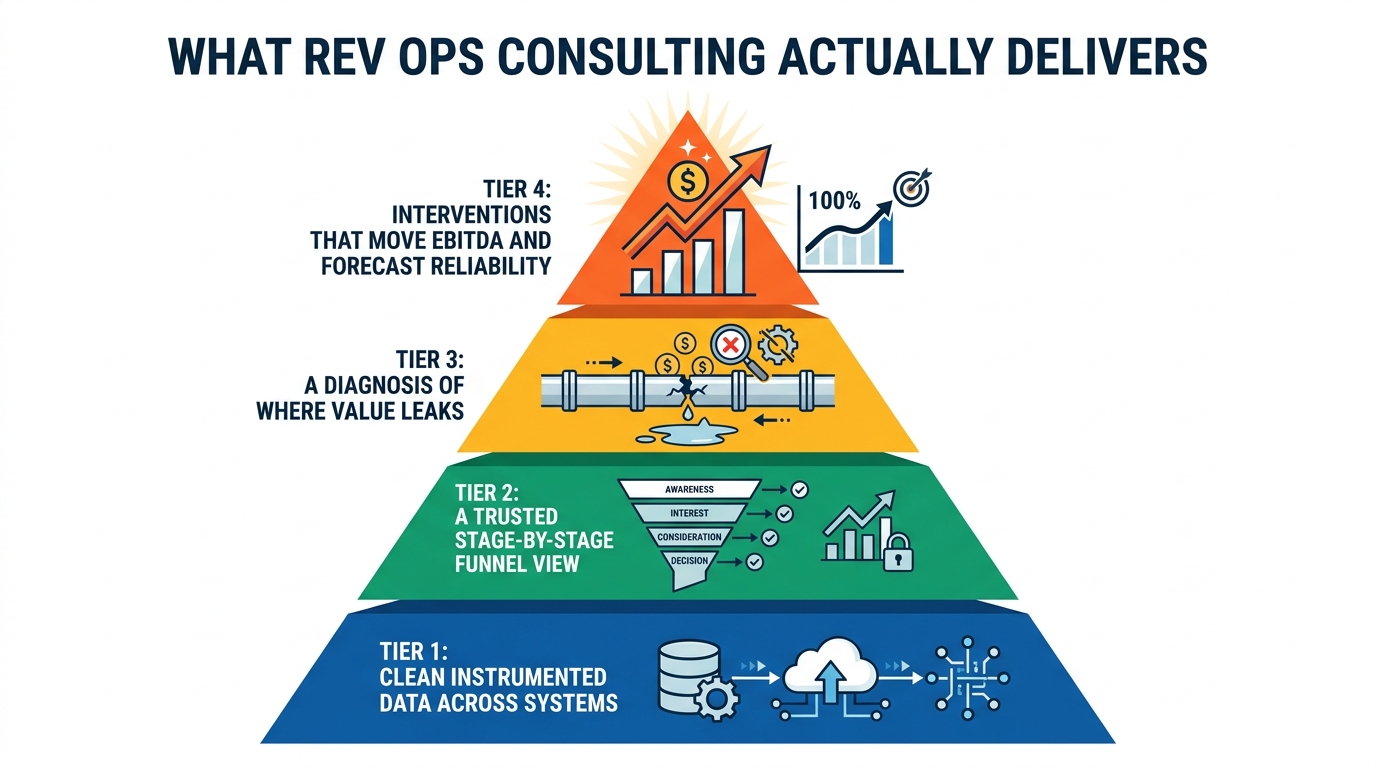
Revenue operations consulting, done properly, is not a productivity project. It is an instrumentation project that ends in a diagnosis. Before you can grow revenue you have to be able to measure it stage by stage, source by source, cohort by cohort. That is why I treat rev ops as a prerequisite to almost every other commercial move, not a parallel workstream. You cannot fix win rate, CAC, or net revenue retention if the underlying data is inconsistent across three systems and two spreadsheets.
So the first decision a deal partner is really making is this: do I trust the numbers that my entire value-creation plan is built on. If the answer is no, rev ops is the fix. If the answer is yes and you are wrong, you will discover it at exit, which is the most expensive possible moment.
I have written before about where these gaps hide in a portfolio in the B2B portfolio revenue leakage diagnostic. The pattern repeats: the leak is rarely a talent problem, it is a visibility problem.
Write the mandate to the stakeholder, not to the tool
The single biggest reason rev ops spend disappoints is that it gets scoped by whoever owns the CRM instead of by whoever owns the outcome. A RevOps manager will scope a CRM cleanup. A CFO will scope forecast reliability. A deal partner will scope multiple expansion. Those are three different projects wearing the same job title.
What the deal partner needs
The deal partner is holding a thesis and an exit horizon. The relevant question is whether the commercial engine supports the growth case underwritten in the model, and whether it will read as clean and scalable to the next buyer. That is a diligence-readiness and enterprise-value question, not an activity question.
What the operating partner needs
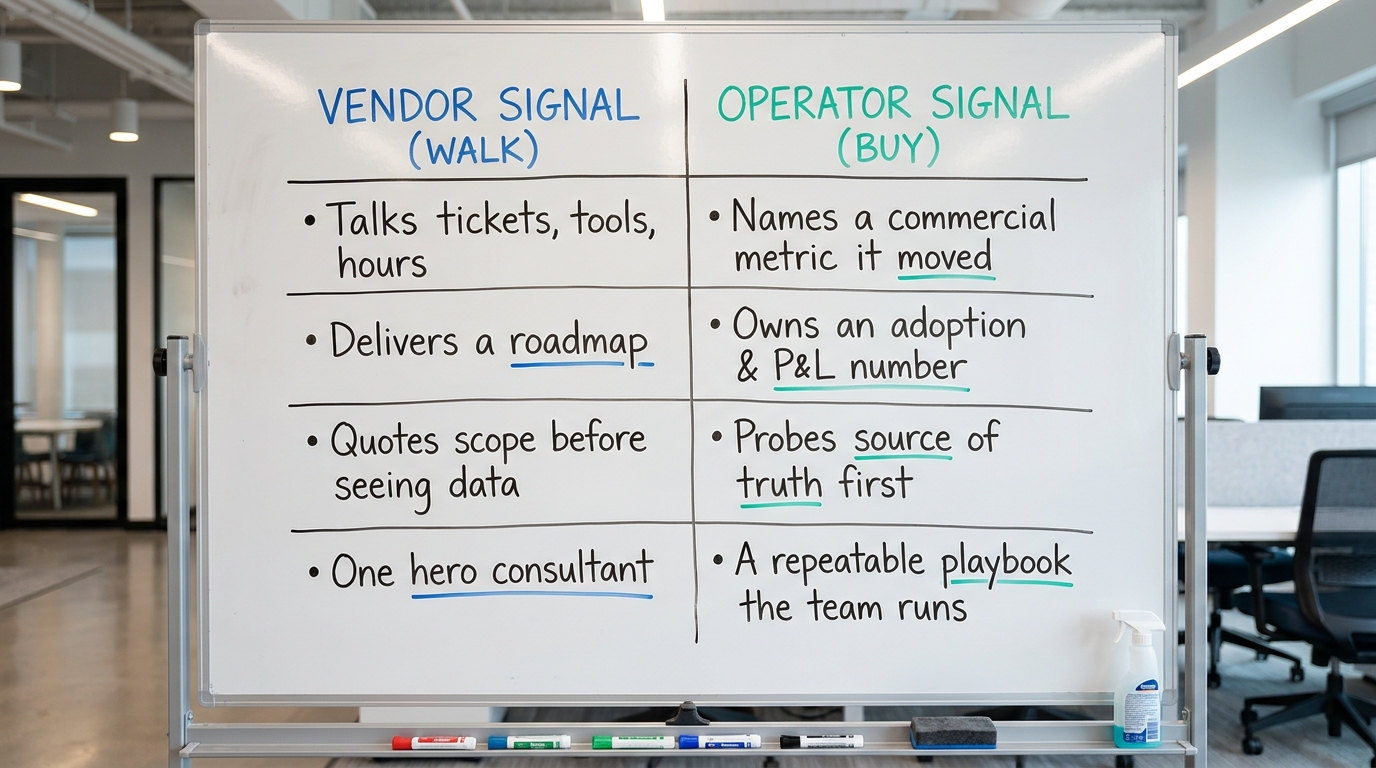
The operating partner needs speed and repeatability. Can this be stood up across more than one portfolio company. Will adoption stick after the consultants leave. Is there a playbook, or is there a hero. I have argued the broader point in PE value creation requires embedded partners, not advisory firms: the deliverable that matters is a system the team can run, not a slide deck they admire.
What the CFO needs
The CFO wants the forecast to stop lying. Forecast accuracy, pipeline coverage that actually predicts bookings, and revenue recognition that survives a quality-of-earnings review. If rev ops does not improve forecast reliability, the CFO has bought a reporting layer, not an operating capability.
When I scope one of these engagements, I insist the mandate be written by the person who owns the outcome. If the operating partner cannot state, in one sentence, the financial consequence they expect, the engagement is not ready to start.
How to judge a rev ops firm before you sign
The market is crowded with firms that will describe their process in loving detail and stay silent on results. Bain’s annual Global Private Equity Report has documented for years how much of the industry’s returns now depend on operational improvement rather than multiple arbitrage or leverage. That shift raises the bar. Commercial execution is no longer a nice-to-have inside the value-creation plan, it is a primary source of return, which means the firms you hire to build it deserve real scrutiny.
Here is how I evaluate them.
Do they lead with the financial consequence or the activity
Ask any prospective firm what they changed at their last engagement. If the answer is “we implemented a new lead-scoring model and rebuilt the dashboards,” that is activity. If the answer is “we lifted qualified pipeline conversion from 14 to 19 percent over two quarters, which added run-rate bookings of X,” that is an outcome, and it can be interrogated. A firm that only speaks in tickets, tools, and hours is telling you what it will do, not what will change.
Will they own a number or only advise on it
There is a hard line between a consultant who produces recommendations and an operator who is accountable to a P&L line. I have laid out that distinction in detail in value creation consultants vs. operators. For a PE-backed asset on a clock, advice you have to implement yourself is a partial delivery. You want the party that will stand behind an adoption metric and a commercial metric, not one that hands you a roadmap and disappears.
Can they survive contact with your data
Good rev ops firms ask uncomfortable questions in the first meeting. What is your source of truth. How many CRM instances. How do you define a qualified opportunity. When was the last time your forecast was within ten percent. If they do not probe the data reality before quoting a scope, they are selling a template.
The metrics that tell you it worked
Activity metrics are the trap. Dashboards built, records cleaned, hours logged, features shipped. None of them is an outcome. The outcomes worth paying for cluster into four buckets, and I would hold any engagement to a subset of these.
- Forecast reliability. The variance between committed forecast and actual bookings, tightening quarter over quarter. This is the metric the CFO and the deal partner both care about, because an unreliable forecast poisons every capital-allocation decision.
- Funnel efficiency. Stage-to-stage conversion and cycle time. If rev ops improves the diagnosis, the sales leadership can act on it, and win rate and velocity move. The fractional CRO work that fixes win rate and CAC depends entirely on this instrumentation existing first.
- Cost of acquisition and retention. CAC payback and net revenue retention, measured against a real baseline, not a vibe. These are the numbers a sophisticated buyer will demand at exit.
- Data integrity. The percentage of pipeline you can trust, single source of truth, consistent definitions. This one is a leading indicator. It is not the outcome, but without it the other three are noise.
Notice the classification discipline here. When a firm tells you a project “will add” pipeline, that is forecast or enabled value, not realized value. Enabled value is real, an instrumented funnel enables a CRO to raise conversion, but it is not the same as bookings in the bank. Hold your firm honest about which is which. I keep this distinction front of mind because it is exactly where diligence gets contentious. It shows up in portfolio company operating reviews as the difference between a KPI that predicts the future and one that only describes the past.
Why fragmented systems quietly cap the multiple
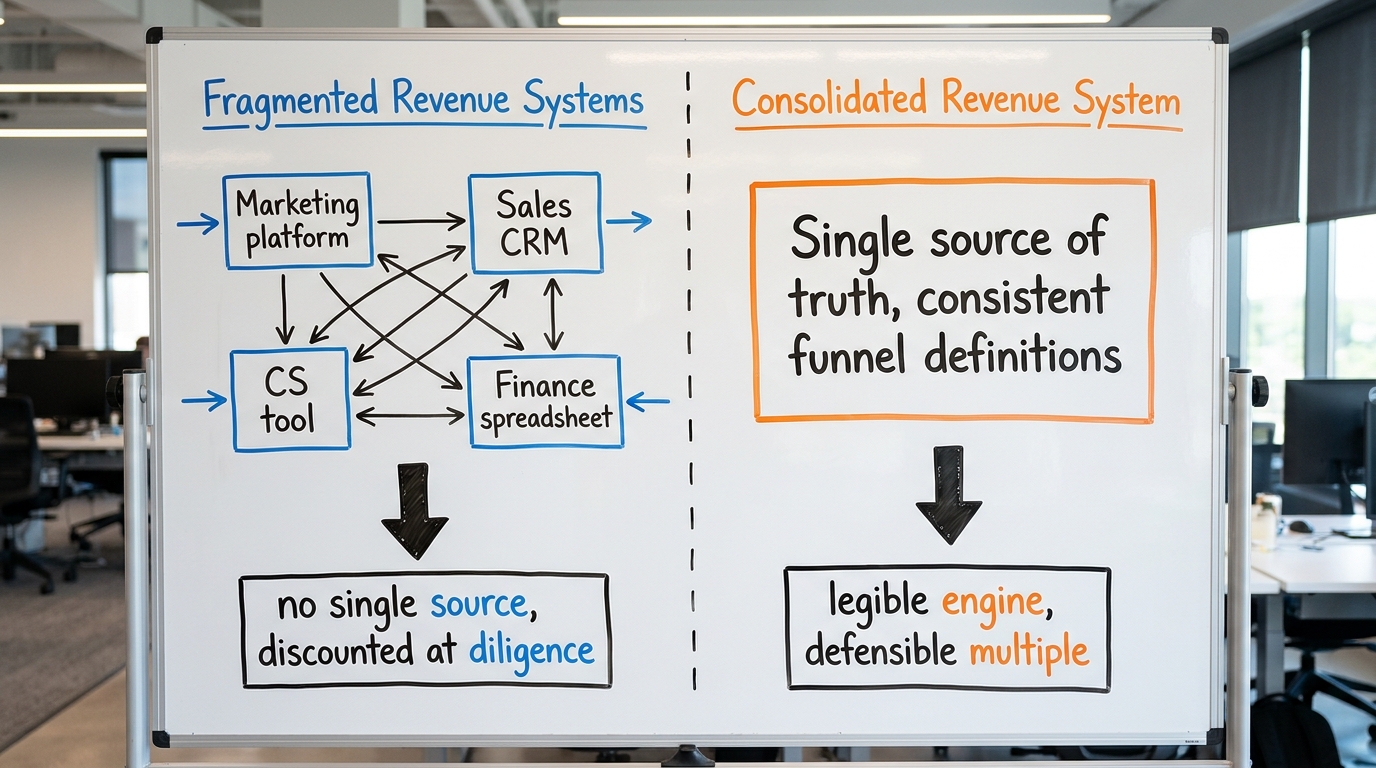
The commercial fit here is what I call revenue systems consolidation, and it is worth naming plainly because it is where most of the value hides. A typical mid-market B2B company acquires its rev ops stack by accretion. Marketing bought a platform. Sales bought a CRM. Customer success bought a tool. Finance runs the real numbers in a spreadsheet. Each was rational in isolation. Together they produce a company that cannot answer basic questions about its own funnel without three people reconciling exports for a day.
This fragmentation is not just an operational annoyance. It is a diligence liability. When a buyer’s commercial due diligence team cannot trace a bookings number back to a clean source, they discount it. McKinsey’s private capital research and BCG’s work on principal investors both keep returning to the same theme: the assets that command premium multiples are the ones where the commercial engine is legible and repeatable, not the ones with the flashiest growth in a single quarter.
Consolidation, done as an operating project rather than an IT migration, produces three things a next buyer pays for: one source of truth, consistent definitions across the funnel, and a management team that can answer diligence questions in the room instead of in a two-week follow-up. Those are the commercial due diligence red flags resolved before they cost you basis points at exit.
How this connects to add-backs and adjusted EBITDA
There is a financial mechanism worth spelling out for the deal partner specifically. When rev ops consolidation eliminates duplicated tooling, redundant licenses, and the shadow labor of manual reconciliation, some of that is a genuine, defensible cost reduction. Whether it lands as a legitimate normalization is a matter of judgment and discipline, which I get into in adjusted EBITDA and the art of add-backs.
The trap is treating a one-time efficiency as though it were a permanent structural improvement, or booking enabled revenue as realized. A quality-of-earnings review will test exactly this. The AICPA’s guidance through AICPA and CIMA on financial reporting standards is the backdrop against which those adjustments get scrutinized, and the SEC’s disclosure regime, documented at SEC.gov, sets the outer boundary for how anything gets characterized to investors. The operator lesson is simple. Let rev ops improve the real economics, and let the finance team decide, conservatively, what qualifies as an adjustment. Do not let the consulting firm write your add-back narrative for you.
Sequencing it inside the hold
Timing determines whether rev ops compounds or gets orphaned. I put the instrumentation and consolidation work early, ideally inside the first hundred days, because everything downstream depends on it. You cannot run a disciplined go-to-market plan on numbers you do not trust. This is why I fold rev ops directly into the 100-day go-to-market plan for a newly acquired B2B business rather than treating it as a later-stage optimization.
The first hundred days
Establish the source of truth. Agree on definitions. Get the funnel instrumented so the baseline is real. Nothing here should feel glamorous. The deliverable is a set of numbers everyone in the deal team believes.
Quarters two through four
Now the diagnosis drives intervention. Where is conversion weakest. Which channel has the worst CAC payback. Which cohort churns. This is where the enabled value starts converting to realized value, and where a fractional commercial leader can actually earn their keep because they finally have the visibility to act.
The eighteen-month mark and beyond
By now the engine should be legible enough to survive diligence and repeatable enough to apply to an add-on acquisition. If you are integrating tuck-ins, a consolidated rev ops backbone turns each integration from a data archaeology project into a plug-in. That is a faster-integration and reduced-operating-risk argument the deal partner can take to the IC.
The failure mode I warn against, which I detail in avoiding value-creation pitfalls in PE GTM, is doing the consolidation as a one-time project and never building the muscle to keep it clean. Data decays. Definitions drift. Without ownership, you are back to reconciling spreadsheets within a year.
The operator’s short checklist
If you are about to commission rev ops work across a portfolio company, hold the engagement to these before you sign.
- The mandate is written by the outcome owner and names a financial consequence in one sentence.
- The firm leads with metrics it moved, with account, period, baseline, and method, not with its tooling.
- The firm will own an adoption number and a commercial number, not just deliver advice.
- The scope starts with the source of truth and definitions before any dashboard is built.
- The economics are classified honestly: realized, run-rate, forecast, or enabled, with no forecast dressed up as realized.
- There is a plan for who owns the system after the engagement ends.
None of this requires you to become a rev ops expert. It requires you to insist that the work connect to a number you can defend at your next board meeting and your next exit. The broader discipline of building organizations that hold up under change is something I explore in future-proofing organizations, and rev ops instrumentation is one of its most underrated foundations.
What to do next
Revenue operations consulting is worth real money when it ends in a diagnosis and a defensible engine, and worth nothing when it ends in a prettier dashboard. The difference is entirely in how you scope it and how you judge it. Buy the outcome, not the activity. Write the mandate from the stakeholder’s seat. Hold the firm to a number. And sequence the instrumentation early enough that everything else in the value-creation plan has clean data to stand on.
If you are weighing a rev ops or revenue systems consolidation engagement inside a portfolio company and want a candid read on whether it will move the number that matters to your thesis, that is precisely the conversation I have with operating partners and deal teams. You can start with a value creation advisory conversation, and if it becomes an execution question, the DevriX private equity team builds the engine, not just the recommendation.
